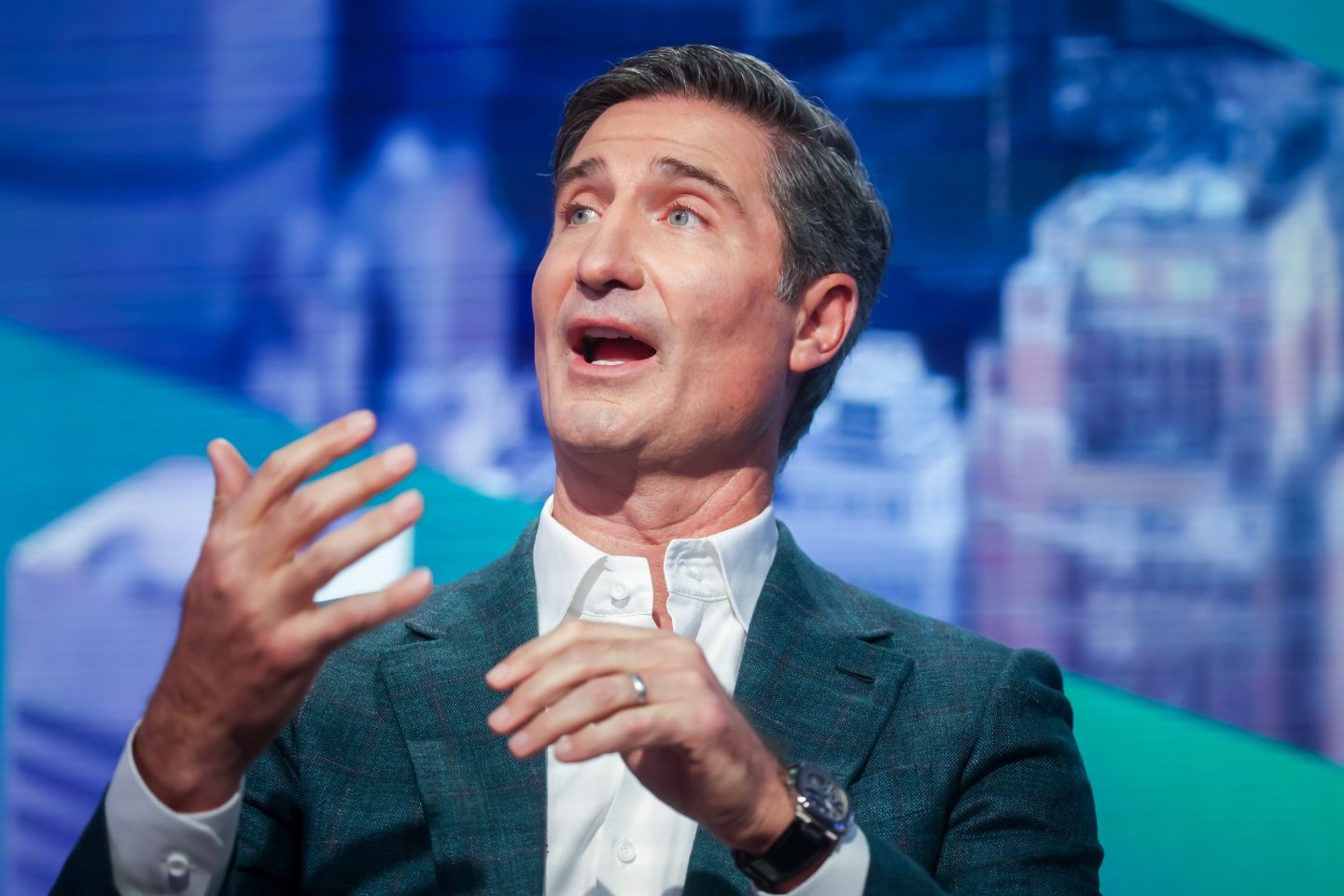
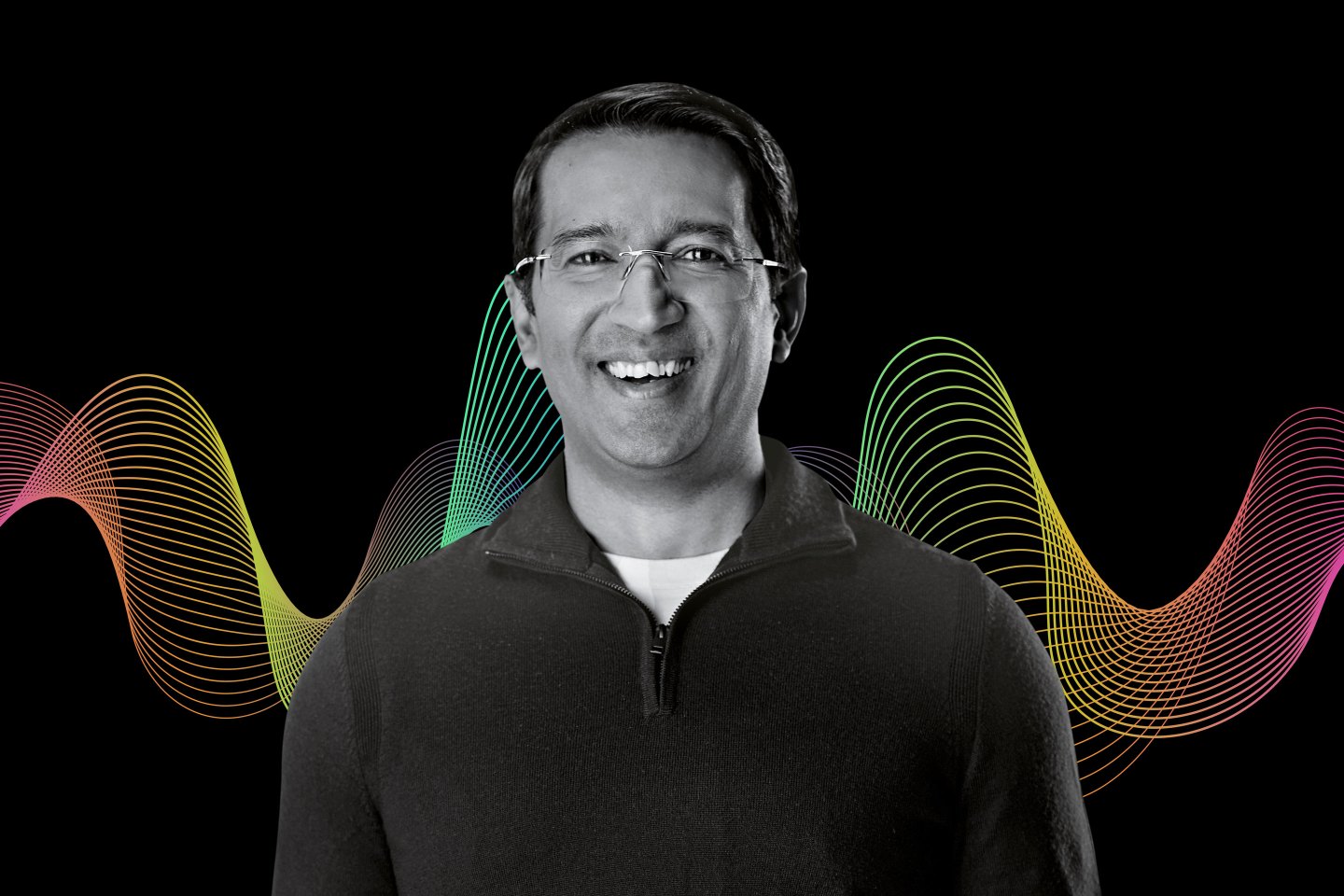
On this episode of Fortune’s Leadership Next podcast, co-hosts Alan Murray and Michal Lev-Ram sit down with Chewy CEO Sumit Singh. They discuss maintaining a customer-forward business even when scaling up, why the Chewy customer service experience is akin to that of a Disney park or high-end resort, and why the company launched B2B services for veterinarians. Singh also explains why he thinks Chewy’s only competition is the company itself. “I believe we control our destiny much more than anybody else can do anything to us,” he says.
Listen to the episode or read the transcript below.
Transcript
Alan Murray: Leadership Next is powered by the folks at Deloitte who, like me, are exploring the changing rules of business leadership and how CEOs are navigating this change.
Welcome to Leadership Next, the podcast about the changing rules of business leadership. I’m Alan Murray.
Michal Lev-Ram: And I’m Michal Lev-Ram.
Murray: Michal, I hear the background noise. Where are you?
Lev-Ram: I’m in Spokane, Washington. I struggled to find a quiet spot today, so I am in the hotel lobby. Pardon the noise. Sorry, but I’m excited to be here.
Murray: Today’s guest is Sumit Singh, the CEO of Chewy, the pet company. It was a really fun conversation.
Lev-Ram: It was. It was. Everybody relates to pets, right? Or almost everybody. We should know the percentage.
Murray: Well, everyone relates to pets and they related to their pets even more when the pandemic hit, and Chewy’s stock soared for a period of time. I think it’s come back down to earth since then. But clearly, Chewy is the dominant player in pet e-commerce. And who knew that was a category?
Lev-Ram: Who knew also that we’re supposed to say pet parent and not pet owner anymore, Alan? So make sure you get the right lingo. Yeah, I know. It was a really fascinating conversation and yes, pet e-commerce, but they’ve also expanded into health care. It’s the first episode where we got to talk about our own pets, Alan, and you told a very sweet story about Cooper.
Murray: Oh yeah. Well, I’ll leave that for the podcast. It’s sad talking about Cooper. But the one thing Cooper was never able to do was come to the office and at Chewy, all the pets come to the office, including simians.
Lev-Ram: Yes, and we heard that even some pigs, I think, came to the office. People have all sorts of strange pets. So anyways, we also got into Chewy’s vision for how AI can assist customer service, not replace it, and a lot of other great topics.
Murray: Yeah. So let’s go pet our pets and let’s dive right in. Sumit Singh of Chewy.
Sumit, welcome to Leadership Next. Great to have you here.
Sumit Singh: Great to be here.
Murray: You’ve had a wild ride over the last six years. You joined this company, you were part of the spin out from PetSmart that happened in 2019?
Singh: Yes.
Murray: Right before the pandemic. The pandemic hit, everybody fell in love with their dogs and more. You had an incredible soaring stock price. It’s come down significantly since then. Tell us a little bit about that journey. I mean, there are not many CEOs who have a roller coaster ride like that.
Singh: It’s been amazing. As I was just sharing, I’ve been dancing into work every day for the last six-and-a-half years. And why wouldn’t you? I mean, you have you know, we’re working through an amazing mission of making pets happy. And it’s a people business. And we get to see our pets every day at work. So it’s pretty awesome.
Murray: Everyone brings pets to work?
Singh: If you come to the Chewy office. I mean, the amount of—we were thinking, how are we going to get any work done and how do you kind of keep all these pets in check? But believe it or not, everybody behaves, and it just works.
Murray: It sounds like sheer chaos.
Singh: We’ve had, you know, besides dogs and cats, we’ve had potbellied pigs and we’ve had hamsters and…
[Laughter.]
Murray: But I wonder if outside of the Chewy office, if the enthusiasm is waning, clearly people are being called back to work. You know, your stock price has come down. What’s the future look like?
Singh: So, no, no, it’s not waning. In fact, you know, we are super excited and in many ways we feel like we’re just getting started. So here’s how you want to think about us. So when I was sort of looking at the company and saying, okay, where do we move forward from, the founding team did an amazing job, and, you know, we got the company to about a billion, about a billion-and-a-half mark. And we said, okay, how do you build this into a $12, $15, $20 billion retailer? And so, you know, at that time it was important to realize the mission and purpose that we wanted to serve. And that became we want to be the most trusted, convenient destination for pet parents and partners everywhere. Sounds like a mouthful, but there’s really only three pieces that are important here: trusted and convenient, destination for both pet parents and partners, and everywhere. By trusted and convenient because in a pet business, in this business, it is the only category outside of kids where customers refer to themselves as pet parents. It’s emotive.
Murray: Yeah.
Singh: And so you have to build and lead through trust and that builds loyalty, and so that’s sort of the first part of it. Destination because what we realized see, Chewy was founded as a food and supplies company. We would serve you your food, we would, you know, ship you your dog collars and beds and all that stuff. But there’s much more to a pet’s journey than that, a pet’s lifecycle than that. There’s an entire health world to go. There are non-health care services.
And then why just pet parents? Think about the community that services pet, right? The veterinarian, the groomer, the trainer, the dog park friend? Looking for content, servicing pets, etc. And we said, well, why should we only stand for customers? Let’s stand for partners. And what that tells you is from a business mindset, what he was saying was we should be a B2C, a B2B company, etc.
And then the last part, everywhere. Why? Because we believe our brand is resilient outside of the United States, and pet parents are more or less the same in any region of the world. So if you put that together, Alan, you not only get a mission and purpose that people can get behind, you get the strategy of the organization, and at any point you can look at that and say, well, where are you trending in fulfilling this journey? And it’s meant to be enduring. So over the last six years, we have really built out our health vertical and I’m happy to kind of dive deeper into it. So we’re very proud of that. So we’ve connected food supplies and health. We’ve built out B2C services, B2B services for veterinarians, and so we’re super proud. And we’ve just entered Canada as our first international foray.
Murray: So you have a lot of [cross-talk].
Singh: From my vantage point, there’s still a lot of innovation to be had. And people, you know, our teams love that.
Lev-Ram: So I’m probably an anomaly in that I think of myself as a pet owner still, not a pet parent, but that’s because I have enough kids. So my my dog is, I just own him. But I totally see that Chewy as a customer, I guess, can sense that customer loyalty and the way that you view your customers as so special. And we all know e-commerce is a tough business. Just tell us a little bit more about your philosophy, the underlying philosophy for customer service and customer loyalty.
Singh: Yeah, the inspiration, first of all, I have a personal experience to share. So when I arrived at Chewy, I’m a product of consumer tech experience forward companies, Dell being one, Amazon being the other. And these companies are great in the way that they build products, from understanding customers and the way to deploy supply chain technology operations and technology, etc. But they’re also very heavily efficiency oriented. And so when I got to Chewy, I was like, well, great, it’s just a customer service or customer care team and this is the journey sometimes you as a leader need to observe and evolve to be able to truly assimilate through what is a gold nugget in the foundation or the growth of a company stage. And I looked at our customer care and I experienced it, and as I experienced our customer care, I did not think about any customer care organization. I thought about Disney, my experience when I walked through a Disney park and how we feel in the way that, you just feel like you’re a part of a dream world like without being welcomed. I compare Chewy to the best hospitality resorts in the way that you are served in, the way that you are treated, and the way that you’re received, and in the way that you’re respected when you walk through the best hospitality resorts. So that’s the mindset in the way that we approach customer service, right? So if I were to summarize this from a business point of view, I would say Chewy is delivering the scale and convenience of e-commerce, but at the best personalized service or high-touch personalized service you should expect of the best local neighborhood pet store.
Lev-Ram: Can you share this story real quick of this incident that kind of went viral where somebody a customer’s pet died and you sent a message? Can you tell the story?
Singh: Yeah, you know, the story essentially goes we have what we call surprise and delight moments where we want to be with the customer’s life cycle or journey through the highs and lows of pet parenting. And this moment that you’re referring is a low of pet parenting when somebody’s pet passed away. And when that happens, we sent flowers because at that moment we are sympathetic, empathetic, we send flowers, we send greetings, handwritten cards. And that moment is a very special moment because most companies will not invest, you know, X number of dollars to be able to pick up flowers to send to customers and be there right in that moment for them. And posts like these, that’s not the only thing we do. We send you handwritten birthday cards. We send you welcome cards. We will send you surprise and delight. We work with over 1,000 local artists where we will send you hand-drawn pet portraits, which you cannot buy from us. They will show up to your doorstep surprise and delight. And let me tell you this, when you get a hand-drawn pet portrait of your beloved pet, I have you for life.
Murray: Yeah. Well, actually it’s funny you say that because I saw a list someone did a ranking of brands’ brand affiliation. I think it was Newsweek and Chewy showed up in the No. 1 spot. Amazon was in the No. 2 spot, which must have been a great pleasure to you as somebody who worked at Amazon.
Singh: Proud of it. Yes. Yes.
Murray: Can you talk a little bit about how you got here to tell us about how you weren’t a pet guy to begin with? Tell us your journey to this job.
Singh: Yeah, so I think, you know, ultimately we are all a product of our experiences and learnings that come along the way, both Amazon and Dell. So I grew up in middle-class India and grew up with the values of high respect for the kind of education and humility and curiosity and resilience. And you get to America and you’re exposed to this massive, amazing land of opportunity and you say, great, I mean, this is a place to learn and innovate and forward can integrate. And so, you know, I was fortunate to be a part of amazing companies like Dell and Amazon, which are pioneers in their own fields. And, you know, ultimately at Amazon, I ended up being a part or a leader that was helping grow the fresh business grocery and grocery is a very difficult business to crack. I mean, imagine forecasting seven types of bananas. Imagine shipping chicken across the country. Imagine trying to ship sushi across Japan. I mean, the Japanese have very, very high standards for stuff like this. So essentially it’s not in the desire to do it. It’s how you work backwards from your customer to truly understand the inputs that essentially appeal and are desirable, and then perfect your processes to be able to serve that experience.
So that job taught me a lot. It taught me about how to run perishable, consumable businesses. It taught me how to manage tough P&Ls, because imagine shipping cat litter across the country—you’re essentially shipping sand. How do you make money shipping sand across the country? These are heavy, bulky boxes, and yet our profitability has never been higher. And our free cash flow has never been higher either. And so I got to Chewy with that mindset, with that training. And I picked up, culturally I was always customer forward. And that is something that I’m super proud that we have retained. You know, it’s easy for startups sometimes and I’m not saying this would have happened at Chewy, but generally when you start up in a category, everybody says they’re customer forward and then the demands of the scale come and the complexity comes and suddenly, customer orientation goes out the door and profitability takes over or process efficiency takes over, and the company starts losing its culture. I am proud to say we maintained a culture of insurgency, right? We maintained a culture of innovation, a culture of customer service. I still read every email. My email is available on LinkedIn. Customers contact me, and when they do this, I learned from Jeff Bezos at Amazon, where I still take those emails and flow them through the company and we try to learn. So essentially, Alan, if you walk through the organization, what you should be looking for is not if the CEO is talking the language, you should be watching if the people are talking the language. And I think our people are talking the language, you know, they’re servicing the language.
Murray: Do you still reply to customer emails in your inbox? And if you do, how many of those do you write a day?
Singh: I do. I did one yesterday night and my average service level response time is less than 20 minutes. It’s become a template now because I truly believe it and it starts out by, “Thank you for writing to me.” And you know, sorry that we’ve disappointed you by not providing you top-class service. That is not the norm at Chewy and we take feedback very seriously.
Murray: Yeah.
Singh: I do and my teams are aware of that. And then we have a mechanism where we will reach out to the customer to understand what truly happened so that we can bring it back and solve that challenge. You know, there’s a term in corporations that’s called killing the zombies. And most companies don’t do this, but they’ll take care of you. But then they’ll never really fix that situation, right? They’ll never really fix that problem. So then the next customer, right, is going to have the same issue. We call it killing the zombies. Did you essentially ask the five whys, get to the root of the issue and build it from the ground back up?
Lev-Ram: You talked a bit about how your customer base has expanded. You’re thinking about your customer base and the partners that you serve. Can you explain how you’re looking at also expanding the business into different, completely different areas like health care? What’s the opportunity there and how are you approaching it?
Singh: In our opinion, health, animal health is the next frontier. I mean, health seems to be the next frontier. And animal health is certainly the next frontier. There are several trends that have been shaping up the animal health industry. First of all, if you’ve taken your dog to a vet, the health industry is and human health was here 20 years ago. So we’re just sort of lagging human health in that way. But it’s looking back 50 years. It’s a legacy industry where technology is not necessarily empowering experiences, it’s not empowering flexible scheduling or servicing through work life needs. That’s sort of one dynamic. The second dynamic is that we haven’t been producing enough veterinarians. And so if you fast forward five years, the capacity for veterinarians is going to underrun demand for veterinarians. The third challenge or opportunity, depending on how you look at it, is the current vet base is maturing and retiring and the new ones that are coming in are younger, they’re primarily female, and they are not only customer oriented, they’re also interested in these work life concepts much more. And so we sort of took a look at this and we said, okay, let’s go start with just the product side. So we first build veterinarian prescription diet, so food, and then we got into pharmacy or medication. Today we run the largest pharmacy in the country.
Murray: You’re not creating drugs. You’re selling drugs.
Singh: We are selling drugs. We are over a billion dollars in that portfolio and we are the largest pharmacy in the country at this point. And all of this has happened in just the last four, four and a half years, right? And then the pandemic happened and the veterinarians were under lockdown and customers were under lockdown. And if Cooper at that particular time had eaten a chocolate, who would have caught, you would have been close.
Murray: Yeah, we’re going to talk about Cooper in a minute.
Singh: So we started getting calls and we said, great, let’s go develop a telehealth service. And that’s what we did. That’s how telehealth was born at Chewy. And, you know, in about 60 days, we’re a tech-forward organization. So in about 60 days, we were able to launch a telehealth service, and that was great. And then we launched into insurance. And so if you fast forward this, we’ve now built a suite of products and services for customers and veterinarians that we are now taking together and saying this is a software out of the box, you can give this to a graduating vet and say, here, go run your practice out of the living room. Go run it out of your garage or go set up your own shop if you want to. And oh, by the way, if you don’t want to do any of those, we are opening our own clinics. You can come work with you.
Murray: Well, how big is the B2B business compared to the B2C business?
Singh: The B2C is is the majority of the business because B2B, we’ve only stepped in about a year, year-and-a-half ago. So it’s very new but ramping fast.
Lev-Ram: And you have clinics, Chewy clinics already are launching?
Singh: We launched our first one in South Florida two weeks ago and we’re very excited about it. We’re launching new ones in Atlanta, in Denver, and so forth and so on. We’re going to launch six to eight this year.
Lev-Ram: How have you not gotten into the pet hotel business?
Murray: I was just going to ask the same question. So that’s what we all need is boarding.
Singh: So that’s the third vertical—that completes the destination is non-health care services. And why we have not is not because I mean, clearly it’s in our mission to be able to do service customers in that arena. But it’s just been a matter of prioritization. Chewy, you know, sometimes we forget that Chewy is only a 12-year-old company and since IPOing in 2019, our revenue was $3 billion, right? So in the last four or five years, we’ve essentially grown revenue four times to $12 billion. That’s what we’ve guided at midpoint this year. And so it’s just a matter of prioritization. We wanted to build out the health platform fully. What the health platform has done is I’m going to take a ten second detour here. We first built fundamentally the technology or the architecture of the organization. Now that is done, we are 100% on the cloud. We have a fully services-oriented architecture and we have pet data, vet data, and customer data all residing in one data mart. It allows us to be able to utilize the same platform to point instead of a veterinarian towards a puppy trainer or towards a dog lover.
Murray: Who’s your competition?
Singh: Ourselves.
Murray: You don’t see anyone else out there.
Singh: Now, I don’t mean to be glib about that. No. So I’ll answer this in two ways. One, I believe we control our destiny much more than anybody else can do anything to us. So in that way, I want my teams to feel like, you know, the speed of innovation and the quality and longevity of customer care is ultimately what will differentiate us because that is what has gotten us here. And if you study companies over a 100-year period, enduring companies have essentially stuck with these two. They’ve been innovative in many fields. Innovation can happen in any field possible, and they’ve maintained kind of the value proposition across care and the longevity around it. Now, of course, if you look at pet, pet has become really interesting in the last ten years or so. Pet was a sleepy, used to be a sleepy category. Right? And the last ten years and I would like to think that you have something to do with this because we stepped in and stepped up the innovation curve in the industry. And when you innovate on the customer’s behalf, it attracts attention.
Murray: And you spun out of PetSmart?
Singh: Yes.
Murray: If you were PetSmart sitting there, wouldn’t you say, Boy, we made a big mistake. I mean, we signed our own death certificate there. Why are we allowing somebody else to take all the online interactive benefits?
Singh: Yeah, I think our sponsor, BC Partners, they had the long-term vision to be able to say, look like, you know, these are two organizations with two different cultures. And as a leadership team, we sat across the table and kind of talked about that, it just made more sense to let the organization kind of preserve an individual identity and move forward with the mission that we were doing now.
[Music starts.]
Murray: Now, I’m here with Jason Girzadas, the CEO of Deloitte US, who had the good sense to sponsor this podcast. Jason, thank you very much for joining me.
Jason Girzadas: Thank you, Alan. It’s a pleasure to be here.
Murray: Jason, the majority of Fortune 500 companies have made commitments to reach net zero to address climate, but it’s still unclear how they actually get there. What’s the role of technology in meeting those ambitious goals?
Girzadas: There’s a broad recognition that the cost of climate change is far greater than the cost of not investing in it. Organizations will continue to utilize technology to move on the journey towards a decarbonized future and a more circular economy. We’re already seeing the benefit of technology through an increase in alternative energy sources. The advances in battery and storage technology are evident. You’re seeing the growth and increased performance of EVs at lower price points. So, the impact and value of technology is being felt already, and that’s only going to continue. It’s pretty clear that climate change requires innovations that don’t exist today, but we do think that there will be new opportunities for innovation to be further accelerated through the development of ecosystems around emerging technologies.
Murray: There’s clearly a lot to do on this front. You talk to a lot of CEOs about this. Do you feel there’s a real sense of urgency on meeting these commitments?
Girzadas: The urgency is there. The call to action around climate change and the path to sustainability is there and the impact of climate change is real. I think the narrative is shifting. One from it being a cost and an inconvenience to decarbonize our economy to one where it’s actually an opportunity. The client organizations that we serve are in their own way charting a path to a sustainable future.
Murray: Jason, thanks for your perspective and thanks for sponsoring Leadership Next.
Girzadas: Thank you.
[Music ends.]
Murray: You had previously told Fortune that you learned the question mark strategy from Jeff Bezos. Any other things you took away from Jeff Bezos?
Singh: A lot. You know, Amazon is an amazing, amazing culture. There’s a Chinese saying that when the student is ready, the teacher will come. You should be able to learn anything from anywhere. But really, it’s a customer-forward principal-led organization. And so, you learn the power of really how to think well and how to build alongside that. You learn the power of building mechanisms and routines that really allow you to stay focused as you scale. And I think the document culture at Amazon is just an amazing format that Jeff invented.
Murray: Talk about technology because we know every industry is being rapidly transformed by AI and now generative AI. What is it doing to Chewy?
Singh: Yeah, I love this topic. Yeah, we are going to live. I mean, we are already living in it, but it’s going to continue to get more fascinating from this point onwards. And it’s a bit of a tale of two cities. So let’s talk about the first one. First of all, innovation will happen across many different sectors. And that’s like Zen master of the obvious. So let me kind of be specific. If you look at the world of supply chain and operations, I think this concept of digital twins will end up disrupting supply chain and operations in the way planning manufacturing, supply chain operations is run, planned, simulated and run. It will improve accuracy. It will drive precision into planning systems, and it will drive accuracy of execution and ultimately drive greater productivity through the systems. So that’s sort of like one.
Then you come to the area of helping customers search, discover, and interact with your products. Could be in any industry. So for Chewy, for example, if you walked in and said, How do I raise a Labrador puppy? You’re going to be able to have real time interactions with the system alongside really personalized recommendations. So the world of search and discover will change pretty rapidly. Then you go to science-driven functions, whether it’s marketing, science, customer service operations, or supply chain science. Machine learning has already been disrupting a bunch of this. And now we’re talking of combining context with natural language processing into these techniques. It’s just going to drive a hyper level of efficiency, in my opinion. So that’s one I said. It’s a tale of two cities. That’s one. What’s the other side? The other side, I think, is governance, right? So how we govern, how we move forward, how we think about sort of how much autonomy a team should have, how much data should be exposed, how do you protect that data and use it wisely, I think are all of the conversations that we are likely going to have to step into concurrently as we’re working through this.
Lev-Ram: One follow-up question on the tech piece. On the customer service side, for a company that’s so, so much of your DNA and and your culture is around customer loyalty and this really like high-touch customer service, you’re talking about handwritten notes, not a lot of e-commerce companies do that. How do you look at the opportunities with some of these AI-powered chat bots, agents to help with customer service without diluting everything that you guys stand for?
Singh: I love that question. It is natural to assume that technology and personalization or technology and creativity are conflicting with each other. And I think what we have to realize is that human beings are great at creativity. They always will be. And technology is great at delivering scale. And so you have to marry these up smartly, right? Our local artists or our handwritten notes in a way that we assimilate through the language, right, is a very personalized mechanism that we are seeking to keep. At the same time, I can automate all of the segmentation of customers, the targeting of customers, the identification of those cohorts. I can also automate how I pick up the right portrait when a customer uploads a pet profile and pass it on to my artist pretty digitally and pretty seamlessly. So I’ve essentially eliminated process waste without really taking out creativity from the system.
We’re developing something called a tool which is called CSR Buddy. It is meant to be a friend to the customer service or the customer care team. It’s essentially a prompter tool. It has all information about the customer. It has a knowledge base which will marry content to let them have more intelligent conversations. We try not to hire from deeply ingrained CS contact centers because we have to untrain them to get them to unlearn the bad habits of getting the customer off the phone. We want to pick up your phone in two rings or less, right? And so we tell our agents, just have a conversation.
Murray: So you’re using the technology not to replace the customer service representative…
Singh: Nope.
Murray: …but to give them all the information they need to be great at their job.
Singh: They shouldn’t spend time looking for information. They should spend time having the conversation. That’s the difference.
Lev-Ram: Okay, so before we get into talking about our own respective pets, which is very, very important, of course, tell us a little bit about just pet ownership or pet parenting trends, I should say, because obviously we saw this insane growth during the pandemic, which I’m sure helped your business out quite a bit. That’s kind of dropped off a little in the last couple of years, I’m guessing. But what do you know about pet trends today and the demographics?
Singh: So, to really get to this point you have to rewind about 15 years, 20 years. You know, the word that’s often used in the pet industry is humanization of pet. And what does that mean? All that means is that 20 years ago or 30 years ago, the pet was out on the porch. Today they’re on the couch, they’re in your bed, and today you refer to them as family. So that’s this concept of humanization of pet. We treat them as family. We treat them as one of our own. So what has that done? What that’s done is it’s led to the consumer wanting to be more aware and feel like a better pet parent when I’m treating my pet right, but I’m also feeding them right and I’m buying the best toys for them, etc. So what did that do? That led to premiumization of products, right? So in the last 15 years, you’ve seen this conditional-based segment, what we call Science Diet. You’ve seen the premium segments come forward. You’re seeing freeze dried, raw, dehydrated, fresh food. Now, this is essentially the consumer being aware that I am going to treat you the same as I treat perhaps another family member. So really, if you track the industry over the last 20 years, it isn’t tonnage growth that has driven the industry forward. It is product innovation and premiumization, which is linked back to this humanization trend. Now let’s talk about the pandemic. It is a bit of a fallacy to think that every household got a pet during the pandemic.
Murray: It was just 95% of households.
[Laughter.]
Singh: No, no, no, no, no, Alan, you know what happened? It’s actually if you look at the data, supply actually shrunk during the pandemic. Now, why is that? It’s because, so shelters feed 60% of new pet adoption in the country. The rest, 40%, comes from breeders. The shelter and rescue community was immediately out of pets in the first six months of the pandemic. Then nobody was returning pets. So they were empty. And then the breeders, I mean, that’s a biological process. You can’t produce more litters suddenly if you wanted to. And so if you really think through this mathematically, you will see it in the data that there was a bump that kind of came in the first six or nine months, but then for the next 12, 15 months, pet supply shrunk because there was no more demand to be served per se. Why companies saw a bump is because we were all at home with our pets and we were feeding them constantly. We were engaging with them constantly. You notice that you needed a dog bed refresh. You said, Oh, there’s that new treat. Oh, well, wouldn’t it be nice to buy this good toy? And so you were overspending on your pet from that point of view because everybody was at home.
Murray: Yeah. With it.
Singh: With it. And it would by the way, that was great for pharmacy because pets were probably getting fatter, you know, sitting at home. So our health [cross talk] getting slightly better, benefited from that threat.
Lev-Ram: Is there Ozempic for pets now?
Singh: [Laughing.] Is there…
Murray: There will be Ozempic for pets. I’m sure Eli Lilly and Novo Nordisk are already working on that.
Singh: So fast forward through COVID. What happened? Supply chains got disrupted and as supply chains are recovering and inflation’s passing through the system. We’ve had 30% inflation pass through the system in the last two years versus you would ask me what is an average year? Two percent.
Murray: Yeah.
Singh: So when you have that sort of an imbalance, so really pandemic, the pandemic shouldn’t be looked at as a two-and-a-half-year curve. It’s really a five-year curve. With 2024 being the fifth year. And so that’s why we’re calling this the year of normalization.
Murray: Yeah. So we’re going to get to some sort of a stable place and you’re confident about that.
Singh: Absolutely.
Murray: And okay, so what is the dog that is by your side when you go to the office?
Singh: It’s my dog, D, the Shih Tzu.
Murray: And what, tell us about D.
Singh: Well, D’s a Shih Tzu. He is 11 years old now and he’s been with us for nine of the last 11 or ten of the last 11 years. I would say he’s quite not like a dog. Doesn’t like to be on your lap. You know, contrary to most Shih Tzus. He is negatively correlated to our forecasts. So, you know, he’s the chief pet, the treat tester. But if he loves a treat, I would short that forecast.
Murray: And know he’s not a good time and does he act like the CEO of the office?
Singh: I don’t think he realizes he’s just…
Murray: That he has special privileges.
Lev-Ram: He’s just like any other dog in the Chewy office. Well, it’s funny you talked about sort of this evolution of how we view our pets, because I definitely feel it in my own family. When I was growing up, my sisters and I would beg our parents for a dog and my dad always said, We can get a dog if you let me train him to attack. And we said, No thanks, us three girls. Fast forward to today. I have a miniature poodle. He sleeps on our bed. His name is Teddy and he is very much part of the family. Even though I say I own him, he’s not my child. Because again, I have three actual kids. So that’s enough.
Murray: And once he gets in your way in the bed, I mean, you like, kick him over or just see respectful.
Lev-Ram: He’s a miniature poodle, so he’s not really in the way.
Murray: That helps.
Singh: Teddy is a great name though.
Lev-Ram: Well, what about you, Alan?
Murray: Well, the Cooper story. So Cooper was a yellow lab that my youngest daughter adopted when she was in high school. Took him with her to college. He lived for a while in a co-ed fraternity where he got to, like, clean up all the beer pong and the pizza on the day after. Very tough life. But lived to be 15 years old, eventually came back home to stay with us because my daughter was spending time with a guy who was allergic to dogs, unfortunately. Anyway, we had to put him to sleep. He couldn’t walk anymore. And she came home and took him on the most epic weekend, took him to the ocean and spent some time walking into the ocean, took him back to the school and to see the old fraternity hang out, fed him Popeye’s fried chicken and chocolate and all the things you’re not supposed to give a dog. It was an amazing event. So, yeah, I get it. I get it. These are an important part of our life.
Lev-Ram: That’s quite a quite a last dinner to give a dog. I’m sure it was a wonderful weekend for him. This has been just such an awesome conversation. First opportunity I think we’ve had on Leadership Next to actually talk about our pets. So thank you so much for joining us.
Singh: It was really nice to see you. Thank you so much.
Murray: Leadership Next is edited by Nicole Vergalla.
Lev-Ram: Our executive producer is Chris Joslin.
Murray: Our theme is by Jason Snell.
Lev-Ram: Leadership Next is a production of Fortune Media.
Murray: Leadership Next episodes are produced by Fortune’s editorial team. The views and opinions expressed by podcast speakers and guests are solely their own and do not reflect the opinions of Deloitte or its personnel. Nor does Deloitte advocate or endorse any individuals or entities featured on the episodes.