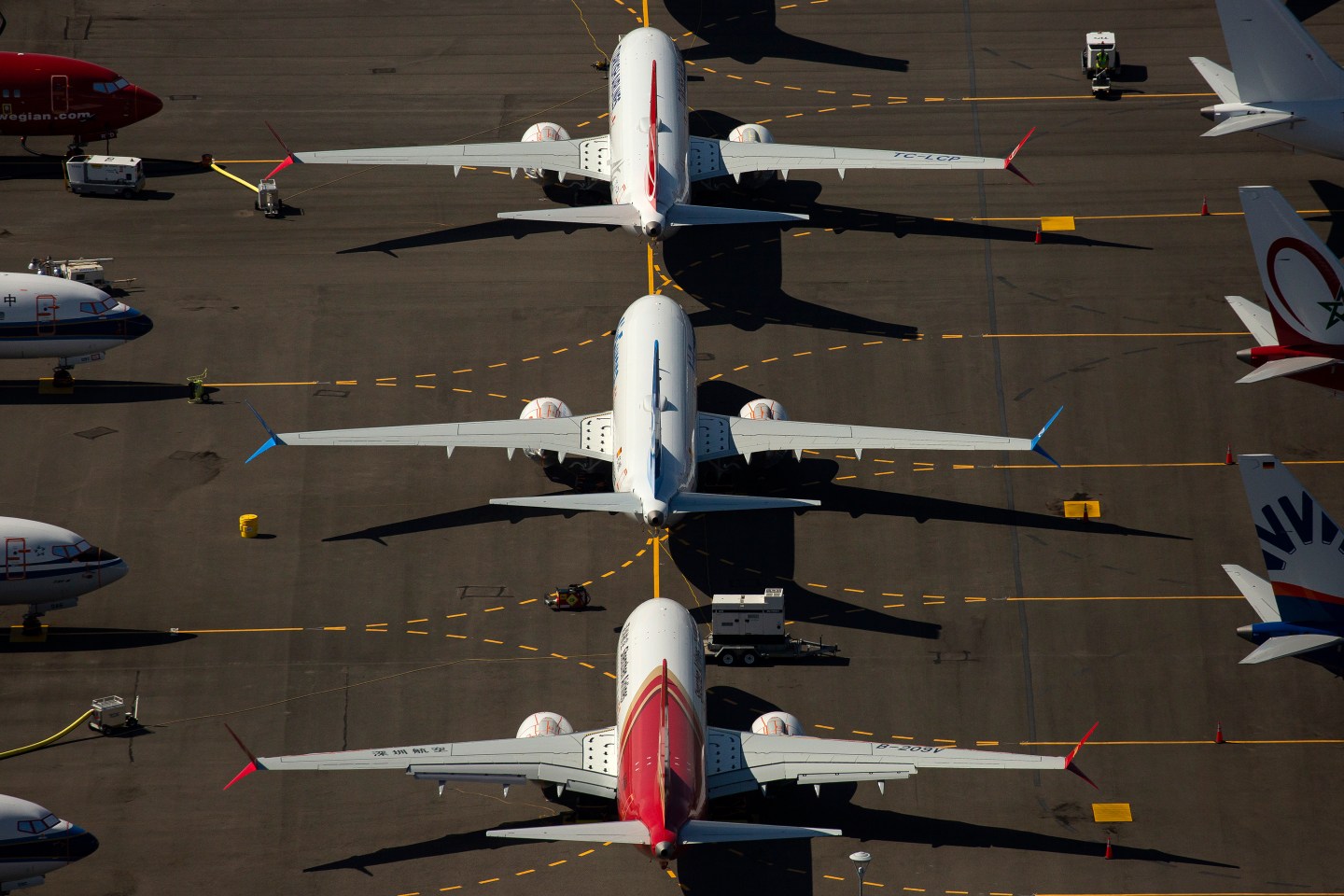
Boeing’s just-announced search for a new leader looms as the premier succession drama in modern corporate history. Boeing desperately needs a superstar featuring a totally different profile from its last several pilots. That’s the only way it can recast its production processes and procedures to regain its old record of safety excellence following the two fatal crashes in 2018 and 2019, and the notorious door-panel blowout over Portland in January.
That Boeing picks the right CEO is of paramount importance to the future of both the global aerospace industry, and the U.S. economy given the planemaker’s role as America’s largest exporter. The company’s production stall has already worsened an airplane shortage that’s forcing customers worldwide to slash flights and raise prices. That Boeing lands smoothly is also critical to the expansion of low- and ultralow-cost carriers essential to keeping fares in check.
On March 25, Boeing unexpectedly unveiled three major changes in management and governance. First, CEO Dave Calhoun will step down at year-end. In late 2019, Calhoun—who was then serving as chairman—took the top job as an emergency replacement for Dennis Muilenburg, whom the board fired in the aftermath of the Lion Air and Ethiopian Airlines crashes, which together killed 347 people. Second, Stan Deal, head of Boeing’s commercial airplanes division, which makes and sells the 737 and 787 series that have suffered so many safety issues, is leaving the company. Stephanie Pope will take his place, adding this leadership role to her position as COO. Third, current chairman Larry Kellner, former CEO of Continental Airlines, will retire from the board at the next shareholder meeting in mid-April. His replacement will be Boeing director and ex–Qualcomm chief Steve Mollenkopf.
It’s unclear what caused the sudden, sweeping upheaval. But a week earlier, airline CEOs who are major Boeing customers expressed their frustration with its leadership by requesting to meet with Kellner and other directors without Calhoun present. Now, new chairman Mollenkopf will lead the most important mission in modern Boeing history, its quest for a third CEO in less than half a decade.
Boeing’s CEO search
The shuffle at the top prompted this writer to ask several sources who’ve had top positions in the aerospace industry what skills and qualities Boeing needed in a CEO. These include customers and suppliers who’ve dealt directly with Boeing’s top management, and witnessed the shortcomings in the C-suite. They all chose to speak only on background. I’ve distilled their recommendations down to the following list of four.
First, the choice between naming an insider and outsider is a tough call. One of my sources believes that the best pick is a Boeing veteran, since the airplane manufacturing business is so complex and specialized that it’s practically a world unto itself. This person says that even switching a top executive on the defense side to the commercial sector or vice versa usually backfires. “The ideal pick is someone from the inside who can see the company from the outside, and knows how it needs to change,” says this former force in the business of aviation.
Another industry veteran insists that naming an insider is a no-go. This sage made the following argument: Boeing needs a hard reset, and that the old “groundhog day” mentality of putting off change has to go, courtesy of a newcomer’s strong push. The types of fundamental problems Boeing is facing don’t age well, and they’re still aging under the current team from which a Boeing stalwart would rise. Someone who’s part of the old regime is the wrong choice for delivering the jarring shake-up required.
Indeed, the new moves suggest that the board is now leaning toward an outside pick. That’s a big shift from what appeared to constitute the previous succession plan. In mid-December of 2023, Boeing announced that Pope would rise to COO, making her Calhoun’s heir apparent. Pope is primarily an excellent financial manager, having served as CFO of commercial airplanes, services, and the defense franchises. But the Alaska Airlines disaster that occurred just one week after Pope took the top operating job, and the many revelations exposing Boeing’s quality-control problems since then, made repairing its manufacturing machine (rather than honing financial management), job one. Pope may have a shot still—after all Boeing just made her head of the commercial airlines sector that’s spawned all the pain, despite her background as a financial manager rather than manufacturing specialist—but her chances appear increasingly slim.
The consensus from my interviews is that a newcomer is probably preferable, simply because it’s so hard to tell if a Boeing manager who says all the right things is a real change agent. Boeing desperately needs a hard slap in the face to transform a mindset that’s strayed from the obsession with quality that made the planemaker great to a focus on speed and profits. Someone who didn’t grow up in the failed culture, who doesn’t have friends in the company, is probably a better choice to bring radical reform.
Second, what needs fixing, is the faulty manufacturing system at the giant Renton and Everett plants in Washington, and at the North Charleston, S.C., facility, that make these marvelous flying machines. Three of Boeing’s four most recent CEOs, Harry Stonecipher (2003–05), Jim McNerney (2005–15), and Calhoun (late 2019–2024), are veterans of General Electric. They absorbed the GE ethos by spending a combined 70 years at the industrial conglomerate. The old GE had a reputation during the years it was run first by Jack Welch and then Jeff Immelt for not heeding the folks on the plant floor who screw the bolts, install the engines, and attach the panels, and believing that managers did the enlightened thinking. The three GE alumni were all big-picture guys who were fairly detached from the production process.
It was unclear, for example, how much time Calhoun spent in Renton, Everett, or North Charleston where the planes, and most of the money, are made; he has residences by a lake in New Hampshire and in a gated community in South Carolina. And Boeing’s headquarters in Arlington, Va., is by geography alone crazily detached from the aircraft-producing locales.
The legacy of Boeing’s three former GE-alum CEOs demonstrates that hiring a chief with aerospace experience only works if he or she is a hands-on operator. Stonecipher, McNerney and Calhoun all led the jet engines business at GE, yet quality control went awry during their tenures at Boeing.
Boeing needs the antithesis of the former, and now mainly discredited, GE style. Only a CEO who keeps a hawk eye on what’s happening at every production station an airplane moves through in Renton or North Charleston can transform its culture. That realization seems to explain the departure of Deal as chief of Boeing’s commercial planes division. Michael O’Leary, the outspoken CEO of European budget carrier Ryanair, and a huge Boeing customer, recently stated in an interview posted on the Skift site that “Deal is a very good salesman, [but] what Boeing needs is someone who will sit in Seattle on a daily basis and [focus on] producing aircraft. What’s the delay? What’s the problem? And fixing the supply chain.” Pope, the COO who took Deal’s job, lacks a steeped-in-planemaking résumé as well.
Third, the new leader should shelve raising shareholder value as a priority. “Instead, the emphasis should be on what needs changing to regain the trust of customers and regulators. Having a stand-down day won’t do it. Get the right processes and culture back. That’s the only way he or she is going to benefit shareholders over time,” says one person whom I interviewed. Stonecipher, McNerney, and Muilenburg all put profitability first, and hence weakened a culture once centered on superb engineering and relentless attention to quality control.
Fourth, the right pick is someone on the younger side. That means a boss in their forties to mid-to-late fifties. Picking another short-termer like Calhoun would be a mistake. Ideally, the new CEO should lead for around seven years or even more. “The worrisome culture developed over 20 years; it will take four to five years to get it back on track,” says one source. The planemaker also stands at a pivotal moment where it needs to rapidly advance on its next-gen narrow-body that will be matched with the new GE open-fan engine. Turning a clean-sheet design into a hit airliner will take several years, and having a single leader drive the program forward is highly preferable to appointing a CEO for, say, a three-year term.
The ”seven years run” issue probably rules out Pat Shanahan, the current CEO of Spirit AeroSystems, the supplier that Boeing plans to purchase. Shanhahan is a nuts-and-bolts manufacturing guy who camped out at Everett over 15 years ago to fix the snags plaguing production of the 787 Dreamliner. The only drawback is that, at 61, Shanahan would probably be an interim choice. And changing the guard again in four years or so won’t ensure the stability and continuity that Boeing needs.
Unfortunately the two other candidates best qualified for the job are probably not available. The first is Larry Culp, who’s engineered a sorcerous turnaround at General Electric—greatly streamlining its manufacturing flow by tapping the expertise of the assembly line folks who make the jet engines and power turbines. Culp has the rare combination of top manufacturing skills and expertise in aerospace that’s ideal. In other words, he’s the whole combo in a single package. But Culp is 61, and by early April, he’ll be running his pet business, GE Aerospace, the engine manufacturer that’s a money machine. It’s his first shot in decades at heading a stand-alone after a career of mostly operating conglomerates. In fact, Culp just took himself out of the running, telling Aviation Week on March 28: “I can best serve Boeing [by] being their best partner and best supplier.”
A second excellent choice would be Mollenkopf. He’s an engineer by training with intimate knowledge of how to make production flow safely and efficiently. He’s also topflight as a leader and manager. Pairing Mollenkopf as CEO with a commercial airplanes chief in the Shanahan mold, though preferably someone with a longer runway, would seem ideal. At Qualcomm, he rebuffed a legal onslaught from Apple, fought off a hostile bid from Broadcom, nixed pressure for a breakup from Jana Partners, and amid all that turmoil, managed to triple the share price during his tenure from 2014 to 2021, outperforming Apple, AMD, and Intel.
The rub: Mollenkopf’s expertise isn’t in making airplanes, but in semiconductors. Still, anyone who’s got an engineer’s grip on the details of complex manufacturing, and shows Mollenkopf’s skill at solving problems, would probably be a good choice for Boeing. Right now, all my sources say, there are no obvious candidates either inside Boeing, in the aerospace industry, or among big manufacturers, that rise to the level of a Mollenkopf, Culp, or Shanahan. One caveat: If Boeing doesn’t pick a CEO who’s a nuts-and-bolts manufacturing ace, it absolutely needs a second leader who would run Boeing’s commercial airplanes division, a taskmaster and proven expert in complex manufacturing, either from another industry, or preferably who earned his or her wings in aerospace.
Sounds like a conundrum. But Boeing’s got an edge—and it’s Mollenkopf. Given his amazing track record, he’s likely to fully understand where Boeing went wrong, and what it will take to repair its procedures and culture. The best bet that Boeing will fly out of this tailspin is that Mollenkopf will guide its board to choosing the right pilot.