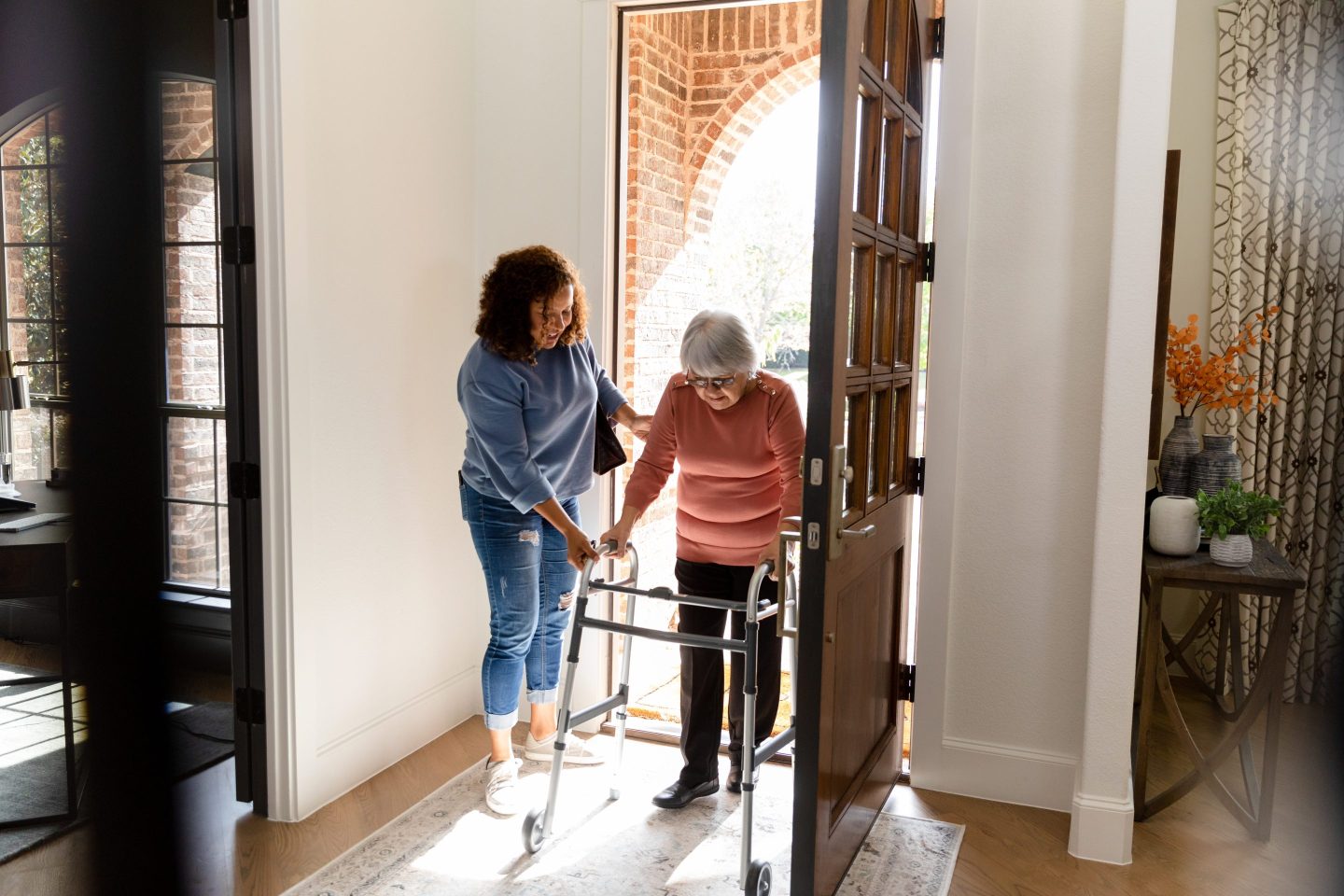
As soon as women get their heads up from the waters of childcare duties, they’re often hit by another wave: eldercare. Dealing with dueling unpaid familial responsibilities, many women are forced to take more career breaks, miss work, move to part-time, or even leave the workforce altogether. That care crunch has damaging effects beyond women’s careers—in fact, it often destabilizes women’s financial security and retirement prospects, according to a new report from Wells Fargo.
There’s no doubt that women feel the effects of the childcare crisis more keenly than men. They often have to take time away from the workforce in order to deal with the brunt of childcare. That’s true not only when women are the lower earners in a relationship due to the pay gap, but even for female breadwinners. And those patterns repeat themselves when it comes to caring for the elderly.
“This whole eldercare responsibility that’s disproportionately shouldered by women, it’s just another issue in terms of their financial preparedness,” Shannon Seery Grein, an economist at Wells Fargo, tells Fortune.
Older women are hit the hardest by the eldercare responsibilities, with women 55 and older making up two-thirds of those not in the workforce for reasons other than retirement or disability, per an analysis from Wells Fargo. That’s seven times the number of men of the same age that are pushed to the same responsibilities.
Because women earn less than men (20% less, on average), they’re more likely to take a step back from work when a parent needs care, fueling “almost a vicious cycle,” Grein says.“If you have a parent or a loved one who requires care, suddenly, a woman is more likely to step out because they earn less, and they can have less of a financial hit to the family unit, potentially, then a man stepping out who earns more,” she adds. As a result, women are set up to make less than their male counterparts and be less equipped to afford their own retirement—a problem that is compounded by the fact that women, on average, live longer than men and so have more years of retirement to cover.
Women provided about $113 billion worth of unpaid care in 2022, estimates Wells Fargo. And when women aren’t outright leaving the labor force to take on this duty, they’re working fewer hours. This past year, 1.3% of men 55+ reported working part-time due to family obligations, compared to 5.3% of women. Men and women provide the same amount of average hours of care when given the familial role as caregivers but women tend to be caregivers more often, explains Grein. The unbalanced caregiving duties at both ages “[strong-arm] women into these career breaks or just entering lower pay positions in general,” as they opt for lower-paid, flexible jobs, per Grein.
As women reach retirement age, the question becomes, who looks after those who look after everyone else? A whopping half the nation’s mothers have no retirement savings, compared to 32% of fathers and 39% of adults without children, per a 2023 analysis from the Century Foundation of Financial Health Network’s data. As boomers share doubts they’ll be able to outlive their retirement savings, women espouse greater concerns. Retired women are 33% more likely than men to say they don’t have enough budgeted for a comfortable retirement, per a Clever survey of 1,000 U.S. retirees.
Eldercare is another hurdle in labor force participation for women, Grein says, but its exact relationship to pay differences creates a chicken-and-egg question. “It all kind of comes back to this persistent pay gap, but at the same time, it also contributes to it,” she says. “This has happened because women earn less? Or does this just cause women to earn less?”
Fairness questions aside, leaving eldercare as an unpaid assignment to women “is a headwind to the modern economy, even if you’re somebody who doesn’t deal with these challenges, on a day to day basis,” explains Grein, as it affects women’s participation rate and feeds into overall economic growth.
An aging workforce and a burgeoning crisis
The issue of women leaving their jobs to take care of their loved ones is only going to grow as America’s population ages. The cohort of the traditional working-age population is set to grow just 0.2% by 2032, outpaced by the population of 65+ that is expected to grow 2.3% percent by the same year, or more than 10 times as fast, per Wells Fargo. As it stands, seniors already represent a whopping 22% of the current population.
As people live longer, the cost of care expands like a rubber band. And care is already not cheap in an inflated economy, as Wells Fargo points to a report from Genworth that clocks the median yearly cost of a private room at a nursing home at $108,000 in 2021 (although some of that is covered by federal financial aid, add the report authors).
By conservative estimates, another 1.7 million senior citizens will be in need of care in 10 years from now, according to the report. This aging population comes along with a “smaller working force,” and the need for an exodus of people of traditional working age who are looking after their parents, which Grein explains will likely “put some downward pressure on labor supply going forward.”
Even so, eldercare isn’t exactly a sexy or hot-button topic —and that’s for a couple of converging reasons. One potential culprit for the lack of focus on the issue of eldercare is America’s ageism, especially toward the older women who shoulder most of this labor. And unlike with childcare, the nation invests a fair amount of money into its eldercare, including through Medicare and Medicaid, adds Grein. Also, the problem hasn’t yet reached the crisis levels of, says childcare: “we haven’t really hit the peak of eldercare,” Grein says.
When women are paid for eldercare, it’s not much. Older women account for most of the paid eldercare roles (27% of healthcare support jobs, versus just 3% of men the same age), and median pay for these jobs remains one-third below the national median in 2022. Typical pay for elder care occupations hovers between $14 and $15 an hour, less than half the national average of $34, according to the Bureau of Labor Statitics.
As the issue becomes more widespread, it’s important to note that eldercare will not just strain women but the economy in general. “The challenge of not addressing this is just a diminished labor force and a diminished financial health of nearly half of the population,” says Grein. “Yes, it’s a woman’s issue but it’s really a macroeconomic challenge.”
As America grays, it becomes clear that we can’t simply lean on underpaid and unpaid women to account for our senior citizens. Of course, the highly-depended-on 55+ women will age as well, “and that funnels into the eldercare issue,” Grein adds.
The need for flexibility
Women have recently made some great progress in the workforce, which stands to be wiped out if converging care issues remain unaddressed.The current gap between men’s and women’s labor force participation is at a record low, according to Wells Fargo. Part of that can be attributed to the newfound flexibility during the pandemic that especially benefited working mothers.
But as hybrid work becomes the new compromise and many executives usher employees back onsite, women’s progress is threatened. “If we don’t have businesses that become more flexible, or that allow leave for their workers, men or women, in order to care for their loved ones and family members, then I think you’re going to have a challenge from a supply perspective,” says Grein. That supply shortage could increase wages, inflation, and interest rates, she adds.
Of course, the nation is already confronting a labor shortage. So unless immigration policy changes or there’s a productivity boom, companies aren’t really in the position to enforce that make workers’ lives difficult, adds Grein.
The solution seems apparent and the ballooning issue is just around the corner. Eldercare is “not something that is so apparent or in your face until it happens, which again, tends to happen suddenly, and I think families are just not prepared for it in general,” says Grein.