• Home
  • Latest
  • Fortune 500
  • Finance
  • Tech
  • Leadership
  • Lifestyle
  • Rankings
  • Multimedia
CommentaryEconomy

We analyzed 46 years of consumer sentiment data–and found that today’s ‘vibecession’ is just men starting to feel as bad about the economy as women historically have

By
Anwesha Majumder
Anwesha Majumder
and
Katherine Gallagher Robbins
Down Arrow Button Icon
By
Anwesha Majumder
Anwesha Majumder
and
Katherine Gallagher Robbins
Down Arrow Button Icon
March 13, 2024, 7:26 AM ET
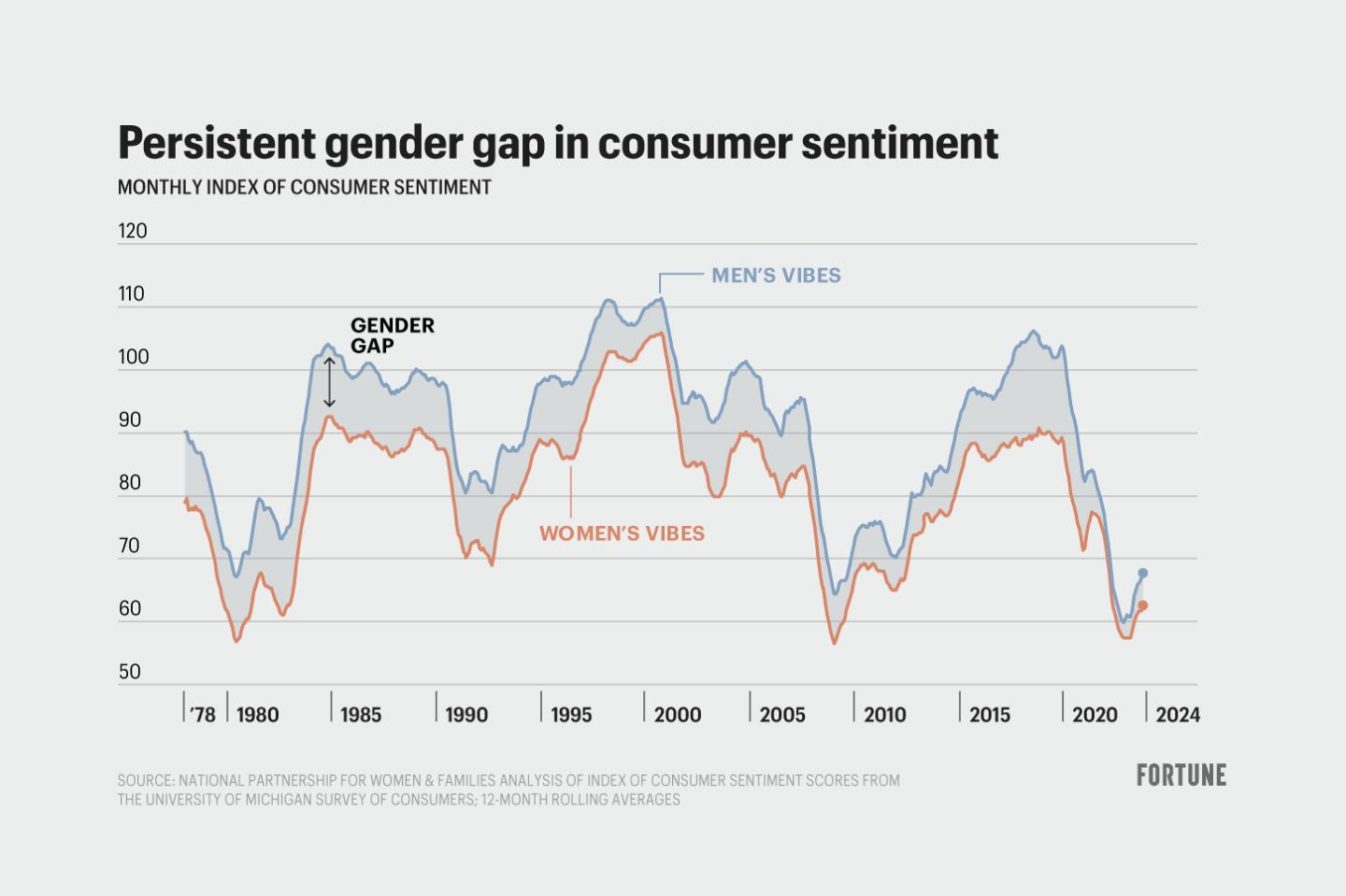
Chart compares male and female consumer sentiments since 1978
Men and women's consumer sentiment since 1978.Fortune

Of the numerous economic trends filling column inches over the last few years, few have gained as much traction as the “vibecession.” Coined by Kyla Scanlon in July 2022, the term refers to the phenomenon of people feeling “meh” about the economy despite positive traditional measures of economic health. Much digital ink has been spilled on the topic, including many recent articles declaring the vibecession has moved from hot in 2023 to not in 2024 as consumer sentiment has rebounded in recent months.

But whose feelings have been driving the vibecession in the first place? In a word, men’s.

Men have nearly always felt sunnier about the economy than women have. Our research shows that in the 46 years of the University of Michigan’s monthly Survey of Consumers, men have felt worse than women about the economy just 15 times. While consumer sentiment has been down across the board since the pandemic began, our analysis also shows that a notable, yet undiscussed, aspect of the vibecession conversation was a substantial narrowing of the gender gap between how men and women feel about the economy. The vibecession was not just about everyone feeling bad about the economy–it was also about men finally feeling the same way as women do.

The economy still caters to the wants and needs of men

It’s not hard to imagine why women have been historically pessimistic about the economy. Women were only guaranteed financial autonomy via the right to open bank accounts or apply for credit or loans in 1974, shortly before the survey began. Through the latter half of the 20th century, women frequently faced unequal and hostile conditions on the job. The Supreme Court did not recognize sexual harassment as sex discrimination in the workplace until 1986–within the lifetime of elder millennials. Women also continue to be forced to juggle work and caregiving, with the only national law explicitly focused on helping people balance these demands, the Family and Medical Leave Act, having been on the books for just three decades. 

These legal and policy advancements helped make the economy work better for women–and the vibes certainly reflect that. Women’s consumer sentiment was 12.5% lower than men’s in the 1980s. By the 2000s, that gap was 10.2%. Over the last two years, it stands at 5.7%. But the truth of the matter is that the economy still caters to the wants and needs of men. It’s why almost half of all new businesses are started by women, but less than 2% of all venture capital dollars go to women-owned businesses. It’s why billions have been sunk into all manner of artificial intelligence startups largely founded by men, but the childcare workforce has barely recovered from COVID-19. It’s why women continue to be paid 78 cents for every dollar paid to a man and the gaps for women of color are worse. 

It’s 2024. We have robot vacuums, phones switch on at a look, and tourists in space. Yet we still live in a society that expects women to work full time while also being full-time caregivers to children and aging parents with minimal support. The persistent gender gap in vibes reflects this impossible bind.

What if, instead of paying attention only when men are feeling as badly about the economy as women are, we focus on policies that lift women’s vibes? For instance, the gap narrowed during the vibecession because women’s perceptions of the economy improved substantially more than men’s in early 2021. What were women reacting to? It’s possible the passage of the American Rescue Plan Act, with its expanded child tax credit, child care rescue funding, and other key family supports buoyed women’s enthusiasm for future financial stability after so many were forced to make painful choices between caregiving and paid work during the first year of the pandemic. Though we can’t say for sure, this seems plausible to us and others given the popularity of these programs, especially for women.

Men’s and women’s vibes moved more or less in tandem throughout 2022, the “vibecession” era, and the overall vibes hit their nadir in June 2022, also the month of highest inflation and the lowest level of consumer sentiment ever recorded for men. The gender vibes gap then grew again in 2023. What happened in 2023? The dissolution of much of the hastily constructed social safety net assembled during the early days of the COVID-19 pandemic and workplaces increasingly returning to “normal”–a normal that never worked well for women. And even though we can’t parse the vibes by race or disability status, experience from other analyses suggests women of color and disabled women are struggling mightily to stay afloat in a system and country that were built to exclude them twice and thrice over. 

To be clear, focusing on consumer sentiment has been a much-needed shift in how we think and talk about the economy. But turning away from this conversation as the gender vibes gap has resurged is concerning. While many excellent journalists have written about moms’ struggles finding child care or the mental load of balancing work and family responsibilities, those discussions are rarely front and center in the economic conversation.

Women are more than half the population, almost half the workforce, and drive consumer spending–but how they feel about the economy hasn’t been a central part of the conversation. That has to change.

Anwesha Majumder, MHS, is the economist at the National Partnership for Women & Families. Katherine Gallagher Robbins, Ph.D., is a senior fellow at the National Partnership for Women & Families.

More must-read commentary published by Fortune:

  • Here’s how the U.S., Europe, and China are faring in the post-pandemic race for economic growth
  • Global trade is at a critical juncture–and we can’t take it for granted, WTO meeting chair warns
  • The U.S. housing market is headed into a pivotal spring season as home sellers wait for their sweet spot, according to Opendoor
  • The anti-DEI movement has gone from fringe to mainstream. Here’s what that means for corporate America

The opinions expressed in Fortune.com commentary pieces are solely the views of their authors and do not necessarily reflect the opinions and beliefs of Fortune.

Join us at the Fortune Workplace Innovation Summit May 19–20, 2026, in Atlanta. The next era of workplace innovation is here—and the old playbook is being rewritten. At this exclusive, high-energy event, the world’s most innovative leaders will convene to explore how AI, humanity, and strategy converge to redefine, again, the future of work. Register now.
About the Authors
By Anwesha Majumder
See full bioRight Arrow Button Icon
By Katherine Gallagher Robbins
See full bioRight Arrow Button Icon

Latest in Commentary

Finance
Lorem ipsum dolor sit amet, consectetur adipiscing elit, sed do eiusmod tempor incididunt ut labore et dolore magna aliqua. Ut enim ad minim veniam
By Fortune Editors
October 20, 2025
Finance
Lorem ipsum dolor sit amet, consectetur adipiscing elit, sed do eiusmod tempor incididunt ut labore et dolore magna aliqua. Ut enim ad minim veniam
By Fortune Editors
October 20, 2025
Finance
Lorem ipsum dolor sit amet, consectetur adipiscing elit, sed do eiusmod tempor incididunt ut labore et dolore magna aliqua. Ut enim ad minim veniam
By Fortune Editors
October 20, 2025
Finance
Lorem ipsum dolor sit amet, consectetur adipiscing elit, sed do eiusmod tempor incididunt ut labore et dolore magna aliqua. Ut enim ad minim veniam
By Fortune Editors
October 20, 2025
Finance
Lorem ipsum dolor sit amet, consectetur adipiscing elit, sed do eiusmod tempor incididunt ut labore et dolore magna aliqua. Ut enim ad minim veniam
By Fortune Editors
October 20, 2025
Finance
Lorem ipsum dolor sit amet, consectetur adipiscing elit, sed do eiusmod tempor incididunt ut labore et dolore magna aliqua. Ut enim ad minim veniam
By Fortune Editors
October 20, 2025

Most Popular

Finance
Lorem ipsum dolor sit amet, consectetur adipiscing elit, sed do eiusmod tempor incididunt ut labore et dolore magna aliqua. Ut enim ad minim veniam
By Fortune Editors
October 20, 2025
Finance
Lorem ipsum dolor sit amet, consectetur adipiscing elit, sed do eiusmod tempor incididunt ut labore et dolore magna aliqua. Ut enim ad minim veniam
By Fortune Editors
October 20, 2025
Finance
Lorem ipsum dolor sit amet, consectetur adipiscing elit, sed do eiusmod tempor incididunt ut labore et dolore magna aliqua. Ut enim ad minim veniam
By Fortune Editors
October 20, 2025
Finance
Lorem ipsum dolor sit amet, consectetur adipiscing elit, sed do eiusmod tempor incididunt ut labore et dolore magna aliqua. Ut enim ad minim veniam
By Fortune Editors
October 20, 2025
Finance
Lorem ipsum dolor sit amet, consectetur adipiscing elit, sed do eiusmod tempor incididunt ut labore et dolore magna aliqua. Ut enim ad minim veniam
By Fortune Editors
October 20, 2025
Finance
Lorem ipsum dolor sit amet, consectetur adipiscing elit, sed do eiusmod tempor incididunt ut labore et dolore magna aliqua. Ut enim ad minim veniam
By Fortune Editors
October 20, 2025
Fortune Secondary Logo
Rankings
  • 100 Best Companies
  • Fortune 500
  • Global 500
  • Fortune 500 Europe
  • Most Powerful Women
  • Future 50
  • World’s Most Admired Companies
  • See All Rankings
Sections
  • Finance
  • Fortune Crypto
  • Features
  • Leadership
  • Health
  • Commentary
  • Success
  • Retail
  • Mpw
  • Tech
  • Lifestyle
  • CEO Initiative
  • Asia
  • Politics
  • Conferences
  • Europe
  • Newsletters
  • Personal Finance
  • Environment
  • Magazine
  • Education
Customer Support
  • Frequently Asked Questions
  • Customer Service Portal
  • Privacy Policy
  • Terms Of Use
  • Single Issues For Purchase
  • International Print
Commercial Services
  • Advertising
  • Fortune Brand Studio
  • Fortune Analytics
  • Fortune Conferences
  • Business Development
  • Group Subscriptions
About Us
  • About Us
  • Editorial Calendar
  • Press Center
  • Work At Fortune
  • Diversity And Inclusion
  • Terms And Conditions
  • Site Map
  • About Us
  • Editorial Calendar
  • Press Center
  • Work At Fortune
  • Diversity And Inclusion
  • Terms And Conditions
  • Site Map
  • Facebook icon
  • Twitter icon
  • LinkedIn icon
  • Instagram icon
  • Pinterest icon

Latest in Commentary

hormuz
CommentaryIran
With Hormuz under strain, a trade corridor built for resilience faces a real-world test
By Angela Chitkara and Samantha SuttonApril 17, 2026
6 hours ago
broker
CommentarySoftware
The 3 forces quietly dismantling the business model that made enterprise software fabulously profitable
By Michael Jacobides and Stefano PuntoniApril 17, 2026
7 hours ago
welti
CommentaryIran
Switzerland’s former ambassador to Iran: here’s how to end this war — and why Pakistan isn’t enough
By Philippe WeltiApril 17, 2026
12 hours ago
Anita Beveridge-Raffo is Head of Retail and Consumer Goods at Palantir Technologies
CommentaryAI agents
Palantir exec: the biggest mistake retailers are making with AI? Trying to do it all with one agent
By Anita Beveridge-RaffoApril 16, 2026
1 day ago
wyle
CommentaryHealth
‘The Pitt’ reveals why healthcare desperately needs a new front door
By Jeremy MorganApril 16, 2026
1 day ago
health
CommentaryHealth Care Service
Two physicians on ending the waiting-room era: bring care home
By Benjamin Kornitzer and Bill FristApril 16, 2026
1 day ago

Most Popular

A world going broke: IMF says America's $39 trillion national debt is actually a global problem—and AI may be the only rescue
Economy
A world going broke: IMF says America's $39 trillion national debt is actually a global problem—and AI may be the only rescue
By Nick LichtenbergApril 16, 2026
24 hours ago
Pope Leo warned the world is in ‘big trouble’ if Elon Musk becomes the first trillionaire
Success
Pope Leo warned the world is in ‘big trouble’ if Elon Musk becomes the first trillionaire
By Preston ForeApril 17, 2026
10 hours ago
Jeff Bezos pledged $10 billion for climate change. With the 2030 clock ticking, his wife, Lauren Sánchez Bezos, is leading the charge to spend it
Environment
Jeff Bezos pledged $10 billion for climate change. With the 2030 clock ticking, his wife, Lauren Sánchez Bezos, is leading the charge to spend it
By Sydney LakeApril 15, 2026
2 days ago
MacKenzie Scott is bypassing the Ivy League and rewriting the $79 billion higher ed playbook by giving to HBCUs and community colleges
Politics
MacKenzie Scott is bypassing the Ivy League and rewriting the $79 billion higher ed playbook by giving to HBCUs and community colleges
By Sydney LakeApril 16, 2026
1 day ago
Germany already told its workers to ditch four-day weeks and work-life balance. Now the government wants to cut their pay for calling in sick, too
Success
Germany already told its workers to ditch four-day weeks and work-life balance. Now the government wants to cut their pay for calling in sick, too
By Orianna Rosa RoyleApril 16, 2026
2 days ago
Current price of oil as of April 16, 2026
Personal Finance
Current price of oil as of April 16, 2026
By Joseph HostetlerApril 16, 2026
1 day ago

© 2026 Fortune Media IP Limited. All Rights Reserved. Use of this site constitutes acceptance of our Terms of Use and Privacy Policy | CA Notice at Collection and Privacy Notice | Do Not Sell/Share My Personal Information
FORTUNE is a trademark of Fortune Media IP Limited, registered in the U.S. and other countries. FORTUNE may receive compensation for some links to products and services on this website. Offers may be subject to change without notice.