• Home
  • Latest
  • Fortune 500
  • Finance
  • Tech
  • Leadership
  • Lifestyle
  • Rankings
  • Multimedia

Trendingnow

1

Jeff Bezos wants the bottom half of earners to pay zero income tax—he says nurses making just $75K should save $12K a year

2

Despite a $500 million net worth, Shaq just finished his fourth degree. He warns graduates: 'Your character will take you further than your resume'

3

Bolt CEO says he let go of his entire HR team for creating problems that didn’t exist: ‘Those problems disappeared when I let them go’ 

1

Jeff Bezos wants the bottom half of earners to pay zero income tax—he says nurses making just $75K should save $12K a year

2

Despite a $500 million net worth, Shaq just finished his fourth degree. He warns graduates: 'Your character will take you further than your resume'

3

Bolt CEO says he let go of his entire HR team for creating problems that didn’t exist: ‘Those problems disappeared when I let them go’ 
CommentaryEconomy

Here’s how the U.S., Europe, and China are faring in the post-pandemic race for economic growth

By
Philipp Carlsson-Szlezak
and
Paul Swartz
Paul Swartz
Down Arrow Button Icon
By
Philipp Carlsson-Szlezak
and
Paul Swartz
Paul Swartz
Down Arrow Button Icon
February 12, 2024, 7:56 AM ET
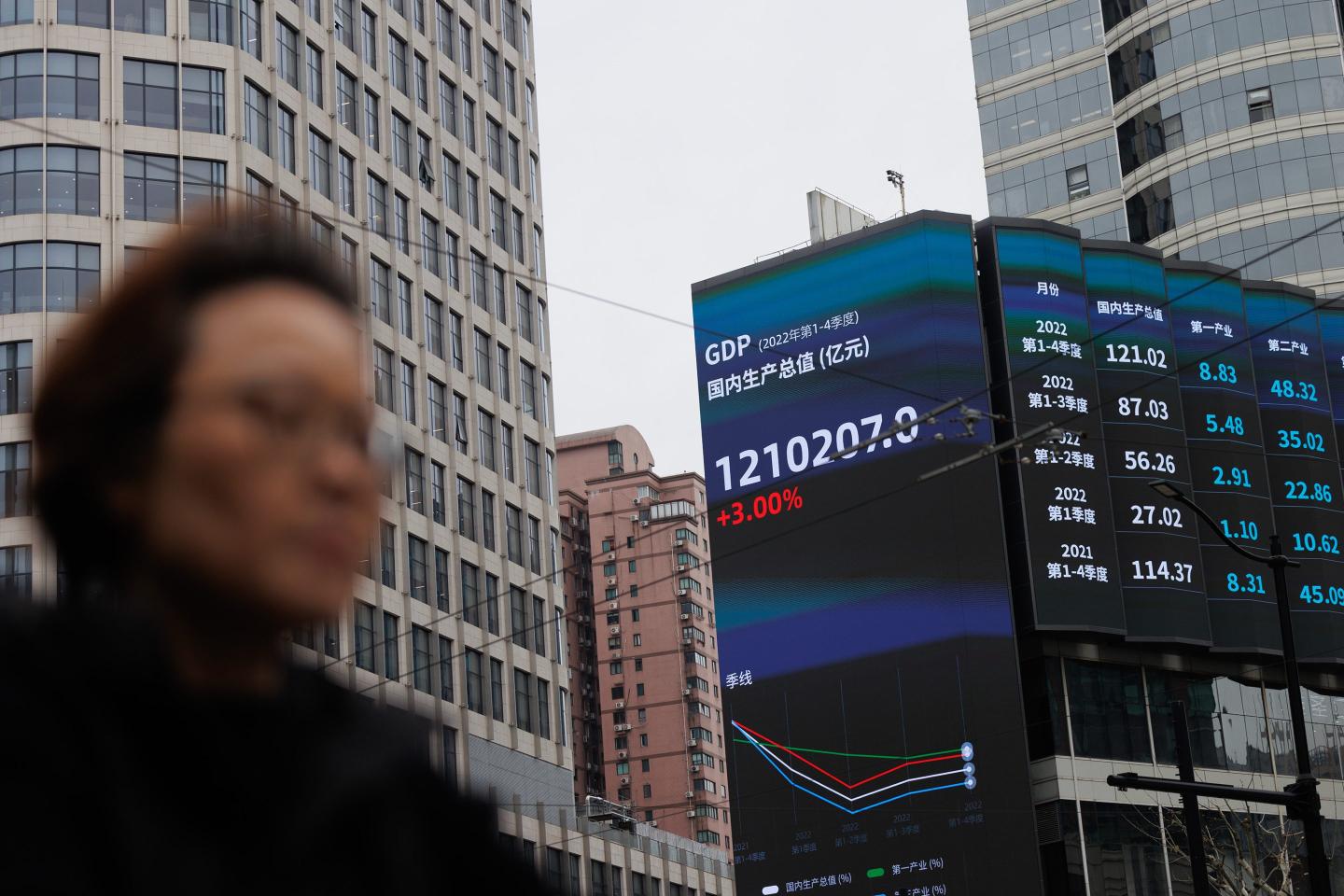
The exit from zero-COVID policies was expected to drive a wave of revenge consumption that would catapult China’s economy back to trend–but the boom never materialized.
The exit from zero-COVID policies was expected to drive a wave of revenge consumption that would catapult China’s economy back to trend–but the boom never materialized.Hugo Hu—Getty Images

Despite the gloomy expectations of recent years, global growth has held up relatively well. However, a succession of shocks–the pandemic, inflation, and the Ukraine war–has tested the resilience of the U.S., Europe, and China in disparate ways. Most significantly, the U.S., starting as a laggard in 2020, is the only bloc that is making a run at returning to its pre-pandemic growth trajectory.

To capture the three blocs’ resilience and new growth trajectories, it is not sufficient to compare their growth rates as each has structural components. Instead, the changing fortunes are revealed in each bloc’s ability–or lack thereof–to fight its way back to their pre-pandemic growth path.

Today, two questions are vital: Have the conflagrations of recent years pushed the blocs off their old path? If so, can they return to it? The answers demonstrate the three blocs’ true resilience and allow us to sketch their paths ahead.

The U.S. has pushed itself to the front

The U.S. economy has experienced the most significant reversal of fortunes, fighting back to its pre-pandemic growth trajectory not once, but twice. It may even end up overshooting that old trend.
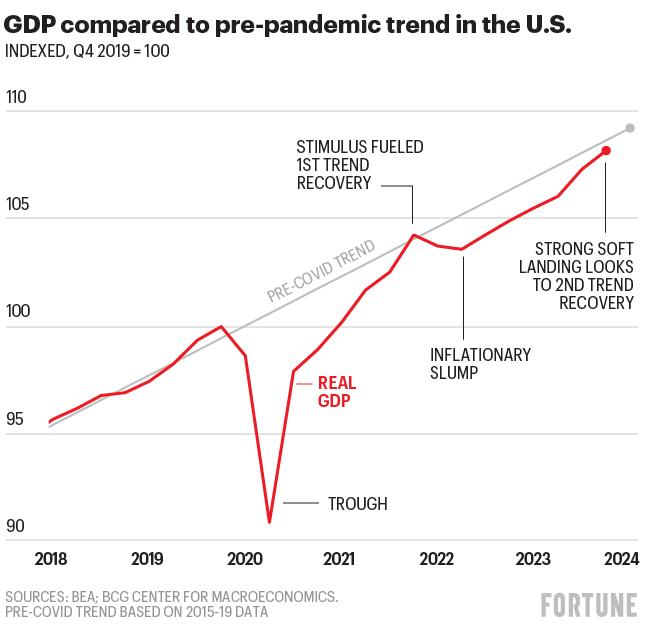
Chart shows post-Covid recovery in the US

After a savage initial shock, the U.S. managed to recover its old trend path thanks to extraordinary stimulus. But inflation and the rapidly rising rates that came with it pushed output off its trend path a second time. Defying the doubters, the economy delivered a strong soft landing putting the U.S. on a path to its pre-pandemic trend for a second time–a testament to truly remarkable resilience.

There are at least three reasons why U.S. resilience is more like a flywheel than a finite, depletable resource. First, strong diversification meant that as the goods overshoot faded in early 2021, a continued recovery in services offset that drag. Second, labor market strength was protected by a significant backlog of demand for workers. Third, household balance sheets were in historically strong shape providing Americans with room to consume even as their real incomes fell.

These strong sources of resilience have been enough to withstand the impact of inflation on incomes and budgets as well as the rapid tightening by monetary policymakers. There is little reason to assume that such resilience will come to a sudden stop.

And it may turn out even better than that. Near-term, the return of real income growth is set to push the economy. And in the longer term, durable labor market tightness looks set to spark higher productivity growth as firms will be forced to turn to technology to compensate for scarce labor. This makes an overshoot of the old trend very plausible.

Severe challenges have broken the eurozone’s momentum

The eurozone had its own, less favorable, reversal of fortunes. The Ukraine war dealt the bloc a particularly bad hand. Though the eurozone too proved resilient, avoiding a recession in the nearly two years since the war started, its growth momentum is broken, and the bloc is now pushed off its pre-pandemic course.
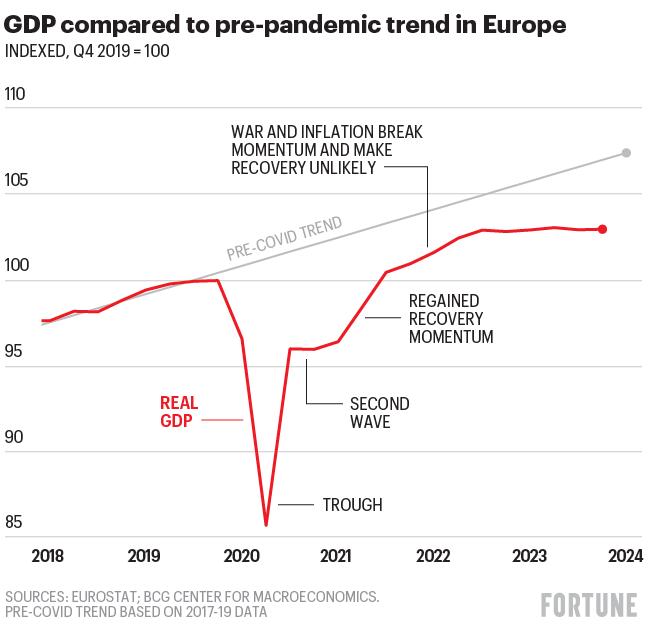
Chart shows post-Covid recovery in Europe

Though the eurozone recovery was fueled by less significant stimulus than the U.S., it appeared to be on track to take a run at a full trend recovery–until the start of the Ukraine war. A downturn was avoided in a compelling show of resilience, but the shock hit hard and made a trend recovery unlikely.

The eurozone’s greater exposure to goods production, Russian energy, and exports left it poorly positioned for the challenges of 2022 and 2023. Rapid adjustments and response to the energy shock showed resilience and proved wrong the initial fears of a severe recession and mothballed production. However, significant pressure on household budgets has meant stagnant growth.

Unlike the pandemic-related shock, the energy shock likely downgrades the eurozone’s underlying growth potential by leaving a more lasting impact on real incomes and by weighing on competitiveness at the margin. Even as growth returns in 2024, this makes a full recovery to the old trend unlikely. An indelible mark has been left on the eurozone economy, a fate the U.S. avoided.

China’s reversal of fortunes

China’s path is another astonishing reversal of fortunes. Its initial recovery was the envy of the rest of the world, yet the economy has now been pushed off its pre-pandemic trend and a return to it looks challenging.
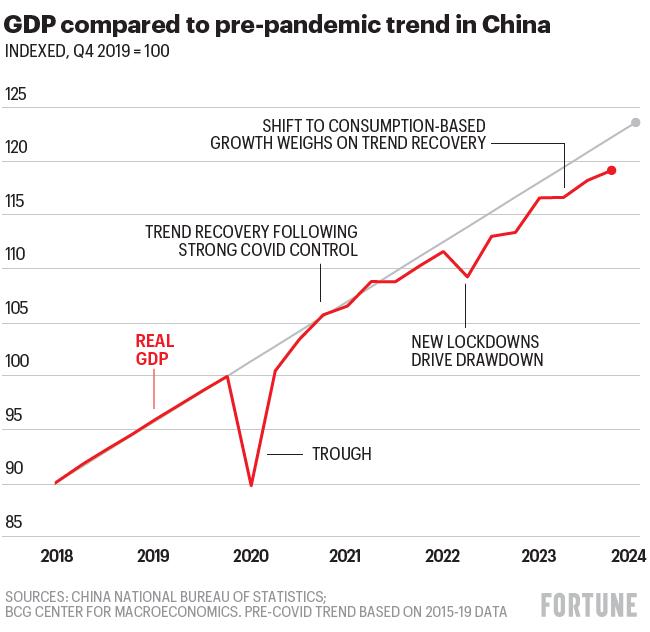
Chart shows post-Covid recovery in China

Though China’s zero-COVID approach delivered a picture-perfect trend recovery, it ultimately required renewed lockdowns that weighed on growth. At the same time, China’s economic model is undergoing a shift away from investment and toward consumption. The exit from zero-COVID policies was expected to drive a wave of revenge consumption that would catapult China’s economy back to trend. So strong was the conviction in this bounce that many thought the resurgent Chinese consumer would stoke global inflation even further in 2023.

However, Chinese consumers lacked the confidence and spending power. Slumps in other areas of the economy, particularly real estate, precluded the hoped-for boom.

Can China return to its old trend path? Successful changes to its growth model have been key to the remarkable record of China’s growth over the last 30 years. Before the 2008 global financial crisis, exports were the engine of growth. With the collapse in Western demand, China found a more reliable source of demand in infrastructure and real estate. A boom in building helped drive another decade of impressive growth but has run out of steam. The third shift, replacing investment with consumption as the engine of growth, is well underway but recent history demonstrates the difficulty of achieving instant rewards. It is also a reminder that consumption-driven growth cannot be managed as stringently as is the case with investments.

Though a trend recovery looks harder now, China’s slowdown should be seen as a sign of overall success. As economies grow richer, their ability to sustain high growth necessarily declines. Labor growth slows, capital is already accumulated significantly, and therefore continued progress depends on the hardest source of growth–productivity growth.

Four years after the start of COVID-19, the three blocs each appear to have settled into new growth trajectories. Even so, new disruptions will follow, and therein lies the challenge for those who need to assess macroeconomic risk. The unpredictability puts a premium on agility and rapid execution when new surprises hit. There is no master plan, no permanent winner, and a fair number of false alarms along the way. Despite the volatility, the global competition for growth is not an impenetrable mystery but an ongoing evolution that requires constant judgment.

Philipp Carlsson-Szlezak is a managing director and partner in BCG’s New York office and the firm’s global chief economist. Paul Swartz is a director and senior economist at the BCG Henderson Institute in New York. They are the authors of the forthcoming book Shocks, Crises, and False Alarms: How to Assess True Macroeconomic Risk (HBR Press, 2024)

More must-read commentary published by Fortune:

  • The markets are starting to realize just how hawkish the Fed is–and reckoning with higher-for-longer interest rates
  • Working fathers are the new target of microaggressions–and they are worried they could be getting ‘daddy tracked’
  • WEF president: ‘It’s time to revitalize trade—and reverse the trend of Slowbalization’
  • The anti-DEI movement has gone from fringe to mainstream. Here’s what that means for corporate America

The opinions expressed in Fortune.com commentary pieces are solely the views of their authors and do not necessarily reflect the opinions and beliefs of Fortune.

About the Authors
By Philipp Carlsson-Szlezak
See full bioRight Arrow Button Icon
By Paul Swartz
See full bioRight Arrow Button Icon

Latest in Commentary

Finance
Lorem ipsum dolor sit amet, consectetur adipiscing elit, sed do eiusmod tempor incididunt ut labore et dolore magna aliqua. Ut enim ad minim veniam
By Fortune Editors
October 20, 2025
Finance
Lorem ipsum dolor sit amet, consectetur adipiscing elit, sed do eiusmod tempor incididunt ut labore et dolore magna aliqua. Ut enim ad minim veniam
By Fortune Editors
October 20, 2025
Finance
Lorem ipsum dolor sit amet, consectetur adipiscing elit, sed do eiusmod tempor incididunt ut labore et dolore magna aliqua. Ut enim ad minim veniam
By Fortune Editors
October 20, 2025
Finance
Lorem ipsum dolor sit amet, consectetur adipiscing elit, sed do eiusmod tempor incididunt ut labore et dolore magna aliqua. Ut enim ad minim veniam
By Fortune Editors
October 20, 2025
Finance
Lorem ipsum dolor sit amet, consectetur adipiscing elit, sed do eiusmod tempor incididunt ut labore et dolore magna aliqua. Ut enim ad minim veniam
By Fortune Editors
October 20, 2025
Finance
Lorem ipsum dolor sit amet, consectetur adipiscing elit, sed do eiusmod tempor incididunt ut labore et dolore magna aliqua. Ut enim ad minim veniam
By Fortune Editors
October 20, 2025

Most Popular

Finance
Lorem ipsum dolor sit amet, consectetur adipiscing elit, sed do eiusmod tempor incididunt ut labore et dolore magna aliqua. Ut enim ad minim veniam
By Fortune Editors
October 20, 2025
Finance
Lorem ipsum dolor sit amet, consectetur adipiscing elit, sed do eiusmod tempor incididunt ut labore et dolore magna aliqua. Ut enim ad minim veniam
By Fortune Editors
October 20, 2025
Finance
Lorem ipsum dolor sit amet, consectetur adipiscing elit, sed do eiusmod tempor incididunt ut labore et dolore magna aliqua. Ut enim ad minim veniam
By Fortune Editors
October 20, 2025
Finance
Lorem ipsum dolor sit amet, consectetur adipiscing elit, sed do eiusmod tempor incididunt ut labore et dolore magna aliqua. Ut enim ad minim veniam
By Fortune Editors
October 20, 2025
Finance
Lorem ipsum dolor sit amet, consectetur adipiscing elit, sed do eiusmod tempor incididunt ut labore et dolore magna aliqua. Ut enim ad minim veniam
By Fortune Editors
October 20, 2025
Finance
Lorem ipsum dolor sit amet, consectetur adipiscing elit, sed do eiusmod tempor incididunt ut labore et dolore magna aliqua. Ut enim ad minim veniam
By Fortune Editors
October 20, 2025
Fortune Secondary Logo
Rankings
  • 100 Best Companies
  • Fortune 500
  • Global 500
  • Fortune 500 Europe
  • Most Powerful Women
  • World's Most Admired Companies
  • See All Rankings
  • Lists Calendar
Sections
  • Finance
  • Fortune Crypto
  • Features
  • Leadership
  • Health
  • Commentary
  • Success
  • Retail
  • Mpw
  • Tech
  • Lifestyle
  • CEO Initiative
  • Asia
  • Politics
  • Conferences
  • Europe
  • Newsletters
  • Personal Finance
  • Environment
  • Magazine
  • Education
Customer Support
  • Frequently Asked Questions
  • Customer Service Portal
  • Privacy Policy
  • Terms Of Use
  • Single Issues For Purchase
  • International Print
Commercial Services
  • Advertising
  • Fortune Brand Studio
  • Fortune Analytics
  • Fortune Conferences
  • Business Development
  • Group Subscriptions
About Us
  • About Us
  • Press Center
  • Work At Fortune
  • Terms And Conditions
  • Site Map
  • About Us
  • Press Center
  • Work At Fortune
  • Terms And Conditions
  • Site Map
  • Facebook icon
  • Twitter icon
  • LinkedIn icon
  • Instagram icon
  • Pinterest icon

Latest in Commentary

brotman
CommentaryVenture Capital
I’ve spent 25 years in venture capital. Here’s how it quietly shut ordinary Americans out of the AI wealth boom—and what could fix it
By Steve BrotmanMay 22, 2026
7 hours ago
cox
CommentarySuccession
McKinsey studied 200 family business successions. The biggest problem wasn’t the heir — it was the outgoing CEO
By Acha Leke and Chaitali MukherjeeMay 22, 2026
8 hours ago
himanshu
CommentaryLayoffs
I’ve led companies through every major tech disruption. AI washing is the same mistake, every time
By Himanshu PalsuleMay 22, 2026
11 hours ago
trump
CommentaryWhite House
Trump Accounts have a bigger problem than billionaire stock donations
By Jin Huang and Stephen RollMay 21, 2026
1 day ago
brigham
CommentaryRailroads
The U.S. freight network is broken by design. One merger could start fixing it
By Brigham A. McCownMay 21, 2026
1 day ago
Elon Musk sits with his fists together, looking up.
Commentaryspace
SpaceX will be worth trillions, but the space station that made it possible is worth even more — if we don’t squander it
By Tejpaul BhatiaMay 20, 2026
2 days ago

Most Popular

Jeff Bezos wants the bottom half of earners to pay zero income tax—he says nurses making just $75K should save $12K a year
Success
Jeff Bezos wants the bottom half of earners to pay zero income tax—he says nurses making just $75K should save $12K a year
By Preston ForeMay 21, 2026
1 day ago
Despite a $500 million net worth, Shaq just finished his fourth degree. He warns graduates: 'Your character will take you further than your resume'
Success
Despite a $500 million net worth, Shaq just finished his fourth degree. He warns graduates: 'Your character will take you further than your resume'
By Preston ForeMay 20, 2026
2 days ago
Bolt CEO says he let go of his entire HR team for creating problems that didn’t exist: ‘Those problems disappeared when I let them go’ 
Workplace Culture
Bolt CEO says he let go of his entire HR team for creating problems that didn’t exist: ‘Those problems disappeared when I let them go’ 
By Preston ForeMay 19, 2026
3 days ago
Pay transparency is exposing a bigger problem: Most companies can't explain why they pay what they pay
Workplace Culture
Pay transparency is exposing a bigger problem: Most companies can't explain why they pay what they pay
By Sydney LakeMay 20, 2026
2 days ago
McKinsey partner says up to 50% of work hours could be transformed within the next 5 years
AI
McKinsey partner says up to 50% of work hours could be transformed within the next 5 years
By Emma BurleighMay 21, 2026
1 day ago
Current price of oil as of May 21, 2026
Personal Finance
Current price of oil as of May 21, 2026
By Joseph HostetlerMay 21, 2026
1 day ago

© 2026 Fortune Media IP Limited. All Rights Reserved. Use of this site constitutes acceptance of our Terms of Use and Privacy Policy | CA Notice at Collection and Privacy Notice | Do Not Sell/Share My Personal Information
FORTUNE is a trademark of Fortune Media IP Limited, registered in the U.S. and other countries. FORTUNE may receive compensation for some links to products and services on this website. Offers may be subject to change without notice.