
• Home
  • Latest
  • Fortune 500
  • Finance
  • Tech
  • Leadership
  • Lifestyle
  • Rankings
  • Multimedia
FinanceMarkets

Wall Street’s ‘excruciating’ FOMO obsession will push the market to a decade of ‘dismal’ returns, warns investment legend John Hussman

Eleanor Pringle
By
Eleanor Pringle
Eleanor Pringle
Senior Reporter, Economics and Markets
Down Arrow Button Icon
Eleanor Pringle
By
Eleanor Pringle
Eleanor Pringle
Senior Reporter, Economics and Markets
Down Arrow Button Icon
February 28, 2024, 6:30 AM ET
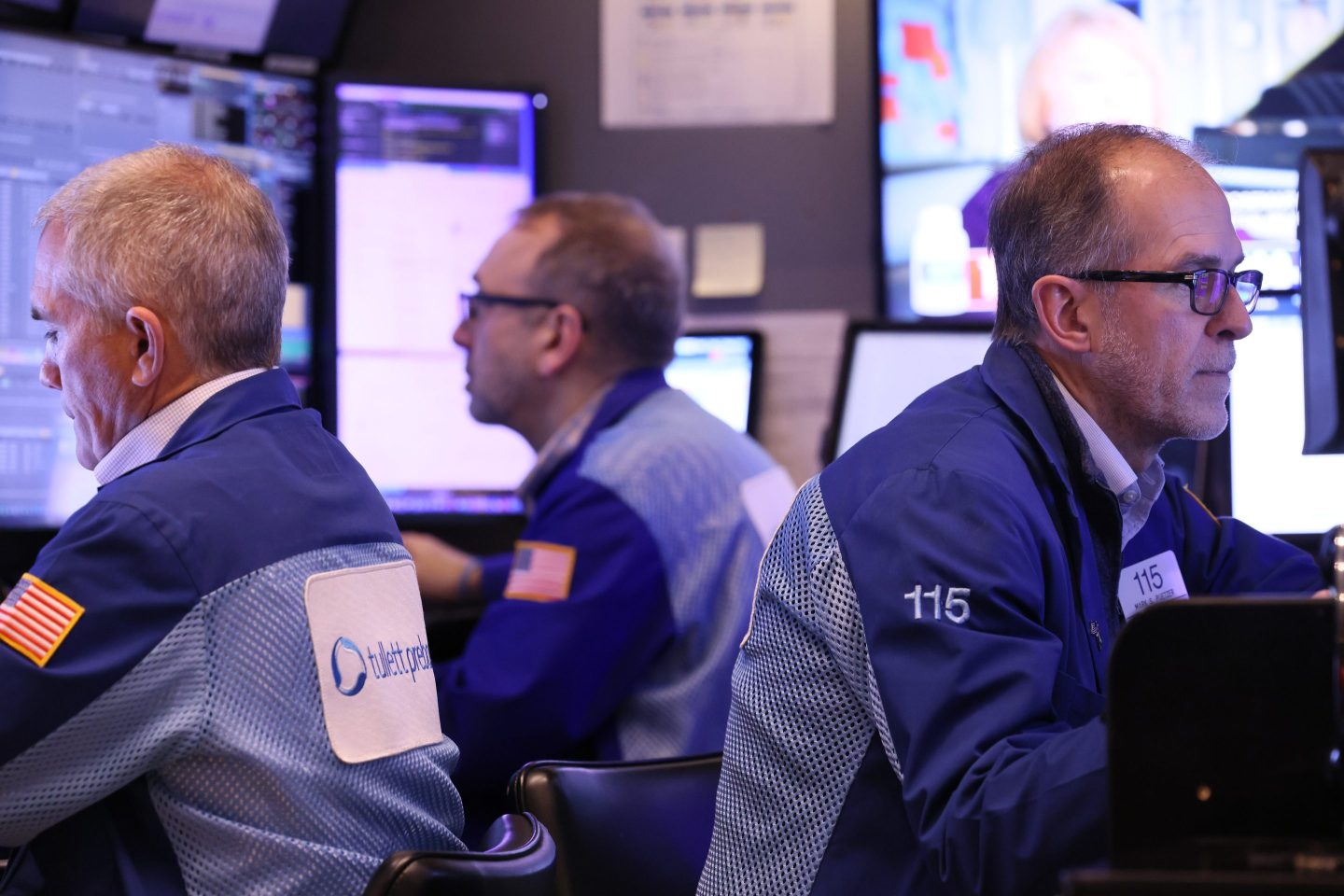
Traders work on the floor of the New York Stock Exchange during morning trading.
Market vet John Hussman has warned FOMO investors will push the market to more than a decade of dismal returns.Michael M. Santiago—Getty Images

It’s not every day a Wall Street legend promises to “stick to their knitting,” but that’s exactly what John Hussman is going to do if it means steering clear of rampant “fear of missing out” (FOMO) trading.

The president of the Hussman Investment Trust is no stranger to crying “crisis”—a fact which might cause bulls to crow—but unfortunately for bulls, Hussman has been right before. The market vet correctly called the 2000 and 2008 market crises, and is once again sounding the alarm about what the next decade will look like for investors.

Yet unlike others of his ilk—Marc Rowan’s Apollo Global Management and Morgan Stanleyto name a few—Hussman isn’t placing the blame solely on the shoulders of an AI “bubble.” Instead, he is holding investors to account, who he believes are piling into shares with little interest in valuations, solely motivated by a fear of missing out.

“Even though the S&P 500 and Nasdaq 100 have struggled to match Treasury bill returns for over two years, investors seem to be developing an excruciating and nearly frantic ‘fear of missing out,’” Hussman wrote in a note. “Lots of pressures are driving that fear: the recent push to nominal record highs, enthusiasm about an economic ‘soft landing,’ an expected ‘pivot’ to lower interest rates, and most recently, euphoria about the prospects for artificial intelligence.”

Soft landing?

Top economists are increasingly confident that the Fed will be able to successfully maneuver a “soft landing”—with Jamie Dimon a notable departure from the general consensus of 80% confidence in this outcome—while approximately 80% of economists surveyed by the Financial Times said they expected to see rate cuts in 2024—again, JPMorgan CEO Dimon isn’t so convinced of this.

Back to Hussman, who agrees that some of the optimism buoying the market is legitimate: AI, for example. This is an area where Dimon and the likes of Mark Cuban are also confident, both having dismissed comparisons to a dotcom bubble.

Indeed, Hussman writes: “It’s reasonable that some of our largest investments should be related to AI, and they are, though not necessarily those with the largest market capitalizations. My impression is that the Fed will indeed pivot to lower rates late this year, though the pivot may be more consistent with the Fed’s aggressive easing during the 2000–2002 and 2007–2009 collapses than with quantitative easing and the recent zero-interest rate bubble.”

Why? “I do believe that current market valuations, whatever metric one chooses, are likely to be followed by weak-to-dismal 10–12 year total returns and deep full-cycle losses,” Hussman writes.

Déjà vu

Hussman’s note also points out that investors still buying into the stock market frenzy have no idea whether they’re buying in at the peak, or whether shares may still climb higher. Across the board, Wall Street titans told Fortune last year they were relatively confident about the continuing performance of the Magnificent Seven (Tesla, Meta, Alphabet, Amazon, Apple, Microsoft, and Nvidia), a group largely credited for the gains across the S&P 500 in recent years.

But Hussman disagrees, saying that although only time will tell, the current market certainly looks like a peak: “We can’t know the future, but it’s straightforward to examine history and do math. Presently, market conditions have a stronger positive correlation with historical market peaks, and a stronger negative correlation with historical market lows, than 99.9% of instances across history.”

The idea that investors might have accidentally—or deliberately—driven share prices beyond the realms of valuation feasibility isn’t a new one. Last year Morgan Stanley’s Mike Wilson wrote that investors had pushed stocks into the “death zone,” a term mountaineers use to refer to altitudes where oxygen is no longer sufficient to sustain human life for an extended period of time.

“Either by choice or out of necessity, investors have followed stock prices to dizzying heights once again as liquidity (bottled oxygen) allows them to climb into a region where they know they shouldn’t go and cannot live very long,” Wilson wrote, according to MarketWatch. “They climb in pursuit of the ultimate topping out of greed, assuming they will be able to ascend without catastrophic consequences. But the oxygen eventually runs out, and those who ignore the risks get hurt.”

Yet Wilson was forced to walk back his outlook after the market rally continued into the spring and summer of 2023. In July, Wilson wrote in a note according to Bloomberg: “We were wrong. 2023 has been a story of higher valuations amid falling inflation and cost cutting.”

Undeterred, Hussman insists he’s sitting back from the fever: “If you’re losing your mind and plagued by fear of missing out, it might be that you’re best served with some passive investment exposure in your portfolio. Investors who want a concentrated position in Big Tech can take a concentrated position in Big Tech. We need not be involved. Our discipline is just our discipline. We’re not going to abandon it because someone else has FOMO.”


Join us at the Fortune Workplace Innovation Summit May 19–20, 2026, in Atlanta. The next era of workplace innovation is here—and the old playbook is being rewritten. At this exclusive, high-energy event, the world’s most innovative leaders will convene to explore how AI, humanity, and strategy converge to redefine, again, the future of work. Register now.
About the Author
Eleanor Pringle
By Eleanor PringleSenior Reporter, Economics and Markets
LinkedIn icon

Eleanor Pringle is an award-winning senior reporter at Fortune covering news, the economy, and personal finance. Eleanor previously worked as a business correspondent and news editor in regional news in the U.K. She completed her journalism training with the Press Association after earning a degree from the University of East Anglia.

See full bioRight Arrow Button Icon

Latest in Finance

InvestingSports
Big 12 in advanced talks for deal with RedBird-backed fund
By Giles Turner and BloombergDecember 13, 2025
8 hours ago
Spanish Prime Minister Pedro Sánchez often praises the financial and social benefits that immigrants bring to the country.
EuropeSpain
In a continent cracking down on immigration and berated by Trump’s warnings of ‘civilizational erasure,’ Spain embraces migrants
By Suman Naishadham and The Associated PressDecember 13, 2025
10 hours ago
EconomyAgriculture
More financially distressed farmers are expected to lose their property soon as loan repayments and incomes continue to falter
By Jason MaDecember 13, 2025
11 hours ago
InvestingStock
There have been head fakes before, but this time may be different as the latest stock rotation out of AI is just getting started, analysts say
By Jason MaDecember 13, 2025
14 hours ago
Politicsdavid sacks
Can there be competency without conflict in Washington?
By Alyson ShontellDecember 13, 2025
14 hours ago
Investingspace
SpaceX sets $800 billion valuation, confirms 2026 IPO plans
By Loren Grush, Edward Ludlow and BloombergDecember 13, 2025
15 hours ago

Most Popular

placeholder alt text
Success
Apple cofounder Ronald Wayne sold his 10% stake for $800 in 1976—today it’d be worth up to $400 billion
By Preston ForeDecember 12, 2025
2 days ago
placeholder alt text
Economy
Tariffs are taxes and they were used to finance the federal government until the 1913 income tax. A top economist breaks it down
By Kent JonesDecember 12, 2025
2 days ago
placeholder alt text
Success
40% of Stanford undergrads receive disability accommodations—but it’s become a college-wide phenomenon as Gen Z try to succeed in the current climate
By Preston ForeDecember 12, 2025
2 days ago
placeholder alt text
Economy
The Fed just ‘Trump-proofed’ itself with a unanimous move to preempt a potential leadership shake-up
By Jason MaDecember 12, 2025
1 day ago
placeholder alt text
Success
Apple CEO Tim Cook out-earns the average American’s salary in just 7 hours—to put that into context, he could buy a new $439,000 home in just 2 days
By Emma BurleighDecember 12, 2025
2 days ago
placeholder alt text
Economy
For the first time since Trump’s tariff rollout, import tax revenue has fallen, threatening his lofty plans to slash the $38 trillion national debt
By Sasha RogelbergDecember 12, 2025
1 day ago
Rankings
  • 100 Best Companies
  • Fortune 500
  • Global 500
  • Fortune 500 Europe
  • Most Powerful Women
  • Future 50
  • World’s Most Admired Companies
  • See All Rankings
Sections
  • Finance
  • Leadership
  • Success
  • Tech
  • Asia
  • Europe
  • Environment
  • Fortune Crypto
  • Health
  • Retail
  • Lifestyle
  • Politics
  • Newsletters
  • Magazine
  • Features
  • Commentary
  • Mpw
  • CEO Initiative
  • Conferences
  • Personal Finance
  • Education
Customer Support
  • Frequently Asked Questions
  • Customer Service Portal
  • Privacy Policy
  • Terms Of Use
  • Single Issues For Purchase
  • International Print
Commercial Services
  • Advertising
  • Fortune Brand Studio
  • Fortune Analytics
  • Fortune Conferences
  • Business Development
About Us
  • About Us
  • Editorial Calendar
  • Press Center
  • Work At Fortune
  • Diversity And Inclusion
  • Terms And Conditions
  • Site Map

© 2025 Fortune Media IP Limited. All Rights Reserved. Use of this site constitutes acceptance of our Terms of Use and Privacy Policy | CA Notice at Collection and Privacy Notice | Do Not Sell/Share My Personal Information
FORTUNE is a trademark of Fortune Media IP Limited, registered in the U.S. and other countries. FORTUNE may receive compensation for some links to products and services on this website. Offers may be subject to change without notice.