Economists just don’t get it. And by it we mean the American consumer’s miserable attitude, which continues to frustrate both President Biden’s reelection prospects and the field of professional forecasters who are praising the ongoing strength of the economy, regardless of what consumers may grumble under their breath.
But that grumbling is loud. Despite historically low unemployment, strong hiring, and gradually cooling inflation, consumers’ mood has remained sour. Consumer sentiment now is hovering near the levels it was over a decade ago, after the close of the Great Recession, as measured by the University of Michigan’s definitive survey. A separate nearly as influential poll from the Conference Board more recently showed Americans’ mood reversing several months of improvements to sink in February. And seven in 10 Americans are still worried about the price of everyday goods, according to Deloitte.
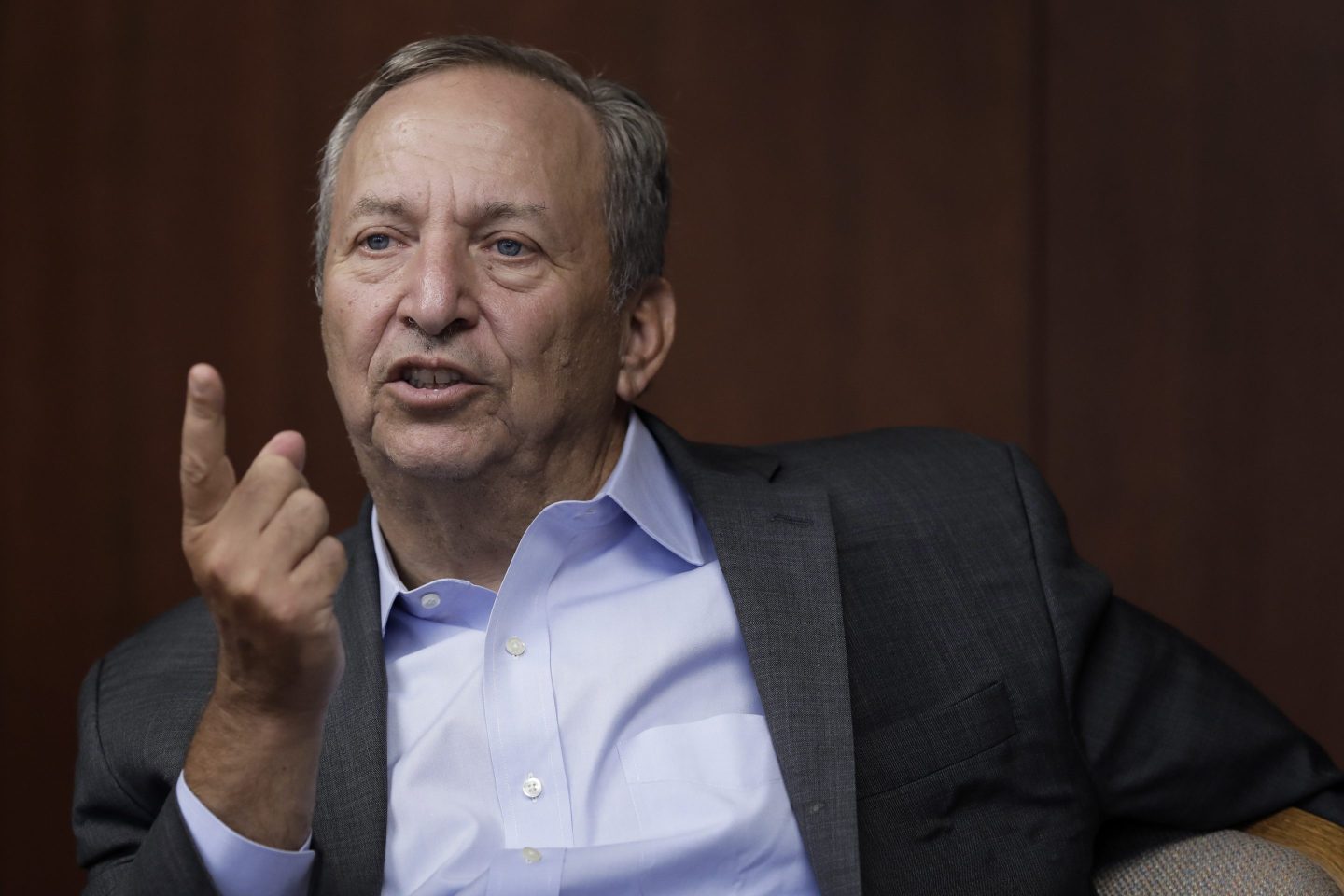
So why won’t consumers get on board with the vibes and admit inflation has fallen? The culprit, according to a new working paper coauthored by former Treasury Secretary Larry Summers, is the very tool that the Federal Reserve uses to bring down crushing inflation: high interest rates. The trick is, he and his coauthors (distinguished economists all) explain, interest rates are really money, too.
“Consumers, unlike modern economists, consider the cost of money part of their cost of living,” they say. Here’s what that means.
What is money, really?
With the Fed last year bringing its benchmark rate to a 20-year high and keeping it there, big-ticket purchases from homes to cars have gotten severely more expensive, Summers, along with Harvard colleagues Judd Cramer and Karl Oskar Schulz and the International Monetary Fund’s Marijn Bolhuis, write in a new National Bureau of Economic Research working paper.
“[T]he interest payment on a new 30-year mortgage for the average house has increased more than threefold since 2021,” the authors write. “The interest payment on a new car loan has increased more than 80%.”
That’s by design; after all, by hiking the cost of big-ticket goods, policymakers hope to drive down consumer demand for them, which will eventually lower prices. But the government’s own inflation calculations leave out the effects of high borrowing costs.
Consider two examples of big-ticket purchases—homes and cars. The consumer price index (CPI), the most widely used measure of inflation, measures housing prices via a survey that asks homeowners how much they’d pay to rent their home; actual housing costs do not enter into this figure. When it comes to cars, the CPI relies on a dataset of 250,000 transactions reported by dealers every month, according to Summers et al.—a figure that also doesn’t include financing costs.
That choice is frankly unrealistic if economists hope to understand what consumers are going through, Summers and company write.
‘The price of money is a big deal’
The surge in interest rates has saddled Americans with draconian payments. The median monthly mortgage payment rose from just $1,500 in 2021 to over $2,600 today, according to Redfin. The average monthly new-car payment has risen by nearly $200 a month in the same period, according to Edmunds. What’s more, high borrowing costs are making banks more stingy about their lending decisions, with lending conditions today similar to those in the aftermath of the Global Financial Crisis and the start of the COVID-19 pandemic, according to Summers.
“It is not surprising that this would affect how consumers feel about the economy,” he writes. But because official CPI measurements leave out the cost of money, it’s no wonder experts find themselves confused about sentiment.
In fact, the CPI wasn’t always measured the way it is today; it underwent a change in 1983 from measuring housing costs directly (including the cost of financing) to essentially asking owners their feelings, which artificially lowered the cost of housing. If CPI today was measured the same way it was in midcentury, inflation at the end of last year would stand at 8%, not 3%. By this measure, inflation in the middle of 2022 peaked at 18%, according to Summers’ estimates, double its official reading of 9%.
To drive the point home, Summers and company conclude with a few stark figures. The portion of Americans saying it’s a bad time to buy a car because of interest rates stood at a record high 34% in November; the number of Americans saying it’s a bad time to buy a house, 68%, was the highest in over 40 years.
Indeed, Summers isn’t the first one to point out the disconnect between how most Americans experience the economy and how experts talk about it. Anti-monopoly researcher Matt Stoller last fall called out the inflation figures as bogus, saying that “the stats are juiced to mislead policymakers.”
“The price of money is a big deal in terms of our experience paying for things, and it’s being excluded from the inflation metric that policymakers use to look at the economy. So that’s why policymakers are confused,” Stoller wrote. “Today’s political class doesn’t even know what they don’t know.”