As nicknames go, Columbia Business School professor Stijn Van Nieuwerburgh has a doozy. The gray lady herself, The New York Times, dubbed him the “prophet of urban doom” last year for his forecasts resulting from his years of research on the economic impact or remote work on real estate and public finance.
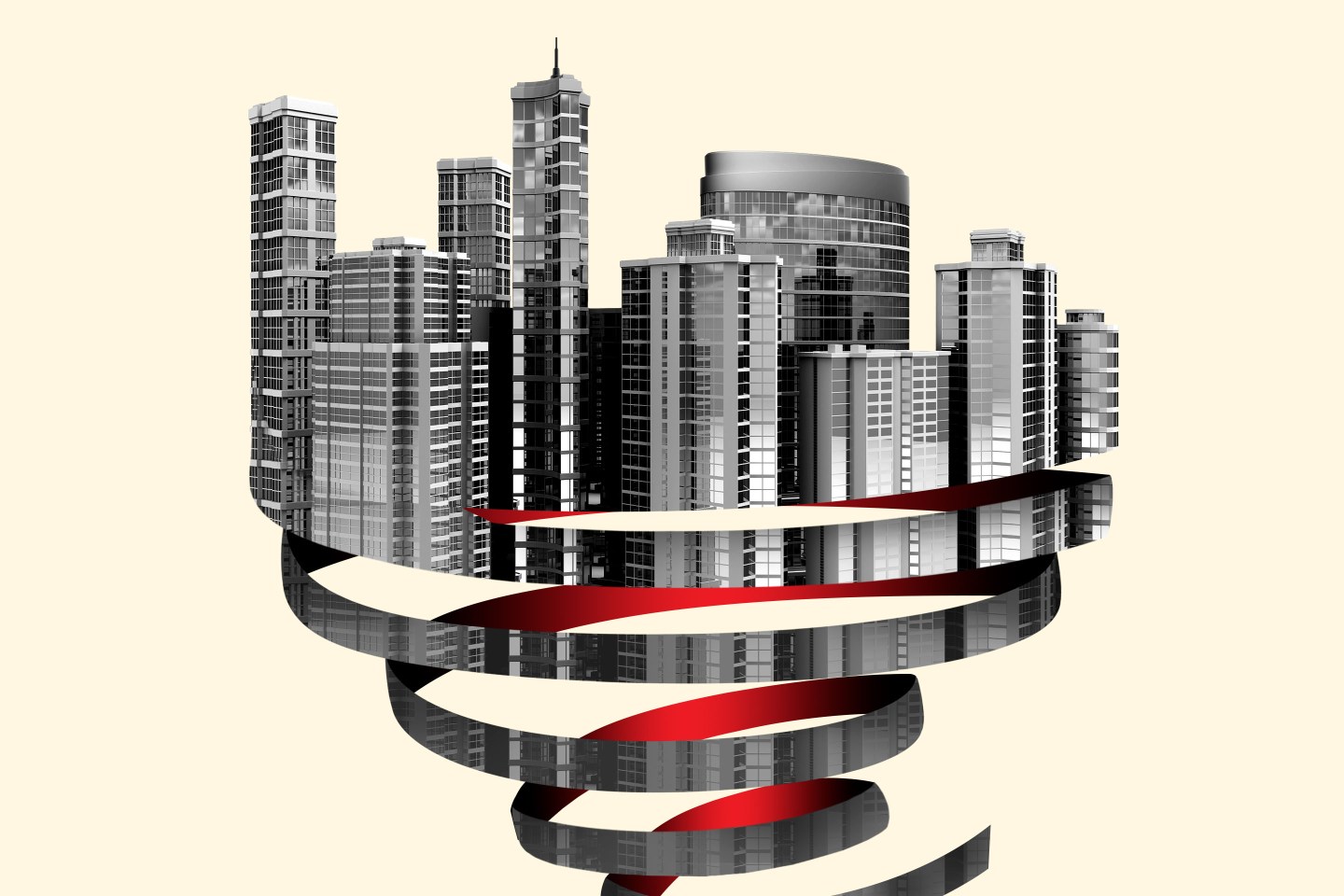
Now, he tells Fortune, he sees an “event horizon” for a 1970s-style downward spiral known in the economics profession as a “doom loop.” And it’s just the first inning.
Everyone knows office buildings across the country have taken a beating from Covid and the rise of remote work. Perhaps only San Francisco is a better example than New York City, where the amount of offices collecting dust is at a record high: almost 20% are sitting empty, hemorrhaging money and shrinking the city’s tax base.
More economists than Van Nieuwerburgh say that the effects could reach far beyond just the real estate sector: Without drastic changes, he says, NYC could be headed for a self-perpetuating “doom loop” that will affect everything from housing values to public services budgets to the crime rate. The most famous example is the 1970s, when “white flight” and a fiscal crisis sent New York into a slump that it didn’t kick for over a decade.
It’s a simple equation, Van Nieuwerburgh said in an interview with Fortune, “Governments cutting spending means less money for transportation, less money for education, for sanitation, for all the things that make cities attractive.”
Van Nieuwerburgh, who joined Columbia in 2018, just a few years after winning an award for his research on shocks in the housing market affecting the macroeconomy, sees the “event horizon” for this doom loop coming soon. As federal grant money runs out and delayed tax effects kick in, he says New York is in the “first inning” of what could spiral into a legitimate urban crisis.
“Over the next three to five years, we’re really going to start seeing this. This cycle is out of control.”
Delayed effects
Remote work has upended the traditional market for urban office space. Studies show that about 30% of paid days are worked from home, a number that trends even higher for more urban sectors such as tech, media and advertising. Commercial property owners are struggling to break even as demand for office spaces has fallen, hurting rents and property values.
The kind of offices that companies want are changing, too. To entice workers back in person, companies are seeking out smaller, newer offices with more amenities and benefits, Fred Cordova, CEO of real estate consultancy Corion Enterprises, told Fortune. That’s putting pressure on the middle-ground (and newly vacant) office buildings that have for years been the backbone of the urban commercial real estate sector. The timing couldn’t be worse.
“A lot of these buildings were purchased after the great financial crisis, in 2013 and 2014. Most of those loans were 10-year loans. So there are almost a trillion dollars of loans coming due,” said Cordova. “There’s no way to refinance … most of them probably can’t pay their debt.”
On top of that, the federal money that poured into the sector to prop it up during Covid is starting to run out, which could usher in a string of defaults. And because of gradualism built into the tax code, comptrollers are just about to start feeling the full effects of the wave of defaults that started a few years ago, said Van Niewerburgh.
That’s what has city budget watchers so worried. Falling commercial property values are already lowering building owners’ tax payments. But struggling commercial owners not being able to pay off their debts—or, potentially, their taxes—could send shockwaves far beyond the real estate sector. New York City generates a little below 10% of its tax revenue from commercial properties, and any meaningful decline to that revenue source would hurt budget expenditures across the board, Van Nieuwerburgh said.
Sending shockwaves
The banking sector, which has high exposure to commercial property, is also under pressure from beleaguered property values. The biggest banks are mostly safe, but much of New York’s commercial property debt is held by smaller regional and local banks that lack the capital to hold on for much longer if vacancies rise and property values continue to fall. Van Neiuwerburgh said that banks own about half of the $6 trillion in commercial real estate debt in the United States—but of that half, 70% is owned by small, regional banks.
“Some of the local banks, the community banks that are overexposed … they’re going to get killed,” said Cordova.
The crux of the “doom loop” theory is that it’s self-perpetuating. If vacancies rise and property values fall, cities can’t collect as much in tax revenue and overexposed banks have to cut back on lending. That means less public spending on things like transit, sanitation and public safety, and less investment in small businesses. A dirtier, more dangerous and less accessible downtown is less likely to attract companies and remote workers, meaning vacancies will rise even more and property values will fall further. Wealthy residents could throw in the towel and move their families (and tax dollars) to low-tax states like Texas or Florida. And thus, the cycle repeats itself.
“The money is now running out, or it has run out. This is the first year where we don’t see extra federal dollars anymore. That’s beginning to bite…[And] the vacancy rate is already at an all-time high,” said Van Nieuwerburgh. “That combination packs a pretty severe punch.”