• Home
  • Latest
  • Fortune 500
  • Finance
  • Tech
  • Leadership
  • Lifestyle
  • Rankings
  • Multimedia
TechChips

The Chip Wars are heating up, with Biden subsidies poised to make an impact after a slow first year

By
Dylan Sloan
Dylan Sloan
Down Arrow Button Icon
By
Dylan Sloan
Dylan Sloan
Down Arrow Button Icon
February 9, 2024, 4:08 PM ET
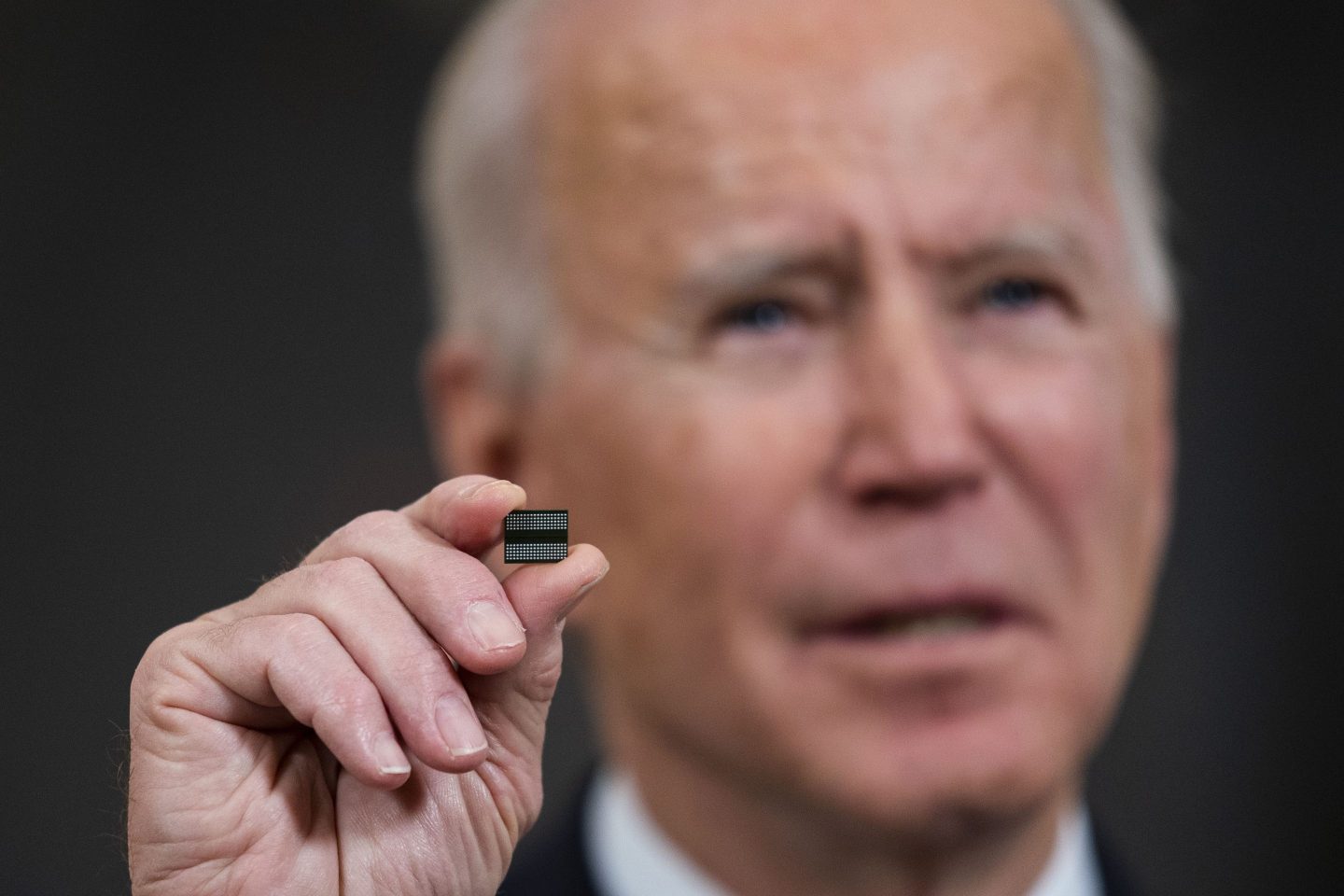
Joe Biden holding a computer chip.
President Biden’s CHIPS Act got off to a slow start.Doug Mills—Getty Images

A year and a half after President Joe Biden signed the $53 billion CHIPS and Science Act into law, the U.S. share of global semiconductor manufacturing has actually decreased, and the government has spent less than half a percent of the money it committed to revitalizing the American microchip industry. 

Recommended Video

But the tide is turning. The Biden administration this morning announced it would direct $5 billion in CHIPS Act money toward a new training facility to boost workforce participation in a semiconductor industry dominated by foreign talent. That’s an indicator of much more to come: After a lengthy review period, the government will start giving out billions more over the coming months, primarily in the form of grants to domestic chip manufacturers such as Intel.

In any case, experts say, it’s too early to ring the alarm bells on what was always designed to be a long-term policy.

“It’s like complaining [during] the eighth month of a pregnancy that nothing has appeared yet,” said Georgetown global innovation policy professor Charles Wessner in an interview with Fortune. Wessner, a senior advisor at theCenter for Strategic and International Studies, called the CHIPS Act “an unprecedented program, both in its focus and its scale … I would venture that they’ve actually made great progress.”

The act aims to reverse a three-decade decline in American semiconductor manufacturing: The United States produced just 12% of the world’s chips in 2020, down from 37% in 1990. East Asian manufacturers such as Taiwan’s TSMC and South Korea’s Samsung have emerged as leaders, with a near-complete duopoly on the advanced microprocessors that power high-consumption tech like virtual reality and artificial intelligence.

The CHIPS Act is the Biden administration’s effort to turn the tide. It committed $53 billion toward subsidizing labor force development, semiconductor R&D, and building chip factories back in August 2022. But as of last month, almost a year and a half later, the government has doled out only about $200 million in grants—0.4% of the money it’s committed. That’s largely the product of a lengthy application process requiring chipmakers to wade through months of red tape in order to secure funds.

Big-name projects have also been pushed back: TSMC announced last month that its $40 billion plant outside Phoenix would delay production a second time, potentially until 2028. And America’s share of the global semiconductor market has continued falling, with no signs of a rebound: from 12% in 2020 to a projected 9.8% in 2024, per a SEMI study.

Still, in one key way, the policy has already earned its worth: The private-sector investment the CHIPS Act has already attracted dwarfs the government’s stake.

“The chip industry is very simple,” said Wessner. “If you want to play, you have to pay—you have to provide incentives. We’re incentivizing small amounts, relatively … The good news is that $50 billion [in federal money] has already attracted $200 billion in commitments from the private sector … The federal money isn’t an incentive, it’s a catalyst. We’re not paying for the whole thing by any stretch.”

The CHIPS Act spawned similar policies worldwide. Japan, South Korea, and the EU all enacted laws promoting domestic semiconductor manufacturing last year. And China is putting a whopping $140 billion behind building its own chips as it bets hard on electric vehicles and AI. 

In China, the impacts are already showing up: Nikkei reported last September that with the help of government aid, over 80% of Chinese semiconductor manufacturers increased their R&D expenses in the first half of 2023. 

“Are we making progress on these? Yes. Would everyone like it to be going faster? Yes,” said Wessner. “When you have a weapons program in the Defense Department, and it doesn’t work, and it costs three times what it’s supposed to cost, we reboot and we keep working on it—because we want the weapon. You have to take the same perspective here.”

The semiconductor world was thrown for a loop yesterday when the Wall Street Journalreported that OpenAI CEO Sam Altman is seeking up to $7 trillion (yes, trillion) in capital to reshape the global semiconductor supply chain and expand computing capacity to meet the demands of AI. Even if Altman secures the money—the UAE’s sovereign wealth fund and Japanese conglomerate SoftBank have been floated as potential investors—he’ll run into the same problem the Biden administration has been dealing with: Building up semiconductor infrastructure takes time.

“There are two things that we usually criticize [the government] for,” said Wessner. “The first is that it’s taking too long. And secondly, that the grants were made too hastily. You can write that [article] in another couple months.”


Join us at the Fortune Workplace Innovation Summit May 19–20, 2026, in Atlanta. The next era of workplace innovation is here—and the old playbook is being rewritten. At this exclusive, high-energy event, the world’s most innovative leaders will convene to explore how AI, humanity, and strategy converge to redefine, again, the future of work. Register now.
About the Author
By Dylan Sloan
See full bioRight Arrow Button Icon

Latest in Tech

Sarandos
Arts & EntertainmentM&A
It’s a sequel, it’s a remake, it’s a reboot: Lawyers grow wistful for old corporate rumbles as Paramount, Netflix fight for Warner
By Nick LichtenbergDecember 13, 2025
3 hours ago
Oracle chairman of the board and chief technology officer Larry Ellison delivers a keynote address during the 2019 Oracle OpenWorld on September 16, 2019 in San Francisco, California.
AIOracle
Oracle’s collapsing stock shows the AI boom is running into two hard limits: physics and debt markets
By Eva RoytburgDecember 13, 2025
4 hours ago
robots
InnovationRobots
‘The question is really just how long it will take’: Over 2,000 gather at Humanoids Summit to meet the robots who may take their jobs someday
By Matt O'Brien and The Associated PressDecember 12, 2025
17 hours ago
Man about to go into police vehicle
CryptoCryptocurrency
Judge tells notorious crypto scammer ‘you have been bitten by the crypto bug’ in handing down 15 year sentence 
By Carlos GarciaDecember 12, 2025
18 hours ago
three men in suits, one gesturing
AIBrainstorm AI
The fastest athletes in the world can botch a baton pass if trust isn’t there—and the same is true of AI, Blackbaud exec says
By Amanda GerutDecember 12, 2025
19 hours ago
Brainstorm AI panel
AIBrainstorm AI
Creative workers won’t be replaced by AI—but their roles will change to become ‘directors’ managing AI agents, executives say
By Beatrice NolanDecember 12, 2025
19 hours ago

Most Popular

placeholder alt text
Economy
Tariffs are taxes and they were used to finance the federal government until the 1913 income tax. A top economist breaks it down
By Kent JonesDecember 12, 2025
1 day ago
placeholder alt text
Success
Apple cofounder Ronald Wayne sold his 10% stake for $800 in 1976—today it’d be worth up to $400 billion
By Preston ForeDecember 12, 2025
23 hours ago
placeholder alt text
Success
40% of Stanford undergrads receive disability accommodations—but it’s become a college-wide phenomenon as Gen Z try to succeed in the current climate
By Preston ForeDecember 12, 2025
22 hours ago
placeholder alt text
Economy
For the first time since Trump’s tariff rollout, import tax revenue has fallen, threatening his lofty plans to slash the $38 trillion national debt
By Sasha RogelbergDecember 12, 2025
18 hours ago
placeholder alt text
Economy
The Fed just ‘Trump-proofed’ itself with a unanimous move to preempt a potential leadership shake-up
By Jason MaDecember 12, 2025
17 hours ago
placeholder alt text
Success
At 18, doctors gave him three hours to live. He played video games from his hospital bed—and now, he’s built a $10 million-a-year video game studio
By Preston ForeDecember 10, 2025
3 days ago
Rankings
  • 100 Best Companies
  • Fortune 500
  • Global 500
  • Fortune 500 Europe
  • Most Powerful Women
  • Future 50
  • World’s Most Admired Companies
  • See All Rankings
Sections
  • Finance
  • Leadership
  • Success
  • Tech
  • Asia
  • Europe
  • Environment
  • Fortune Crypto
  • Health
  • Retail
  • Lifestyle
  • Politics
  • Newsletters
  • Magazine
  • Features
  • Commentary
  • Mpw
  • CEO Initiative
  • Conferences
  • Personal Finance
  • Education
Customer Support
  • Frequently Asked Questions
  • Customer Service Portal
  • Privacy Policy
  • Terms Of Use
  • Single Issues For Purchase
  • International Print
Commercial Services
  • Advertising
  • Fortune Brand Studio
  • Fortune Analytics
  • Fortune Conferences
  • Business Development
About Us
  • About Us
  • Editorial Calendar
  • Press Center
  • Work At Fortune
  • Diversity And Inclusion
  • Terms And Conditions
  • Site Map

© 2025 Fortune Media IP Limited. All Rights Reserved. Use of this site constitutes acceptance of our Terms of Use and Privacy Policy | CA Notice at Collection and Privacy Notice | Do Not Sell/Share My Personal Information
FORTUNE is a trademark of Fortune Media IP Limited, registered in the U.S. and other countries. FORTUNE may receive compensation for some links to products and services on this website. Offers may be subject to change without notice.