Richard Florida knows cities. He’s an urban planner; a professor at the University of Toronto’s Rotman School of Management; a distinguished scholar-in-residence at UT’s School of Cities; and an academic advisor to Boston Consulting Group’s Henderson Institute. He’s perhaps best known for coining “creative class,” a phrase that encompasses roughly 30% of the U.S. workforce and refers to those who create “meaningful new forms.” This was supposed to be the hip, affluent, white-collar demographic that every city planner wanted to attract and build around. That idea didn’t quite materialize, but it still looms large in the sociology and urban design spheres.
Now, Florida has a theory on remote work and what it’s doing to all the superstar cities (and their downtowns) that were supposed to be doomed by all the missing foot traffic. That’s simply shortsighted, he says.
Remember: The pandemic-induced shift to working from home was supposed to bring global cities to their knees, as workers avoided parting with their hard-earned cash for commuting, shop-bought sandwiches, and after-work drinks. “Remote work is costing Manhattan more than $12 billion a year,” Bloomberg warned, just earlier this year.
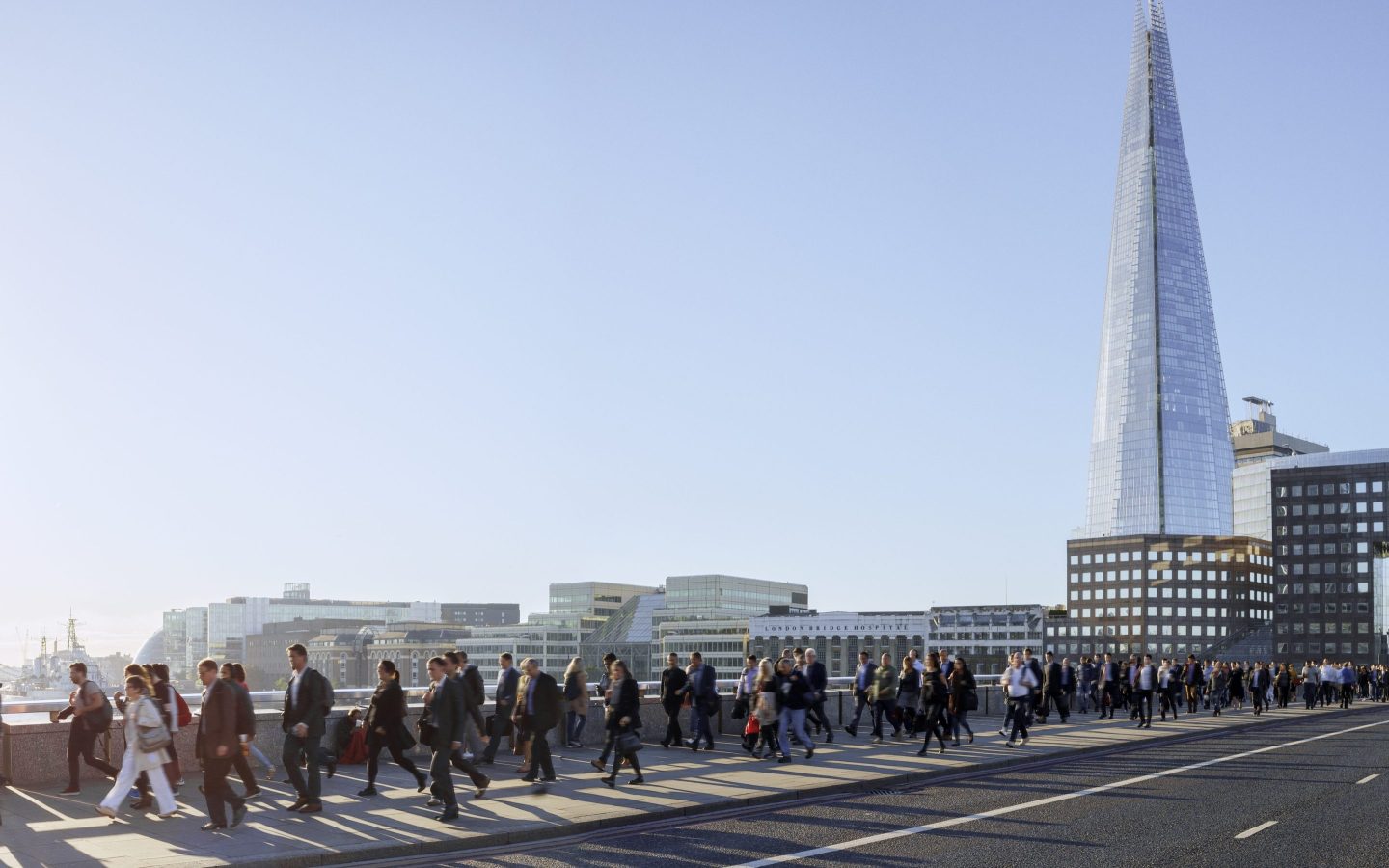
This is “100% wrong,” Florida tells Fortune: London and New York in particular have grown even stronger, becoming the super capitals of the world, what Florida calls “global superstar hubs.” And this is because of remote working—not in spite of it, he says, brandishing fresh research for a piece he coauthored with BCG associates in the Harvard Business Review.
“When you look at the centrality of cities to the global economy, London and New York tend to come out on top,” Florida adds. Almost every neighborhood in those densely populated cities has its own kind of bespoke identity and third space, he says. “There’s one for artists, one for innovators, one for professionals. I think that’s what people want.”
London and New York are also global financial hubs where the vast majority of their countries’ industries and banks are headquartered. As a result, when workers based in those cities spread out or work from far-flung suburbs, New York and London expand, too, without having to grow their physical footprint, Florida explains: “They can take advantage of these digital and virtual connectivities to outside peripheries.”
That’s creating “a new kind of city,” Florida says, explaining that for all of human history, cities were “places where people worked.” This meant they had large labor markets and large concentrations of industries, in finance, insurance, real estate, manufacturing, high-tech. “People lived there, so they could work there.” Technology and remote work changed all this, he says, making cities “no longer places to live and work.” Now, they are all about “connection,” and that means we are witnessing the rise of something new, what Florida calls the “Meta City.”
What’s a Meta City?
Florida and his team’s core argument, as he puts it, is that today’s digital technology has untethered workers from any geographical location or physical clustering. But even that assertion is “massively oversimplified.” Florida’s team includes Vladislav Boutenko and Antoine Vetrano, leaders in BCG’s travel, cities, and infrastructure practice, and research assistant Sara Saloo.
Rather than a spreading or hollowing out of major urban areas, a new kind of city—the Meta City—has risen, and it combines the best of physical clustering with the best of digital connectivity.
“We can now be connected anywhere we are, but that doesn’t mean what I think many pundits and experts think,” Florida tells Fortune. “The places that are central to the economy, that aggregate the most talent, that have the most headquarters, that have the biggest and most important centers for connections, are still places like New York and London.” These are still amazing places to connect, whereas he says the ones that remain insular, singling out Hong Kong, in particular, will be left behind.
Meta Cities aren’t meant to compete with the New Yorks and Londons of the world. Rather, they’re a modern equivalent of what used to be called a “satellite city.” As Florida and his team explained in the Harvard Business Review, Meta Cities are really “a web of cities that operate as a distinct unit and are attached to a major—often global—economic hub.”
Residents of Meta Cities are people who, during the pandemic, moved to more affordable areas, while still working for a company based in a large city and likely still commanding their big-city salary. Some prime examples, Florida said, are Austin—who rose thanks to its status as “a satellite of San Francisco’s long-established tech hub”—and Miami, which is “enmeshed in New York City’s finance and real estate complex.” (Earlier this year, Florida referred to Miami as “the sixth borough” on account of the city’s high volume of New York–based workers.)
Meta Cities, by definition, are less permanent than “superstar” cities, and Florida expects them to “come and go” as new areas become popular. (While Meta Cities “become hot,” he adds, they can also lose their appeal or quickly become too expensive because of their “smaller size, smaller housing inventory, less extensive transportation infrastructure, or less developed schools and educational systems.”) It seems as if this has already happened to Austin, which saw the greatest new resident influx of any U.S. city from 2020 to 2021. The mass migration led Axios to dub Austin “a sleepy capital/university town [turned] booming tech-company magnet.” But in 2022, it lost its luster and became the only Texas city to actually lose residents.
But regardless of which cities are having their moment, one thing is clear: Meta Cities—and superstar cities, for that matter—will rely on the continued prominence of remote work to maintain their status.
That shouldn’t be a long shot. Since Florida began his research on preferred working arrangements in 2000, responses have been remarkably consistent. “They say, ‘I want to work on great projects with great people in great spaces and great places—but those spaces don’t mean a conventional cubicle farm office,’” he said.
RTO mandates ‘aren’t gonna work’
Some 1 million workers in the U.S. alone returned to their cubicles this fall, with Meta and Amazon leading the September back-to-work drive. But the big push to get workers back to their desks is not only detrimental to cities that want to keep their superstar status, it’s also a pretty pointless pursuit for employers.
“The last relic of the industrial age are the office tower districts which are like factories for knowledge work,” Florida insists, adding that office use was already in decline before the pandemic dealt the traditional workspace a final deadly blow.
“Knowledge workers are different from factory workers; they’re not intrinsically motivated … so you have to figure out a way that attracts them, retains them, and motivates them,” he adds. “The idea that you can package knowledge workers in these vertical towers and keep forcing them to work—that’s over.”
For employers who keep insisting otherwise, Florida has three words of warning: “People will leave.” After all, there are plenty of remote roles around the world to choose from that the laptop class can dial into from their living rooms.
“The companies that will be most successful are the ones that enable talent to do their job from where they are,” he says. “And that doesn’t mean giving up a physical platform.”
That’s because where they are isn’t necessarily at home. Often workers are setting up camp at restaurants, cafés, or bars, Florida’s research has found. “They hate commuting to a giant cubicle farm in an office tower [from] nine to five, sitting there, not knowing what they’re supposed to do.”
While offices in their current form may become less relevant in the future, Florida predicts that these “third spaces”—where workers neither live or work, but choose to go to connect with others—will rise to increased prominence. That’s why offices will still need a physical presence in big cities like London and New York. Ultimately, workers still want to go somewhere central to connect, albeit in a swanky bar rather than an overly air-conditioned conference room.
“Great spaces and great places aren’t necessarily a cubicle farm in an office building downtown,” Florida adds. “It’s all about encouraging managers to think in a new way about their spatial strategy—their allocation of workspaces for people, and that isn’t just, ‘Okay, we have an office with a desk here with your name on it.’”
In other words, employers: The world is your oyster. Think of the Meta City as your new giant workspace, where any downtown restaurant can be used as a meeting room. The big challenge for bosses now will be ensuring that their workers are productive in all spaces—not in any one.