First-class recreation centers in low-income neighborhoods — dozens of them, scattered around the nation. That was the vision of Joan Kroc, billionaire philanthropist and heiress to the McDonald’s fortune of her husband, Ray.
When she died in 2003, Joan Kroc stunned the Salvation Army when she left what amounted to $1.8 billion — roughly half her fortune —with instructions to carry out her wish for the centers. In today’s dollars, that is $2.9 billion.
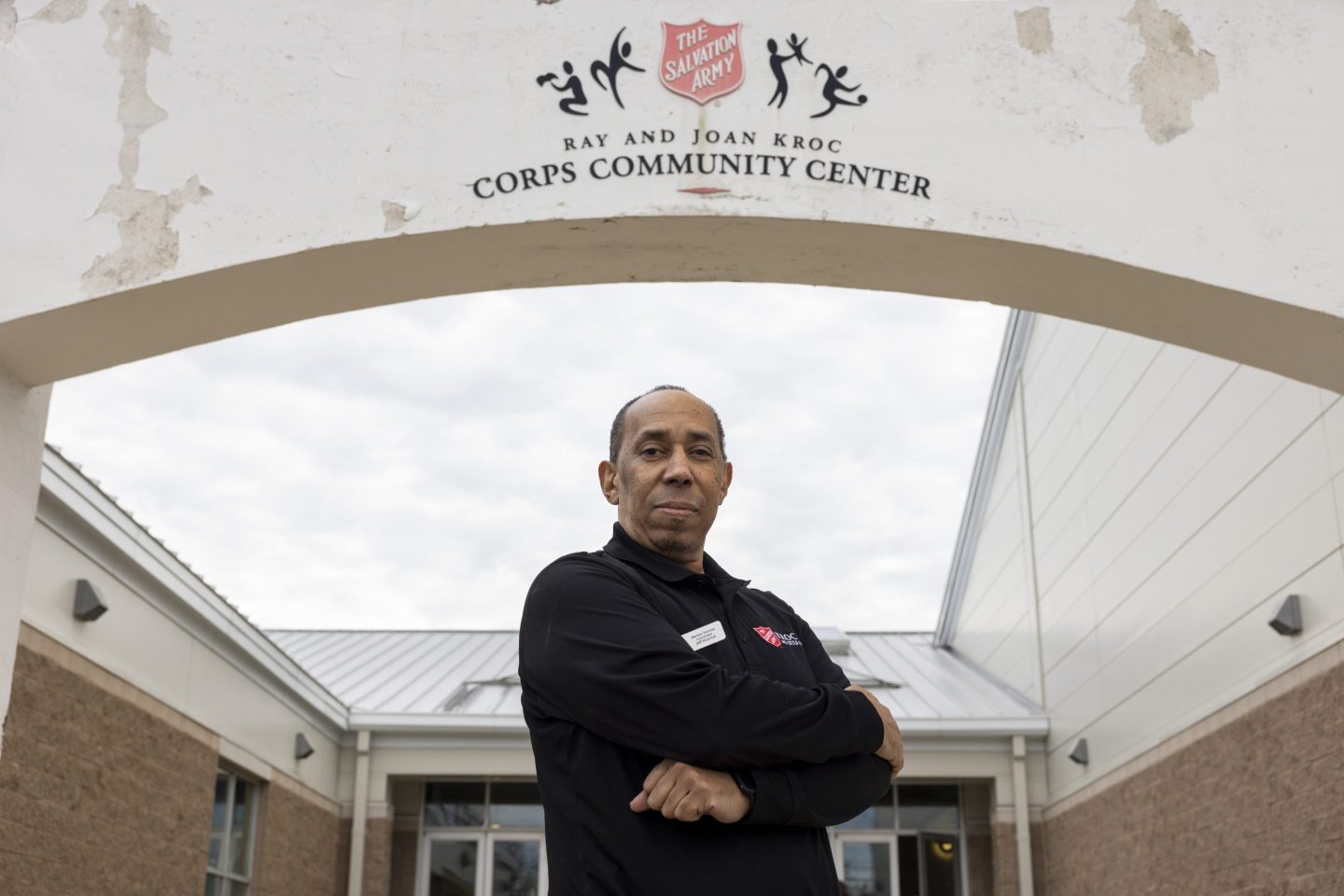
And today, 20 years later, 26 grand, state-of-the-art Kroc centers have opened in places as varied as Ashland, Ohio; Guayama, Puerto Rico; and Quincy, Illinois. Salvation Army officials say 1.2 million people belong to Kroc fitness centers, and over 3 million people annually are served through a wide variety of other programs, including job training, theatrical performances, and afterschool care.
The Phoenix Kroc Center hosts a financial literacy course and filmmaking workshop. In Boston, a culinary arts program provides job training. Several nonprofits keep offices at the Kroc facility in Augusta, Georgia. In San Francisco, the center is attached to housing for veterans and for young people who have aged out of foster care.
The path to this point has not been easy for an organization whose hallmark is frugality — one accustomed to raising much of its money in small gifts from everyday donors. The Salvation Army didn’t solicit the Kroc windfall, and it certainly hadn’t planned to open and maintain dozens of lavish, world-class recreation facilities.
Kroc’s will specified that the group was to divide the money equally among its four U.S. territories. Half was to be earmarked for the construction of recreation centers, with the other half deposited into endowments to support them. None of the bequest was to be used for existing programs, nor was the Army to convert existing buildings.
The centers were to serve as “campuses of opportunity” where “no child should ever feel envy toward contemporaries who came from higher economic and social backgrounds,” according to a document from Kroc’s lawyer. Beyond that, the heiress’s instructions were remarkably vague.
In recent years, Joan Kroc’s wide-ranging philanthropy has been eclipsed by the headline-grabbing donations of MacKenzie Scott, a woman dispensing a fortune amassed thanks to fast delivery as opposed to fast food. But long before Scott’s benevolence, Kroc developed her own deeply personal and unorthodox brand of giving.
An early and innovative leader in alcoholism education and treatment, she funded the creation of a groundbreaking medical school curriculum in the 1970s to teach doctors-in-training to diagnosis addiction. To advocate for nuclear disarmament in the 1980s, she purchased newspaper ads nationally, urging concerned citizens to take action. At the same time, she quietly supported early efforts to combat the emerging AIDS crisis.
In the late ’90s, after touring poor neighborhoods in the Southern California area she’d called home since Ray’s purchase of baseball’s San Diego Padres decades earlier, Kroc planted the seeds of what would become her ultimate gift.
Witnessing kids aimlessly milling about on city streets sparked the idea of a safe gathering place. Kroc herself had grown up poor in St. Paul, Minnesota, and, as a young wife and mother, supported her daughter and first husband with her masterful piano playing.
Impressed by what she understood to be the Salvation Army’s “efficient” capacity to “wring the most out of a nickel,” she called for a meeting with San Diego area Army officials and requested a proposal for a recreation center to be situated in a poor neighborhood.
Presented with modest plans, Kroc pushed back, insisting on a “showpiece of exceptional quality.”
By the time the grand 195,000-square-foot facility in five San Diego buildings opened to the public in 2002, it featured a National Hockey League-regulation ice rink, three pools, sports fields, a library, a climbing wall, and a 540-seat theater. The price tag to construct and endow operations at the center: $93 million.
Not long after, Kroc, then 74, was diagnosed with a terminal brain tumor, and she and her small staff of advisers revved into action to prepare her final wishes.
Faced with about $3 billion in assets, she compiled a list of recipients of unrestricted gifts, including the peace centers she’d created at Catholic universities Notre Dame and the University of San Diego ($50 million each); Ronald McDonald House Charities ($60 million), and National Public Radio ($225 million).
In the two decades since Kroc’s bequest, quantifying the precise impact on all of the communities served by the Kroc centers is difficult. Because the Salvation Army is a church, it does not have to report its finances, and the precise operating budgets of the centers are not public, nor is their financial health.
Still, a 2015 study commissioned by national headquarters calculated that the centers radiated a nationwide economic “halo effect” of nearly $270 million — including the impact of the initial construction, ongoing maintenance, creation of jobs, and the health and fitness benefits to the population.
And the $900 million Kroc required the Salvation Army to tuck away into endowments to support the centers has ballooned to nearly the size of the original gift, $1.5 billion.
While the Kroc centers have succeeded in carrying out what Kroc had intended, some philanthropy experts say MacKenzie Scott’s approach of making unrestricted gifts is far wiser than Kroc’s declaration of what the Salvation Army should do – especially since the charity wasn’t asked anything about its interest in creating centers nationwide.
Phil Buchanan, president of the Center for Effective Philanthropy, received $10 million from Scott and last year issued a study on how Scott’s donations had impacted a wide swath of nonprofits.
“If you really want to make a difference, you’re better off allowing (recipients) to deploy the resources, rather than saying from on high in donor-land, ‘I want you to do this particular thing,’” he said. “There’s often a sort of ego and legacy component to giving that’s not always consistent with having the most impact.”
While many nonprofit executives would agree, people who work at the Kroc centers see things a little differently.
Angelia Grandberry grew up in the projects across the street from the Gulf Coast Kroc Center in Biloxi, Mississippi, back when drug dealers loitered on the corner and kids hung around smoking weed and drinking beer for lack of a better place to go.
Now, decades later, she runs the day care and camp programs at the center, where she relishes the opportunity to hire local teens to help her. She proudly wears her Kroc shirt around the community.
The center has provided a safe space, she said, where piano and guitar lessons are offered, family bingo nights are held, and children can play safely as they wait for their parents after school. Some of the locals were initially intimidated by the opulence of the place, Grandberry said, and thought it meant they wouldn’t be welcome. She explained that Joan Kroc meant for the place to be accessible to all — that beauty was part of her plan.
“What she wanted was for kids from low-income families to be able to come here,” she said. “In my view, her dream is coming true.”
_____
This article was provided to The Associated Press by the Chronicle of Philanthropy. Lisa Napoli is the author of four books, including “Ray & Joan: The Man Who Made the McDonald’s Fortune & the Woman Who Gave It All Away.” The AP and the Chronicle receive support from the Lilly Endowment for coverage of philanthropy and nonprofits and are solely responsible for this content.