• Home
  • News
  • Fortune 500
  • Tech
  • Finance
  • Leadership
  • Lifestyle
  • Rankings
  • Multimedia
FinanceHousing

San Francisco could get 90% of its homeless off the streets with the country’s fiercest housing speculation tax, but landlords are already fighting it tooth and nail

Irina Ivanova
By
Irina Ivanova
Irina Ivanova
Deputy US News Editor
Down Arrow Button Icon
Irina Ivanova
By
Irina Ivanova
Irina Ivanova
Deputy US News Editor
Down Arrow Button Icon
October 21, 2023, 5:00 AM ET
San Francisco
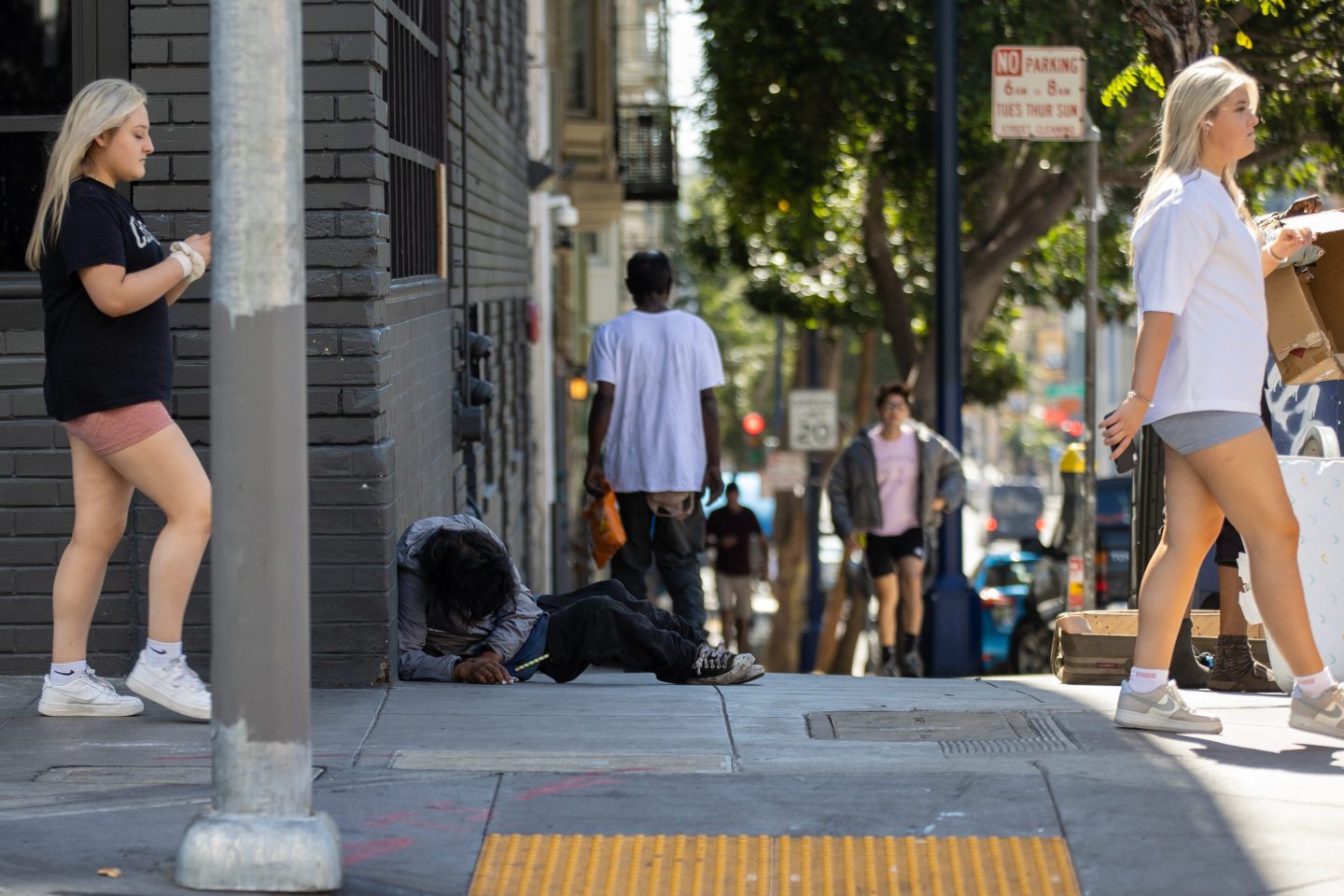
Homeless people seen in the Tenderloin district of San Francisco in California, United States on September 24, 2022.Tayfun Coskun/Anadolu Agency via Getty Images

Most cities have homeless problems and lots of vacant housing units, but everything is magnified in San Francisco. Last year, there were 7,700 people living in shelters or on the street in the city by the bay, according to city figures. Meanwhile, there were more than 60,000 vacant units at the end of 2021, according to a policy analysis from last fall, although that figure included newly built apartments and those awaiting sale. Enter the vacant home tax.

Recommended Video

This week, San Francisco formalized a voter-approved law, also known as Proposition M, to crack down on owners of multifamily units that let them sit vacant. The law, which goes into effect in January, could push as many as 7,000 units on the market, according to city estimates—that would be literally 90% of the city’s homeless getting housed, based on the above data. Problem solved?

This could be a big deal for a city of less than a million that has become the face of modern fears of a 1970s-style “doom loop” given its endemic homelessness, ever-present cost-of-living crisis, and famously dysfunctional housing market. But real-estate interests are already fighting the law in state court, claiming their right to not rent their property is enshrined in the Constitution. 

“The primary purpose of the law is to fill empty homes,” supervisor Dean Preston, the law’s chief backer, told Fortune Friday. “Holding housing off the market for a long time, when there are people who need housing, is bad for our city,” he said. “Our hope is that [the tax] is enough to change the decision making of the real-estate speculator or the owner of the property.”

Sometimes, developers have a strategy of buying buildings, removing longtime tenants, and then reselling at a profit, Preston said. More recently, some new constructions have failed to sell units amid a market slump, creating “zombie buildings,” the San Francisco Chroniclereported last month. 

“We have a situation where we have thousands of people living on the streets homeless, and tens of thousands of units being held off the market,” Preston told Fortune. “We have buildings in my district that have been empty for years.”

The strongest vacancy tax in the U.S.

The tax, which is rather narrow, would apply to between 4,400 and 7,300 units, according to an estimate from the city’s budget analyst. Also known as Proposition M, it exempts single-family homes, duplexes, short-term rentals, nonprofit and institutional housing, such as nursing homes, as well as any apartment used as a primary residence. It also allows for additional time for new buildings awaiting an occupancy certificate or that are rendered uninhabitable by natural disasters. 

While a handful of cities, including neighboring Oakland, Washington, D.C., and Vancouver, have passed some form of vacancy taxes, Preston believes San Francisco’s is the most aggressive in the country. And several groups representing landlords, including the San Francisco Apartment Association, Small Property Owners of San Francisco Institute and the San Francisco Association of Realtors sued the city in February, claiming the law violated their constitutional rights. 

“The United States Supreme Court has repeatedly held that property-owners’ power to exclude [others from the property] has traditionally been considered one of the most treasured strands in an owner’s bundle of property rights,” the lawsuit argues, quoting from a 1982 decision. San Francisco’s property owners are already overburdened with “legal, administrative, practical and economic impediments to renting,” the suit claims, naming rent-control laws, property registration requirements, and the difficulty in evicting tenants. 

In other cases, apartments may sit empty because of high crime or few jobs in the area, but their owners may be loath to drop their asking rent for fear that rent control laws wouldn’t let them raise it in the future, the suit says. Still others may wish to keep a condo to live in a few months out of the year, or live alone in a four-unit building because they don’t want to deal with the hassle of renting to tenants, the suit says, naming situations that apply to two of the plaintiffs.

Under the vacancy tax, owners would be on the hook for $2,500 to $5,000 per empty unit, depending on its size—an amount that increases every year it’s left unoccupied. An empty building of 10 mid-sized apartments (1,000 to 2,000 square feet) would incur a tax of $140,000 by its third year, and the amount would then be indexed to the federal Consumer Price Index.

The tax is directed to fund affordable-housing programs, Preston said, but added that “raising money is not the primary purpose of this measure.” 

“If 10,000 units get filled in the next few years, we’ll be happy even if there’s little to no tax revenue,” he said.
Fortune Brainstorm AI returns to San Francisco Dec. 8–9 to convene the smartest people we know—technologists, entrepreneurs, Fortune Global 500 executives, investors, policymakers, and the brilliant minds in between—to explore and interrogate the most pressing questions about AI at another pivotal moment. Register here.
About the Author
Irina Ivanova
By Irina IvanovaDeputy US News Editor

Irina Ivanova is the former deputy U.S. news editor at Fortune.


See full bioRight Arrow Button Icon

Latest in Finance

picture of two bitcoins
CryptoBitcoin
Bitcoin bounces back more than 10% after brutal week
By Carlos GarciaDecember 3, 2025
1 hour ago
Rich woman lounging on boat
SuccessWealth
The wealthy 1% are turning to new status symbols that can’t be bought—and it’s hurting Dior, Versace, and Burberry
By Emma BurleighDecember 3, 2025
1 hour ago
Greg Abbott and Sundar Pichai sit next to each other at a red table.
AITech Bubble
Bank of America predicts an ‘air pocket,’ not an AI bubble, fueled by mountains of debt piling up from the data center rush
By Sasha RogelbergDecember 3, 2025
2 hours ago
Dell
Personal FinanceWhite House
Why the government is really going to give your baby $1,000, collecting interest until they turn 18
By Moriah Balingit and The Associated PressDecember 3, 2025
4 hours ago
Bessent
BankingFederal Reserve
‘We’re going to veto them’: Bessent backs new rules to give White House more power over Federal Reserve
By Christopher Rugaber and The Associated PressDecember 3, 2025
4 hours ago
Bessent
Economyphilanthropy
Scott Bessent calls the Giving Pledge well-intentioned but ‘very amorphous,’ growing from ‘a panic among the billionaire class’
By Nick LichtenbergDecember 3, 2025
4 hours ago

Most Popular

placeholder alt text
North America
Jeff Bezos and Lauren Sánchez Bezos commit $102.5 million to organizations combating homelessness across the U.S.: ‘This is just the beginning’
By Sydney LakeDecember 2, 2025
1 day ago
placeholder alt text
Economy
Ford workers told their CEO 'none of the young people want to work here.' So Jim Farley took a page out of the founder's playbook
By Sasha RogelbergNovember 28, 2025
5 days ago
placeholder alt text
North America
Anonymous $50 million donation helps cover the next 50 years of tuition for medical lab science students at University of Washington
By The Associated PressDecember 2, 2025
1 day ago
placeholder alt text
C-Suite
MacKenzie Scott's $19 billion donations have turned philanthropy on its head—why her style of giving actually works
By Sydney LakeDecember 2, 2025
1 day ago
placeholder alt text
Success
Warren Buffett used to give his family $10,000 each at Christmas—but when he saw how fast they were spending it, he started buying them shares instead
By Eleanor PringleDecember 2, 2025
1 day ago
placeholder alt text
Economy
Elon Musk says he warned Trump against tariffs, which U.S. manufacturers blame for a turn to more offshoring and diminishing American factory jobs
By Sasha RogelbergDecember 2, 2025
1 day ago
Rankings
  • 100 Best Companies
  • Fortune 500
  • Global 500
  • Fortune 500 Europe
  • Most Powerful Women
  • Future 50
  • World’s Most Admired Companies
  • See All Rankings
Sections
  • Finance
  • Leadership
  • Success
  • Tech
  • Asia
  • Europe
  • Environment
  • Fortune Crypto
  • Health
  • Retail
  • Lifestyle
  • Politics
  • Newsletters
  • Magazine
  • Features
  • Commentary
  • Mpw
  • CEO Initiative
  • Conferences
  • Personal Finance
  • Education
Customer Support
  • Frequently Asked Questions
  • Customer Service Portal
  • Privacy Policy
  • Terms Of Use
  • Single Issues For Purchase
  • International Print
Commercial Services
  • Advertising
  • Fortune Brand Studio
  • Fortune Analytics
  • Fortune Conferences
  • Business Development
About Us
  • About Us
  • Editorial Calendar
  • Press Center
  • Work At Fortune
  • Diversity And Inclusion
  • Terms And Conditions
  • Site Map

© 2025 Fortune Media IP Limited. All Rights Reserved. Use of this site constitutes acceptance of our Terms of Use and Privacy Policy | CA Notice at Collection and Privacy Notice | Do Not Sell/Share My Personal Information
FORTUNE is a trademark of Fortune Media IP Limited, registered in the U.S. and other countries. FORTUNE may receive compensation for some links to products and services on this website. Offers may be subject to change without notice.