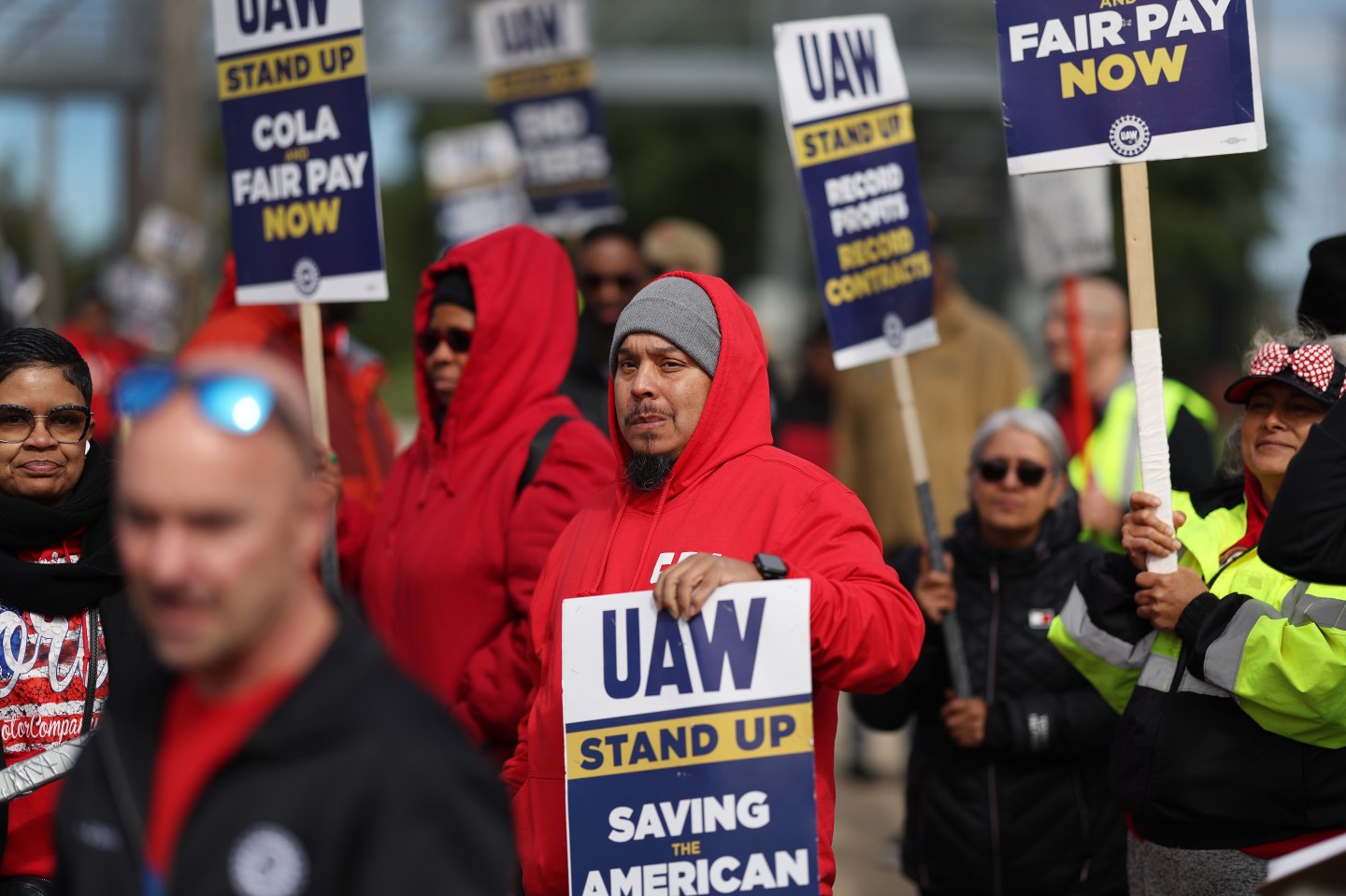
From auto production lines to Hollywood, the power of labor unions is back in the national spotlight.
But despite historic strikes and record contract negotiations this year, there’s a lot stacked against labor organizers today. Union membership rates have been falling for decades due to changes in the U.S. economy, employer opposition, growing political partisanship and legal challenges.
“Even though we’re seeing stronger support for unions, (with) the highest popularity of union favorability in polls since at least 1960s, translating the worker desire for representation into actual representation is really hard under our current system,” Alexander Colvin, dean of Cornell University’s School of Industrial and Labor Relations, told The Associated Press.
WHAT’S DRIVING UNION ACTIVITY NOW?
At least 457,000 workers have participated in 315 strikes in the U.S. just this year, according to Johnnie Kallas, a Ph.D. candidate and the project director of Cornell University’s Labor Action Tracker.
The strikes have led to more than 7.4 million days of missed work in 2023, S&P Global Market Intelligence said, the highest level in almost a quarter century.
Labor activism is reaching a boiling point amid soaring costs of living and rising inequality, particularly the growing pay gap between workers and top executives. Those inequities only became more glaring during the COVID-19 pandemic as U.S. corporations raked in record profits.
“It’s kind of a perfect storm, (so) you see a lot of union movement these days,” said Eunice Han, an assistant professor at the University of Utah specializing in labor economics.
The tightest U.S. labor market in decades is adding to leverage workers feel they have to challenge their employers.
The unemployment rate in the U.S. is close to 50-year lows and there are now about 1.5 open jobs for every unemployed person, according to recent government data.
In August, American employers posted a shocking 9.6 million job openings, far exceeding the expectations of economists in and out of the U.S. Federal Reserve, which as been attempting to cool the labor market with a string of interest rate hikes.
Open jobs means American workers are quitting in higher numbers because they are confident of landing a better paying job.
The unemployment rate in September and August was 3.8%, further signaling leverage for workers.
UNION RATES HAVE BEEN FALLING FOR DECADES. WHY?
While pickets lines seem to be everywhere, union membership rates have been declining for decades. Only 6% of private U.S. sector workers belong to unions today, a sliver of the 35% that were union members in 1953.
Todd Vachon, an assistant professor in the Rutgers School of Management and Labor Relations, points to the post-World War II Taft-Hartley Act, which restricted the power of labor unions — as well as factors like relocating manufacturing jobs overseas and an uptick in anti-union stances from both employers and lawmakers that grew in the 70s and 80s.
Vachon notes one pivotal moment in particular, when President Ronald Reagan fired all striking air traffic controllers in 1981.
“That sent a really clear signal to the business community that it’s a-okay to be completely anti-union and to be so in a very belligerent way, because even the president of the United States is doing it,” he said.
Separately, with the rise of the gig economy, some large companies have recategorized employees as “contractors,” making it harder for them to unionize. And growth in sectors that haven’t had a strong history of union membership, such as technology, has also contributed to the decline in unionization.
Last year, the number of both public and private sector workers belonging to unions actually grew by 273,000, according to data from the Bureau of Labor Statistics. But the U.S. workforce grew at an even faster rate, meaning the percentage of those belonging to unions fell slightly.
WHAT LABOR LAWS IMPACT UNIONS TODAY?
The National Labor Relations Act of 1935 granted private sector employees the right to unionize, but legal backing for public workers came decades later and even that varies by state.
A 1961 executive order from President John F. Kennedy allowed federal employees to organize. That came around the same era that states also began to pass labor laws for their own public workers.
Generally, states in the Northeast, upper Midwest and West Coast adopted more expansive collective bargaining laws — reaching all different categories of public employees, Vachon explains.
Some states in the South and lower Midwest “will allow police and firefighters to collectively bargain, but not state employees. Or they’ll let state employees bargain, but they can only bargain over wages,” Vachon said. “That shows you how important the labor law is. It really sets the framework for which workers can either organize a union successfully or not.”
A handful of states also have “right to work” laws which, in unionized workplaces, require unions to represent everyone regardless of whether individuals choose to pay dues or formally join. Such legislation has been criticized for undermining the financial resources and bargaining power of unions.
Attitudes towards unionization have become increasingly partisan, too, and also divided geographically. Politically “blue” states tend to have higher unionization rates than “red” states. Several states have also dialed back on union protections in recent years, Han said.
MORE CHALLENGES ORGANIZING TODAY
Unionization efforts have expanded but many are taking place where there is little history of organized labor, creating a higher bar for workers.
Colvin points to Starbucks workers who have seen union drives clipped in the last year. Starbucks has been accused of chilling organization by closing unionized stores and firing pro-union workers. There are limits for organizers under current labor law.
“We have a labor law that was designed in the era in the 30s and 40s, when auto plants of 10,000 workers (were organizing),” he said. Starbucks is “split into these small coffee shops of 15 workers… They need to join together to have any kind of bargaining power against a big employer. But our labor law isn’t structured to help them do that,” Colvin said.
Service jobs can be hard to organize due to part-time work and high turnover rates. The same can be said for Amazon warehouses, where there have been pushes for unions.
Still, more workers in numerous industries have begun organizing in recent years. And, particularly with high-profile strikes and contract negotiations seen this summer, there is a reinvigorated spotlight on labor.
According to Gallup public approval of stronger unions stood stood at 67%, down slightly from the 71% approval seen last year, but mirroring levels last seen in the 1960s.
But the desire to organize can only go so far without policy change, experts say.
“We’re absolutely at a turning point in people’s consciousness,” Vachon adds. “Whether that translates into actual a change of direction for union density, I think, is going to depend a lot on how that consciousness plays out in the political arena.”