When Sen. Chuck Schumer quietly relaxed the U.S. Senate’s dress code, supposedly to accommodate Sen. John Fetterman’s desire to wear hooded sweatshirts and gym shorts, the backlash was swift.
Apparently, it was enough to compel senators to unanimously pass a resolution on Sept. 28, 2023, mandating a coat, tie and slacks for men on the Senate floor.
As a fashion historian, I’ve heard this tune before. It’s the same one sung by college administrators in the late 1950s when women wanted to wear pants to the campus cafeteria. And I could hear the chorus of befuddled office managers who wanted to ban polo shirts in the early 1990s, just as Casual Fridays revolutionized what people wear to work.
The people living through these changes often consider them devolution rather than evolution. An old guard steps forward to protect the sartorial standards of a previous time by using terms such as “respect” and “tradition.” They might be able to staunch the shift, as the Senate seems to have done. But time and again, their efforts to regulate attire ultimately end up failing.
‘Brainless’ students bare their legs
Shorts, in particular, have a history of eliciting ire.
The Shorts Protest of 1930 brought more than 600 students to the hallowed steps of Robinson Hall at then-all-male Dartmouth College to defy the much-hated dress codes outlawing exercise clothing in campus buildings.
The editors of the student newspaper had challenged readers to “bring forth your treasured possession – be it tailored to fit or old flannels delegged” so that the men could “lounge forth to the supreme pleasure of complete leg freedom.” The students came in old basketball uniforms, tweed walking shorts and newly minted cutoffs.
It was bigger than campus rules. It was about freedom and self-expression. The Associated Press picked up the story and took it national. Student papers at Princeton and Harvard covered it, too, and Fox Movietone News showed up to record the day’s events.
The blowback from the old guard was instant and vitriolic. A “Prominent Boston Clothier” sat down and wrote a letter to the university to declare the “average American student” to be “the most brainless of any student in the world” and “Having no brains to make them famous, they must use their legs.”
Regulating women’s bodies
Women also decided to get into the shorts game. Beginning in the late 1920s, shorts worn by women in public spaces were the subject of intense debate for more than 30 years.
Social critics, boyfriends and fashion writers tried to put parameters on “when” and “where” the garment could be worn. Shorts were banned from church services but not from informal social activities. You couldn’t wear them to dinner at the cafeteria, but they were OK for lunch. And some country clubs in the 1930s made women wear trenchcoats to the tennis court in order to cover their shorts.
Time moved on, and men and women continued to simply … wear shorts. In 1955, Esquire confirmed for readers, “You can now wear shorts for sports and informal business anywhere the weather’s hot, and no one is going to bat an eye.”
Pants pushback
For decades, written or unwritten dress rules also forbade women from wearing pants to formal settings.
University deans, schoolmarms and human resources managers penned dress codes outright forbidding the garment or relegating it to certain areas. Etiquette writers explained that slacks “insulted the aesthetic sense of men” and were appropriate in only one setting: when “you’re roughing it.”
Nonetheless, women continued to wear pants in many varieties.
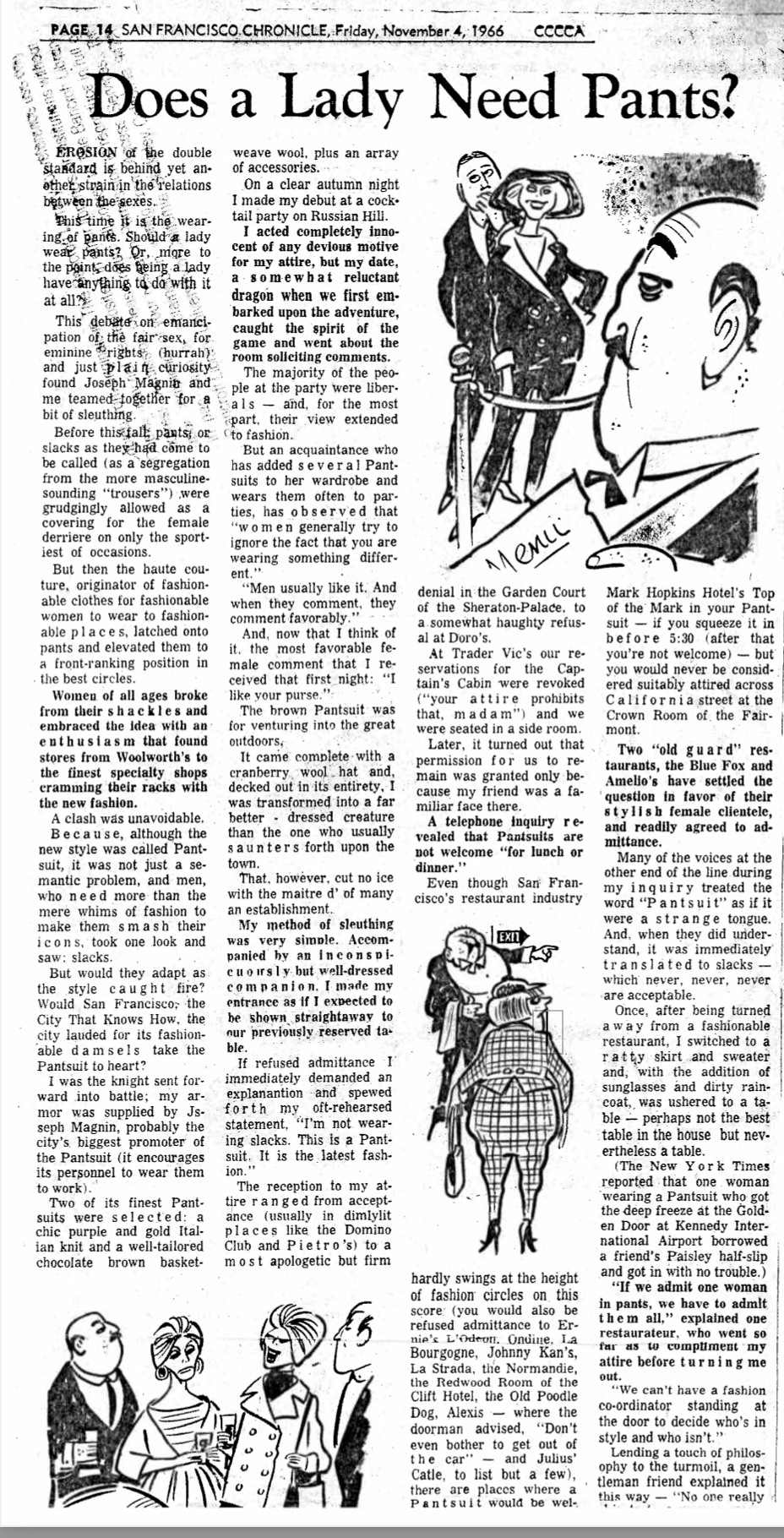
In November 1970, a reporter for the San Francisco Chronicle researched an article on maitre d’s at fancy restaurants refusing to seat women in pantsuits. At one establishment, the host explained to her, “If we admit one woman in pants, we have to admit them all.” Others cited “propriety” and “decorum” as reasons to deny entrance.
The criticisms surrounding Schumer’s decision sound a lot like the complaints against female politicians wearing pants. In 1993, Sens. Carol Moseley-Braun and Barbara Mikulski wore their pantsuits to the Senate floor.
Rather than remove the women, Martha Pope, the first female sergeant-at-arms, amended the written dress rules to specify pantsuits as appropriate business attire.
Independence and individuality
As sartorial standards change, what people wear in public becomes ground zero for hashing out new ideas of race, class and gender. Most often, wealthy white men are the arbiters of “appropriate” and “inappropriate.”
For more than a century, fashion has dramatically moved away from being a top-down regulatory process to being a means of individual expression. At a celebratory fashion show for the country’s bicentennial in 1976, former Miss America Bess Myerson told the audience, “Our clothing and our lifestyle have reflected each other, reinforcing our independence and individuality.”
She proclaimed that in 20th-century America, fashions were not “uniforms of rank or class, as they were in many old lands from which our people fled.”
Whether written down or just implicit, dress codes have meaning only when they are enforced. To me, the idea of policing the dress of adult professionals is simply outdated.
When John Fetterman wears gym shorts in public, I see him tapping into his personal identity and his political brand. Despite the buttoned-up outrage and jokes from Susan Collins about wearing a bikini on the Senate floor, fashion is born of culture, and culture is dynamic.
And cultural forces are almost impossible to beat back.
Deirdre Clemente is Associate Professor of History, University of Nevada, Las Vegas.
This article is republished from The Conversation under a Creative Commons license. Read the original article.