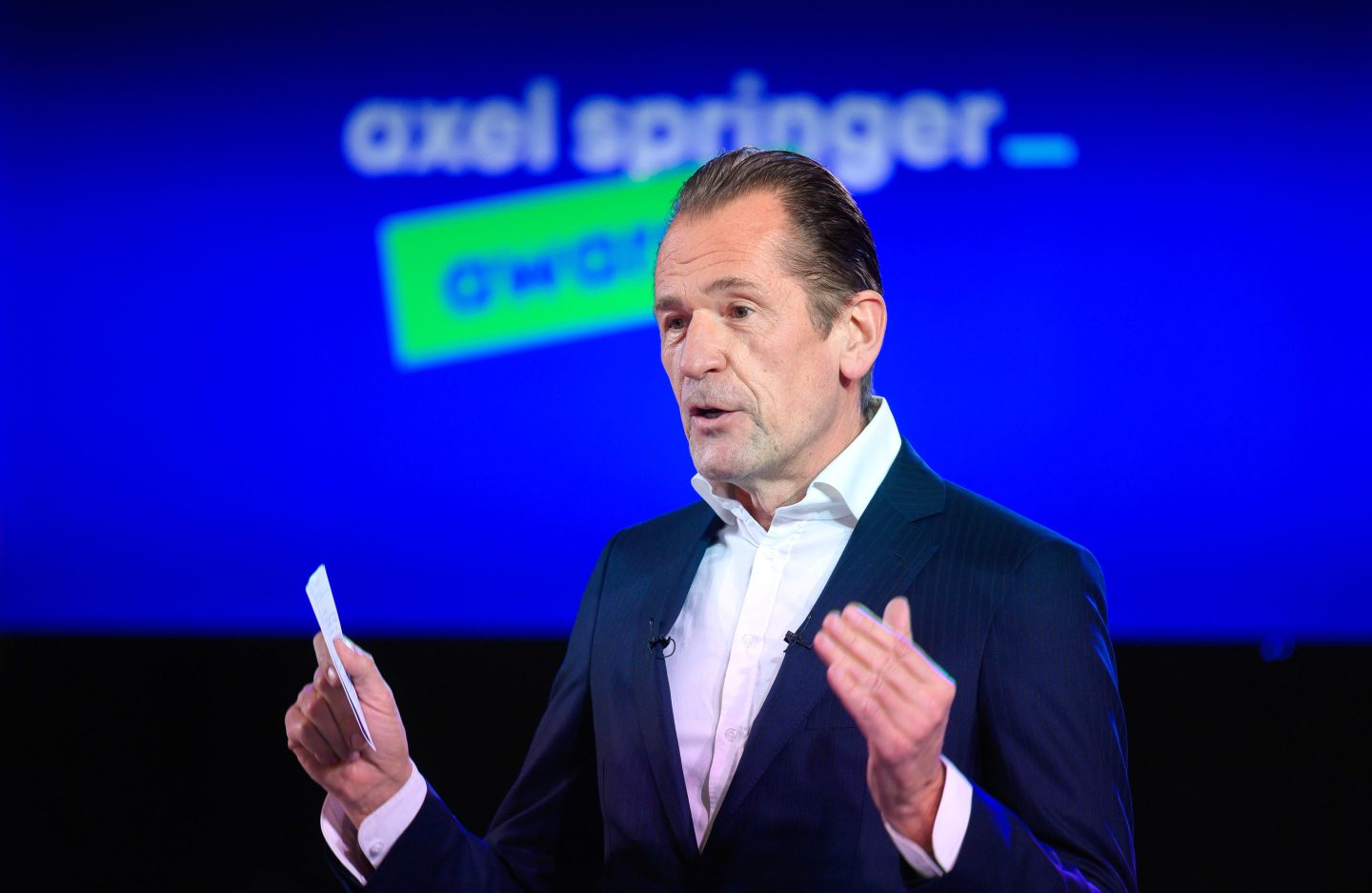
I was invited to a conversation in the Kremlin in 2005, a few months after Paul Klebnikov, the editor of Forbes Russia, was killed right outside the magazine’s Moscow offices. At the time, Forbes Russia was a licensed edition of the American magazine published in Russia by the Axel Springer publishing group, of which I had been CEO for two years.
On July 9, 2004, leaving work late at night, Paul was attacked by unidentified gunmen, who shot him nine times from a slow-moving car. A father of three young children, he initially survived the attack, but died in the hospital when the elevator taking him to the operating theater got stuck between two floors. Witnesses described the attack as an assassination. Commentators speculated that a Forbes Russia story about the tax affairs of Russia’s 100 richest individuals might have prompted the ambush. Some reckoned oligarchs were behind the murder; others, the government itself.
Our meeting was organized by the German government. The aim: to encourage our publishing company to keep doing business in Russia.
In the early morning hours of January 20, 2005, I flew to Moscow from Berlin and spent almost three hours inching through the traffic jam on the monumental road that leads to the city center and Red Square. As soon as I arrived at the Kremlin, my cell phone was confiscated (weeks later, I could still hear Russian voices during calls and on my voicemail; I ultimately changed my handset and number). I was escorted through labyrinthine corridors to a reception room where an interpreter was waiting for me. There was some coffee and sparkling water. When the appointed time rolled round, nothing happened. Half an hour later, still nothing, and no indication of how long the delay would be.
After an hour or so, I got the interpreter to ask the secretary what was going on. Her response: All of this is normal, the president has important matters to attend to, it isn’t possible to give an exact time, please have another coffee. I thought of the legendary trip my company’s founder, Axel Springer, made to Moscow in 1958. He had to wait for two weeks before Nikita Khrushchev finally received him. Was Putin trying to copy this?
Two and a half hours later—and after another five or so inquiries on my part—I wasn’t just annoyed by the blatant humiliation ritual, but also genuinely concerned. There was a crucial board meeting in Berlin the following morning which I couldn’t afford to miss. Given the airport’s operating hours and the three-hour drive back, I was going to be compelled to say something in order to get home in time.
Politely, I explained my dilemma to the wide-eyed secretary, and said that unfortunately, I’d have to postpone the meeting if it didn’t take place within the next hour. They clearly weren’t expecting this. Lots of commotion ensued: Men started scurrying around the office, doors slammed. Then, after half an hour, the big moment arrived. The president was ready.
Together with the interpreter and a Kremlin aide, I stood before an oversized double door. It suddenly opened onto a never-ending ceremonial hall with ornate, gold-leaf stucco ceilings. A guard gestured to me that I should wait. Only when Vladimir Putin entered through the opposite door was I allowed to start walking. Protocol dictated we meet in the exact center of the room—every movement precisely orchestrated like a court ritual. We took our prescribed seats at a gigantic table. The interpreter sat beside us but never uttered a single word. Putin spoke in a low voice that was difficult to understand, but in excellent, almost accent-free German with a slight Saxonian lilt.
He opened the discussion by saying how much he regretted the Klebnikov incident and that our publishing company must not, under any circumstances, let this terrible event deter it from doing business in Russia. The crime would be investigated as a matter of utmost urgency. We will find the perpetrators, he said in what was practically a whisper, forcing me to lean forward to catch his words. We will find them, he promised. You can be sure of that.
Then we moved on to broader issues. One part of the conversation lodged itself in my memory. Putin said that Chechen terrorism was a major challenge for his country. I asked: Isn’t the fight against Islamism arguably a common challenge, and thus a common concern for the United States, the EU, and Russia? Yes, he replied, we have many commonalities and shared concerns. And then he uttered the crucial words: If only the United States would stop treating us like a colony. Our Russian culture is much older than theirs, our feelings run much deeper than theirs. We have our own traditions, we have our own sense of pride. We are not an American colony.
And there it was, flashing away quite unmistakably: the wounded pride of the head of a former superpower, which now found itself downgraded to middling status. He was consumed with an ambition to change precisely this status, an ambition that would take an increasingly radicalized form over the next few years. Even then, in that earlier phase, which looks relatively benign from today’s perspective, it still felt unsettling, and dangerous. After a few more turns on the conversational merry-go-round, and exactly 30 minutes later, Putin brought the discussion to a close. I hear you’re in a hurry, he said. Don’t worry, we’ll give you an escort to the airport to speed things up.
With motorcycles riding information both in front of and behind my car, blue lights flashing, and megaphones blaring, we raced to the airport. It was a demonstration of power, intimidating for all concerned. I sat behind my car window, hiding from outside viewers and feeling embarrassed. I reached the airport much too early.
Following the murder of our editor, we kept the magazine open and didn’t change a thing editorially. Its coverage remained just as critical as before. We held our course when, years later, the mayor of Moscow threatened another editor in a bid to stop the publication of an article about his wife. And especially during the annexation of Crimea in 2014, when our publication took a highly independent stance that criticized the government.
The conflict was finally resolved in a different way. In 2014, the Russian government passed a law limiting the foreign holdings of Russian media to 20%—a law that took effect in 2017 with retroactive force. As a result, we would have to sell 80% of our business to a Russian national. We were discreetly informed of the expectation to find a pro-government buyer. That way, we could continue making money in Russia, but editorial control would be in ”safer” hands. The Axel Springer publishing group instead ”sold” 100% of the business for a symbolic price to a regime critic.
The damage to the company was considerable and the conclusion obvious: It would have been better if we had never done business in Russia.