• Home
  • Latest
  • Fortune 500
  • Finance
  • Tech
  • Leadership
  • Lifestyle
  • Rankings
  • Multimedia
Commentaryclimate change

COP 28 president: ‘It’s time to transform climate finance–and bridge its $2.4 trillion gap’

By
Sultan Al Jaber
Sultan Al Jaber
Down Arrow Button Icon
September 19, 2023, 5:09 AM ET
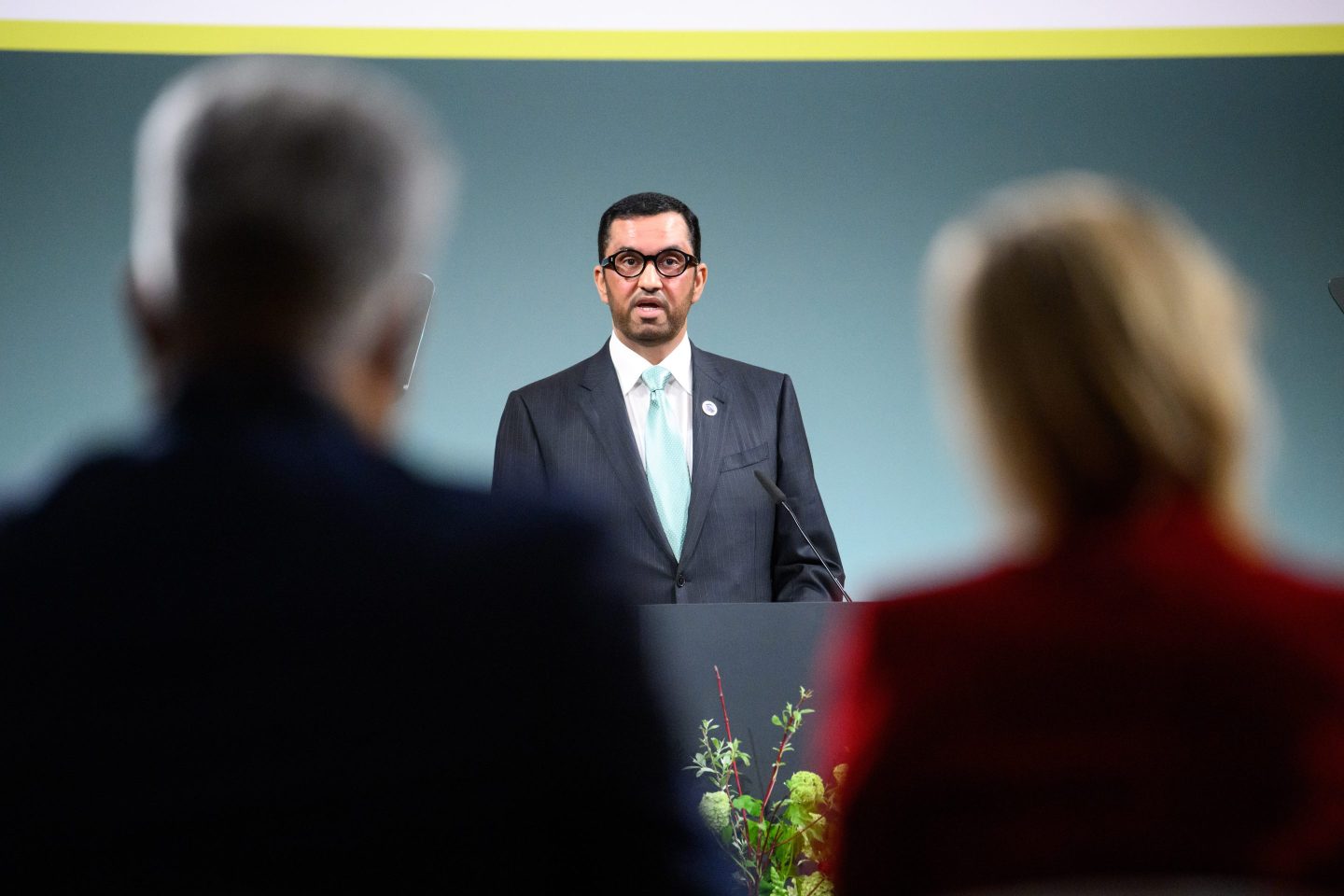
Sultan Al Jaber, Ph.D., is the president-designate of COP28, the UAE’s minister for industry and advanced technology, special envoy for climate, chairman of Masdar, and group CEO of the Abu Dhabi National Oil Company (ADNOC).
Sultan Al Jaber, Ph.D., is the president-designate of COP28, the UAE’s minister for industry and advanced technology, special envoy for climate, chairman of Masdar, and group CEO of the Abu Dhabi National Oil Company (ADNOC).Bernd von Jutrczenka - Picture alliance - Getty Images

If you want to understand the state of the world’s climate efforts, follow the money. Here’s the daunting reality: By 2030, the developing world will need more than $2.4 trillion to address climate change–not as a one-off, but every single year. Of this total, donor countries have committed to mobilize $100 billion annually, a small fraction of what is needed. They have repeatedly fallen short until this past summer at the Paris Summit after a lot of pressure was applied. Now the challenge is how best to mobilize committed finance to restore trust, while simultaneously building a new climate financial infrastructure.

This raises a fundamental question: Is the world capable of mobilizing the trillions of dollars necessary to fund the climate transition? I believe the answer is yes–but not without a concerted effort from governments, international financial institutions, and the private sector to reform the current financial architecture and better align global and domestic financial flows with the world’s climate goals.

Let’s be clear about the stakes. Without major reform of the current financial system, it will be impossible to adequately build new zero-carbon energy, food, and transport systems. We will not have the ability to invest in the resources and infrastructure that help developing countries–especially small island developing states and economies across the Global South–to cope with flooding, droughts, heatwaves, storms, and other climate shocks.

However, if we get this right, creating a better climate finance system can catalyze the biggest economic transformation since the Industrial Revolution. It presents a multi-trillion-dollar opportunity to unlock better forms of growth, create new jobs, new firms, and entirely new industries–and to leave a world to our children and grandchildren that is safer, cleaner, and more prosperous.

The UN General Assembly has climate finance reform in its hands

As leaders gather in New York for the UN General Assembly this week, we urgently need to rally behind a well-defined framework for overhauling climate finance. We must build on the recent momentum of the Barbados Bridgetown Initiative, France’s Summit for a New Global Financing Pact, and the Africa Climate Summit so that the upcoming COP28 climate summit can deliver concrete outcomes.

In an effort to build such a framework, the COP28 Presidency is holding a series of dialogues with a diverse group of leaders to agree on a set of principles for how to fix climate finance. The first dialogue took place in August with the Independent High-Level Expert Group on Climate Finance, and some clear principles are emerging.

We must urgently restore trust in the system. Developed nations must honor their commitments to channel $100 billion annually towards developing countries and show progress on the goal of doubling adaptation finance by 2025. Policymakers must also fund and operationalize the Loss and Damage Fund, forged at COP27 in Sharm el-Sheikh last year, to aid vulnerable nations in responding to climate-related crises.

Governments need to unleash the potential of the private sector by creating the right policy incentives and instruments. For its part, the private sector must actively partner with governments and international organizations to create the necessary conditions for investment. We have already had a glimpse of what’s possible. For example, at the African Climate Summit that took place earlier this month in Nairobi, the UAE launched a $4.5 billion Finance Initiative that will bring private and public sector partners together with African governments to help unlock Africa’s clean energy potential. By setting out clear investment and renewable energy diversification plans, putting in place enabling regulations and policy frameworks, and taking action to modernize basic infrastructure, governments can raise significant sums of private capital for sustainable growth.

Another concrete way that governments can empower the private sector is by shaping better-functioning voluntary carbon markets. These markets can be powerful instruments for channeling private capital from developed to developing economies and for driving investments into new technologies. However, to date, they have been riddled with quality and integrity issues. Governments can help increase trust in these markets by enforcing high integrity standards, robust regulations, clear definitions, and penalties.

Finally, we need international financing institutions to operate more efficiently. Multilateral Development Banks need to be significantly recapitalized. They also need to work better together as a system, supporting common country approaches and platforms. Ultimately, the focus should be on tools that further open, rather than crowd out, more private sector capital.

International financing institutions should rethink how mechanisms–such as the IMF’s Special Drawing Rights–can be used to help alleviate the debt burden of climate-stricken vulnerable countries, free up fiscal space for investments, and leverage private finance. The role of the IMF is also important to incentivize the right policies for domestic borrowing and resource mobilization for climate needs.

Money waiting to be unlocked

There is a broad range of additional policies and mechanisms that can make a difference–from tax reforms to debt swaps for climate and nature, all the way to initiatives that leverage private philanthropy. We must use every tool we can to fill the climate finance gap.

Fixing climate finance is daunting but doable. It begins with restoring trust, which must continue this UNGA. I therefore call on all governments, development institutions, and business leaders to use these crucial next few months before COP28 to raise their ambitions and deliver on their pledges. They should also go further, and support fundamental reform of the global financial architecture to deliver climate finance at scale. The money is waiting to be unlocked. Now let’s use this UNGA–and the months leading to COP28–to build the right framework and political will to unlock it.

Sultan Al Jaber, Ph.D., is the president-designate of COP28, the UAE’s minister for industry and advanced technology, special envoy for climate, chairman of Masdar, and group CEO of the Abu Dhabi National Oil Company (ADNOC).

The opinions expressed in Fortune.com commentary pieces are solely the views of their authors and do not necessarily reflect the opinions and beliefs of Fortune.
Join us at the Fortune Workplace Innovation Summit May 19–20, 2026, in Atlanta. The next era of workplace innovation is here—and the old playbook is being rewritten. At this exclusive, high-energy event, the world’s most innovative leaders will convene to explore how AI, humanity, and strategy converge to redefine, again, the future of work. Register now.
About the Author
By Sultan Al Jaber
See full bioRight Arrow Button Icon

Latest in Commentary

Finance
Lorem ipsum dolor sit amet, consectetur adipiscing elit, sed do eiusmod tempor incididunt ut labore et dolore magna aliqua. Ut enim ad minim veniam
By Fortune Editors
October 20, 2025
Finance
Lorem ipsum dolor sit amet, consectetur adipiscing elit, sed do eiusmod tempor incididunt ut labore et dolore magna aliqua. Ut enim ad minim veniam
By Fortune Editors
October 20, 2025
Finance
Lorem ipsum dolor sit amet, consectetur adipiscing elit, sed do eiusmod tempor incididunt ut labore et dolore magna aliqua. Ut enim ad minim veniam
By Fortune Editors
October 20, 2025
Finance
Lorem ipsum dolor sit amet, consectetur adipiscing elit, sed do eiusmod tempor incididunt ut labore et dolore magna aliqua. Ut enim ad minim veniam
By Fortune Editors
October 20, 2025
Finance
Lorem ipsum dolor sit amet, consectetur adipiscing elit, sed do eiusmod tempor incididunt ut labore et dolore magna aliqua. Ut enim ad minim veniam
By Fortune Editors
October 20, 2025
Finance
Lorem ipsum dolor sit amet, consectetur adipiscing elit, sed do eiusmod tempor incididunt ut labore et dolore magna aliqua. Ut enim ad minim veniam
By Fortune Editors
October 20, 2025

Most Popular

Finance
Lorem ipsum dolor sit amet, consectetur adipiscing elit, sed do eiusmod tempor incididunt ut labore et dolore magna aliqua. Ut enim ad minim veniam
By Fortune Editors
October 20, 2025
Finance
Lorem ipsum dolor sit amet, consectetur adipiscing elit, sed do eiusmod tempor incididunt ut labore et dolore magna aliqua. Ut enim ad minim veniam
By Fortune Editors
October 20, 2025
Finance
Lorem ipsum dolor sit amet, consectetur adipiscing elit, sed do eiusmod tempor incididunt ut labore et dolore magna aliqua. Ut enim ad minim veniam
By Fortune Editors
October 20, 2025
Finance
Lorem ipsum dolor sit amet, consectetur adipiscing elit, sed do eiusmod tempor incididunt ut labore et dolore magna aliqua. Ut enim ad minim veniam
By Fortune Editors
October 20, 2025
Finance
Lorem ipsum dolor sit amet, consectetur adipiscing elit, sed do eiusmod tempor incididunt ut labore et dolore magna aliqua. Ut enim ad minim veniam
By Fortune Editors
October 20, 2025
Finance
Lorem ipsum dolor sit amet, consectetur adipiscing elit, sed do eiusmod tempor incididunt ut labore et dolore magna aliqua. Ut enim ad minim veniam
By Fortune Editors
October 20, 2025
Rankings
  • 100 Best Companies
  • Fortune 500
  • Global 500
  • Fortune 500 Europe
  • Most Powerful Women
  • Future 50
  • World’s Most Admired Companies
  • See All Rankings
Sections
  • Finance
  • Leadership
  • Success
  • Tech
  • Asia
  • Europe
  • Environment
  • Fortune Crypto
  • Health
  • Retail
  • Lifestyle
  • Politics
  • Newsletters
  • Magazine
  • Features
  • Commentary
  • Mpw
  • CEO Initiative
  • Conferences
  • Personal Finance
  • Education
Customer Support
  • Frequently Asked Questions
  • Customer Service Portal
  • Privacy Policy
  • Terms Of Use
  • Single Issues For Purchase
  • International Print
Commercial Services
  • Advertising
  • Fortune Brand Studio
  • Fortune Analytics
  • Fortune Conferences
  • Business Development
About Us
  • About Us
  • Editorial Calendar
  • Press Center
  • Work At Fortune
  • Diversity And Inclusion
  • Terms And Conditions
  • Site Map

© 2025 Fortune Media IP Limited. All Rights Reserved. Use of this site constitutes acceptance of our Terms of Use and Privacy Policy | CA Notice at Collection and Privacy Notice | Do Not Sell/Share My Personal Information
FORTUNE is a trademark of Fortune Media IP Limited, registered in the U.S. and other countries. FORTUNE may receive compensation for some links to products and services on this website. Offers may be subject to change without notice.


Latest in Commentary

TD Jakes
CommentaryReligion
To heal a divided nation, America’s next chapter must rediscover a common unity
By T.D. JakesDecember 16, 2025
14 hours ago
tree
CommentaryInflation
Colorado is suffering from Christmas Tree inflation because Denver imports most of them—from North Carolina and the Pacific Northwest
By Ali Besharat and The ConversationDecember 16, 2025
15 hours ago
Charles Lamanna
CommentaryMicrosoft
I lead Microsoft’s enterprise AI agent strategy. Here’s what every company should know about how agents will rewrite work
By Charles LamannaDecember 15, 2025
2 days ago
Julian Braithwaite is the Director General of the International Alliance for Responsible Drinking
CommentaryProductivity
Gen Z is drinking 20% less than Millennials. Productivity is rising. Coincidence? Not quite
By Julian BraithwaiteDecember 13, 2025
4 days ago
carbon
Commentaryclimate change
Banking on carbon markets 2.0: why financial institutions should engage with carbon credits
By Usha Rao-MonariDecember 13, 2025
4 days ago
Dr. Javier Cárdenas is the director of the Rockefeller Neuroscience Institute NeuroPerformance Innovation Center.
Commentaryconcussions
Fists, not football: There is no concussion protocol for domestic violence survivors
By Javier CárdenasDecember 12, 2025
5 days ago

Most Popular

placeholder alt text
Success
Meetings are not work, says Southwest Airlines CEO—and he’s taking action, by blocking his calendar every afternoon from Wednesday to Friday 
By Preston ForeDecember 15, 2025
2 days ago
placeholder alt text
Success
'I had to take 60 meetings': Jeff Bezos says 'the hardest thing I've ever done' was raising the first million dollars of seed capital for Amazon
By Dave SmithDecember 15, 2025
1 day ago
placeholder alt text
Economy
America's $38 trillion national debt 'exacerbates generational imbalances' with Gen Z and millennials paying the price, warns think tank
By Eleanor PringleDecember 16, 2025
17 hours ago
placeholder alt text
Future of Work
The job market is so bad, people in their 40s are resorting to going back to school instead of looking for work
By Sydney LakeDecember 16, 2025
20 hours ago
placeholder alt text
Innovation
An MIT roboticist who cofounded bankrupt Roomba maker iRobot says Elon Musk's vision of humanoid robot assistants is 'pure fantasy thinking'
By Marco Quiroz-GutierrezDecember 16, 2025
14 hours ago
placeholder alt text
Success
Bad luck, six-figure earners: Elon Musk warns that money will 'disappear' in the future as AI makes work (and salaries) irrelevant
By Orianna Rosa RoyleDecember 15, 2025
2 days ago