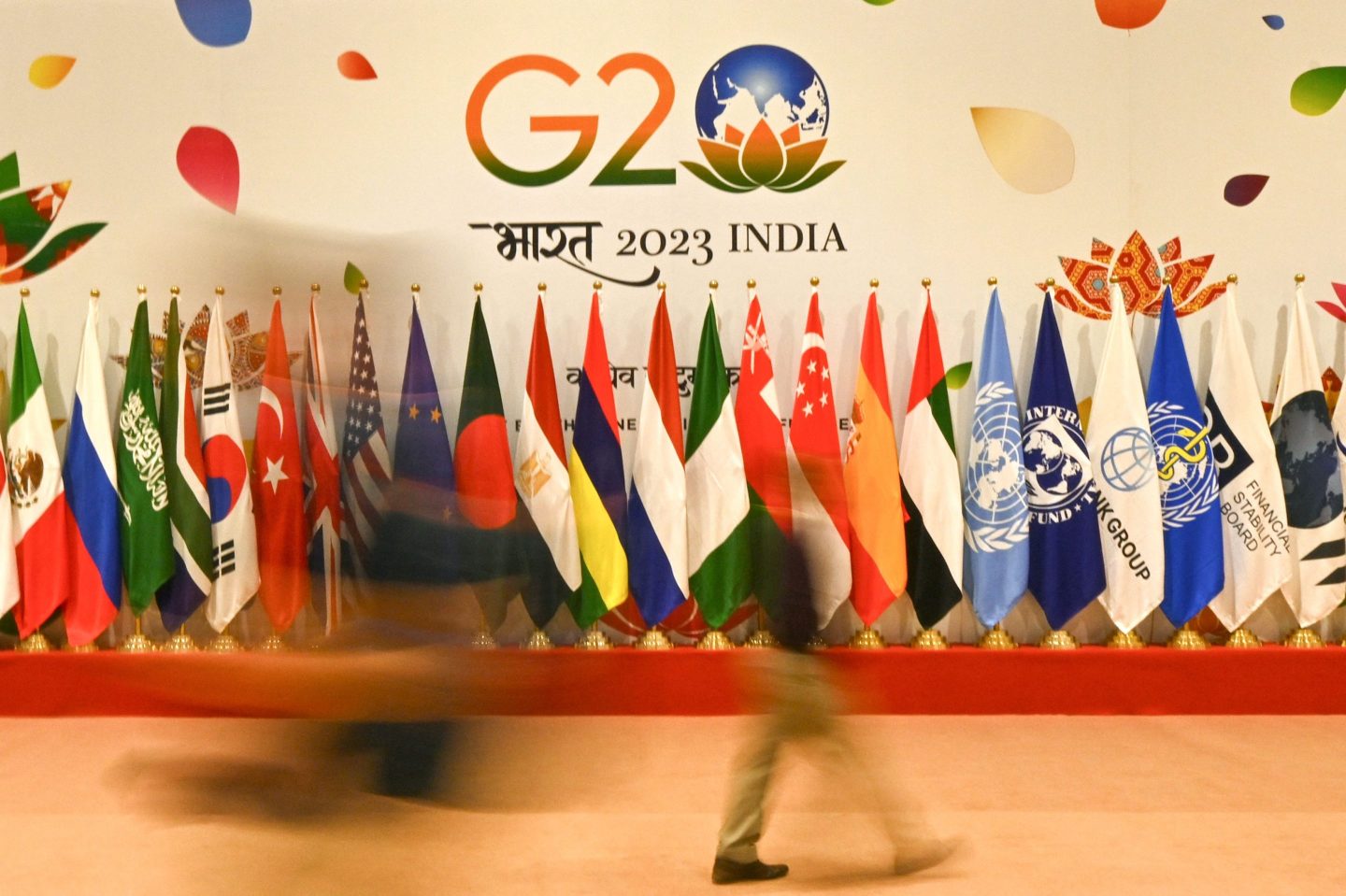
World leaders are gathering in New Delhi for a summit to cap off India’s presidency of the Group of 20. In an era in which geopolitics are back with a vengeance and international cooperation is at a standstill, one must ask, what is the value of the G20?
Having first emerged in the aftermath of the 1997 Asian financial crisis, the G20 was initially designed to put out economic fires. The forum took on new importance in 2008 and was elevated to leader-level summits with the emergence of the global financial crisis. At the time, it worked.
With a remarkable degree of collaboration between President Barack Obama and the leaders of China, India, various European countries, and even Russia, the G20 prevented a global recession from turning into a great depression. It did so by coordinating macroeconomic policies, mobilizing hundreds of billions of dollars for crisis management, and establishing important mechanisms for regulatory cooperation, such as the Financial Stability Board.
Based on this success, the G20 was declared the “premier forum for our international economic cooperation” at the Pittsburgh summit in September 2009. However, in recent years, the G20 has proven to be no more effective in crisis management than in serving as a steering committee of the global economy. Importantly, it has missed opportunities to tackle critical global challenges, such as the pandemic and climate change.
Today, it is hard to imagine the same level of cooperation between the countries that banded together during the Great Financial Crisis on almost any issue. India has leveraged its chairmanship of the G20 this year to highlight its economic success and to promote some of its domestic accomplishments, including in the area of digital public infrastructure. Its theme–“One Earth, One Family, One Future”–suggests a broad agenda for collaboration, but geopolitics have prevented India, and Indonesia as the prior G20 chair, from using the forum to make progress on the most pressing international challenges. Chinese President Xi Jinping’s decision not to attend the New Delhi summit makes it all the more difficult for any progress to be made with China by any of the participants.
Clearly, there can be no consensus among the 20 major countries about the war in Ukraine.
In its heyday, the G20 was a productive forum for laying the groundwork for progress at the UN climate change negotiations. This now seems to be beyond the realm of possibility as well. There is little chance of the next G20 summit reaching any meaningful consensus on the role of fossil fuels, which might have given a boost to the climate change negotiations to be held in the UAE in November.
However, there is still value to these gatherings. Summits can be action-forcing, mobilizing each country’s bureaucracies to get things done by a set deadline. G20 summits can also be important opportunities for formal bilateral talks and informal pull-aside meetings that might otherwise be difficult to pull off.
To have more than 20 leaders, largely unstaffed, in a room for two days is a rare opportunity. Summits are valuable for providing leaders with an opportunity for unscripted and candid exchanges of views. That has proven easier to do with smaller, more like-minded groups, such as the G7, but the G20 would be well-served to throw out all the prepared speeches and talking points and focus on open conversations about the most important issues of the day.
The G20 Is also emerging as an important forum for a dialogue between the West, China, Russia, and middle powers. This dynamic is particularly evident in the fact that the troika of G20 chairs–last year’s Indonesia, this year’s India, and next year’s Brazil–are all developing countries that play an important role in maintaining the continuity of the G20’s work.
Sometimes, these middle powers are referred to as the Global South, but it is in no way a monolithic group. Unlike the Non-Aligned Movement that emerged during the Cold War, these countries will work with the West on certain issues and perhaps be more sympathetic to China and Russia on others.
To manage this complexity, the U.S. will need to engage consistently in a more nuanced form of diplomacy than has traditionally been the case: fewer clearcut friends and adversaries and more attention to the variable geometry of building coalitions of support around specific issues. The Biden administration’s intent to lay out a value proposition for the Global South is a potentially important step in that direction.
The G20 might have lost its luster as the premier forum for international economic cooperation, but still has a potentially useful role to play. It will be up to India to make the most of the next summit–and the United States to demonstrate that it can navigate the changing dynamics of a rapidly changing international system with skill and sophistication.
Michael Froman is the president of the Council on Foreign Relations. He was the G20 Sherpa from 2009 to 2012 and the U.S. Trade Representative from 2013 to 2017.
The opinions expressed in Fortune.com commentary pieces are solely the views of their authors and do not necessarily reflect the opinions and beliefs of Fortune.