• Home
  • News
  • Fortune 500
  • Tech
  • Finance
  • Leadership
  • Lifestyle
  • Rankings
  • Multimedia
PoliticsChina

Biden’s commerce chief just denied the U.S. is breaking up with China and then listed all the ways it’s doing exactly that

Paolo Confino
By
Paolo Confino
Paolo Confino
Reporter
Down Arrow Button Icon
Paolo Confino
By
Paolo Confino
Paolo Confino
Reporter
Down Arrow Button Icon
August 29, 2023, 6:03 PM ET
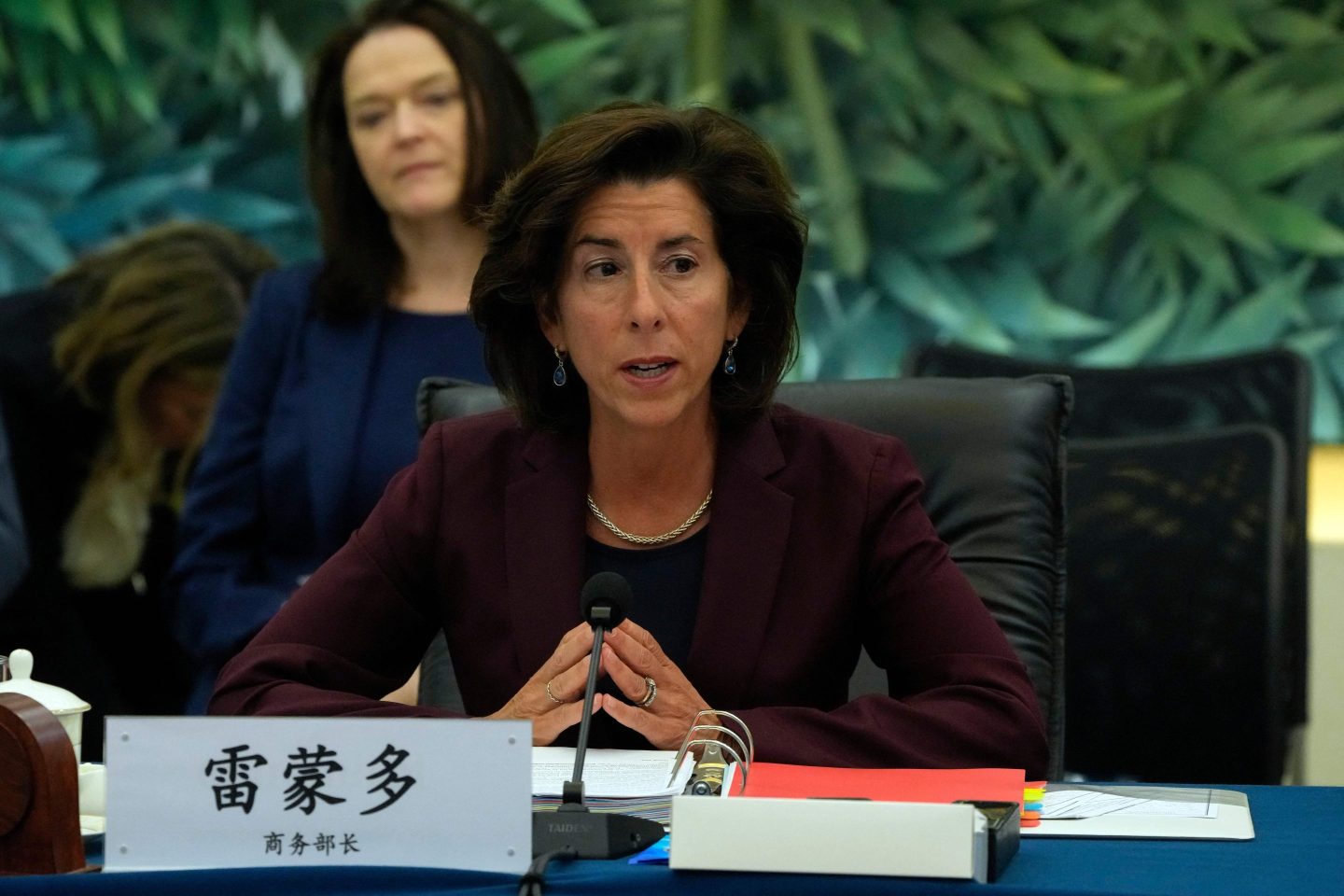
U.S. Commerce Secretary Gina Raimondo sits at a table in front of a nameplate with Chinese lettering.
U.S. Commerce Secretary Gina Raimondo met with China Commerce Minister Wang Wentao in Beijing on Monday.Andy Wong—AFP/Getty Images

Gina Raimondo’s visit to China this week involves the commerce secretary walking a political tightrope so taut it might snap at any moment. She had to try to smooth over a tense U.S.-China relationship while at the same time not appearing in any way lenient on national security issues. But try as she might, she kept on giving off a certain unmistakable message: We’re just not that into you.

Recommended Video

During the course of her visit, Secretary Raimondo, who is the fourth high-level official from the Biden administration to visit China this year, reiterated the importance that economic ties play in the relationship between the world’s two largest economies. 

Raimondo sought to be unequivocal in her support for a continued relationship. 

“I want to be clear that we do not seek to decouple or to hold China’s economy back,” Raimondo told Vice Premier He Lifeng. She added that she and her counterpart, Chinese Commerce Minister Wang Wentao, agreed to “talk informally and as frequently as would be helpful” to revive interaction on trade.

But there were several big catches.

First, Raimondo relayed a message from the business community: China is an increasingly unwelcoming place to do business.

“Increasingly I hear from businesses, ‘China is uninvestable because it’s become too risky,’” she said. “There are the traditional concerns that they’ve become accustomed to dealing with. And then there’s a whole new set of concerns, the sum total of which is making China feel too risky for them to invest.”

The new policies combined with China’s faltering economy have made foreign investors skittish about investing in the mainland. Over the weekend, the government passed a series of measures meant to rejuvenate its economy, only for foreign investors to sell off $1.1 billion in Chinese equities. In the past China had placed limits on selling securities when markets looked rough, another in a string of recent policies that likely made investors nervous about doing business in the world’s second largest economy. 

Raimondo went into more detail in Beijing, underscoring how difficult recoupling, or preventing decoupling, could be.

Those pesky export controls

Despite what Raimondo said about decoupling or lack thereof, things have gotten significantly less close over the past several months. 

In April, the Chinese government passed a new anti-espionage law that banned the transfer of any information related to the country’s national security and broadened the definition of spying. The U.S. accused China of keeping the law intentionally vague and expressed concerns that it might hurt American companies. 

U.S. officials in turn also implemented a series of measures to address growing concerns over China’s potential threats to national security. For starters, the U.S. implemented a ban on sharing semiconductor technology with certain Chinese firms over fears that the technology might be used for military and surveillance purposes. The U.S. says the decision was made in the interest of national security, not to harm China economically. 

Raimondo adamantly reinforced this point. “The United States is committed to being transparent about our export enforcement control strategy,” she said. “I want to be clear. We are not compromising or negotiating in matters of national security—period.” 

China retaliated against U.S. export controls by ordering certain Chinese companies to stop using memory chips from Micron Technology. At the time, Raimondo called the move “economic coercion,” some of the bluntest language she had used to decry China’s alleged habit of using its economy to further its political aims. On this trip, Raimondo criticized what she considered arbitrary enforcement of Chinese policies against U.S. companies like Micron. “Our export controls are clear and transparent,” she said. “There’s been no rationale given around what’s happened to Micron. There’s been limited due process, and that’s why I brought it up.”

The U.S. has also placed restrictions on exports from Nvidia, the leading chip manufacturer in the world. Nvidia’s business has soared in tandem with the recent A.I. boom. 

Lately, America has also laid the groundwork to wean itself off a reliance on Chinese manufacturing for another hot-button industry: electric vehicles. The U.S. is eager for electric-car makers to move their supply chains away from China, according to Reuters. A law banning the importation of products manufactured in the Xinjiang province—where there have been reports that members of the region’s Uyghur minority have been sent to forced labor camps—now encompasses electric vehicle batteries. 

These sorts of moves have all been part of the U.S. government’s efforts to steer investments away from China. All while reinforcing the idea that a mutually beneficial economic relationship will be the first step in easing other tensions between the two countries. 

“The plan and the hope is that the commercial relationship, done right, can stabilize the political relationship,” Raimondo said. 

Chinese Premier Li Qiang, the country’s second-highest-ranking official, echoed the sentiment, calling the trade between the two countries the “anchor of stability.”

Fortune Brainstorm AI returns to San Francisco Dec. 8–9 to convene the smartest people we know—technologists, entrepreneurs, Fortune Global 500 executives, investors, policymakers, and the brilliant minds in between—to explore and interrogate the most pressing questions about AI at another pivotal moment. Register here.
About the Author
Paolo Confino
By Paolo ConfinoReporter

Paolo Confino is a former reporter on Fortune’s global news desk where he covers each day’s most important stories.

See full bioRight Arrow Button Icon

Latest in Politics

U.S. President Donald Trump attends a meeting of his Cabinet in the Cabinet Room of the White House on December 02, 2025 in Washington, DC.
EconomyTariffs
Trump says national debt is ‘peanuts’ and his tariff income will pay everyone a $2,000 dividend too—but the math doesn’t add up
By Eleanor PringleDecember 3, 2025
1 hour ago
Federal Reserve Bank Chair Jerome Powell
EconomyFederal Reserve
Trump’s pick for chairman isn’t enough to threaten Fed independence, says Bank of America—especially if Jerome Powell decides to stick around
By Eleanor PringleDecember 3, 2025
7 hours ago
Sabrina Carpenter
LawImmigration
Sabrina Carpenter rips ‘evil and disgusting’ White House use of one of her songs in an ICE raid video montage
By Fatima Hussein and The Associated PressDecember 2, 2025
22 hours ago
Elon Musk, standing with his arms crossed, looks down at Donald Trump sitting at his desk in the Oval Office
EconomyTariffs and trade
Elon Musk says he warned Trump against tariffs, which U.S. manufacturers blame for a turn to more offshoring and diminishing American factory jobs
By Sasha RogelbergDecember 2, 2025
1 day ago
A student driver gets on a truck as the instructor watches in Calif., Nov. 15, 2021.
LawShipping
Nearly half of U.S. truck-driving schools face closure in crackdown on ‘poorly trained drivers’
By Josh Funk and The Associated PressDecember 2, 2025
1 day ago
Trump
CommentaryTariffs and trade
The trade war was never going to fix our deficit
By Daniel BunnDecember 2, 2025
1 day ago

Most Popular

placeholder alt text
Economy
Ford workers told their CEO 'none of the young people want to work here.' So Jim Farley took a page out of the founder's playbook
By Sasha RogelbergNovember 28, 2025
5 days ago
placeholder alt text
North America
Jeff Bezos and Lauren Sánchez Bezos commit $102.5 million to organizations combating homelessness across the U.S.: ‘This is just the beginning’
By Sydney LakeDecember 2, 2025
1 day ago
placeholder alt text
Success
Warren Buffett used to give his family $10,000 each at Christmas—but when he saw how fast they were spending it, he started buying them shares instead
By Eleanor PringleDecember 2, 2025
1 day ago
placeholder alt text
Economy
Elon Musk says he warned Trump against tariffs, which U.S. manufacturers blame for a turn to more offshoring and diminishing American factory jobs
By Sasha RogelbergDecember 2, 2025
1 day ago
placeholder alt text
North America
Anonymous $50 million donation helps cover the next 50 years of tuition for medical lab science students at University of Washington
By The Associated PressDecember 2, 2025
1 day ago
placeholder alt text
C-Suite
MacKenzie Scott's $19 billion donations have turned philanthropy on its head—why her style of giving actually works
By Sydney LakeDecember 2, 2025
1 day ago
Rankings
  • 100 Best Companies
  • Fortune 500
  • Global 500
  • Fortune 500 Europe
  • Most Powerful Women
  • Future 50
  • World’s Most Admired Companies
  • See All Rankings
Sections
  • Finance
  • Leadership
  • Success
  • Tech
  • Asia
  • Europe
  • Environment
  • Fortune Crypto
  • Health
  • Retail
  • Lifestyle
  • Politics
  • Newsletters
  • Magazine
  • Features
  • Commentary
  • Mpw
  • CEO Initiative
  • Conferences
  • Personal Finance
  • Education
Customer Support
  • Frequently Asked Questions
  • Customer Service Portal
  • Privacy Policy
  • Terms Of Use
  • Single Issues For Purchase
  • International Print
Commercial Services
  • Advertising
  • Fortune Brand Studio
  • Fortune Analytics
  • Fortune Conferences
  • Business Development
About Us
  • About Us
  • Editorial Calendar
  • Press Center
  • Work At Fortune
  • Diversity And Inclusion
  • Terms And Conditions
  • Site Map

© 2025 Fortune Media IP Limited. All Rights Reserved. Use of this site constitutes acceptance of our Terms of Use and Privacy Policy | CA Notice at Collection and Privacy Notice | Do Not Sell/Share My Personal Information
FORTUNE is a trademark of Fortune Media IP Limited, registered in the U.S. and other countries. FORTUNE may receive compensation for some links to products and services on this website. Offers may be subject to change without notice.