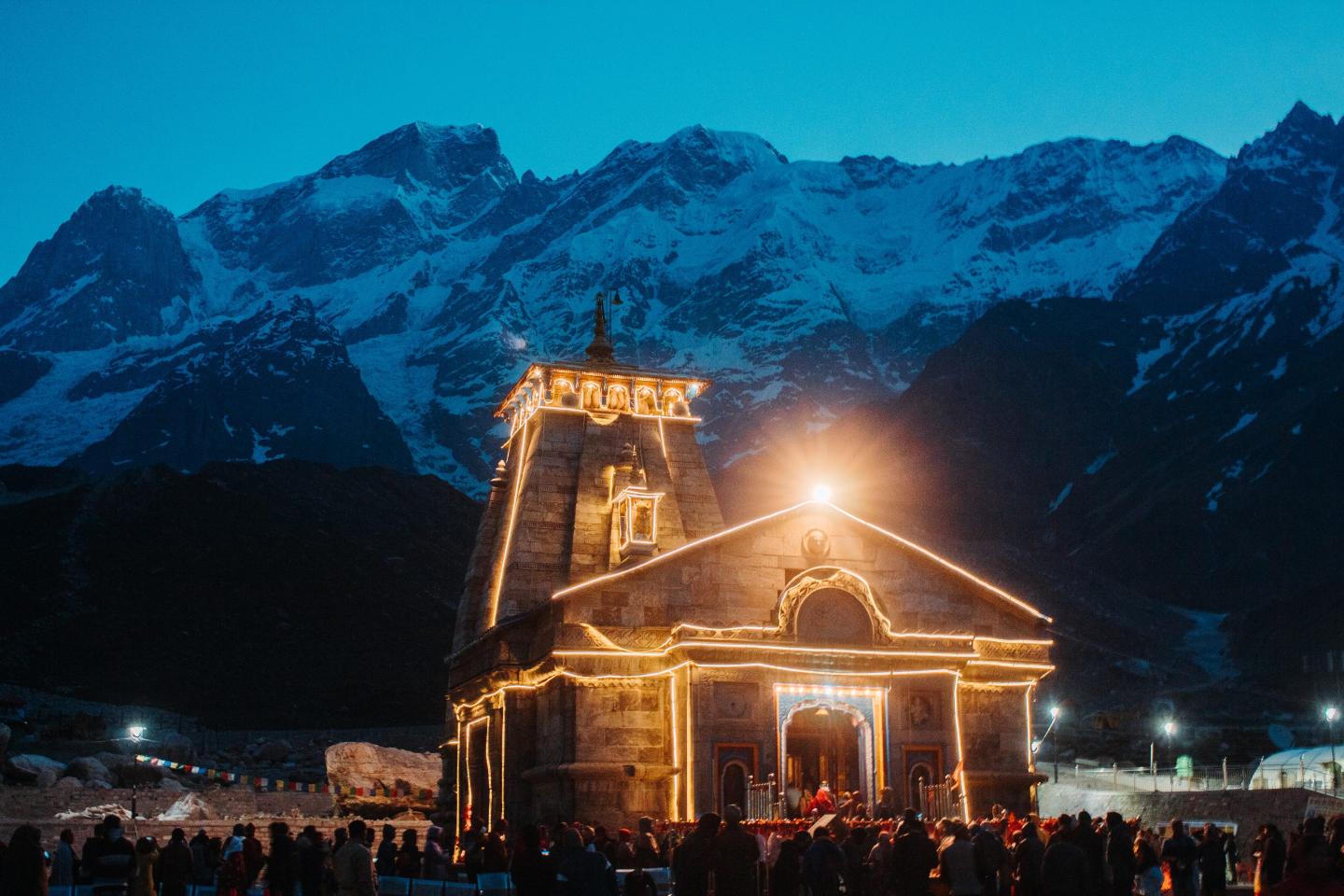
The famous pilgrimage site of Kedarnath, located in the central Himalayas of India, is believed to be a sacred land. It has been referred to as “deva bhumi,” or the “land of the gods,” for centuries.
Millions of people visit this region each year in search of divine blessings and other religious benefits as part of what is known as the Char Dham Yatra, or the pilgrimage to four sacred mountainous abodes devoted to different gods and goddesses. Situated at the base of 20,000-foot snowy peaks, Kedarnath is one of these four major destinations.
The mighty Hindu god Shiva is believed to have manifested in the middle of a meadow in Kedarnath as a conical rock formation that has long been worshiped as a lingam, an embodied form of the deity. A stone temple has stood over the lingam for at least a thousand years, at an altitude of about 12,000 feet.
I visited this area in 2000, 2014 and 2019 as part of research I’ve been conducting for decades on religion, nature and ecology; I have spent numerous summers in the Himalayas. Many in the vast crowds of people on the Char Dham Yatra told me that they believe it is important to undertake this pilgrimage at least once in their lifetime, often identifying it as the most significant journey they will ever perform.
But climate change now threatens the sacred sites of this region. As global temperatures rise, glaciers on the 20,000-foot peaks above Kedarnath that are key sources of the Mandakini River, a major tributary of the Ganges, are melting and retreating at alarming rates. In turn, as I argue in my book, “Understanding Climate Change through Religious Lifeworlds,” climate change disasters are acting as powerful drivers of religious transformations, reshaping religious ideas and practices.
Threats to the Himalayan region
Glacial deterioration is happening worldwide, but subtropical glaciers in high mountainous areas such as the Indian Himalayas are more vulnerable because of their low latitudes. Many climate scientists believe that climate change is affecting the Himalayas more than almost any other region of the world.
Melting glaciers leave massive amounts of water in lakes held in place by unstable natural dams formed of rubble heaped up when the glaciers were healthy and pushing down a slope. The expanding lakes left behind by shrinking glaciers are increasingly prone to glacial lake outburst floods. Another serious danger threatening high mountainous areas as a result of global warming is the shift from snow to extreme rain at increasingly higher altitudes.
Snow clings to hillsides and melts gradually, while rain rushes down slopes immediately, causing destructive erosion, landslides and deluges. The combination of extreme rain and glacial lake outburst floods can lead to deadly flooding, as demonstrated by a catastrophe in Kedarnath in 2013.
Kedarnath disaster
Himalayan researchers determined that in June 2013, more than a foot of rain fell within 24 hours near Kedarnath at elevations never previously recorded. The entire watershed above Kedarnath was filled with raging water. Additionally, the Mandakini River burst out of its banks, causing landslides and devastating flooding.
To make matters worse, the rubble dam that had held back the glacial lake formed by the melting Chorabari Glacier above Kedarnath suddenly breached, releasing a high wall of crashing water. In a matter of 15 minutes, the entire content of the lake was emptied, cresting over three-story buildings with a pounding flow that University of Calcutta scientists estimated was half the volume of Niagara Falls.
Fortunately – or, according to pilgrims, miraculously – a 30-foot oblong boulder rolled down the mountain and stopped just before the ancient temple, parting the powerful waters and protecting the temple so that it remained standing without major damage. Every other building in the town of Kedarnath was demolished.
Government figures claim over 6,000 people died, but those involved in the rescue operations set the figure much higher. Most of the dead were pilgrims.
‘The Gods are angry’
The destructive flooding is changing people’s beliefs. The gods of this region are closely associated with the land itself; and these gods, nature and humans are intimately connected. People living in this region understand the dramatic changes taking place here in terms of this triad.
A resident of Gangotri explained, “The gods are angry with us because of how we are now acting.” When I said to him that I thought this area is where people have been coming for a long time to receive the blessing from the gods, he responded, “Yes, but now they are angry with us. That is why this (Kedarnath disaster) has happened. And more will come if we do not change our ways.”
I found this to be a common view – weather-related disasters were being understood as a result of the immoral actions of human beings, particularly the disregard for the environment.
One significant theological change that appeared to be underway within Himalayan Hinduism as a result of climate change was the transformation of the primary conception of the gods from those who bless to those who punish. “There is so much sin in the world today,” a resident of Uttarkashi told me. “People are making a lot of pollution. Because of this, the climate is changing and the gods are beginning to punish us.”
In some ways there is nothing new in the assertion that human morality and the environment are intimately linked, but the degree of change that is now happening has introduced a new level of concern.
Wandering holy men in this region are witnessing firsthand the dramatic changes in the Himalayas during their years of travel. One holy man living in this area explained, “The gods are nature. When we disrespect nature, we disrespect the gods. They are now angry because of what we are doing to nature. This is why the destructive storms are increasing.”
Conditional hope
All is not lost, however, and there remains some hope for a better outcome. There is a sense that things can still be turned around and the worst avoided if humans are willing to change their ways. Specifically, many articulated this as a return to a more respectful relationship with the gods of the land.
When asked how to please the gods and turn things around, a man in Kedarnath put it simply: “To once again respect the land and nature.” There is no great difference between treating the gods with respect and nature well. A woman I spoke to in Uttarkashi elaborated on this: “The gods and the land are the same. And we are mistreating both. The floods are like a warning slap to a child. They are a wake-up call telling us to change our ways. … If not, we will be finished.”
Human behavior remains a major factor in the holistic worldview that connects humans, gods and environment, and a return to respectful relationships is the key to a sustainable future.
Many Himalayan residents say that humans have the choice to return to a more mutually beneficial relationship with the natural world, but if the gods’ stormy warnings are not heeded, then massive destruction and a gruesome end is near.
Uncertain future
Destructive floods continue to happen in the central Himalayas with increasing force and frequency. Since the 2013 disaster at Kedarnath, more than 800 people have been killed in flash floods in the Char Dham region.
The Kedarnath pilgrimage was suspended in 2022 because of deadly landslides and flooding, but the Indian government has also heavily promoted religious tourism in this area. The year 2022 saw a record number of pilgrims visiting Kedarnath and the three other Char Dham sites in the central Himalayas, which only puts more stress on the land, with additional buildings, crowded roads and polluting vehicles.
With vehicles, factories and other human activities continuing to pump excessive amounts of greenhouse gases into the atmosphere, warming the planet, experts fear disasters like Kedarnath saw in 2013 will become only more common.
David L. Haberman is Professor Emeritus, Religious Studies, Indiana University.
This article is republished from The Conversation under a Creative Commons license. Read the original article.