• Home
  • News
  • Fortune 500
  • Tech
  • Finance
  • Leadership
  • Lifestyle
  • Rankings
  • Multimedia
TechAI

A.I. can identify keystrokes by just the sound of your typing and steal information with 95% accuracy, new research shows

Paige Hagy
By
Paige Hagy
Paige Hagy
Down Arrow Button Icon
Paige Hagy
By
Paige Hagy
Paige Hagy
Down Arrow Button Icon
August 8, 2023, 1:55 PM ET
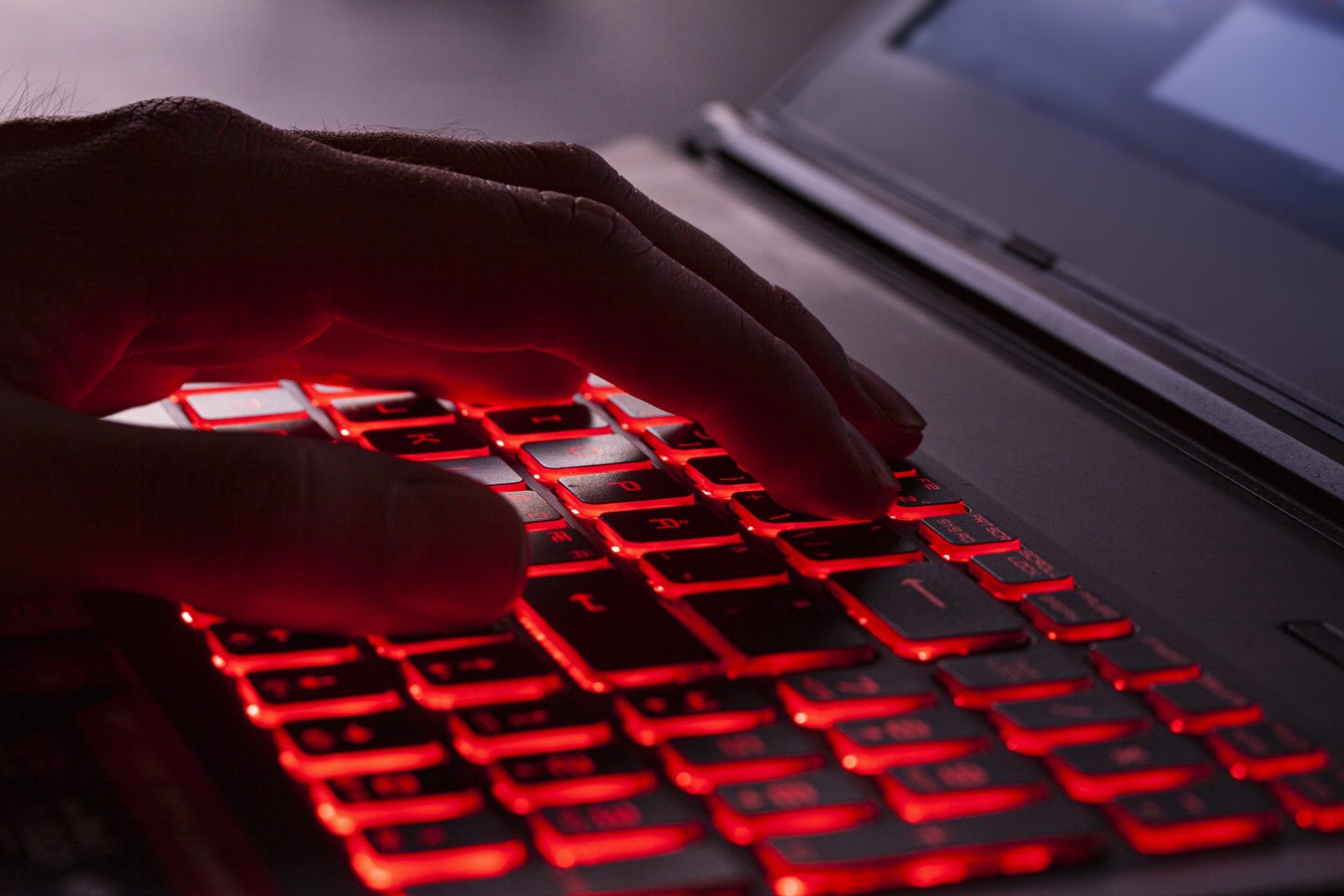
Close up of fingers typing on glowing red backlight keys on a computer keyboard.
Laptop users are at risk of having sensitive information stolen just by the sound of typing on their keyboard. Ole Schwander—Getty Images

You may have gotten used to covering your webcam, but now you might have to start muffling the sound of your keyboard too.

Recommended Video

Laptop users are at risk of having sensitive information including private messages, passwords, and credit card numbers stolen just by typing on their keyboard. A new paper by a team of researchers from British universities shows that artificial intelligence can identify keystrokes by sound alone with 95% accuracy. And as technology continues to develop at a rapid pace, attacks such as these will become more sophisticated.

In this study, experimenters correctly identified keystrokes on a MacBook Pro through a nearby phone recording 95% of the time, and through a recorded Zoom call at a 93% rate.

The research paper details what it calls “acoustic side channel attacks” in which a malicious third party uses a secondary device, like a cell phone sitting next to a laptop or an unmuted microphone on a video-conferencing software such as Zoom, to record the sound of typing. The third party then feeds the recording through a deep-learning A.I. trained to recognize the sound of individual pressed keys to decipher what exactly was typed.

Deep learning (DL) is a subset of machine learning in which computers are taught to process data in a way similar to the human brain—essentially using a multilayered “neural network” to “learn” from large amounts of data and accurately produce insights and predictions. Deep-learning models can recognize patterns in pictures, texts, sounds, and other data. This type of A.I. is in everyday products like digital assistants like Amazon’s Alexa and voice-enabled TV remotes, as well as newer technologies like self-driving cars.

“With the recent developments in both the performance of (and access to) both microphones and DL models, the feasibility of an acoustic attack on keyboards begins to look likely,” the paper said.

The paper, published on August 3, was authored by Joshua Harrison, a software development engineer at Amazon who recently graduated with a Masters of Engineering from Durham University, as well as University of Surrey lecturer Ehsan Toreini and Royal Holloway University of London senior lecturer Maryam Mehrenzhad.

Mitigating the ever-developing threat

Laptops are especially ideal targets for these attacks because of their portability, according to the paper. People often take their laptops to work in public spaces like libraries, coffee shops, and study areas, where the sound of typing can easily be recorded without notice from the targeted user.

One of the main concerns of the paper is that people are unaware of these kinds of attacks, so they do nothing to prevent them.

“The ubiquity of keyboard acoustic emanations makes them not only a readily available attack vector, but also prompts victims to underestimate (and therefore not try to hide) their output,” the paper said. “For example, when typing a password, people will regularly hide their screen but will do little to obfuscate their keyboard’s sound.”

One way to mitigate the threat of this attack is by using stronger passwords with multiple cases, like special characters, upper and lowercase letters, and numbers. Passwords with full words might be more easily deduced and therefore at greater risk of attack. 

And while the pressing of the shift key can be recognized by A.I., it cannot yet recognize the “release peak” of the shift key amidst the sound of other keys, “doubling the search space of potential characters following a press of the shift key,” the paper said. 

Another simple way to deter these kinds of attacks is by using two-factor authentication. This is a security method that requires two forms of identification to access accounts and data. For instance, the first factor may be a password and the second may be an account activity confirmation through an email or on a separate device. 

Biometric authentication, like fingerprint scans and facial recognition, can also lessen the risk of an attack.

But as A.I. continues to evolve, so too will these attacks. The authors of the paper recommended that future studies analyze the use of smart speakers to record keystrokes, “as these devices remain always-on and are present in many homes.” 

The authors also suggested that future research should explore the implementation of a language model used in tandem with a deep-learning A.I. Language models, like viral chatbot ChatGPT, are trained on large series of text to recognize patterns of speech. 

A language model “could improve keystroke recognition when identifying defined words as well as an end-to-end real-world implementation of an ASC attack on a keyboard,” the paper said. 

Fortune Brainstorm AI returns to San Francisco Dec. 8–9 to convene the smartest people we know—technologists, entrepreneurs, Fortune Global 500 executives, investors, policymakers, and the brilliant minds in between—to explore and interrogate the most pressing questions about AI at another pivotal moment. Register here.
About the Author
Paige Hagy
By Paige Hagy
LinkedIn iconTwitter icon
See full bioRight Arrow Button Icon

Latest in Tech

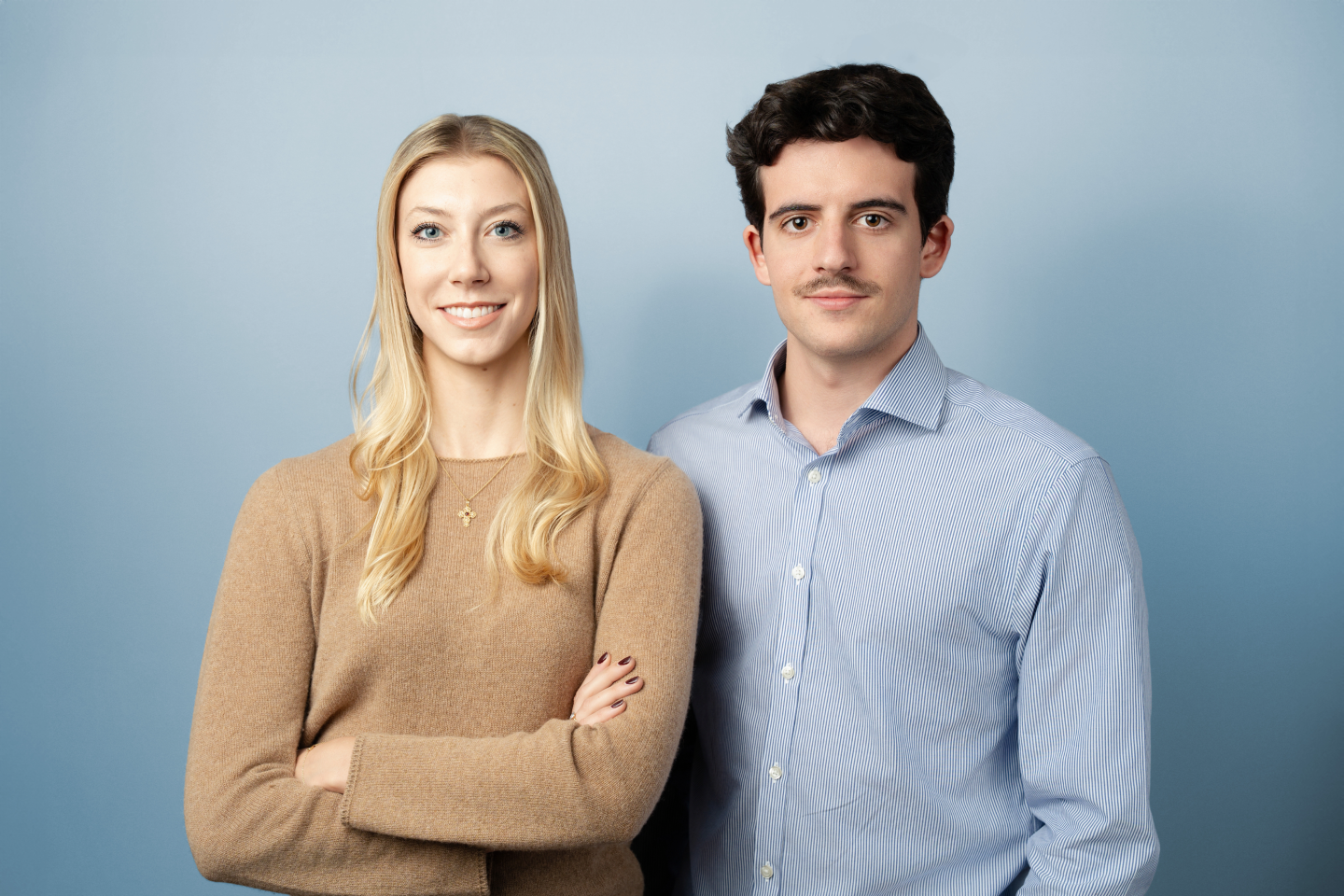
Two men sit and smile in front of a building
Cryptostablecoins
Exclusive: Former Citadel employees raise $17 million for Fin, a global stablecoin app ‘without all the complexity’
By Carlos GarciaDecember 3, 2025
27 minutes ago
CybersecuritySmall Business
Main Street’s make-or-break upgrade: Why small businesses are racing to modernize their tech
By Ashley LutzDecember 3, 2025
57 minutes ago
MagazineMarkets
Why an AI bubble could mean chaos for stock markets—and how smart investors are protecting their portfolios
By Alyson ShontellDecember 3, 2025
1 hour ago
Rakesh Kumar
CommentarySemiconductors
China does not need Nvidia chips in the AI war — export controls only pushed it to build its own AI machine
By Ramesh KumarDecember 3, 2025
2 hours ago
Rochelle Witharana is Chief Financial and Investment Officer for The California Wellness Foundation
Commentarydiversity and inclusion
Fund managers from diverse backgrounds are delivering standout returns and the smart money is slowly starting to pay attention
By Rochelle WitharanaDecember 3, 2025
2 hours ago
CryptoCryptocurrency
Exclusive: Harvard grads raise $20 million for Ostium, a platform focused on a derivative popular with crypto traders
By Ben WeissDecember 3, 2025
2 hours ago

Most Popular

placeholder alt text
Economy
Ford workers told their CEO 'none of the young people want to work here.' So Jim Farley took a page out of the founder's playbook
By Sasha RogelbergNovember 28, 2025
5 days ago
placeholder alt text
North America
Jeff Bezos and Lauren Sánchez Bezos commit $102.5 million to organizations combating homelessness across the U.S.: ‘This is just the beginning’
By Sydney LakeDecember 2, 2025
1 day ago
placeholder alt text
Success
Warren Buffett used to give his family $10,000 each at Christmas—but when he saw how fast they were spending it, he started buying them shares instead
By Eleanor PringleDecember 2, 2025
1 day ago
placeholder alt text
Economy
Elon Musk says he warned Trump against tariffs, which U.S. manufacturers blame for a turn to more offshoring and diminishing American factory jobs
By Sasha RogelbergDecember 2, 2025
23 hours ago
placeholder alt text
C-Suite
MacKenzie Scott's $19 billion donations have turned philanthropy on its head—why her style of giving actually works
By Sydney LakeDecember 2, 2025
1 day ago
placeholder alt text
North America
Anonymous $50 million donation helps cover the next 50 years of tuition for medical lab science students at University of Washington
By The Associated PressDecember 2, 2025
1 day ago
Rankings
  • 100 Best Companies
  • Fortune 500
  • Global 500
  • Fortune 500 Europe
  • Most Powerful Women
  • Future 50
  • World’s Most Admired Companies
  • See All Rankings
Sections
  • Finance
  • Leadership
  • Success
  • Tech
  • Asia
  • Europe
  • Environment
  • Fortune Crypto
  • Health
  • Retail
  • Lifestyle
  • Politics
  • Newsletters
  • Magazine
  • Features
  • Commentary
  • Mpw
  • CEO Initiative
  • Conferences
  • Personal Finance
  • Education
Customer Support
  • Frequently Asked Questions
  • Customer Service Portal
  • Privacy Policy
  • Terms Of Use
  • Single Issues For Purchase
  • International Print
Commercial Services
  • Advertising
  • Fortune Brand Studio
  • Fortune Analytics
  • Fortune Conferences
  • Business Development
About Us
  • About Us
  • Editorial Calendar
  • Press Center
  • Work At Fortune
  • Diversity And Inclusion
  • Terms And Conditions
  • Site Map

© 2025 Fortune Media IP Limited. All Rights Reserved. Use of this site constitutes acceptance of our Terms of Use and Privacy Policy | CA Notice at Collection and Privacy Notice | Do Not Sell/Share My Personal Information
FORTUNE is a trademark of Fortune Media IP Limited, registered in the U.S. and other countries. FORTUNE may receive compensation for some links to products and services on this website. Offers may be subject to change without notice.