“Oppenheimer,” the epic new movie directed by Christopher Nolan, takes audiences into the mind and moral decisions of J. Robert Oppenheimer, leader of the team of brilliant scientists in Los Alamos, New Mexico, who built the world’s first atomic bomb. It’s not a documentary, but it gets the big historical moments and subjects right.
The issues that Nolan depicts are not relics of a distant past. The new world that Oppenheimer helped to create, and the nuclear nightmare he feared, still exists today.
Russian President Vladimir Putin is threatening to use nuclear weapons in his war in Ukraine. Iran is doing everything it can to develop nuclear weapons. China is expanding its nuclear arsenal. Hostile governments like China are stealing U.S. defense technologies, including from Los Alamos.
Charges that Oppenheimer was a Soviet spy and a security risk – a major focus of the movie – have been disproved. In December 2022, the Biden administration posthumously voided the U.S. Atomic Energy Commission’s 1954 decision to revoke Oppenheimer’s security clearance, calling that process biased and unfair. Declassified records reveal that Soviet spying on the U.S. atomic bomb effort advanced Moscow’s bomb program, but Oppenheimer was no spy.
Oppenheimer’s perspective
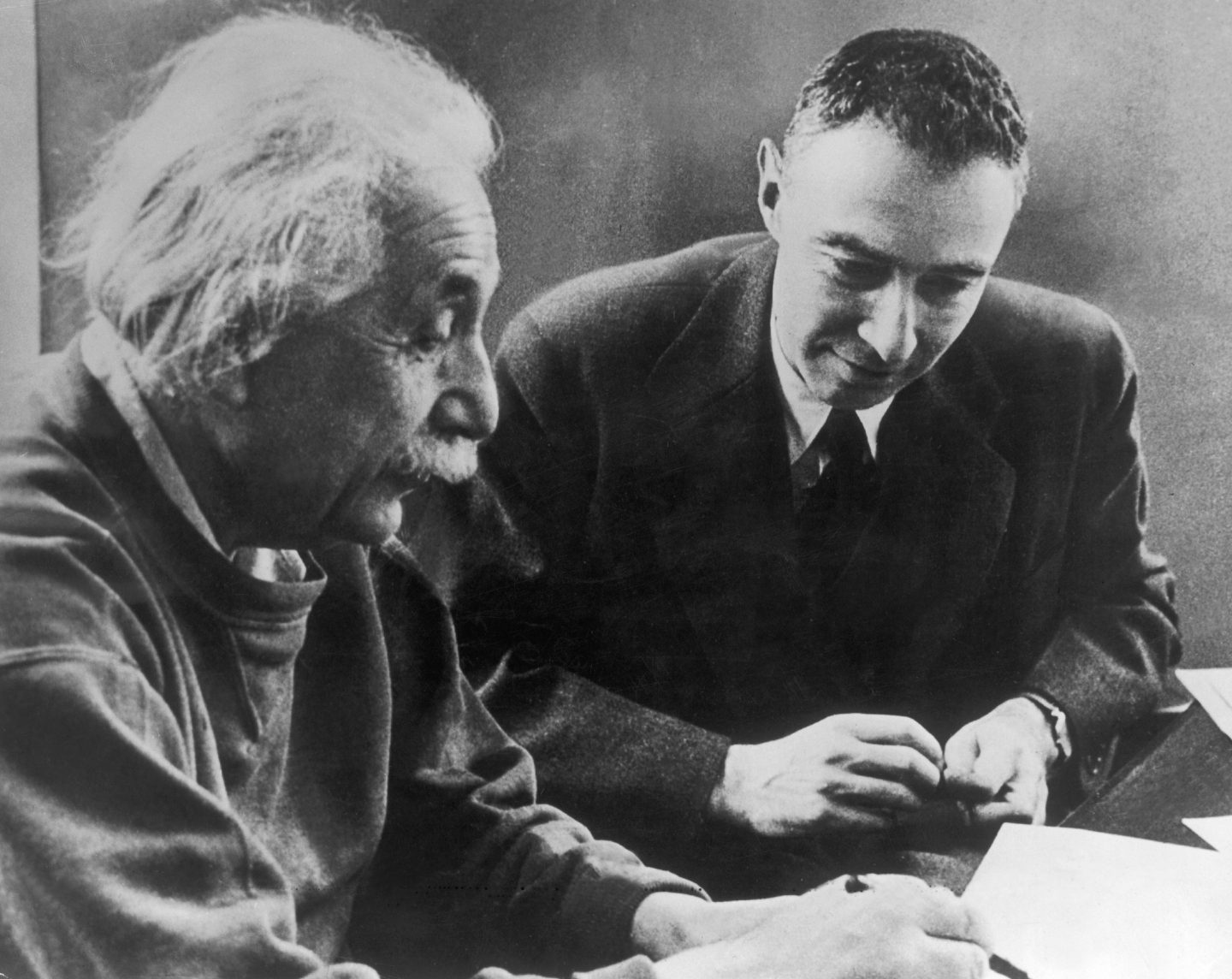
Oppenheimer joined the Manhattan Project, a nationwide effort to build an atomic bomb before the Nazis developed one, in 1942. The scientists he led at the Los Alamos site were probably the most talented group of minds ever assembled in a single laboratory, including 12 eventual Nobel laureates.
In 1954, at the height of the McCarthy era, Oppenheimer was accused of being a communist and even a Soviet spy. What’s the truth?
We know that in the 1930s, and until 1943, Oppenheimer was a Communist sympathizer. His brother Frank and his girlfriend Jean Tatlock belonged to the Communist Party of the United States, and Oppenheimer’s wife Katherine was a former member.
For Oppy, as his students called him, Marxism was intellectually interesting, but it was also practical. Oppenheimer saw communism as the best defense against the rise of fascism in Europe, which, being of Jewish heritage, was personal for him.
By 1943, however, Oppenheimer’s support for Communist Party causes shifted – evidently, as he realized the enormity of his mission to produce an atomic bomb. That year, Oppenheimer helped U.S. Army security officers identify scientists he believed were communists.
Russian overtures
Oppenehimer was a top target for Soviet intelligence, which assigned him the code names CHESTER and CHEMIST. He was also being cultivated by Soviet intelligence officers. But being targeted and cultivated for recruitment is not the same as being a recruited spy.
As the movie shows, in 1943, Oppenheimer’s academic colleague at the University of California, Berkeley, Haakon Chevalier, told Oppenheimer that a British scientist working in San Francisco could relay information to the Soviets. Oppenheimer rejected the approach, but for reasons that remain unclear, he did not inform authorities for several months.
Over the ensuing years, Oppenheimer provided at least three versions of the story, sometimes involving his brother Frank. It seems likely that Robert was trying to protect his brother from Army security.
Archives made available after the Soviet Union’s collapse now establish beyond doubt that Oppenheimer was not a Soviet agent. In fact, Soviet intelligence reports about the Manhattan Project reveal that at key points, Stalin’s spy chiefs were frustrated that their operatives had not recruited Oppenheimer. But the Russians did penetrate the Manhattan Project – the greatest security breach in U.S. history.
All the Kremlin’s men
Multiple scientists who worked on the Manhattan Project provided critical information about U.S. atomic bomb research to the Soviet Union.
“Oppenheimer” focuses on Klaus Fuchs, a brilliant theoretical physicist who fled from Nazi Germany to Britain and became a British naturalized subject. From the time he started to work on Britain’s wartime atom bomb project, Fuchs was in what he later described as “continuous contact” with Soviet intelligence, providing theoretical calculations that were necessary to build the atom bomb.
General Leslie Groves, the military commander of the Manhattan Project, later blamed the British for failing to identify Fuchs as a Soviet spy. That’s correct. But the declassified dossier on Fuchs from Britain’s security service, MI5, shows that at the time, the agency did not have any positive, reliable evidence of Fuchs’s communism. MI5 knew that Fuchs was anti-Nazi, but not that he was pro-Soviet.
As I discuss in my new book, “Spies: The Epic Intelligence War Between East and West,” other spies at Los Alamos included a prodigious scientist, Theodore “Ted” Hall (code name MLAD, or “Young”); Julius Rosenberg (code name ANTENNA, later LIBERAL); David Greenglass (BUMBLEBEE, CALIBER). Other Soviet spies, like the British scientist Alan Nunn May, worked in other parts of the Manhattan Project.
These men had multiple motives for betraying U.S. atomic secrets. They were communist true believers and thought atomic weapons were too powerful to be held by one country alone. Moreover, they had a (misguided) defense – that the Soviet Union was America’s wartime ally, so they were “only” delivering secrets to an allied government. But as Nolan correctly shows in the movie, when Chevalier approached Oppenheimer with the same argument, Oppenheimer retorted that it was still treason.
Soviet espionage inside the Manhattan Project would change history. By the end of World War II, Stalin’s spies had delivered the secrets of the atomic bomb to the Kremlin. This accelerated Moscow’s bomb project. When the Soviets detonated their first atomic weapon in August 1949, it was a replica of the weapon built at Los Alamos and dropped by the Americans on Nagasaki.
Even now, nearly 80 years later, secrets about Soviet nuclear espionage are still emerging. One Soviet agent whose espionage has only recently been revealed is George Koval (code name DEVAL), an American engineer who was drafted into the Manhattan Project, where he worked on polonium bomb “initiators” at a facility in Dayton, Ohio.
After Koval died in 2006, at the age of 93, Russia’s ministry of defense disclosed that the initiator for the first Soviet atomic bomb was prepared to specifications provided by Koval. Putin posthumously honored Koval as a “Hero of Russia,” offering a champagne toast in his honor.
New targets
If Nolan’s film inspires audiences to read the deeply researched biography of Oppenheimer by Kai Bird and Martin Sherwin, which inspired Nolan to make this movie, or other accounts of the Manhattan Project or the Cold War, they will find that the underlying tissues of science and espionage remain alive.
Today, the world stands at the edge of technological revolutions that will transform societies in the 21st century, much as nuclear weapons did in the 20th century: artificial intelligence, quantum computing and biological engineering. Watching “Oppenheimer” makes me wonder whether hostile foreign governments may already have stolen keys to unlocking these new technologies, in the same way the Soviets did with the atom bomb.
Calder Walton is Assistant Director, Applied History Project and Intelligence Project, Harvard Kennedy School.
This article is republished from The Conversation under a Creative Commons license. Read the original article.