
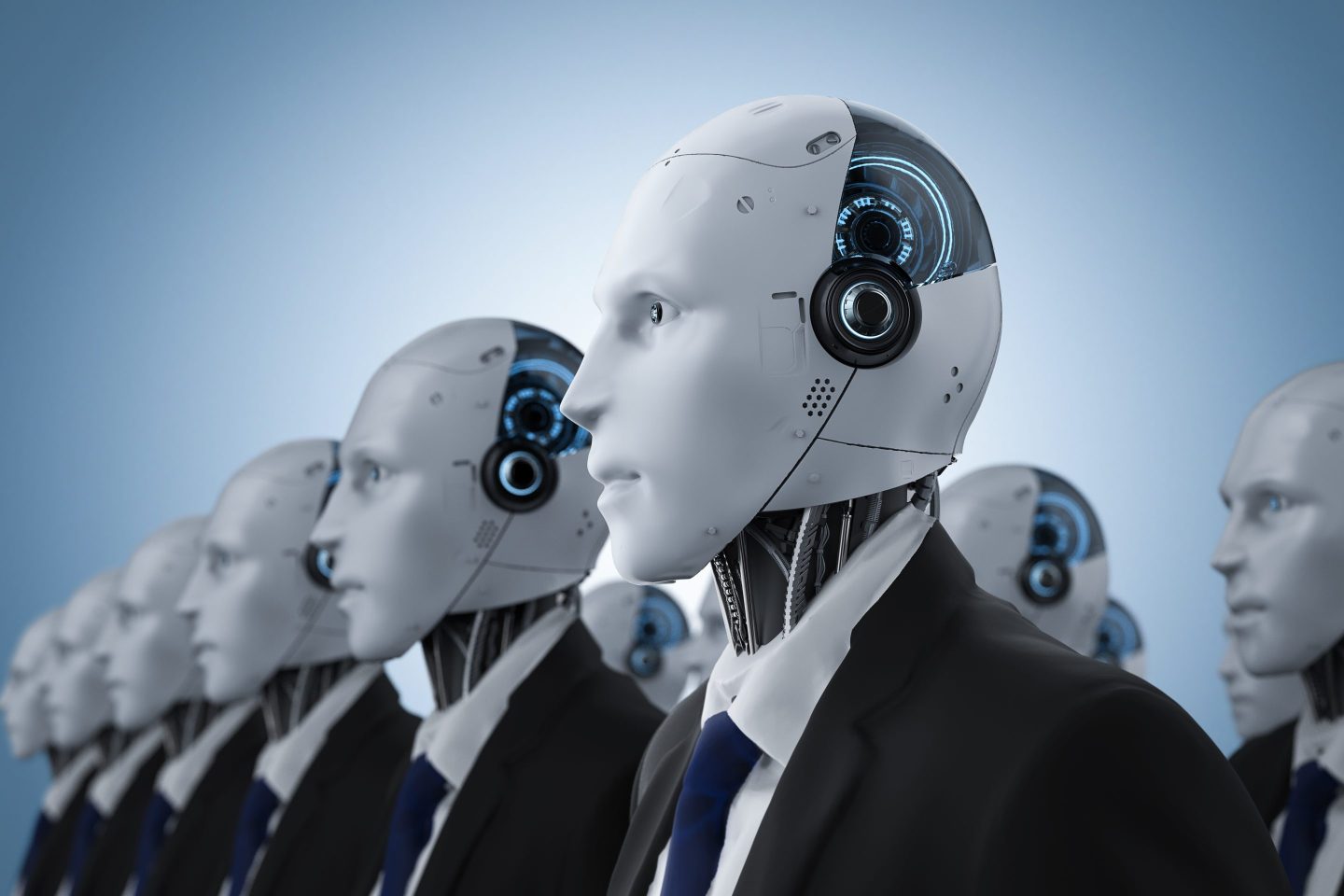
Future CEOs and other denizens of the C-suite may look back on Nov. 30, 2022, with decidedly mixed emotions. That day, the launch of OpenAI’s ChatGPT reversed years of research findings about which workers would be most threatened by automation. For the first time, instead of low- and middle-skilled workers, it’s top executives who are seemingly in A.I. crosshairs.
“I think decisions CEOs make will be amenable to machines in the long run,” says Anton Korinek, an economist and professor at the University of Virginia’s Darden business school, who has studied artificial intelligence and its effects on labor. “It will be possible to automate everything CEOs can do. The trillion-dollar question, of course, is how long that long run is going to be.”
The reversal of research results has been startling. The Organization for Economic Cooperation and Development last year published a hefty study on how A.I. will affect workers, based on a survey of experts conducted before the ChatGPT launch. One conclusion: The C-suite needn’t worry. Of 48 different kinds of jobs, “top executives” ranked No. 47 on “automatability.” Only “religious workers” were less threatened.
But more recent studies paint a starkly different picture. A post-ChatGPT study by researchers at Princeton University, the University of Pennsylvania, and New York University, using U.S. Department of Labor data on more than 800 occupations, finds that chief executive jobs are in the top 12% of positions that could be significantly changed or eliminated by ChatGPT-type technology. More broadly, the study finds that “highly educated, highly paid, white-collar occupations may be most exposed to generative A.I.”
“What a contrast to what most people were worried about just a year ago,” Korinek observes. “We thought automation may affect lower-skilled physical workers. After the ChatGPT moment, it looks like just the opposite is happening.”
Could A.I. really eliminate C-suite positions, typically the highest paid jobs in business? In theory, yes. Incorporation laws don’t require companies to have anyone in those positions. Charles Elson, a corporate governance authority and an attorney at the Holland & Knight law firm, says those laws require that “the affairs of the corporation shall be under the direction of the board of directors. There’s no law that you have to have a CEO or other officers.”
In practice, however, experts say the C-suite may be more stoutly armor-plated than the academics think. In the real world, technology—even highly capable technology—isn’t the only factor determining how top-level jobs will get done. A chatbot won’t take over a C-suite job until it can clear three hurdles, none of them easy. In order, from easiest to most difficult:
It would have to do the whole job
Sounds obvious, but the difference between doing the whole job and doing almost the whole job is night and day. If A.I. can do much but not all of a CFO’s job, for example, the CFO becomes more productive and valuable. Economists would say the technology complements the worker. But if A.I. can do the whole job, the technology substitutes for the worker, and the worker is unemployed.
Today’s A.I. could be a turbocharged complement to C-suite executives. For example, Mustafa Suleyman, cofounder of the pioneering A.I. company DeepMind, has launched a startup called Inflection.ai, which offers a personal assistant that it claims will help you talk through tough decisions, come up with creative ideas, change jobs, learn a new skill, and much else. But current A.I. isn’t ready to negotiate contracts with your suppliers and customers, evaluate your employees, or allocate your company’s capital.
How long before A.I. can do all that and more, enabling it to substitute for C-suite labor rather than just complement it? It could be sooner than you expect. A.I. engines are doubling their capabilities every three to six months, according to Stanford University’s Institute for Human-Centered Artificial Intelligence and researchers led by Jaime Sevilla at the U.K.’s University of Aberdeen. Consider ChatGPT Plus, which launched in February, an upgrade on ChatGPT at $20 per month. Original ChatGPT scored in the bottom 10% of test takers on the Uniform Bar Exam, while ChatGPT Plus scores in the top 10%. ChatGPT is limited when it comes to performing advanced math, but ChatGPT Plus includes a tool called Code Interpreter, which analyzes data, creates charts, and performs complex math on the user’s own data.
Even those impressive capabilities leave a long way still to go, however. Korinek believes a world-class A.I. CEO would require long-predicted artificial general intelligence (AGI), which OpenAI CEO Sam Altman defines as “A.I. systems that are generally smarter than humans.” And that level of technology may not be just around the corner. When Geoffrey Hinton, one of the “godfathers of A.I.,” was asked recently when AGI would arrive, he tweeted, “I now predict 5 to 20 years but without much confidence,” and he later told the Guardian newspaper that he “wouldn’t rule out 100 years.”
Yet even AGI won’t be enough to displace a human C-suite executive, because a digital replacement would have to do more than master tasks. Specifically…
It would have to satisfy regulators
All businesses are regulated, and some—financial services, health care, transportation, manufacturing—are heavily regulated. How much trust will regulators invest in A.I.? For example, imagine that a bank wants A.I. to take over a function previously handled by the CFO: “That is going to be heavily scrutinized by the regulators,” says David Wilkins, a Harvard Law School professor whose work on the role of the general counsel has familiarized him with many regulated industries, “particularly after the information about ChatGPT and its tendency to hallucinate.”
Another example: In any publicly traded company’s SEC annual report, the CFO and CEO must sign statements certifying that “this report does not contain any untrue statement of a material fact or omit to state a material fact,” among many other promises. Would regulators allow A.I. to sign that certification? That puts the government in charge of allowing A.I. to displace CFOs and CEOs.
But even without the regulatory wrinkle, A.I is unlikely to replace a human executive because…
It would have to satisfy society: customers, employees, shareholders, communities
Korinek foresees a future in which humans may be hired for some jobs “merely for the fact of being human,” even if A.I. could do the jobs more effectively and at lower cost. He calls them “nostalgic jobs.” C-suite positions may be prime candidates.
A.I.’s galloping advance “forces us to ask what are the human qualities that we value among our top leaders,” says Wilkins, whose areas of study include leadership and ethics. “It’s not just reaching the correct decision. It’s also about persuading people to feel good about that decision, to be motivated to follow that decision.”
Even if A.I. makes better decisions than humans do, Wilkins believes, that won’t be enough. Will A.I. “make us feel that we have been heard, been valued, been judged by something we can understand, meaning another human being?” he asks. He acknowledges that we have already accepted speaking to bots on the phone, resolving disputes on eBay and Amazon without ever engaging a person, and forsaking human interaction in other ways. But “we’re a long way from giving up on that altogether,” he says. “If we do give up on that altogether, then it’s not clear to me what being human really means anymore.”
The nature of humanity is deep waters even for the C-suite. To take just one more step, let’s imagine that in the coming decades the conception of humanity changes. Indistinguishable humanoid robots—think of the Synths in the TV series Humans, or the Replicants in the 1982 film Blade Runner—become real, powered by artificial general intelligence. Could they displace the C-suite?
Creating such robots will obviously be a much harder job than developing only the AGI component. But whenever that might happen—maybe then.