• Home
  • Latest
  • Fortune 500
  • Finance
  • Tech
  • Leadership
  • Lifestyle
  • Rankings
  • Multimedia
TechAI

Bill Gates likens the rise of A.I. to nuclear weapons: ‘It’s not as grim as some people think’

Eleanor Pringle
By
Eleanor Pringle
Eleanor Pringle
Senior Reporter, Economics and Markets
Down Arrow Button Icon
Eleanor Pringle
By
Eleanor Pringle
Eleanor Pringle
Senior Reporter, Economics and Markets
Down Arrow Button Icon
July 13, 2023, 7:00 AM ET
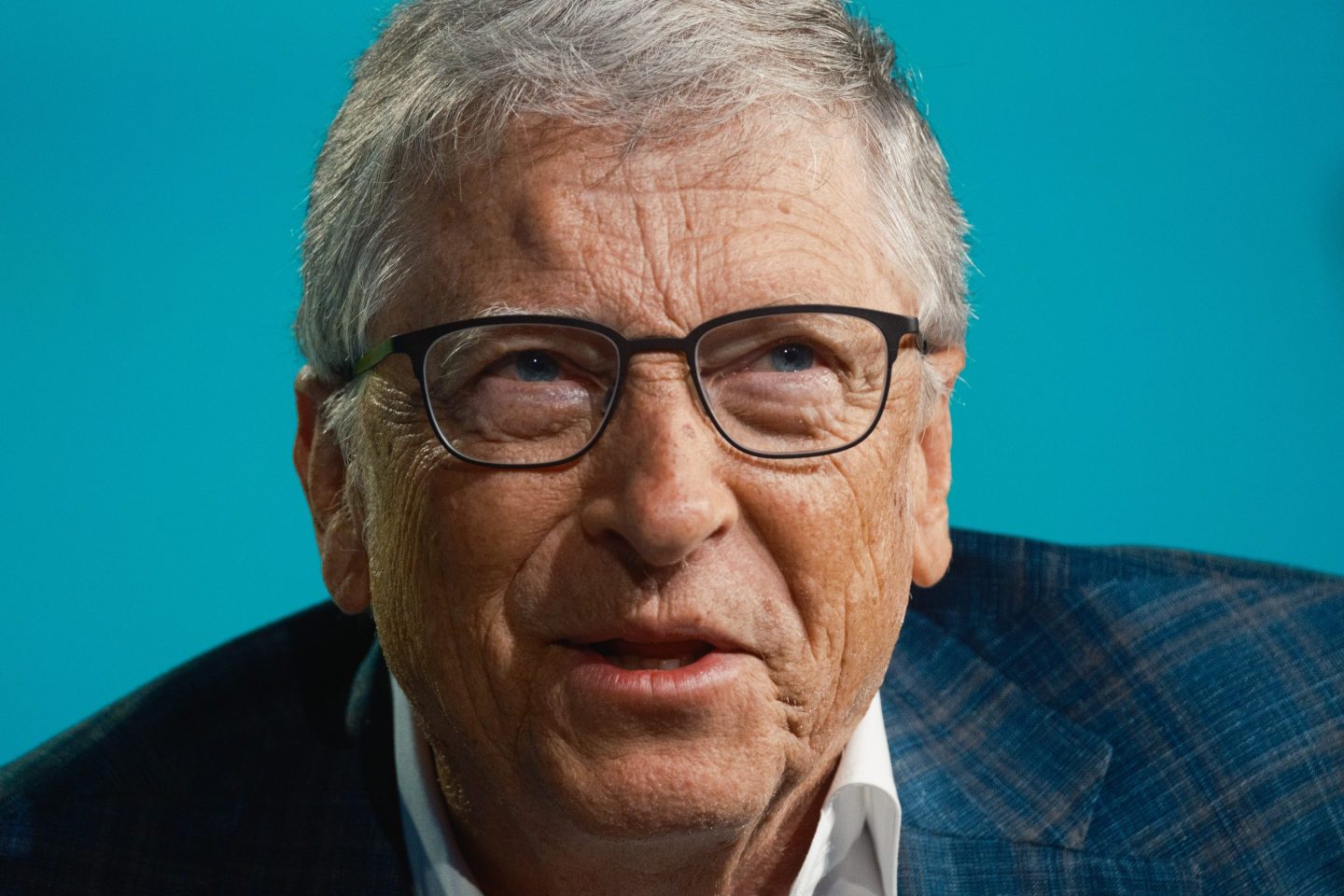
Bill and Melinda Gates Foundation, during the EEI 2023 event in Austin, Texas, US, on Monday, June 12.
Bill Gates says estimations about how good or bad A.I. will be are overdramatic. Jordan Vonderhaar—Bloomberg/Getty Images

Microsoft cofounder Bill Gates is doubling down on his support for artificial intelligence—dismissing fears the technology could destroy humanity and take over the world.

Recommended Video

The billionaire philanthropist has long been a cautionary advocate of the technology, having worked with Sam Altman’s OpenAI since 2016. Microsoft has since poured $13 billion into the ChatGPT maker.

In a blog post on his website Gates Notes, the founder of the Bill & Melinda Gates Foundation likened large language models (LLMs) like ChatGPT and Google’s Bard to other disruptive innovations like cars and nuclear weapons.

Both had filled the public with fear, Gates pointed out, and yet, through a series of guardrails, had been wrestled into a usable form.

“We didn’t ban cars—we adopted speed limits, safety standards, licensing requirements, drunk-driving laws, and other rules of the road,” wrote Gates—who just helped mint another A.I. unicorn.

“Although the world’s nuclear nonproliferation regime has its faults, it has prevented the all-out nuclear war that my generation was so afraid of when we were growing up.”

Using nuclear weapons as an example, Gates suggested regulators should look to history for a blueprint on how to handle the development of chatbots.

He explained: “For example, it will have a big impact on education, but so did handheld calculators a few decades ago, and, more recently, allowing computers in the classroom. We can learn from what’s worked in the past.”

The result, Gates believes, is that “the future of A.I. is not as grim as some people think or as rosy as others think.”

It’s this opinion that has previously incurred the wrath of fellow tech titan, Tesla CEO Elon Musk. In a response to one of Gates’ earlier essays on the power of LLMs, Musk lashed out: “I remember the early meetings with Gates. His understanding of A.I. was limited. Still is.”

At the time Musk was one of the early signatories of an open letter calling a six-month pause on the development of anything more advanced than OpenAI’s GPT-4 chatbot. The Twitter owner has since launched his own A.I. company, xAI.

A.I. should be turned on itself

Gates also believes that the problems created by A.I. can be combated by the technology itself.

Take deepfakes—created by a type of A.I. called deep learning that can produce realistic videos and images that are digitally altered—which Gates believes have the power to undermine elections and democracy as well as have “horrific emotional impact” on individual victims.

Gates, reportedly worth $134 billion, said he is “hopeful” however, thanks to the fact that A.I. can not only create deepfakes but also identify them. Intel, he highlighted, has developed a deepfake detector while the government’s Defense Advanced Research Projects Agency is working on technology to identify whether video or audio has been manipulated.

The 67-year-old is also “guardedly optimistic” that the security industry will be able to combat more advanced hackers by using the technology to their own effect.

“A.I. can be used for good purposes as well as bad ones,” he wrote—pointing out that government and private-sector security teams need to have access to the most up-to-date technology in order to combat such attacks.

Gates made a veiled dig at the Musk-backed development pause for this reason, writing: “This is also why we should not try to temporarily keep people from implementing new developments in A.I., as some have proposed.

“Cybercriminals won’t stop making new tools. Nor will people who want to use A.I. to design nuclear weapons and bioterror attacks. The effort to stop them needs to continue at the same pace.”

Governments need to step up

Gates also addressed two of the major concerns from the public: job losses and changes to education.

On job losses—of which Goldman Sachs has predicted there will be 300 million because of A.I.—Gates squarely placed the responsibility on governments and business: “They’ll need to manage it well so that workers aren’t left behind—to avoid the kind of disruption in people’s lives that has happened during the decline of manufacturing jobs in the United States.”

Across the board—from deepfakes to children using ChatGPT to do their homework—Gates told policymakers they need to “be equipped to have informed, thoughtful dialogue with their constituents,” as well as establishing how closely they would work with other countries on legislation.

Lastly, Gates had advice for the public: engage.

“It’s the most transformative innovation any of us will see in our lifetimes, and a healthy public debate will depend on everyone being knowledgeable about the technology, its benefits, and its risks,” he concluded.

Join us at the Fortune Workplace Innovation Summit May 19–20, 2026, in Atlanta. The next era of workplace innovation is here—and the old playbook is being rewritten. At this exclusive, high-energy event, the world’s most innovative leaders will convene to explore how AI, humanity, and strategy converge to redefine, again, the future of work. Register now.
About the Author
Eleanor Pringle
By Eleanor PringleSenior Reporter, Economics and Markets
LinkedIn icon

Eleanor Pringle is an award-winning senior reporter at Fortune covering news, the economy, and personal finance. Eleanor previously worked as a business correspondent and news editor in regional news in the U.K. She completed her journalism training with the Press Association after earning a degree from the University of East Anglia.

See full bioRight Arrow Button Icon

Latest in Tech

NewslettersCIO Intelligence
Inside tractor maker CNH’s push to bring more artificial intelligence to the farm
By John KellDecember 10, 2025
2 hours ago
NewslettersTerm Sheet
5 VCs sounds off on the AI question du jour
By Amanda GerutDecember 10, 2025
3 hours ago
Databricks co-founder and CEO Ali Ghodsi (right) with Fortune editorial director Andrew Nusca at Fortune Brainstorm AI 2025 in San Francisco. (Photo: Stuart Isett/Fortune)
NewslettersFortune Tech
How Databricks could achieve a trillion-dollar valuation
By Andrew NuscaDecember 10, 2025
3 hours ago
Zhenghua Yang
SuccessSmall Business
At 18, doctors gave him three hours to live. He played video games from his hospital bed—and now, he’s built a $10 million-a-year video game studio
By Preston ForeDecember 10, 2025
4 hours ago
AsiaCoupang
Coupang CEO resigns over historic South Korean data breach
By Yoolim Lee and BloombergDecember 10, 2025
6 hours ago
AIpalantir
New contract shows Palantir is working on a tech platform for another federal agency that works with ICE
By Jessica MathewsDecember 9, 2025
13 hours ago

Most Popular

placeholder alt text
Economy
‘Fodder for a recession’: Top economist Mark Zandi warns about so many Americans ‘already living on the financial edge’ in a K-shaped economy 
By Eva RoytburgDecember 9, 2025
16 hours ago
placeholder alt text
Success
When David Ellison was 13, his billionaire father Larry bought him a plane. He competed in air shows before leaving it to become a Hollywood executive
By Dave SmithDecember 9, 2025
1 day ago
placeholder alt text
Banking
Jamie Dimon taps Jeff Bezos, Michael Dell, and Ford CEO Jim Farley to advise JPMorgan's $1.5 trillion national security initiative
By Nino PaoliDecember 9, 2025
18 hours ago
placeholder alt text
Uncategorized
Transforming customer support through intelligent AI operations
By Lauren ChomiukNovember 26, 2025
14 days ago
placeholder alt text
Real Estate
The 'Great Housing Reset' is coming: Income growth will outpace home-price growth in 2026, Redfin forecasts
By Nino PaoliDecember 6, 2025
4 days ago
placeholder alt text
Success
Even the man behind ChatGPT, OpenAI CEO Sam Altman, is worried about the ‘rate of change that’s happening in the world right now’ thanks to AI
By Preston ForeDecember 9, 2025
21 hours ago
Rankings
  • 100 Best Companies
  • Fortune 500
  • Global 500
  • Fortune 500 Europe
  • Most Powerful Women
  • Future 50
  • World’s Most Admired Companies
  • See All Rankings
Sections
  • Finance
  • Leadership
  • Success
  • Tech
  • Asia
  • Europe
  • Environment
  • Fortune Crypto
  • Health
  • Retail
  • Lifestyle
  • Politics
  • Newsletters
  • Magazine
  • Features
  • Commentary
  • Mpw
  • CEO Initiative
  • Conferences
  • Personal Finance
  • Education
Customer Support
  • Frequently Asked Questions
  • Customer Service Portal
  • Privacy Policy
  • Terms Of Use
  • Single Issues For Purchase
  • International Print
Commercial Services
  • Advertising
  • Fortune Brand Studio
  • Fortune Analytics
  • Fortune Conferences
  • Business Development
About Us
  • About Us
  • Editorial Calendar
  • Press Center
  • Work At Fortune
  • Diversity And Inclusion
  • Terms And Conditions
  • Site Map

© 2025 Fortune Media IP Limited. All Rights Reserved. Use of this site constitutes acceptance of our Terms of Use and Privacy Policy | CA Notice at Collection and Privacy Notice | Do Not Sell/Share My Personal Information
FORTUNE is a trademark of Fortune Media IP Limited, registered in the U.S. and other countries. FORTUNE may receive compensation for some links to products and services on this website. Offers may be subject to change without notice.