

Inflation is painful. It robs everyone, from the postman to Wall Street’s most powerful investment bankers, stealing their spending power without a vote—and it does so with a penchant for society’s most vulnerable. But deflation might be even worse. While falling prices can sound appealing, deflationary environments are terrible for growth. As former Goldman Sachs CEO Lloyd Blankfein explained in a Bloomberg interview in October 2021, it all comes down to consumers’ expectations for the future:
“When you have deflationary expectations, you say, ‘You know something? I’ll wait for tomorrow.’ Tomorrow, you wake up and you say, ‘I’ll wait another day because it’s getting cheaper and easier,’ et cetera…Then you really are in the economic doldrums.”
Blankfein argues that even though inflation is horrible for any economy, deflation is something that central banks truly can’t “tolerate,” because it can crush demand as consumers and businesses delay purchases and investments. And that is exactly the problem that China is facing now.
“Whereas everywhere else in the world the risk is persistent inflation. In China, the risk is persistent deflation,” Greg Daco, EY’s chief economist, told Fortune. “And if you look at final demand, both on the industrial goods front, and on the consumer front, they both indicate the increased likelihood of a prolonged period of deflation.”
Here’s how rapidly the situation has changed for the world’s second largest economy, why it’s happening—and how it could be a disaster in the making.
Why prices might keep falling
Just six months ago, economists and investment banks were worried that China’s reopening after nearly three years of strict “zero COVID” lockdowns would result in a surge of economic activity this year, exacerbating already sky-high global inflation. But now, even though consumers are back shopping at malls and dancing at concerts across China, the reopening has failed to deliver as promised. The nation’s ailing property sector, elevated youth unemployment rate, and $35 trillion in nagging local government debt have weighed on economic growth and led consumer prices in the country to stall.
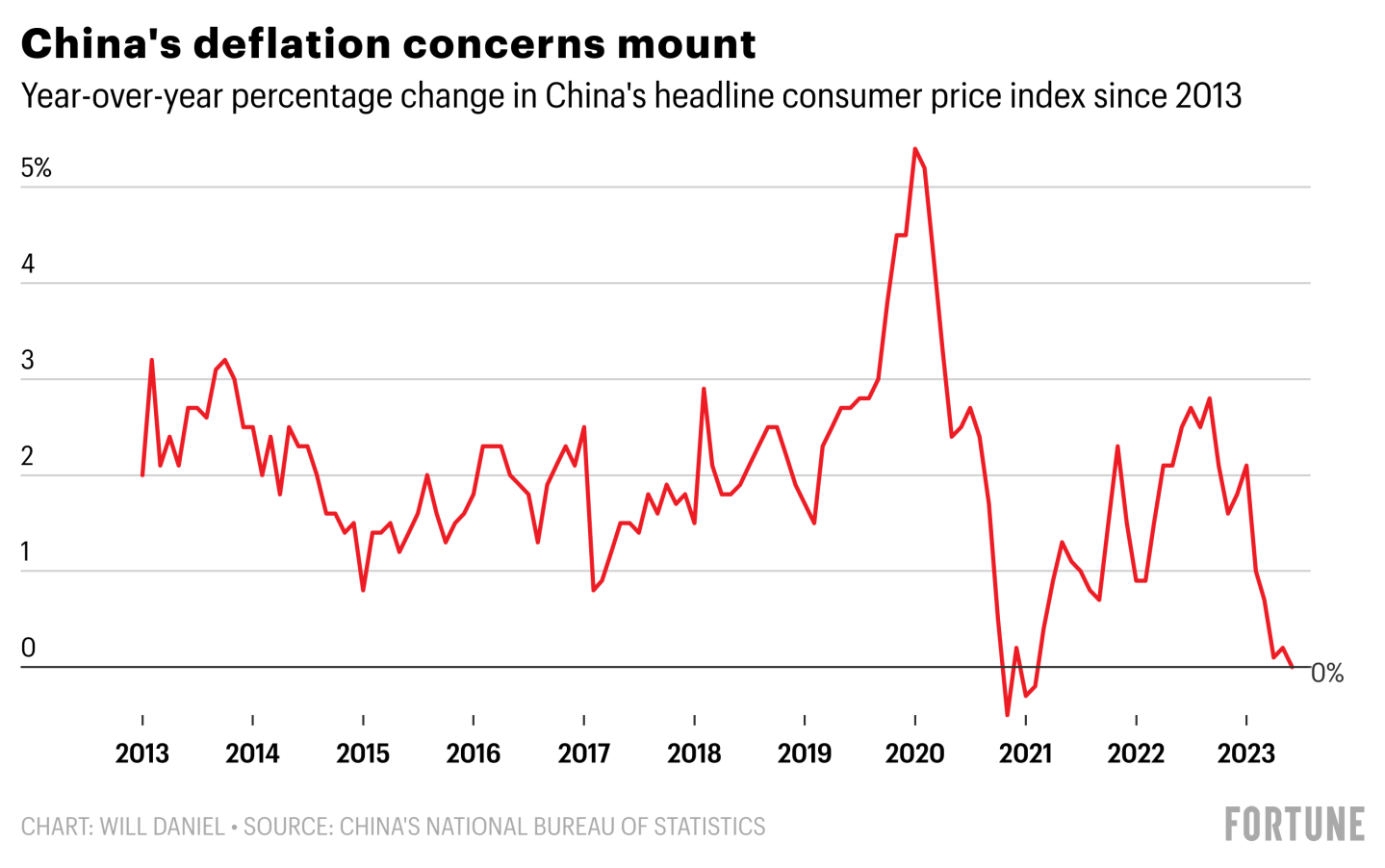
After rising 0.2% year over year in May, China’s consumer price index (CPI) was flat in June, surprising economists who had expected another 0.2% rise, according to China’s National Bureau of Statistics (NBS). The drop, which pushed Chinese inflation to its lowest level since February 2021, was driven mainly by falling pork and energy prices. But core inflation, which excludes more volatile food and energy prices, actually fell 0.1% from a year ago in June. Nomura analysts led by Harrington Zhang said in a Monday note that the data reflected “weak demand for core goods” and that they expect inflation to “slip further” next month to –0.5%.
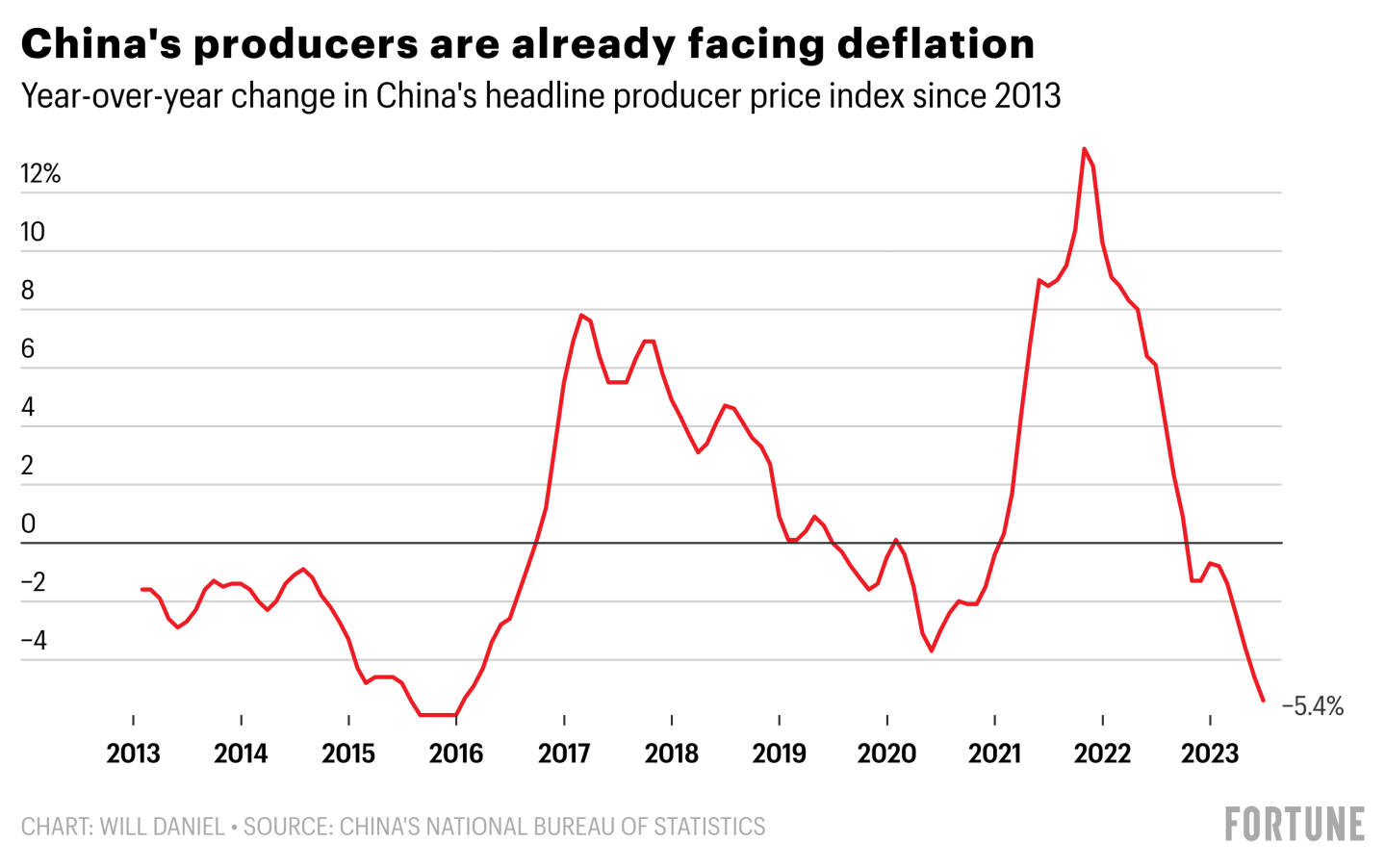
China’s producer price index (PPI) also sank 5.4% year over year last month, compared with a 4.6% drop in May, China’s NBS reported Monday. It was the sharpest decline in producer prices in more than seven years and the ninth consecutive down month for the index. Zhang and his team said the reading was largely a result of “a sharp decline” in raw materials prices and waning demand from manufacturers.
Amid signs of anemic growth and falling producer prices, the Chinese government and People’s Bank of China (PBoC) have been working to boost spending and investment in the country. While other nations have repeatedly raised interest rates to fight inflation this year, the PBoC decided to cut its key medium-term interest rate in June. And China’s State Council also pledged to roll out “more forceful measures” to boost economic growth last month. Nomura’s analysts believe the latest inflation data increases the odds that more fiscal and monetary stimulus will come throughout the year. All eyes will be on government officials at a politburo meeting later this month when they review the country’s first half economic performance and reveal their second half plan of attack.
“The ultralow inflation reading lends support to our view that the PBoC is likely to implement two more rounds of policy rate cuts of 10bp [basis points] each, and another 25bp [basis points] cut to the RRR over the rest of the year,” the Nomura analysts wrote, referencing China’s key medium-term interest rate as well as banks’ reserve requirement ratio (RRR).
An alarm bell for China
If officials in the Chinese Communist Party and at the PBoC aren’t able to boost economic growth and the Chinese economy becomes mired in deflation, it could be a nightmare scenario for the nation.
“It’s a real risk that their economy becomes stuck in this deflationary environment,” EY’s Daco explained. “We know, in terms of potential growth, from the Japanese experience that if you combine a deflationary environment and an elevated debt environment…it’s the worst of both worlds.”
Daco noted that deflation makes debt more expensive and also delays consumption and investment by consumers because they expect to be able to get a better deal in the future as prices fall. “So growth is delayed, and the cost of debt is increased,” he said.
Nomura Research Institute’s chief economist Richard Koo has warned that China is facing a “balance sheet recession” as was seen during Japan’s “lost decade” in the 1990s as consumers and businesses shift from investing and spending toward debt minimization owing to persistent deflation. This effect could be even worse in China because the country lacks a social safety net, according to EY’s Daco. Without government backing, Chinese consumers are forced to save far more instead of spending and investing to boost economic growth.
“It’s a lingering issue and a structural issue in the Chinese economy that we’ve had for decades now,” he said. “That’s one of the reasons why we still have an underwhelming growth trajectory from China—because people are not spending as freely as we have observed in the U.S. or in Europe post-COVID.”
Good news for the Federal Reserve
While deflation certainly isn’t going to help China’s domestic economy, it’s likely a welcome sign for the U.S. Federal Reserve, which is attempting to quash the remains of inflation after more than a year of aggressive interest rate hikes.
Ed Yardeni, veteran market watcher and founder of Yardeni Research, said that China’s deflation might help the U.S. producer price index (PPI) inflation rate “surprise to the downside” when it’s released on Thursday. He noted that the the U.S. PPI has historically been “highly correlated” with China’s owing to the level of trade between the two nations. “China’s weak post-pandemic recovery may be deflationary for the global economy,” he wrote in a Saturday note to clients.
EY’s Daco said that while no central bank wants to see deflation, the Fed would be pleased to see some “disinflationary currents from the rest of the world” amid its fight against rising U.S. consumer prices.
“If import prices are falling, that’s a positive sign. It means less pass-through to consumers, and that means less consumer price inflation. So those types of global disinflationary currents are certainly welcome from the Fed’s perspective,” he concluded.
China’s deflation issues may be good news for Fed officials, but the stakes for the global economy over the long term are massive. The nation’s rise from a developing nation to a global superpower and major economic rival to the U.S. since the 1990s has reshaped the world, and persistent deflation could challenge that status, recalling the America-Japan rivalry of the 1980s that went sideways in the 1990s and beyond. For China’s Gen Z, grappling with record high unemployment of more than 20%, it’s a disaster waiting to happen.