You’ve probably been hearing about the massive problem of the national debt for years. If you’re Gen Z, it’s been an issue your entire conscious life. Since 2000, the debt has grown from $5.6 trillion to over $31.38 trillion—a whopping 460% increase—while threatening to let the nation default has become a hot button issue. (The oldest members of Gen Z were born in 1997, so they’ve lived with financial doomsday warnings about the debt since they were 3 years old.) Threats in Congress to refuse to raise the debt ceiling have also grown in frequency over the last 20 years, usually as Republicans, the party traditionally associated with debt reduction (despite Republican Presidents George W. Bush and Donald Trump both significantly growing the deficit), hammer on the need to cut spending while a Democrat is in office.
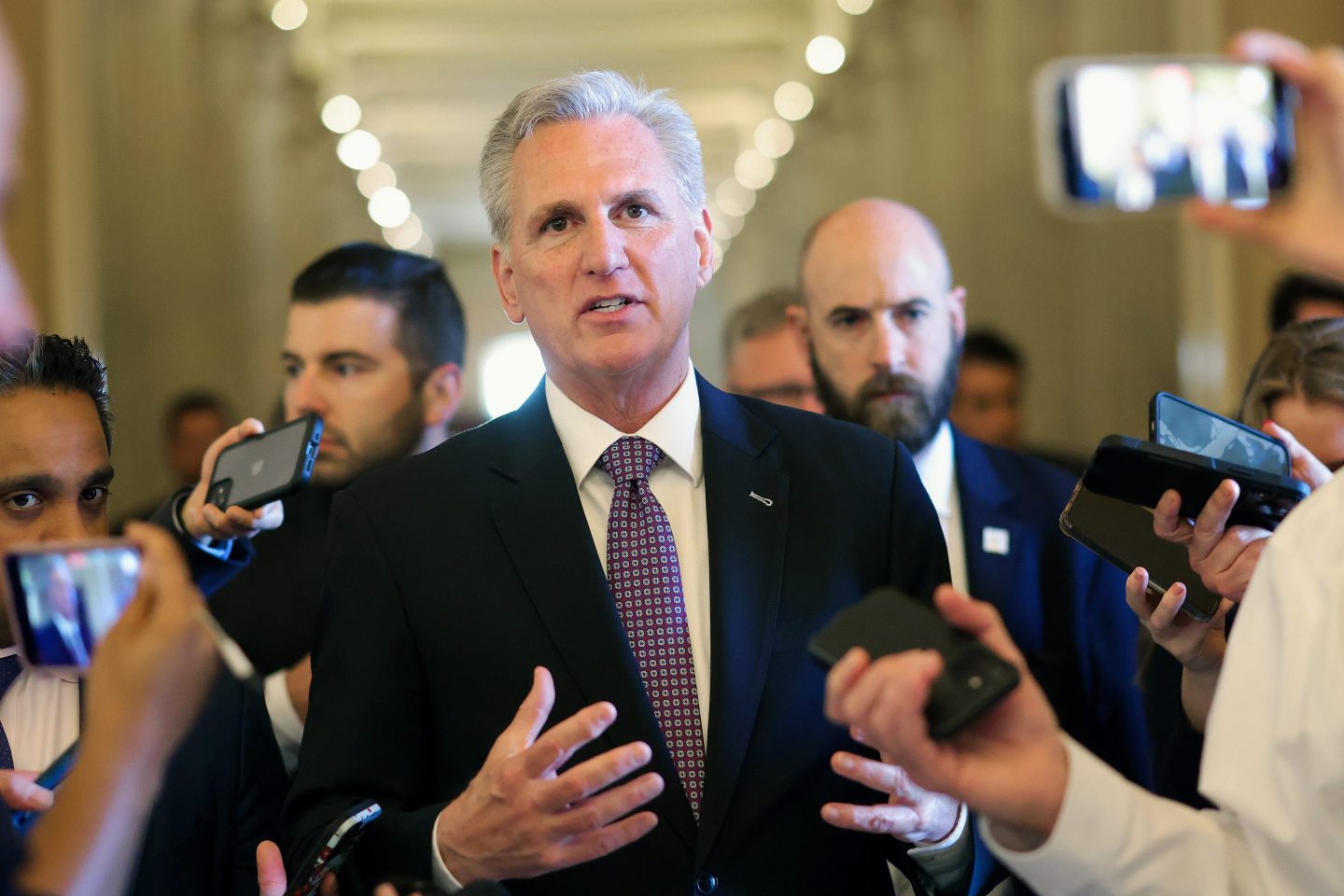
Still, despite a few close calls, the U.S. has never defaulted on its debt obligations. But the tug-of-war is playing out again today, as Republican Speaker of the House Kevin McCarthy has refused to pass what Democratic President Joe Biden calls a “clean” debt ceiling bill (i.e., with no spending cuts attached).
The debt ceiling is the legal limit on the total amount of debt the federal government can borrow to finance its spending. It’s not even a very old part of American history: It was enacted in another economic era, in 1917, as Congress ironically sought to streamline the fundraising process along with entry into World War I. The federal government technically hit the debt ceiling on January 19 of this year—the 79th time since 1960, according to the Treasury Department. As it has multiple times before, Treasury has been using what it calls “extraordinary measures” to keep paying America’s bills. But now, the so-called “X-date,” by which the government will not be able to fulfill all of its obligations even with these financial maneuvers is rapidly approaching, with Treasury Secretary Janet Yellen estimating the country could hit it as early as June 1.
Presidents in both Democratic and Republican administrations have raised the ceiling over 100 times since World War II, according to the Congressional Research Service. Though there have been many publicly partisan fights over it—perhaps most noticeably in 2011 and 2013—the parties have always reached some sort of agreement.
Yellen has been decrying the “catastrophic” effects of a default on not just the markets, the dollar’s reputation, and the U.S.’s credit rating, but also on the personal finances of huge swaths of the country. Experts such as Mark Zandi, chief economist of Moody’s Analytics, agree, as he testified to Congress recently: “The Treasury debt limit is an immediate threat to any optimism the economy can skirt recession in the coming year and poses a long-term threat to the nation’s finances and economic growth.”
So how could a failure to lift the debt ceiling—and a default on the national debt—hurt you? Here are three possible “catastrophic” financial disasters that could occur.
1 – Delayed Social Security payments
No one knows exactly how the government would react to an unprecedented default on its debt, but most immediately, the U.S. government might divert funds to its debt obligations, forgoing payments to tens of millions of Social Security beneficiaries in the process.
“Social Security beneficiaries seeing delays in their payments could face trouble with expenses such as rent and utilities,” write Wendy Edelberg of the Hamilton Project Louise Sheiner of the Hutchins Center on Fiscal and Monetary Policy. “[F]ederal contractors and employees would face uncertainty about how long their payments would be delayed.”
Eventually, the government would pay delayed benefits. But that could have catastrophic effects for many seniors and other recipients who rely on their monthly payments to get by.
2 – Higher interest rates
The economy has been hammered by higher interest rates for several months as the Federal Reserve has escalated its campaign to bring inflation down. Many financial experts—including Zandi—have said a recession is likely to happen this year. A failure to lift the debt ceiling would make a recession a nearly instant event. “The timing couldn’t be worse for the economy,” he said.
So interest rates on mortgages, car loans, and credit cards have already gone up, but a default would send them even higher—not to mention business borrowing costs.
And even if the debt were resolved after a default, “rates would not fall back to where they were previously,” Zandi said, since Treasury securities would no longer be perceived as risk-free by global investors, he predicted that “future generations of Americans would pay a steep economic price.”
Even the threat of breaching the debt ceiling can raise rates: The 2011 debt ceiling impasse led to increased borrowing costs totaling over $1 billion, according to the Government Accountability Office. And reports say the current uncertainty is already causing mortgage rates to rise now.
“If policymakers actually do fail to increase or suspend the limit before the Treasury runs out of cash and defaults on its obligations, interest rates will spike and stock prices will crater, with enormous costs to taxpayers and the economy,” Zandi said.
3 – Job loss and market turmoil
White House economists recently estimated that as many as 8 million people could lose their job during a prolonged default. It would also almost assuredly lead to a recession, affecting all Americans in some way, as “an actual default would roil global financial markets and create chaos,” according to the Committee for a Responsible Federal Budget. “Both domestic and international markets depend on the relative economic and political stability of U.S. debt instruments and the U.S. economy.”
Defaulting could put the country in a situation similar to the global financial crisis, according to the report from Moody’s. That could result in a loss of $12 trillion in household wealth, with stocks potentially falling by as much as one-third.
“The timing could not be worse for the economy; even before the specter of a debt limit breach, many CEOs and economists believe a recession is likely this year,” the report reads.
That said, the stock market has remained strong so far, even as the country moves closer to the X-date.
“On June 15th, quarterly federal income taxes are due. That will provide a big influx of revenue into the Treasury Department,” says Keith Singer, a certified financial planner (CFP) in Florida. “The question is will we make it to June 15th?”
Still, financial advisors say not to panic. Most have faith that Democrats and Republicans will be able to come to an agreement so as to avoid the financial markets falling into complete chaos.
“Should you be overly concerned in the next couple of weeks of the approaching X-date and pivot a good portion of your nest egg to cash, gold bars and crypto? The short answer is no,” says Jon Ulin, a CFP in Florida. “Simply put, the U.S. cannot afford to have its reputation tarnished.”