• Home
  • Latest
  • Fortune 500
  • Finance
  • Tech
  • Leadership
  • Lifestyle
  • Rankings
  • Multimedia
EnvironmentCalifornia

California legislators, with no explanation, block a bill that would have let people sue oil companies if they got sick from a nearby oil well

By
Sophie Austin
Sophie Austin
and
The Associated Press
Down Arrow Button Icon
By
Sophie Austin
Sophie Austin
and
The Associated Press
Down Arrow Button Icon
May 19, 2023, 5:27 AM ET
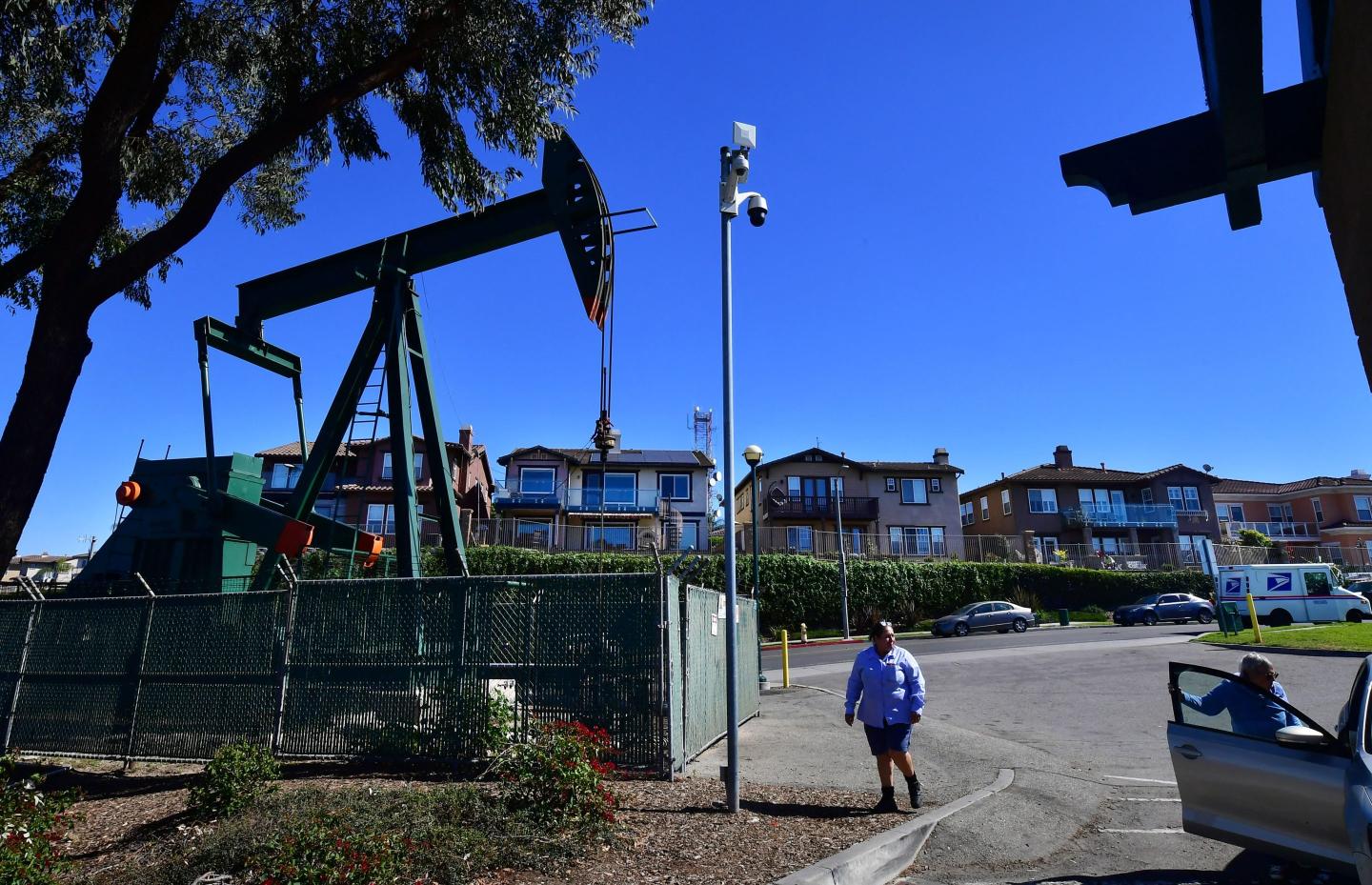
A California law banning new oil wells near homes and schools, passed last year, has yet to take effect after the oil industry helped push a voter referendum on the issue.
A California law banning new oil wells near homes and schools, passed last year, has yet to take effect after the oil industry helped push a voter referendum on the issue.Frederic J. Brown—AFP/Getty Images

California lawmakers blocked two big environmental bills Thursday: One that would have ramped up the state’s emissions targets, and another that would have made oil companies liable for the health problems of people who live close to oil wells.

Recommended Video

They are among the hundreds of bills that did not survive the Legislature’s suspense file, a mysterious process where lawmakers decide—with no explanation—which bills will get a chance to become law later this year and which ones should not move forward.

Last year, Gov. Gavin Newsom signed a law that bans drilling new oil wells within 3,200 feet (975 meters) of sensitive areas like homes and schools. But the law hasn’t taken effect because the oil industry qualified a referendum on the 2024 ballot asking voters to overturn it.

That referendum angered environmental and health advocates. They decided if the oil industry wanted to block that law, then they would try to pass another law to let people who got sick from living too close to wells to sue the oil companies responsible for them. The bill, authored by Sen. Lena Gonzalez, would have required oil companies to pay up to $1 million to people who have cancer or other health problems associated with the well.

“Today, we missed a key opportunity to advance legislation that would hold polluters accountable and prevent further harm to families who are just trying to stay healthy and have a better quality of life,” Gonzalez said in a statement.

The Senate Appropriations Committee stopped the bill from getting a vote by the full Senate, meaning it is not likely to become law this year. Jamie Court, president of the advocacy group Consumer Watchdog, blamed committee chair Sen. Anthony Portantino, a Democrat from Burbank who is also running for Congress.

“A bill like this should get a hearing by the full Senate and not be shoved in a drawer by one politician when we have millions of people living within a half mile of oil wells whose lives and health are at threat every damn day,” Court said.

Portantino’s office did not respond to an email seeking comment about why the bill was held.

Kara Greene, a spokesperson for the Western States Petroleum Association, which opposed the bill, said it would have been unfair to oil and gas companies and done more harm than good.

“The billions of dollars and the fiscal mess that this bill would have caused to the State and local governments from their own liabilities, the fiscal responsibility of inherited wells, and the cost to the court system, would be substantial,” Greene said in a statement.

State Sen. Henry Stern, a Malibu Democrat, introduced another bill this year that would have required the state to reduce its planet-warming emissions to 55% below the 1990 level by the end of 2030. The state has already set out to reduce those emissions by 40% by that same deadline.

“The bill dying was a reflection of the impasse I worry we’re heading towards on climate in California,” Stern said in a statement. “As the world races ahead, we may get stuck debating pathways forward.”

A similar bill introduced last year didn’t make it to the governor’s desk.

California is also aiming to achieve carbon neutrality, meaning the state will remove as many carbon emissions as it releases, by 2045. The state Air Resources Board has approved rules to limit pollution from cars, trucks, lawn mowers and trains.

Bills that were held in the Senate and Assembly appropriations committees are not likely to pass this year, with a June 2 deadline looming for legislation to advance from one chamber.

Other bills that failed included a plan to allow people struggling with suicidal thoughts to voluntarily register themselves on a “do not sell” list for firearms, and a proposal to ban people under 21 years old from using mobile phones, even hands-free, while driving. A bill that would require the Department of Justice to investigate all police’s use-of-force incidents that resulted in the death of civilians also didn’t make it through Thursday, nor did legislation that would have expanded access to mental health treatment for inmates.

Some proposals, including legislation to create a mental health hotline for California State University system students and a bill to stock government bathrooms with free menstrual products, were designated as two-year bills, meaning that they won’t be voted on before January.

Once bills are voted on in the Senate or Assembly, those that passed will move on to the other chamber. The Legislature has until mid-September to pass bills, then Newsom has about a month to reject them or sign them into law.

Join us at the Fortune Workplace Innovation Summit May 19–20, 2026, in Atlanta. The next era of workplace innovation is here—and the old playbook is being rewritten. At this exclusive, high-energy event, the world’s most innovative leaders will convene to explore how AI, humanity, and strategy converge to redefine, again, the future of work. Register now.
About the Authors
By Sophie Austin
See full bioRight Arrow Button Icon
By The Associated Press
See full bioRight Arrow Button Icon

Latest in Environment

carbon
Commentaryclimate change
Banking on carbon markets 2.0: why financial institutions should engage with carbon credits
By Usha Rao-MonariDecember 13, 2025
9 hours ago
mackenzie
Personal Financephilanthropy
‘This year, I really see education and climate’: Patterns in billionaire MacKenzie Scott’s massive giving emerge with time
By Thalia Beaty and The Associated PressDecember 11, 2025
2 days ago
Google DeepMind cofounder and CEO Demis Hassabis
AIU.K.
Google DeepMind agrees to sweeping partnership with U.K. government focused on science and clean energy
By Jeremy KahnDecember 10, 2025
3 days ago
InnovationBrainstorm AI
Rivian CEO says buying an EV isn’t a political choice, pointing out that R1 buyers are split evenly between Republicans and Democrats
By Jason MaDecember 10, 2025
3 days ago
AIBrainstorm AI
Google Cloud CEO lays out 3-part strategy to meet AI’s energy demands, after identifying it as ‘the most problematic thing’
By Jason MaDecember 8, 2025
5 days ago
Apple CEO Tim Cook wearing a white polo shirt and throwing up a peace sign
Big TechApple
Apple won’t be the same in 2026. Meet the company’s next generation of leaders and rising stars after its biggest executive exodus in years
By Dave SmithDecember 8, 2025
5 days ago

Most Popular

placeholder alt text
Economy
Tariffs are taxes and they were used to finance the federal government until the 1913 income tax. A top economist breaks it down
By Kent JonesDecember 12, 2025
1 day ago
placeholder alt text
Success
Apple cofounder Ronald Wayne sold his 10% stake for $800 in 1976—today it’d be worth up to $400 billion
By Preston ForeDecember 12, 2025
1 day ago
placeholder alt text
Success
40% of Stanford undergrads receive disability accommodations—but it’s become a college-wide phenomenon as Gen Z try to succeed in the current climate
By Preston ForeDecember 12, 2025
1 day ago
placeholder alt text
Economy
The Fed just ‘Trump-proofed’ itself with a unanimous move to preempt a potential leadership shake-up
By Jason MaDecember 12, 2025
1 day ago
placeholder alt text
Economy
For the first time since Trump’s tariff rollout, import tax revenue has fallen, threatening his lofty plans to slash the $38 trillion national debt
By Sasha RogelbergDecember 12, 2025
1 day ago
placeholder alt text
Success
Apple CEO Tim Cook out-earns the average American’s salary in just 7 hours—to put that into context, he could buy a new $439,000 home in just 2 days
By Emma BurleighDecember 12, 2025
1 day ago
Rankings
  • 100 Best Companies
  • Fortune 500
  • Global 500
  • Fortune 500 Europe
  • Most Powerful Women
  • Future 50
  • World’s Most Admired Companies
  • See All Rankings
Sections
  • Finance
  • Leadership
  • Success
  • Tech
  • Asia
  • Europe
  • Environment
  • Fortune Crypto
  • Health
  • Retail
  • Lifestyle
  • Politics
  • Newsletters
  • Magazine
  • Features
  • Commentary
  • Mpw
  • CEO Initiative
  • Conferences
  • Personal Finance
  • Education
Customer Support
  • Frequently Asked Questions
  • Customer Service Portal
  • Privacy Policy
  • Terms Of Use
  • Single Issues For Purchase
  • International Print
Commercial Services
  • Advertising
  • Fortune Brand Studio
  • Fortune Analytics
  • Fortune Conferences
  • Business Development
About Us
  • About Us
  • Editorial Calendar
  • Press Center
  • Work At Fortune
  • Diversity And Inclusion
  • Terms And Conditions
  • Site Map

© 2025 Fortune Media IP Limited. All Rights Reserved. Use of this site constitutes acceptance of our Terms of Use and Privacy Policy | CA Notice at Collection and Privacy Notice | Do Not Sell/Share My Personal Information
FORTUNE is a trademark of Fortune Media IP Limited, registered in the U.S. and other countries. FORTUNE may receive compensation for some links to products and services on this website. Offers may be subject to change without notice.