• Home
  • News
  • Fortune 500
  • Tech
  • Finance
  • Leadership
  • Lifestyle
  • Rankings
  • Multimedia
Environmentclimate change

The world’s largest lakes are losing 5.7 trillion gallons of water a year to climate change, study finds

By
Seth Borenstein
Seth Borenstein
and
The Associated Press
Down Arrow Button Icon
By
Seth Borenstein
Seth Borenstein
and
The Associated Press
Down Arrow Button Icon
May 18, 2023, 7:25 PM ET
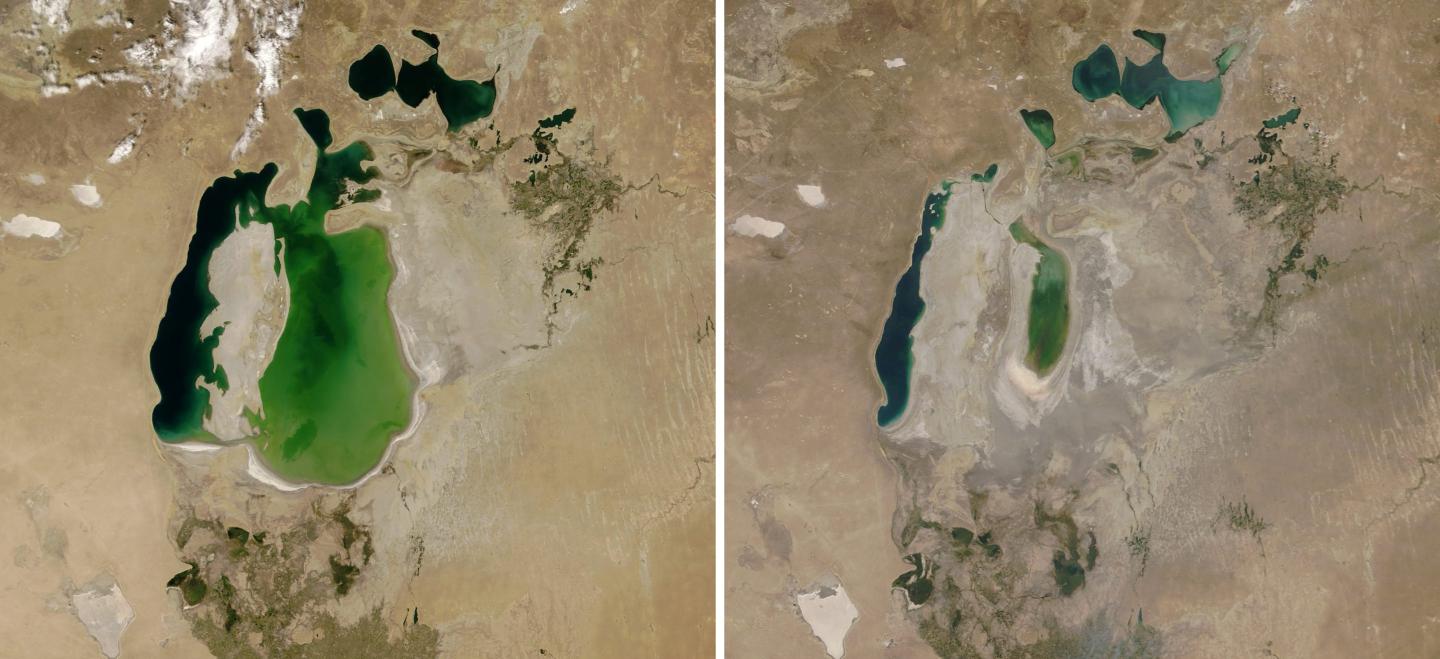
Aral Sea
These photos provided by NASA Earth Observatory shows the Aral Sea is visible on Aug. 25, 2000, left, and on Aug. 21, 2018 between Kazakhstan and Uzbekistan.NASA Earth Observatory via AP

Climate change ‘s hotter temperatures and society’s diversion of water have been shrinking the world’s lakes by trillions of gallons of water a year since the early 1990s, a new study finds.

Recommended Video

A close examination of nearly 2,000 of the world’s largest lakes found they are losing about 5.7 trillion gallons (21.5 trillion liters) a year. That means from 1992 to 2020, the world lost the equivalent of 17 Lake Meads, America’s largest reservoir, in Nevada. It’s also roughly equal to how much water the United States used in an entire year in 2015.

Even lakes in areas getting more rainfall are shriveling. That’s because of both a thirstier atmosphere from warmer air sucking up more water in evaporation, and a thirsty society that is diverting water from lakes to agriculture, power plants and drinking supplies, according to a study in Thursday’s journal Science.

Authors also cited a third reason they called more natural, with water shrinking because of rainfall pattern and river runoff changes, but even that may have a climate change component. That’s the main cause for Iran’s Lake Urmia to lose about 277 billion gallons (1.05 trillion liters) a year, the study said.

The declining lakes don’t mean places are suddenly going to go without drinking water, but it may lead to more competition for lake water, which is also used in hydroelectric power and recreation such as boating, the study authors said.

“More than half of the decline is primarily attributable to human consumption or indirect human signals through climate warming,” said study lead author Fangfang Yao, a climate scientist at the University of Colorado.

The diversion of water from lakes — a direct human cause of shrinkage — is probably larger and more noticeable because it is “very acute, very local and it has the capability of really changing the landscape,” said co-author Ben Livneh, a University of Colorado hydrologist.

But the indirect human shrinking, from warmer air due to climate change, “is this global blanketing effect that kind of affects everything or more places,” Livneh said. California’s Mono Lake is a good example of this type of shrinking, Yao said.

Even areas that are getting wetter because of climate change are losing lake water because hotter air is sucking more moisture out of the lakes. And that means more water in the air, which can fall as rain or snow but “may end up falling as rain far away, outside the basin where it evaporated or even over the ocean,” Livneh said in an email.

Yao, Livneh and colleagues used almost 30 years of satellite observation, climate data and computer simulation to figure out what’s happening to lakes and found more than half of them have shrunk so much that it is statistically significant and not random.

In the United States, Lake Mead lost two-thirds of its water between 1992 and 2020, while the Great Salt Lake also shrank noticeably, Yao said. The Great Lakes dropped considerably from 1992 to 2013 then plateaued and then increased.

Another problem is that lakes are filling with sediment or dirt from upstream rivers.

Scientists have long known about the problems of climate change, diversion and sedimentation, “however the complete quantification of water storage variations for large lakes that Yao and colleagues provide is new” and it creates “a much more complete picture” than past research has, said University of North Carolina hydrology professor Tamlin Pavelsky, who wasn’t part of the study.

“I’m generally most worried about lakes that are ecologically important and in populated areas without a lot of other good sources of water,” Pavelsky said in an email. “Lake Urmia in Iran, the Dead Sea, the Salton Sea … these are all worrisome.”

It’s likely to get worse as society looks for more water and more reservoirs with a growing population and a warmer Earth, said UCLA climate hydrologist Park Williams, who wasn’t part of the study.

___

Associated Press climate and environmental coverage receives support from several private foundations. See more about AP’s climate initiative here. The AP is solely responsible for all content.

Fortune Brainstorm AI returns to San Francisco Dec. 8–9 to convene the smartest people we know—technologists, entrepreneurs, Fortune Global 500 executives, investors, policymakers, and the brilliant minds in between—to explore and interrogate the most pressing questions about AI at another pivotal moment. Register here.
About the Authors
By Seth Borenstein
See full bioRight Arrow Button Icon
By The Associated Press
See full bioRight Arrow Button Icon

Latest in Environment

coal
EnvironmentCoal
‘You have an entire culture, an entire community that is also having that same crisis’: Colorado coal town looks anxiously to the future
By Brittany Peterson, Jennifer McDermott and The Associated PressDecember 6, 2025
1 day ago
data center
EnvironmentData centers
The rise of AI reasoning models comes with a big energy tradeoff
By Rachel Metz, Dina Bass and BloombergDecember 5, 2025
2 days ago
Jaguar
EnvironmentArizona
‘This species is recovering’: Jaguar spotted in Arizona, far from Central and South American core
By Susan Montoya Bryan and The Associated PressDecember 5, 2025
2 days ago
Steve Jobs holds up the first iPod Nano
Big TechApple
Apple is experiencing its biggest leadership shake-up since Steve Jobs died, with over half a dozen key executives headed for the exits
By Dave SmithDecember 5, 2025
2 days ago
Paul Atkins
CommentaryCorporate Governance
Turning public companies into private companies: the SEC’s retreat from transparency and accountability
By Andrew BeharDecember 5, 2025
2 days ago
Four years ago, BKV started buying up the two Temple power plants in Texas—located between Austin and Dallas—which now total 1.5 gigawatts of electricity generation capacity—enough to power more than 1.1 million homes, or a major data center campus. There is room to expand.
Energypower
How a Texas gas producer plans to exploit the ‘megatrend’ of power plants for AI hyperscalers
By Jordan BlumDecember 5, 2025
3 days ago

Most Popular

placeholder alt text
AI
Nvidia CEO says data centers take about 3 years to construct in the U.S., while in China 'they can build a hospital in a weekend'
By Nino PaoliDecember 6, 2025
1 day ago
placeholder alt text
Economy
The most likely solution to the U.S. debt crisis is severe austerity triggered by a fiscal calamity, former White House economic adviser says
By Jason MaDecember 6, 2025
23 hours ago
placeholder alt text
Real Estate
The 'Great Housing Reset' is coming: Income growth will outpace home-price growth in 2026, Redfin forecasts
By Nino PaoliDecember 6, 2025
1 day ago
placeholder alt text
Big Tech
Mark Zuckerberg rebranded Facebook for the metaverse. Four years and $70 billion in losses later, he’s moving on
By Eva RoytburgDecember 5, 2025
2 days ago
placeholder alt text
Asia
Despite their ‘no limits’ friendship, Russia is paying a nearly 90% markup on sanctioned goods from China—compared with 9% from other countries
By Jason MaNovember 29, 2025
8 days ago
placeholder alt text
Economy
JPMorgan CEO Jamie Dimon says Europe has a 'real problem’
By Katherine Chiglinsky and BloombergDecember 6, 2025
22 hours ago
Rankings
  • 100 Best Companies
  • Fortune 500
  • Global 500
  • Fortune 500 Europe
  • Most Powerful Women
  • Future 50
  • World’s Most Admired Companies
  • See All Rankings
Sections
  • Finance
  • Leadership
  • Success
  • Tech
  • Asia
  • Europe
  • Environment
  • Fortune Crypto
  • Health
  • Retail
  • Lifestyle
  • Politics
  • Newsletters
  • Magazine
  • Features
  • Commentary
  • Mpw
  • CEO Initiative
  • Conferences
  • Personal Finance
  • Education
Customer Support
  • Frequently Asked Questions
  • Customer Service Portal
  • Privacy Policy
  • Terms Of Use
  • Single Issues For Purchase
  • International Print
Commercial Services
  • Advertising
  • Fortune Brand Studio
  • Fortune Analytics
  • Fortune Conferences
  • Business Development
About Us
  • About Us
  • Editorial Calendar
  • Press Center
  • Work At Fortune
  • Diversity And Inclusion
  • Terms And Conditions
  • Site Map

© 2025 Fortune Media IP Limited. All Rights Reserved. Use of this site constitutes acceptance of our Terms of Use and Privacy Policy | CA Notice at Collection and Privacy Notice | Do Not Sell/Share My Personal Information
FORTUNE is a trademark of Fortune Media IP Limited, registered in the U.S. and other countries. FORTUNE may receive compensation for some links to products and services on this website. Offers may be subject to change without notice.