• Home
  • Latest
  • Fortune 500
  • Finance
  • Tech
  • Leadership
  • Lifestyle
  • Rankings
  • Multimedia
FinanceBanks

New York Fed economists explain why SVB and Signature Bank suddenly turned into rural 1930s banks without deposit insurance

Tristan Bove
By
Tristan Bove
Tristan Bove
Down Arrow Button Icon
May 15, 2023, 6:08 PM ET
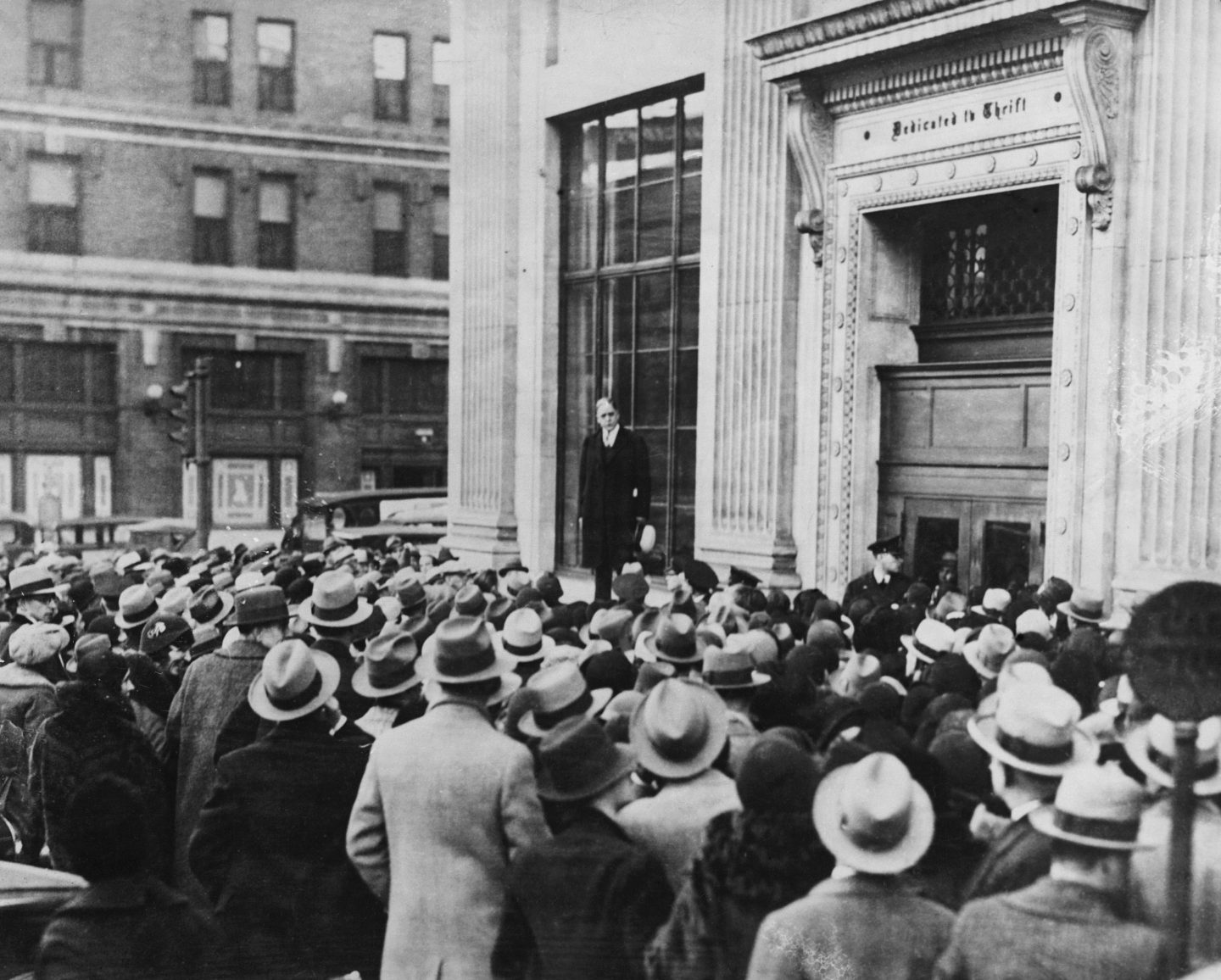
John Poole, president of the Federal American Bank, addresses a crowd of depositors in 1933.
John Poole, president of the Federal American Bank, addresses a crowd of depositors in 1933.Hulton-Deutsch Collection/CORBIS/Corbis via Getty Images

In the wake of Depression-era bank runs that caused thousands of financial institutions to fail, the government began doing something different in the 1930s—it created the FDIC and started insuring deposits. It was intended to make people feel confident in the banking system, and less likely to pull their money out. 

Recommended Video

But that deposit insurance only goes so far—up to $250,000 for each depositor, to be exact. So when Silicon Valley Bank and Signature Bank collapsed in March and sent ripple effects throughout the banking sector, many pointed to the banks’ swathes of uninsured deposits totalling in the millions and billions as one of the main factors behind the panic, along with the Federal Reserve’s interest rate hikes and depositor panic fueled by social media. 

Although SVB and Signature were covered by the Federal Deposit Insurance Corporation, the nature of their deposits—many uninsured and in a small amount of industries—has similarities with the 9,000 banks that failed in the 1930s, according to a new blog post by economists with the Federal Reserve Bank of New York. 

The authors argue that like Depression-era banks in tiny rural communities, deposits with SVB and Signature were held by a small number of like-minded people, many of whom worked in the same industry and spoke with each other frequently. The banks also failed to control the narrative, which magnified the risk of a chaotic bank. 

With their “concentrated and uninsured deposit bases,” Silicon Valley Bank and Signature Bank look “quite similar to the small rural banks of the 1930s, before the creation of deposit insurance,” the Fed economists wrote.

Parallels to the 1930s

During the first years of the Great Depression, thousands of bank failures led to $1.3 billion in losses for depositors. But the damage was likely magnified because of the lack of deposit insurance—individual bank customers were more likely to pull out their money out of a bank at the first signs of trouble. 

“Before the FDIC was in operation, large-scale cash demands of fearful depositors often struck the fatal blow to banks that might otherwise have survived,” the FDIC’s website states. Many of those failed banks were dedicated to rural communities, with the majority of their depositors being local and employed in the agricultural sector. 

Although SVB and Signature banks didn’t cater to small town farmers, the Fed economists pointed out that their depositors were also part of tight-knit communities—in finance, tech and law. 

“Both SVB and SB had a depositor base that looked local, in that depositors reportedly interacted with one another in their regular business dealings,” they wrote. “SVB’s depositors were connected through venture capital networks and SB’s depositors were connected through law firm networks.”

Before its collapse, SVB had made a name for itself as the bank of choice for California’s startup and venture capital elite. Nearly half of all U.S. venture-backed startups banked with SVB, according to the bank itself, and its big gamble to concentrate on tech, which for years seemed like a good bet, eventually came back to bite it as a significant number of its clients were affected by evaporated VC funding over the past year.

Signature also had a concentration problem, as one of the only banks to offer services to crypto companies after many others began turning their backs on the sector earlier this year. Signature’s deposits were more diversified than Silvergate, a bank highly-focused on cryptocurrency that also collapsed in March, but was still reliant on customers from a relatively small pool of industries, as Signature was largely concentrated in banking services for real estate and law firms.

Because the bulk of both banks’ clients were companies, most deposits also exceeded the FDIC’s insurable limit of $250,000. In fact, the two banks had some of the highest proportions of uninsured deposits in the whole banking sector. Among banks with at least $50 billion in assets, SVB had the highest share of uninsured deposits at 93.8%, while Signature came in fourth with 89.3%, according to S&P Global Market Intelligence.

As many of the bank’s depositors knew each other professionally, the bank runs happened almost overnight, as account-holders spread panic on social media and instant messaging platforms like Twitter, Slack, and Whatsapp, with some venture capitalists telling their portfolio companies on group chats to move their funds out of SVB “as fast as possible,” magnifying the risks of concentration.

The New York Fed economists argued that the banks’ failure of communication and transparency was chiefly responsible for the sudden run, while advising other institutions to focus on managing narratives around risk that might threaten to erode confidence in future. 

Like the small rural banks that failed a century ago, banks like SVB and Signature with highly concentrated and localized customer bases need to be adept at handling information to restore confidence before panic, which justified or not, undermines the financial soundness of banking institutions, the New York Fed economists wrote.

“Both SVB and SB, like the small rural banks before the creation of the FDIC, should have been acutely aware of the importance of managing the information about their balance sheet,” they said. “Looking ahead, our work emphasizes that banks need to remain aware of, and actively manage, the information about balance sheet risks that is presented to their depositors, especially in times of financial stress.”

Join us at the Fortune Workplace Innovation Summit May 19–20, 2026, in Atlanta. The next era of workplace innovation is here—and the old playbook is being rewritten. At this exclusive, high-energy event, the world’s most innovative leaders will convene to explore how AI, humanity, and strategy converge to redefine, again, the future of work. Register now.
About the Author
Tristan Bove
By Tristan Bove
LinkedIn iconTwitter icon
See full bioRight Arrow Button Icon

Latest in Finance

Finance
Lorem ipsum dolor sit amet, consectetur adipiscing elit, sed do eiusmod tempor incididunt ut labore et dolore magna aliqua. Ut enim ad minim veniam
By Fortune Editors
October 20, 2025
Finance
Lorem ipsum dolor sit amet, consectetur adipiscing elit, sed do eiusmod tempor incididunt ut labore et dolore magna aliqua. Ut enim ad minim veniam
By Fortune Editors
October 20, 2025
Finance
Lorem ipsum dolor sit amet, consectetur adipiscing elit, sed do eiusmod tempor incididunt ut labore et dolore magna aliqua. Ut enim ad minim veniam
By Fortune Editors
October 20, 2025
Finance
Lorem ipsum dolor sit amet, consectetur adipiscing elit, sed do eiusmod tempor incididunt ut labore et dolore magna aliqua. Ut enim ad minim veniam
By Fortune Editors
October 20, 2025
Finance
Lorem ipsum dolor sit amet, consectetur adipiscing elit, sed do eiusmod tempor incididunt ut labore et dolore magna aliqua. Ut enim ad minim veniam
By Fortune Editors
October 20, 2025
Finance
Lorem ipsum dolor sit amet, consectetur adipiscing elit, sed do eiusmod tempor incididunt ut labore et dolore magna aliqua. Ut enim ad minim veniam
By Fortune Editors
October 20, 2025

Most Popular

Finance
Lorem ipsum dolor sit amet, consectetur adipiscing elit, sed do eiusmod tempor incididunt ut labore et dolore magna aliqua. Ut enim ad minim veniam
By Fortune Editors
October 20, 2025
Finance
Lorem ipsum dolor sit amet, consectetur adipiscing elit, sed do eiusmod tempor incididunt ut labore et dolore magna aliqua. Ut enim ad minim veniam
By Fortune Editors
October 20, 2025
Finance
Lorem ipsum dolor sit amet, consectetur adipiscing elit, sed do eiusmod tempor incididunt ut labore et dolore magna aliqua. Ut enim ad minim veniam
By Fortune Editors
October 20, 2025
Finance
Lorem ipsum dolor sit amet, consectetur adipiscing elit, sed do eiusmod tempor incididunt ut labore et dolore magna aliqua. Ut enim ad minim veniam
By Fortune Editors
October 20, 2025
Finance
Lorem ipsum dolor sit amet, consectetur adipiscing elit, sed do eiusmod tempor incididunt ut labore et dolore magna aliqua. Ut enim ad minim veniam
By Fortune Editors
October 20, 2025
Finance
Lorem ipsum dolor sit amet, consectetur adipiscing elit, sed do eiusmod tempor incididunt ut labore et dolore magna aliqua. Ut enim ad minim veniam
By Fortune Editors
October 20, 2025
Rankings
  • 100 Best Companies
  • Fortune 500
  • Global 500
  • Fortune 500 Europe
  • Most Powerful Women
  • Future 50
  • World’s Most Admired Companies
  • See All Rankings
Sections
  • Finance
  • Leadership
  • Success
  • Tech
  • Asia
  • Europe
  • Environment
  • Fortune Crypto
  • Health
  • Retail
  • Lifestyle
  • Politics
  • Newsletters
  • Magazine
  • Features
  • Commentary
  • Mpw
  • CEO Initiative
  • Conferences
  • Personal Finance
  • Education
Customer Support
  • Frequently Asked Questions
  • Customer Service Portal
  • Privacy Policy
  • Terms Of Use
  • Single Issues For Purchase
  • International Print
Commercial Services
  • Advertising
  • Fortune Brand Studio
  • Fortune Analytics
  • Fortune Conferences
  • Business Development
About Us
  • About Us
  • Editorial Calendar
  • Press Center
  • Work At Fortune
  • Diversity And Inclusion
  • Terms And Conditions
  • Site Map

Latest in Finance

tariffs
PoliticsTariffs and trade
53-year-old customs broker wants to ‘Make Trade Boring Again,’ saying you won’t believe how complex cheese is these days
By Matt Sedensky and The Associated PressDecember 24, 2025
5 hours ago
gas
Energyoil and gas
Americans may be angry about affordability, but gas prices are the cheapest they’ve been all year in most states
By Wyatte Grantham-Philips and The Associated PressDecember 24, 2025
6 hours ago
Big TechTesla
Tesla faces NHTSA probe over Model 3 emergency door handles
By Dana Hull and BloombergDecember 24, 2025
8 hours ago
Donald Trump, standing in the Oval Office, frowns and looks to the side.
Economyaffordability
Obama’s former top economic advisor says he feels ‘a tiny bit bad’ for Trump because gas prices are low, but consumer confidence is still plummeting 
By Sasha RogelbergDecember 24, 2025
10 hours ago
EconomyMillionaires
Millionaire tax plans spread as Washington state eyes new levy
By Anna Edgerton, Casey Murray and BloombergDecember 24, 2025
11 hours ago
Dianna Tompkins sits on a stair in front of her home in Demotte, Ind., Dec. 17, 2025.
Arts & Entertainmentgovernment shutdown
When SNAP payments stopped, a fast-moving nonprofit program rushed in with $12 million—and kept families fed
By James Pollard and The Associated PressDecember 24, 2025
11 hours ago

© 2025 Fortune Media IP Limited. All Rights Reserved. Use of this site constitutes acceptance of our Terms of Use and Privacy Policy | CA Notice at Collection and Privacy Notice | Do Not Sell/Share My Personal Information
FORTUNE is a trademark of Fortune Media IP Limited, registered in the U.S. and other countries. FORTUNE may receive compensation for some links to products and services on this website. Offers may be subject to change without notice.


Most Popular

placeholder alt text
Retail
Trump just declared Christmas Eve a national holiday. Here’s what’s open and closed
By Dave SmithDecember 24, 2025
17 hours ago
placeholder alt text
Personal Finance
Financial experts warn future winner of the $1.7 billion Powerball: Don't make these common money mistakes
By Ashley LutzDecember 23, 2025
1 day ago
placeholder alt text
Personal Finance
Trump turns government into giant debt collector with threat to garnish wages on millions of Americans in default on student loans
By Annie Ma and The Associated PressDecember 24, 2025
16 hours ago
placeholder alt text
Economy
Obama's former top economic advisor says he feels 'a tiny bit bad' for Trump because gas prices are low, but consumer confidence is still plummeting 
By Sasha RogelbergDecember 24, 2025
10 hours ago
placeholder alt text
Success
The average worker would need to save for 52 years to claw their way out of the middle class and be classified as wealthy, new research reveals
By Orianna Rosa RoyleDecember 23, 2025
1 day ago
placeholder alt text
Success
'When we got out of college, we had a job waiting for us': 80-year-old boomer says her generation left behind a different economy for her grandkids
By Mike Schneider and The Associated PressDecember 23, 2025
2 days ago