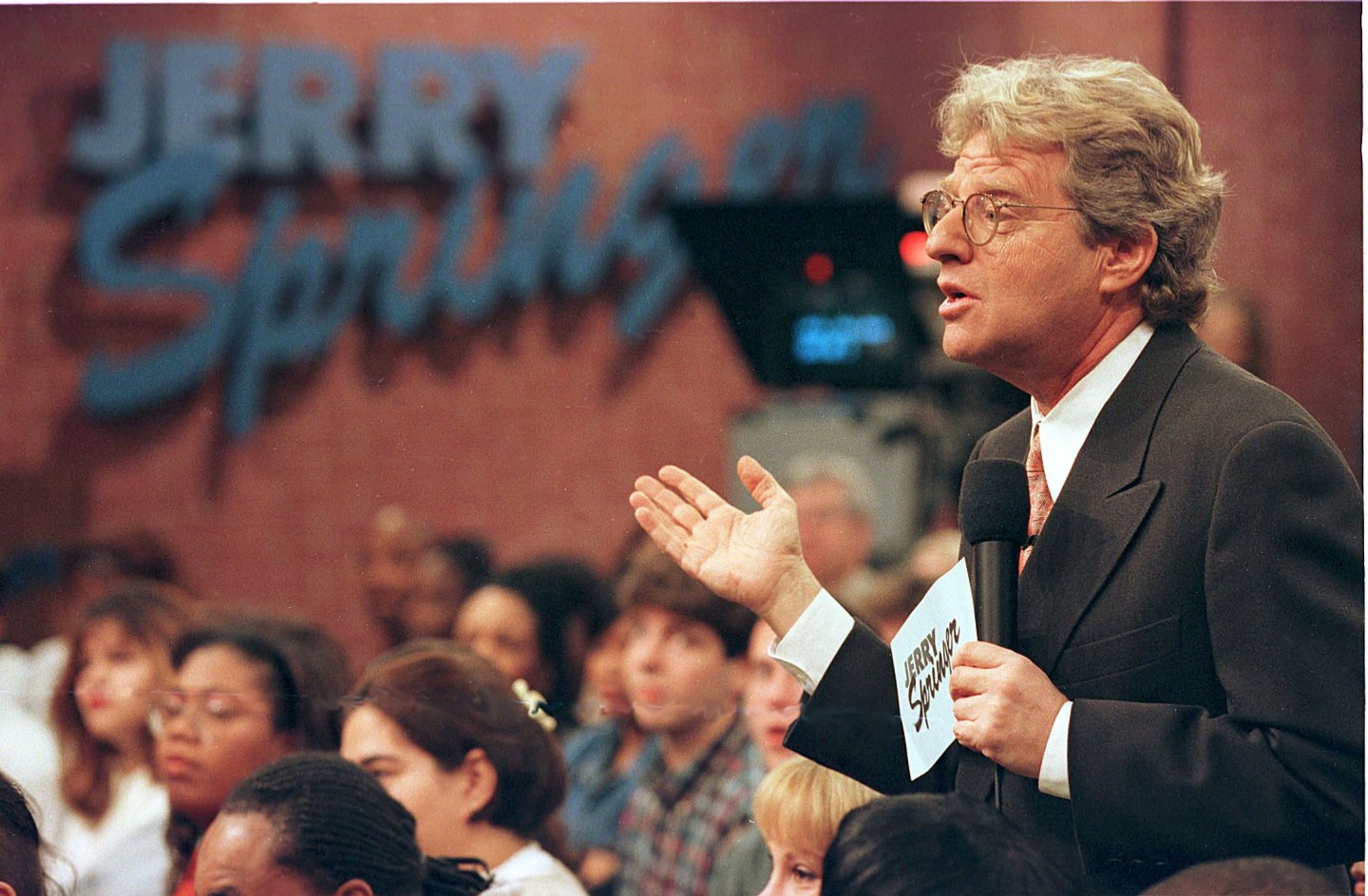
Since Jerry Springer’s death on April 27, 2023, writers have been working through the cultural significance of his eponymous daytime talk show.
For 27 years, Springer’s circus of sensationalism was a remarkably durable and bankable commodity. Helping to normalize outrageousness in culture, it taught content creators that shamelessness is a lucrative industry.
It’s been framed as a harbinger of “‘anything goes’ reality television” or “trash TV” and decried for setting a “new standard for tawdriness” and for providing audiences with the “guilty pleasure” of “chair-throwing.”
But as a media historian interested in the ways that sound structures our experience of TV shows and films, when I think of “The Jerry Springer Show,” I think of the sounds – the studio audience chanting “Jerry! Jerry!,” the boxing bell ringing when fists start flying, and the sonic dissonance between the heavy metal-tinged theme song and the soothing, paternal tone of its host.
But one of its most iconic sounds was added in post-production: the 1000 hertz censor bleep, which became more prevalent as the behavior on the show grew more profane.
The origins of bleeping
The history of broadcasters’ bleeping out profanity reveals a lot about our culture’s ongoing negotiation of a murky concept.
While the First Amendment protects political speech, it does not protect profanity, and in 1964 the Supreme Court gave the Federal Communications Commission the authority to police language in broadcasting.
Yet using sounds to mask offensive language predates the FCC and dates back to a 1921 radio speech on Newark, New Jersey’s WJZ by vaudeville actress Olga Petrova. Petrova was famous for her outspoken advocacy for feminism and birth control, and station managers worried that she might violate the 1873 Comstock Act, which prohibited the distribution of obscene materials, including information about contraception. So the radio engineers created a mechanism for masking her words with music from a phonograph when she dared speak her mind – and they ended up needing to use it several times.
By the time the FCC was established in 1927, studio engineers were regularly masking profanity, as the industry was always trying to stay one step ahead of the censors and stay in the good graces of advertisers. Further innovations, like the seven-second delay, aided the policing of live talk shows, allowing engineers to cover dirty words before they reached the audience’s ears.
Just exactly who deployed the bleep tone first is unclear, but engineers had long used the 1000 hertz sine wave tone to test equipment connections, so it was at their fingertips. By the mid-1960s, the bleep tone was heard everywhere, so much so that bleeping was used in FCC deliberations as a verb to define the practice of masking profanity.
Bleeping’s feedback loop
Yet by 1970, bleeping out words on TV news was viewed as a potential problem, with some regulators wondering if it unnecessarily tempered the way people actually behaved.
FCC chairman Dean Burch, for example, thought the commission should reconsider its use: “If a man stands up and calls me a dirty son of a bitch, I wonder whether we are giving the viewer the full flavor of the news if we quote him as saying, ‘You’re a dirty bleep, bleep, bleep.’”
Nonetheless, most broadcasters tended to err on the side of caution. Bleeping out profanity became so common in U.S. broadcasting that it inspired George Carlin to satirize the practice in his Seven Dirty Words You Can’t Say on TV monologue.
After the FCC came down on Pacifica Radio for broadcasting the bit, Pacifica sued the FCC and the case made it to the Supreme Court, which, in its decision, granted the FCC limited power to protect the public from profanity, especially during the daytime when kids might be listening.
Afterward, bleeping became more commonplace on radio and television.
Yet for audiences yearning for counterculture programming that seemed more real, focusing attention on profanity by bleeping it created a feedback loop that made cursing – and the rebels who did it – more appealing to audiences, piquing their interest about what the bleep concealed.
At the same time, networks pushing for deregulation wanted to show that they could self-censor and that FCC oversight wasn’t necessary. By the early 1980s, a new radio format based on shocking public sensibilities, the “shock jock,” had emerged. Radio performers like Don Imus and Howard Stern found that audiences would tune in to hear profane behavior and would return daily to see just how far the performers would go.
Industry programming followed the ratings.
Springer’s brand of profane realism
By the time Springer’s show began in 1991, a paradoxical mix of deregulation and self-censoring had settled over the industry, producing edgy shows with lots of bleeps.
Audiences experienced bleeped performances as more authentic. Provocateurs like Madonna knew cursing drew attention, and she has repeatedly used the self-promotional technique ever since her infamous spot on “The Arsenio Hall Show” in 1990, when she talked about giving good [bleep]. It was the highest-rated Arsenio show ever.
Springer quickly learned that booking guests who required bleeps boosted ratings.
As the show found its niche, it shifted so that it was no longer Springer confronting racists, deviants or polygamists. Instead, guests involved in relationship betrayals or with simmering resentments would confront one another. As the frequency of the bleeps and fights increased, the ratings began to soar. By 1997, it often matched “The Oprah Winfrey Show” at the top of the ratings leaderboard.
In one “Final Thoughts” segment in 1995, Springer defended his fight-inducing exploitation of raw emotion, calling it “the price of reality, this loss of civility, as we take entertainment to the edge of real life and real people.” The bleeping became central to the aesthetic, a Pavlovian signal to audiences at home that the explosive behavior was “real.”
In fact, media researchers have shown that bleeping words actually draws attention to them and that audiences perceive the frequency of profanity to be higher when words are bleeped.
That [bleeping] reality TV sound
By the turn of the century, the show’s sound mix was set, with audiences chanting “Jerry! Jerry!” whenever the bleeps started flying. By the show’s third decade, in episodes like “You slept with my stripper sister,” everyone seemed to be in on the pro wrestling nature of the spectacle.
In case they weren’t, the bleep sound was often accompanied by a boxing bell, cuing everyone that [bleep] was getting real.
Toward the end of the show’s run, the meaning of the bleep sound became more comedic. Where audience reaction shots once revealed them gasping, now they were laughing.
The bleep sound, a standard effect heard across the burgeoning reality TV format, had great comedic impact in shows like “The Osbournes,” where Ozzy would stumble around muttering profanity that had to be bleeped. It’s telling that the bleep became a sound effect used in scripted comedy as well, exploited in shows like “Arrested Development” and “South Park” for maximum effect.
Today, when broadcasters want to censor profanity on live shows, like they did during the Oscars after Will Smith slapped Chris Rock, they tend to mute the sound rather than bleep over it.
Nonetheless, even if what counts as profanity keeps shifting, the meaning of the bleep sound is universally understood: It means profanity is happening. And like the definition of obscenity given by Supreme Court Justice Potter Stewart way back in 1964, people know it when they hear it.
Matthew Jordan is Associate Professor of Media Studies, Penn State.
This article is republished from The Conversation under a Creative Commons license. Read the original article.