• Home
  • Latest
  • Fortune 500
  • Finance
  • Tech
  • Leadership
  • Lifestyle
  • Rankings
  • Multimedia
FinanceFederal Reserve

Silicon Valley Bank collapsed because its managers were terrible and regulators dropped the ball, according to a new Fed report

By
Christopher Rugaber
Christopher Rugaber
,
Ken Sweet
Ken Sweet
, and
The Associated Press
Down Arrow Button Icon
By
Christopher Rugaber
Christopher Rugaber
,
Ken Sweet
Ken Sweet
, and
The Associated Press
Down Arrow Button Icon
April 28, 2023, 11:17 AM ET
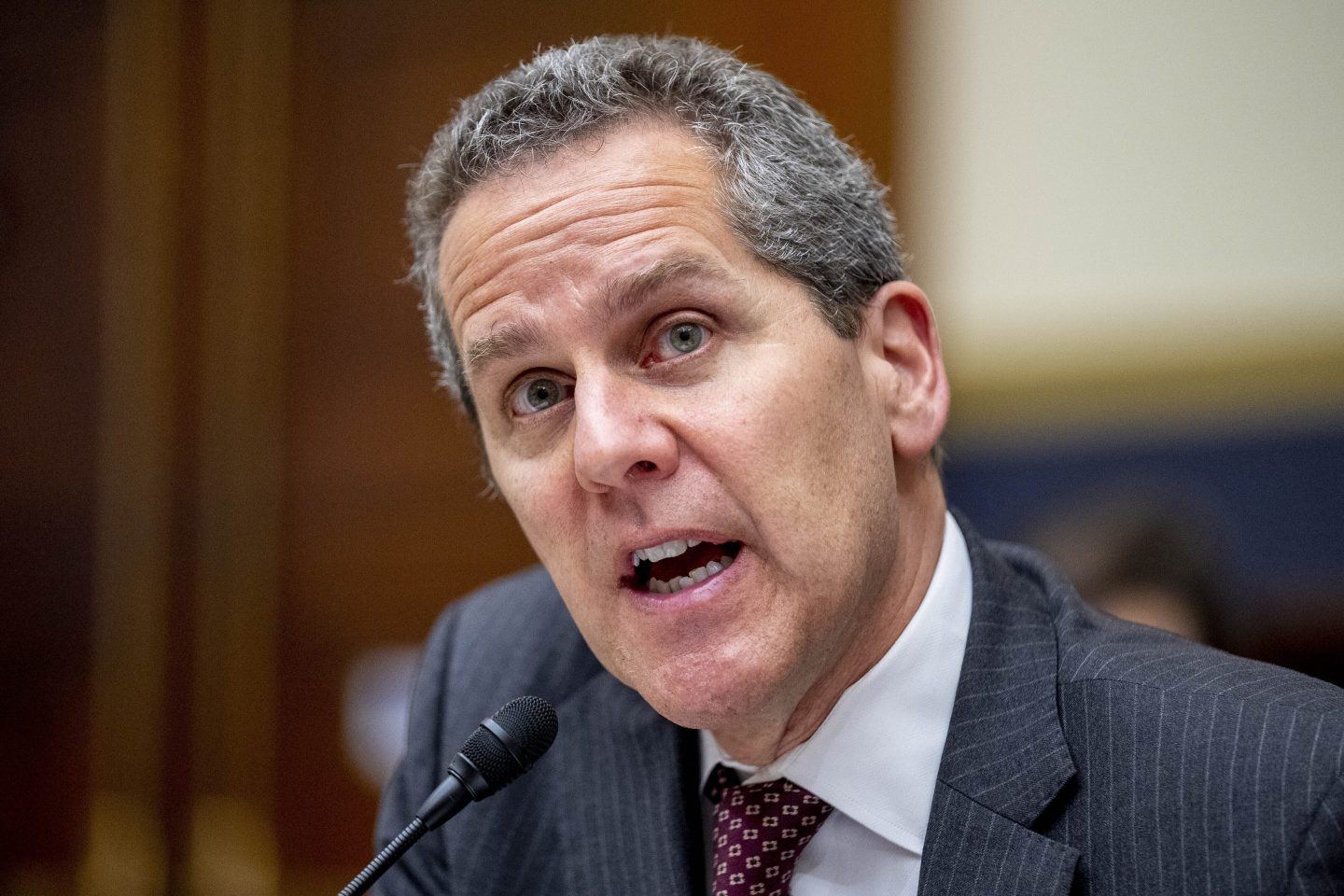
Federal Reserve Board of Governors Vice Chair for Supervision Michael Barr testifies at a House Financial Services Committee hearing on Capitol Hill, Wednesday, March 29, 2023, in Washington.
Federal Reserve Board of Governors Vice Chair for Supervision Michael Barr testifies at a House Financial Services Committee hearing on Capitol Hill, Wednesday, March 29, 2023, in Washington.Andrew Harnik—AP Images

The Federal Reserve blamed last month’s collapse of Silicon Valley Bank on poor management, watered-down regulations and lax oversight by its own staffers, and said the industry needs stricter policing on multiple fronts to prevent future bank failures.

Recommended Video

The Fed was highly critical of its own role in the bank’s failure in a report released Friday. The report, compiled by Michael Barr, the Fed’s chief regulator, says bank supervisors were slow to recognize blossoming problems at Silicon Valley Bank as it quickly grew in size in the years leading up to its collapse. The report also points out underlying cultural issues at the Fed, where supervisors were unwilling to be hard on bank management when they saw growing problems.

Those cultural issues stemmed from legislation passed in 2018 that sought to lighten regulation for banks with less than $250 billion in assets, the report concluded. The Fed also weakened its own rules the following year, which exempted banks below that threshold from stress tests and other regulations. Both Silicon Valley Bank and New York-based Signature Bank, which also failed last month, had assets below that level.

The changes increased the burden on regulators to justify the need for supervisory action, the report said. “In some cases, the changes also led to slower action by supervisory staff and a reluctance to escalate issues.”

Separate reports also released Friday by the Federal Deposit Insurance Corp. and the Government Accountability Office, the investigative arm of Congress, also faulted the Fed and other regulators for a lack of urgency regarding Silicon Valley’s deficiencies. About 95% of its deposits exceeded the FDIC’s insurance cap and its deposits were concentrated in the technology industry, making the bank vulnerable to a panic.

The FDIC’s report concerned the failure of Signature Bank on March 12 and the specific problems that led to its collapse: the bank’s exposure to cryptocurrencies and an overreliance on uninsured deposits. The FDIC also found that Signature Bank’s failure was also likely fallout from the failure of Silicon Valley Bank.

But the FDIC found its own regulatory deficiencies, notably insufficient staffing to adequately supervise Signature Bank, which was based in New York. The agency also took a light-handed approach to regulation, the report found.

“The FDIC could have been more forward-looking and forceful in its supervision,” the FDIC said in its report.

In its report, the Fed said it plans to reexamine how it regulates larger regional banks such as Silicon Valley Bank, which had more than $200 billion in assets when it failed, although less than the $250 billion threshold for greater regulation.

“While higher supervisory and regulatory requirements may not have prevented the firm’s failure, they would likely have bolstered the resilience of Silicon Valley Bank,” the report said.

Banking policy analysts said the trio of critical reports make it more likely regulation will be tightened, though the Fed acknowledged it could take years for proposals to be implemented.

The reports “provide a clear path for a tougher and more costly regulatory regime for banks with at least $100 billion of assets,” said Jaret Seiberg, an analyst at TD Cowen. “We would expect the Fed to advance proposals in the coming months.”

Alexa Philo, a former bank examiner for the Federal Reserve Bank of New York and senior policy analyst at Americans for Financial Reform, said the Fed could adopt stricter rules on its own, without relying on Congress.

“It is long past time to roll back the dangerous deregulation under the last administration to the greatest extent possible, and pay close attention to the largest banks so this crisis does not worsen,” she said.

The Fed also criticized Silicon Valley Bank for tying executive compensation too closely to short-term profits and the company’s stock price. From 2018 to 2021, profit at SVB Financial, Silicon Valley Bank’s parent, doubled and the stock nearly tripled.

The report also points out that there were no pay incentives tied to risk management. Silicon Valley Bank notably had no chief risk officer at the firm for roughly a year, during a time when the bank was growing quickly.

The Fed’s report, which includes the release of internal reports and Fed communications, is a rare look into how the central bank supervises individual banks as one of the nation’s bank regulators. Typically such processes are confidential, and rarely seen by the public, but the Fed chose to release these reports to show how the bank was managed up to its failure.

Bartlett Collins Naylor, financial policy advocate at Congress Watch, a division of Public Citizen, was surprised at the degree to which the Fed blamed itself for the bank failure.

“I don’t know that I expected the Fed to say ‘mea culpa’ — but I find that adds a lot of credibility,” to Federal Reserve leadership, Naylor said.

Silicon Valley Bank was the go-to bank for venture capital firms and technology start-ups for years, but failed spectacularly in March, setting off a crisis of confidence for the banking industry. Federal regulators seized Silicon Valley Bank on March 10 after customers withdrew tens of billions of dollars in deposits in a matter of hours.

Two days later, they seized Signature Bank. Although regulators guaranteed all the banks’ deposits, customers at other midsize regional banks rushed to pull out their money — often with a few taps on a mobile device — and move it to the perceived safety of big money center banks such as JPMorgan Chase.

The report also looks at the role social media and technology played in the bank’s last days. While the bank’s management was poor and ultimately that was the reason the bank failed, the report also notes that social media caused a bank run that happened in just hours, compared to days for earlier bank runs like those seen in 2008.

Although the withdrawals have abated at many banks, First Republic Bank in San Francisco appears to be in peril, even after receiving a $30 billion infusion of deposits from 11 major banks in March. The bank’s shares have plunged 70% this week after it revealed the extent to which customers pulled their deposits in the days after Silicon Valley Bank failed.

___

Sweet reported from New York. Reporter Fatima Hussein contributed from Washington.

Join us at the Fortune Workplace Innovation Summit May 19–20, 2026, in Atlanta. The next era of workplace innovation is here—and the old playbook is being rewritten. At this exclusive, high-energy event, the world’s most innovative leaders will convene to explore how AI, humanity, and strategy converge to redefine, again, the future of work. Register now.
About the Authors
By Christopher Rugaber
See full bioRight Arrow Button Icon
By Ken Sweet
See full bioRight Arrow Button Icon
By The Associated Press
See full bioRight Arrow Button Icon

Latest in Finance

Finance
Lorem ipsum dolor sit amet, consectetur adipiscing elit, sed do eiusmod tempor incididunt ut labore et dolore magna aliqua. Ut enim ad minim veniam
By Fortune Editors
October 20, 2025
Finance
Lorem ipsum dolor sit amet, consectetur adipiscing elit, sed do eiusmod tempor incididunt ut labore et dolore magna aliqua. Ut enim ad minim veniam
By Fortune Editors
October 20, 2025
Finance
Lorem ipsum dolor sit amet, consectetur adipiscing elit, sed do eiusmod tempor incididunt ut labore et dolore magna aliqua. Ut enim ad minim veniam
By Fortune Editors
October 20, 2025
Finance
Lorem ipsum dolor sit amet, consectetur adipiscing elit, sed do eiusmod tempor incididunt ut labore et dolore magna aliqua. Ut enim ad minim veniam
By Fortune Editors
October 20, 2025
Finance
Lorem ipsum dolor sit amet, consectetur adipiscing elit, sed do eiusmod tempor incididunt ut labore et dolore magna aliqua. Ut enim ad minim veniam
By Fortune Editors
October 20, 2025
Finance
Lorem ipsum dolor sit amet, consectetur adipiscing elit, sed do eiusmod tempor incididunt ut labore et dolore magna aliqua. Ut enim ad minim veniam
By Fortune Editors
October 20, 2025

Most Popular

Finance
Lorem ipsum dolor sit amet, consectetur adipiscing elit, sed do eiusmod tempor incididunt ut labore et dolore magna aliqua. Ut enim ad minim veniam
By Fortune Editors
October 20, 2025
Finance
Lorem ipsum dolor sit amet, consectetur adipiscing elit, sed do eiusmod tempor incididunt ut labore et dolore magna aliqua. Ut enim ad minim veniam
By Fortune Editors
October 20, 2025
Finance
Lorem ipsum dolor sit amet, consectetur adipiscing elit, sed do eiusmod tempor incididunt ut labore et dolore magna aliqua. Ut enim ad minim veniam
By Fortune Editors
October 20, 2025
Finance
Lorem ipsum dolor sit amet, consectetur adipiscing elit, sed do eiusmod tempor incididunt ut labore et dolore magna aliqua. Ut enim ad minim veniam
By Fortune Editors
October 20, 2025
Finance
Lorem ipsum dolor sit amet, consectetur adipiscing elit, sed do eiusmod tempor incididunt ut labore et dolore magna aliqua. Ut enim ad minim veniam
By Fortune Editors
October 20, 2025
Finance
Lorem ipsum dolor sit amet, consectetur adipiscing elit, sed do eiusmod tempor incididunt ut labore et dolore magna aliqua. Ut enim ad minim veniam
By Fortune Editors
October 20, 2025
Fortune Secondary Logo
Rankings
  • 100 Best Companies
  • Fortune 500
  • Global 500
  • Fortune 500 Europe
  • Most Powerful Women
  • Future 50
  • World’s Most Admired Companies
  • See All Rankings
Sections
  • Finance
  • Fortune Crypto
  • Features
  • Leadership
  • Health
  • Commentary
  • Success
  • Retail
  • Mpw
  • Tech
  • Lifestyle
  • CEO Initiative
  • Asia
  • Politics
  • Conferences
  • Europe
  • Newsletters
  • Personal Finance
  • Environment
  • Magazine
  • Education
Customer Support
  • Frequently Asked Questions
  • Customer Service Portal
  • Privacy Policy
  • Terms Of Use
  • Single Issues For Purchase
  • International Print
Commercial Services
  • Advertising
  • Fortune Brand Studio
  • Fortune Analytics
  • Fortune Conferences
  • Business Development
  • Group Subscriptions
About Us
  • About Us
  • Editorial Calendar
  • Press Center
  • Work At Fortune
  • Diversity And Inclusion
  • Terms And Conditions
  • Site Map
  • About Us
  • Editorial Calendar
  • Press Center
  • Work At Fortune
  • Diversity And Inclusion
  • Terms And Conditions
  • Site Map
  • Facebook icon
  • Twitter icon
  • LinkedIn icon
  • Instagram icon
  • Pinterest icon

Latest in Finance

 The world’s 500 richest people made more than a quarter trillion yesterday as volatile markets react to fragile Iran war ceasefire
EconomyBillionaires
 The world’s 500 richest people made more than a quarter trillion yesterday as volatile markets react to fragile Iran war ceasefire
By Jacqueline MunisApril 9, 2026
3 hours ago
Only five ships crossed the Strait of Hormuz Thursday, far below Iran’s pledge as negotiations begin
EnergyIran
Only five ships crossed the Strait of Hormuz Thursday, far below Iran’s pledge as negotiations begin
By Eva RoytburgApril 9, 2026
5 hours ago
7 best debt relief companies 2026
Personal FinanceLoans
7 best debt relief companies 2026
By Joseph HostetlerApril 9, 2026
6 hours ago
iran
EnergyFood and drink
A global food emergency: Why the closed Strait of Hormuz puts half the world’s calories at risk
By Aya S. Chacar and The ConversationApril 9, 2026
8 hours ago
Willie Walsh, wearing a blue suit, looks to his right with his mouth slightly open.
EnergyAviation
Jet fuel supply disruptions are comparable to 9/11 and could take months to replenish even if Hormuz Strait is reopening, airline trade group warns
By Sasha RogelbergApril 9, 2026
8 hours ago
erewhon
EconomyFood and drink
Americans hate the economy so much, they’re buying $22 smoothies
By Yuanyuan (Gina) Cui, Patrick Van Esch and The ConversationApril 9, 2026
8 hours ago

Most Popular

The U.S. government is spending $88 billion a month in interest on national debt—equal to spending on defense and education combined
Economy
The U.S. government is spending $88 billion a month in interest on national debt—equal to spending on defense and education combined
By Fortune EditorsApril 9, 2026
13 hours ago
2 years ago, Saudi Arabia quietly canceled the ‘petrodollar’ deal with America that wired the world economy for 50 years. Then war broke out in Iran
Energy
2 years ago, Saudi Arabia quietly canceled the ‘petrodollar’ deal with America that wired the world economy for 50 years. Then war broke out in Iran
By Fortune EditorsApril 7, 2026
2 days ago
The U.S. had a national debt ‘home run’ in its grasp, says Jamie Dimon. But the government did nothing, and now its best option is crisis management
Economy
The U.S. had a national debt ‘home run’ in its grasp, says Jamie Dimon. But the government did nothing, and now its best option is crisis management
By Fortune EditorsApril 8, 2026
2 days ago
Self-made billionaire MrBeast says his work-life balance is nonexistent and calls it a ‘miracle’ if he works less than 15-hour days: ‘I live to work’
Success
Self-made billionaire MrBeast says his work-life balance is nonexistent and calls it a ‘miracle’ if he works less than 15-hour days: ‘I live to work’
By Fortune EditorsApril 8, 2026
1 day ago
Gen Z doesn't want your full-time job. They want several part-time roles, and it's reshaping the entire workforce
Success
Gen Z doesn't want your full-time job. They want several part-time roles, and it's reshaping the entire workforce
By Fortune EditorsApril 9, 2026
17 hours ago
Gen Z workers are so fearful AI will take their job they’re intentionally sabotaging their company’s AI rollout
AI
Gen Z workers are so fearful AI will take their job they’re intentionally sabotaging their company’s AI rollout
By Fortune EditorsApril 8, 2026
1 day ago

© 2026 Fortune Media IP Limited. All Rights Reserved. Use of this site constitutes acceptance of our Terms of Use and Privacy Policy | CA Notice at Collection and Privacy Notice | Do Not Sell/Share My Personal Information
FORTUNE is a trademark of Fortune Media IP Limited, registered in the U.S. and other countries. FORTUNE may receive compensation for some links to products and services on this website. Offers may be subject to change without notice.