

Apple CEO Tim Cook was in India this week to open the brand’s first flagship stores in the country. “The energy, creativity, and passion in Mumbai is incredible!” Cook tweeted. “We are so excited to open Apple BKC — our first store in India.”
The energy, creativity, and passion in Mumbai is incredible! We are so excited to open Apple BKC — our first store in India. pic.twitter.com/talx2ZQEMl
— Tim Cook (@tim_cook) April 18, 2023
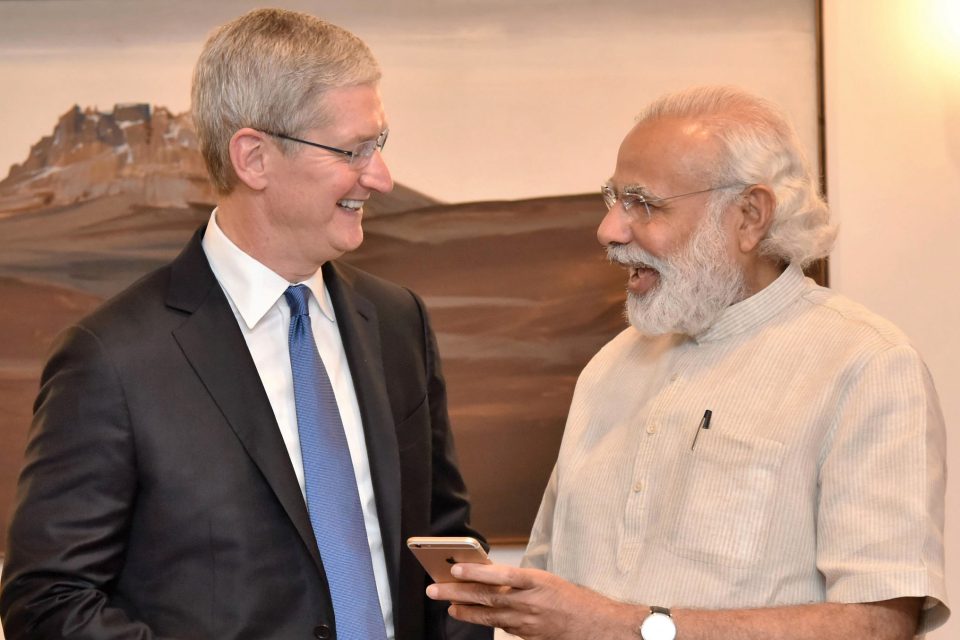
But that wasn’t all. The Apple chief spent the next few days visiting Prime Minister Narendra Modi, meeting Bollywood stars and business magnates, and learning about the local culture—a sign of India’s increasing importance in Apple’s growth story.
India manufactures 6% of the iPhones—a miniscule number in comparison to China, where the bulk of Apple’s products are made, according to tech market research firm Counterpoint Research. But that number is rising rapidly. India is now making an estimated 13 million iPhones annually, compared to 5 million just three years ago. And as the country’s market share in the purchase and production fronts grow, Apple is paying attention.
Beyond its flagship store, Apple is increasingly looking towards India as it tries to reduce its manufacturing reliance on China following COVID-19-related supply chain disruptions and growing geopolitical tensions with Taiwan. During Apple’s first quarter earnings call in February, Cook said he was “very bullish on India,” calling it a “hugely exciting market” and “a major focus” for the company.
Experts say India was the obvious choice for new factories because of its skilled labor force, access to a big smartphone market, and government support for manufacturing. And apart from creating hundreds of thousands of jobs, Apple’s metaphorical spotlight on India is also boosting the country as it tries to position itself as an economic powerhouse.
“India has the greatest growth potential of any other region and that makes sense for Apple to go after,” Gene Munster, managing partner at Deepwater Asset Management, a tech-focused investment firm, told Fortune.
India as a manufacturing hub
India began positioning itself as a destination for international business in the 1990s, following economic liberalization policies, making it the global hub for outsourcing IT services.
“Western companies realized over time that they went for cost but they stayed there for quality,” Debmalya Mukherjee, associate dean at University of Akron’s business school, whose expertise includes global business and emerging economies like India, told Fortune.
At the national level, Modi’s government has been promoting his “Make in India” campaign since 2014, seeking to boost local manufacturing and create jobs. Production Linked Incentive (PLI) programs offer financial benefits to manufacturers in industries like electronics and semiconductors to attract domestic and foreign investments. And some of those policies have worked in Apple’s favor.
“All three manufacturing partners for Apple in India, Foxconn, Wistron, and Pegatron, are awardees of the PLI scheme which has been one of the top government schemes aimed at increasing manufacturing in India,” Prachir Singh, senior analyst at Counterpoint Research, told Fortune.
The pandemic also helped India by supercharging a shift for companies like Apple to consider the country as a major manufacturing hub. Lockdowns due to China’s zero-COVID strategy led to prolonged disruptions that “significantly reduced capacity” for iPhone 14 production last year. Apple’s global revenue fell in the last three months of 2022 as a result—the first quarterly decline since 2019. Other production locations in Asia, including Vietnam, stand to benefit from Apple’s diversification from China. But India, the world’s most populous country, offered access to a tremendous middle-income consumer market that had not been directly tapped by Apple yet, and could potentially propel its growth.
“If you’re a tech company, which means that growth needs to be part of your DNA, in order to grow you have to go after big markets,” Munster said. “When you look at the world, the most juicy opportunity is India to drive that growth.”
Last September, Apple announced that it would make iPhone 14 in India, where it had been assembling some of its earlier models since 2017, including the iPhone SE and iPhone 12. In 2023, 5% of Apple’s iPhone 14 are projected to be made in India, climbing to 25% by 2025, according to JPMorgan analysts. One of Apple’s major suppliers, Foxconn, is also reportedly eyeing an expansion in southern India as part of this push.
Apple did not immediately return Fortune’s request for comment.

The smartphone conundrum
Despite India’s growing prominence in Apple’s supply chain, it’s not going to outshine China anytime soon.
China still controls the lion’s share of the brand’s products. As of January, more than 95% of Apple’s top products were manufactured in China, the Financial Times reported. And India’s massive manufacturing opportunity also comes with systemic challenges. Some of the hurdles include steady access to utilities like electricity provided by individual states and long-pending labor reforms, according to Richard Rossow, the India chair at the Center for Strategic and International Studies, a policy think tank.
“You still don’t necessarily see massive waves of the big manufacturing investors flocking to India,” Rossow said.
On the consumer end, Apple products are still considered a luxury item. Brands offering cheaper alternatives including Samsung and Xiaomi capture nearly 40% of India’s smartphone market share compared to Apple’s 4%, according to Counterpoint.
India has also been slow to change its rules to allow companies like Apple to sell their products directly to consumers. Apple’s late retail foray into India was due to regulations that prevented foreign companies from opening single-brand stores in India unless 30% of the raw materials that go into the product were sourced locally. Instead, Apple had to sell its products in India through third parties. But that restriction was eased in 2019, paving way for Apple to finally open a store this week after its initial plan to do so in 2021 was delayed because of COVID-19.
The country’s relatively low rate of smartphone usage compared to some Asian peers suggests that India is ripe with opportunities for the iPhone-maker, particularly among the burgeoning upper middle class segment. Indian customers are opting for trade-in, financing and bundling schemes to purchase Apple’s products as more of them want to be associated with the premium brand, according to Counterpoint.
Apple has already gained an edge against rivals by setting up shop in India—a move that other businesses could also follow and profit from, according to Rossow.
“Either you go there [India], you make a big splash and you start learning how to operate in the market, or you wait till it’s perfect, and at which time you probably missed the bus,” Rossow said.