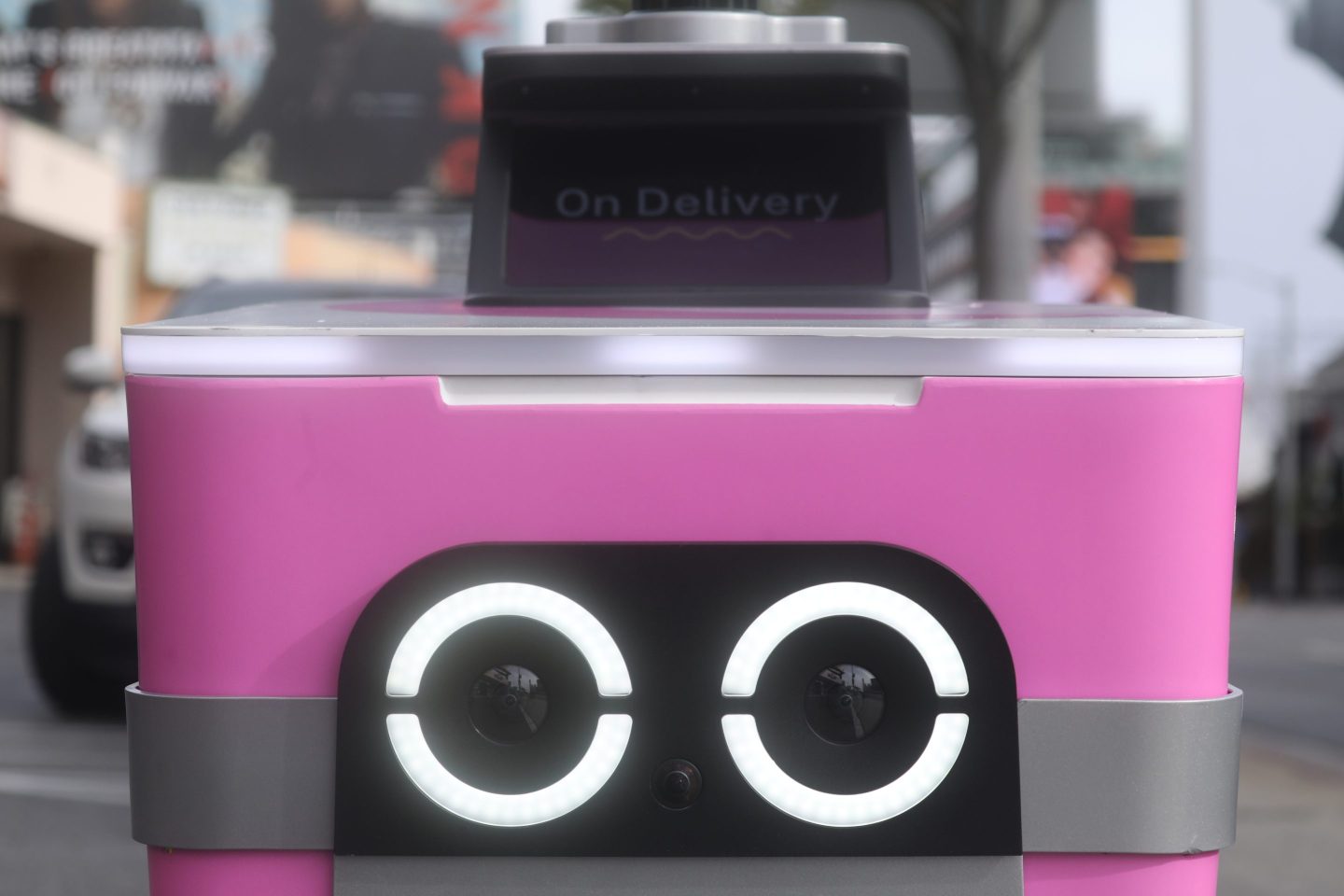
If you live in San Francisco or Los Angeles, there’s a chance you will have seen a small, trundling robot roving around the streets, autonomously delivering food from purveyors to paying customers. If you have seen it, you might even think the clunky four-wheeled foodbox is a little cute. If you do, that’s by design.
“The difficulty with introducing robotics to an urban space is the social aspect,” Gadi Amit, president and principal designer of NewDealDesign, told me when the trolley-like Serve robot debuted in 2019. “It’s managing the negative reaction to robots in the street and mitigating the potential backlash against them.”
Serve was the result of a collaboration between design agency NewDealDesign and delivery services company Postmates. Postmates was later acquired by Uber and spun off into Serve Robotics, which continues to operate Serve. The challenge Postmates and the design studio were trying to solve was how to stop San Franciscans from turning against the mini delivery cart.
People have trust issues with robots. Perhaps you can blame the Terminator franchise for that, although, sometimes, humans also simply enjoy harassing robots.
In Japan, researchers observed unattended children habitually blocking the path of mobile information robots, the type that scoot around malls, and occasionally kicking and hitting the poor machines. And let’s not forget Hitchbot, the hitchhiking robot that traveled safely across five countries in 2015 before meeting its demise in Philadelphia, where someone dismembered it.
In crowded cities, sharing the sidewalk with robots becomes an issue of annoyance. Getting caught behind a slow-moving pedestrian is irritating enough, but it’s worse when the interloper is a slow-moving robot that you can’t communicate with.
“There are ways we communicate continuously with society, but we haven’t built that language with robots yet,” Amit says.
Eye contact is a particularly useful tool in human interaction, indicating to the other person that you have, at the very least, noticed them. To that end, NewDealDesign designed Serve so that the twin camera lenses it uses for computer-aided driving are mounted on the front of the cart, like two bright eyes, turning the essential hardware into an emotive tool.
Serve Robotics isn’t alone in its endeavor to make its products personable. The same year Serve hit the streets of San Francisco, Jaguar Rolls-Royce piloted an autonomous driving pod equipped with animated eyes that could indicate to pedestrians that the car had “seen” them.
Relatability is also integral to Embodied’s Moxie, a toddler-sized robot with an animated face designed to mimic children’s body language, respond to their emotions, and teach kids with developmental disorders better emotional awareness. But some research shows that anthropomorphizing robots too much can actually make the androids appear less trustworthy than their more mechanical peers.
A 2016 paper in the International Journal of Social Robotics found that the more human-like social robots are (robots that perform a social or caregiving function) the more people feel threatened that the distinction between humans and machines is eroding.
Serve, at least, doesn’t look at all like a human and so is able to be emotive without much risk of falling into that “uncanny valley.” As the industry for “social robots” matures, perhaps the market will tell how human is too human for robotic design.
Eamon Barrett
eamon.barrett@fortune.com
IN OTHER NEWS
A.I. for the classroom
A.I. has the potential to enhance the learning experience of children worldwide, Lyft CEO David Risher says in this op-ed, but the tool could also increase inequity if not deployed properly. Risher is the cofounder of edtech nonprofit Worldreader, which promotes literacy, and he outlines ways in which generative A.I. could be used to augment traditional reading experiences, calling on industry leaders to include no-profits like his in the rollout of A.I. tools.
Transformation needs transformers
Businesses are keen to integrate A.I. into their organizations, BCG says, but often encounter difficulties when implementing the new tech. One issue, in particular, is that employees are often skeptical of the change. According to BCG’s survey of 600 companies, 76% of managers were “challenged by their employees’ lack of trust or understanding of A.I. technology.” The solution? Hire a dedicated “transformer.”
NPR quits Twitter
National Public Radio is quitting Twitter over the social media company’s recent actions under owner Elon Musk to stamp it with labels the news organization says are meant to undermine its credibility. In a statement, NPR said last Wednesday that the broadcaster’s “organizational accounts will no longer be active on Twitter because the platform is taking actions that undermine our credibility by falsely implying that we are not editorially independent.”
Emerging economies have more faith
Research from KPMG shows that people in emerging economies have more trust in A.I. than people in developed economies do. According to the survey of 17,000 people worldwide, China, India, South Africa, and Brazil are the only countries where more than half the population say they trust A.I. India leads the pack, with 75% of respondents overall accepting A.I. Japan and Finland are at the bottom of the list with only 23% trust.
TRUST EXERCISE
Last week, the Pew Research Center released the results of its survey on whether the American public trusts cryptocurrency. According to the results, Fortune’s David Meyer reports, few do:
The Pew Research Center yesterday released the results of a survey showing that a whopping 88% of Americans have heard at least something about crypto, and three-quarters of those people are either not very confident (36%) or not at all confident (39%) about the safety and reliability of virtual currencies. A mere 6% are very or extremely confident in crypto.