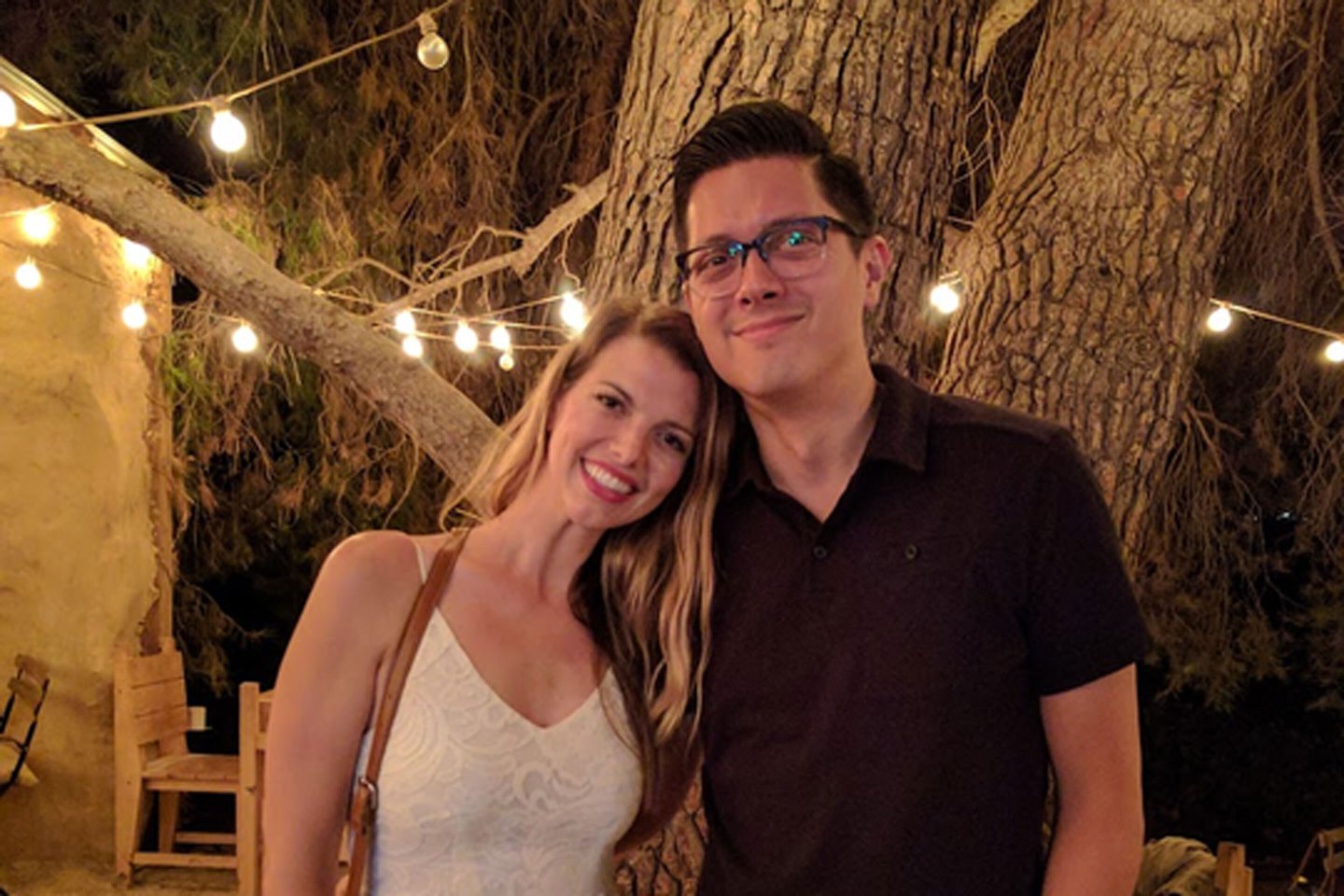
Stan Oklobdzija and his partner, Sarah Boyd, live in a one-bedroom condo in Los Angeles’ Little Tokyo, and he realizes he’s lucky. “We are in the top [percent] of incomes, between what I make and what she makes,” he told Fortune, adding that their earnings amount to around $225,000 per year. But they’re renting, and he doesn’t see that ever changing. “With housing costs being what they are, just the idea of us ever owning a home is absolutely, like it’s funny. It’s like, we might as well own a spaceship.”
Each of them makes a six-figure salary, he says, with Oklobdzija, 40, being a visiting assistant professor of public policy at UC Riverside and his partner, 35, working in the digital advertising industry. They pay $2,400 a month in rent, and he tweeted late last month that “the idea that we could ever own a home here is hilarious.” If someone who makes six figures, and together with his partner makes more than $200,000, feels as though they can’t afford a home in Los Angeles, how can we expect it to be affordable for anyone making less than that?
Oklobdzija is right when he says he’s in the top range of salary earners. As of 2021, the median household income in the city of Los Angeles was $69,778, per the Census Bureau. Those in the 95th percentile of household incomes in the city make nearly $243,000 and those in the 80th percentile make $115,000, according to Statistical Atlas. Meanwhile, the average Los Angeles home value is $891,820, per Zillow, more than double the average U.S. home value.
The U.S. Department of Housing and Urban Development defines affordable housing “as housing on which the occupant is paying no more than 30% of gross income for housing costs, including utilities.” Oklobdzija and his partner aren’t the only high-earners that are still renting instead of owning.
As a professor of public policy, Oklobdzija’s research tends to focus on housing policy, and before this role he was the research director for California YIMBY (a pro-development, “yes-in-my-backyard” advocacy organization), which says it’s “working to pass legislation to end CA’s housing shortage by empowering and growing the YIMBY movement.” Oklobdzija says that despite earning more and advancing in his career, he’s come to eventually realize that he’s not hitting the milestones that previous generations did, like owning a home.
“The inability of millennials to enter into the homeownership market in ways that previous generations have has always been sort of described as some sort of like the inherited failing of young people…rather than looking at these insane structural barriers that are put in place,” Oklobdzija says. Those barriers, he suggests, are making incumbent homeowners far richer while immiserating an entire generation of people (his generation), along with communities of color and lower-income communities that have historically faced those same barriers. Oklobdzija’s message for Gen Z? “Get ready,” he said with a laugh.
There was a time where Los Angeles built to accommodate new demand, with “just a glut of building,” as Oklobdzija referred to it, adding that the same could be said for cities across the nation. More than 40 million housing units were built in the United States during the 30-year period following the end of World War II, and in California alone approximately 6 million housing units were constructed during the same period, according to a postwar housing analysis by the California Department of Transportation. But that began to end in the 1970s and into the 1980s with measures like Proposition U, passed in 1986, that had a major impact by cutting in half the floor-area ratio, the lot size of a property, and the amount of development permitted for most commercially zoned land, thus limiting development of multifamily housing.
“There was a massive downzoning of Los Angeles,” Oklobdzija says. “So it literally became illegal to build multifamily, it became illegal to build anything other than single-family homes on large lots.” That changed the game for higher-density housing and triggered a scarcity crisis that manifested in higher prices.
“We have a desire to own something. It doesn’t need to be a detached single-family home…But it’s just been illegal in Los Angeles, and still remains illegal in Los Angeles, in most of the city, to construct these types,” Oklobdzija says. “I mean, if you look at the west side of Los Angeles, like nothing has changed there in 40 years.”
He’s not the first or last person to blame the nation’s housing crisis—largely due to its shortage of homes, which sends prices up—on the inability to build. For instance, economics writer Noah Smith recently wrote that America’s “inability to build things,” housing for one, is often stalled because of permitting and developing rules (worsened by NIMBYs or “not-in-my-backyard” antidevelopment residents), and is crippling the country as a result.
Oklobdzija, taking this a step further, called it a “refusal to build.” Oklobdzija argues that housing policy is local policy because land use is typically set by local elected officials. “Those local elected officials, they don’t win reelection by doing the right thing,” but rather by what will get them votes. That often means catering to NIMBYs who typically argue that higher density and new development will negatively affect their quality of life or the surrounding environment—and bring their property values down.
“NIMBY-ism is an extremely potent force,” Oklobdzija says. “And unfortunately, American political institutions are set up such that the best way to stay in office for a local elected official is to cave into the NIMBYs.” Oklobdzija says, “We don’t have to have a housing crisis, we are choosing to have a housing crisis.”
According to Los Angeles County, the region needs to add nearly 500,000 affordable homes to meet current demand, just for lower-income renter households. We’ve seen how this has played out in the unhoused population. As of last year, 69,144 people were experiencing homelessness in Los Angeles County. While California Gov. Gavin Newsom is attempting to address the housing shortage in a variety of ways, including announcing a plan to allocate $30 million to building small homes across the state and filing a lawsuit against Huntington Beach’s ban on accessory dwelling units, to mention a few, the crisis is ongoing.
Oklobdzija knows that he and his partner have options in terms of owning a home. They may not be ideal options, but he realizes they’re in a better position than most, and that’s why he questions what it’s like for those with less means, financially. Nonetheless, Oklobdzija says that even if he decided to buy that $600,000 one-bedroom with $1,000 HOA every month, in a sort of extreme hypothetical situation that he gave Fortune, the down payment would still be an issue aside from monthly costs.
“Where are we going to come up with this down payment? Even with the money that we make, it’s impossible to come up with 20%,” Oklobdzija says. “People don’t just have $100,000 in cash just kind of kicking it.”
Every time he and his partner opened up Zillow, or even looked at alerts, to see if they can make the move into homeownership, Oklobdzija says, it just isn’t something that feels like a reality for them. He gave the analogy of a treadmill, claiming that it feels they’re “sprinting just to stay in place.” Later this year, Oklobdzija is moving to New Orleans for a professorship at Tulane, a move that he said Los Angeles’ market, in part, prompted him to make.