• Home
  • Latest
  • Fortune 500
  • Finance
  • Tech
  • Leadership
  • Lifestyle
  • Rankings
  • Multimedia
FinanceBanks

A legal scholar says the Dodd-Frank act put in place after the Great Recession proved to be useless amid SVB’s collapse

Will Daniel
By
Will Daniel
Will Daniel
Down Arrow Button Icon
Will Daniel
By
Will Daniel
Will Daniel
Down Arrow Button Icon
March 24, 2023, 1:45 PM ET
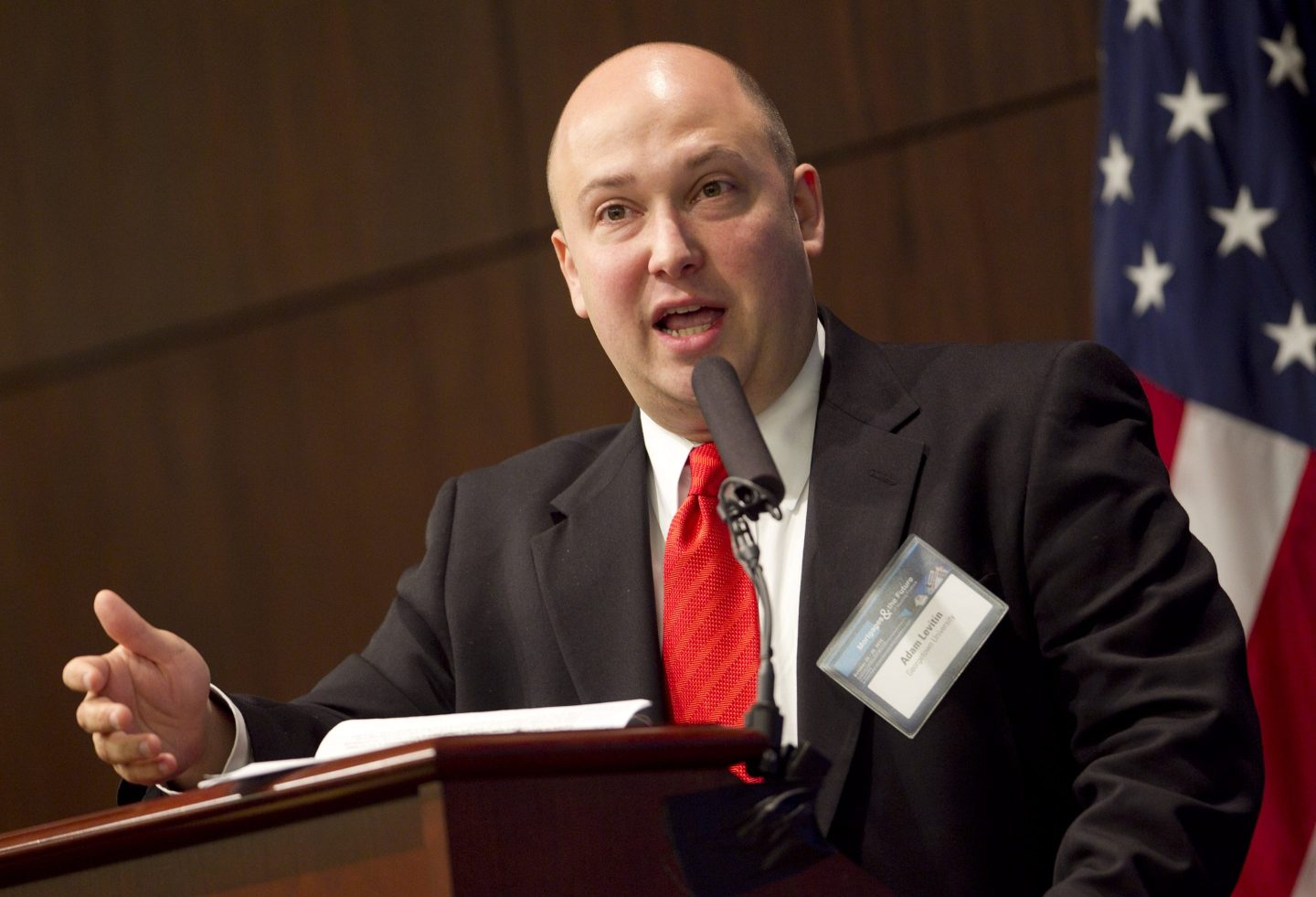
Adam Levitin, professor of law at Georgetown University, speaks during the symposium of mortgages and the future of housing finance at the Federal Deposit Insurance Corp. in Arlington, Virginia on Oct. 25, 2010.
Adam Levitin, professor of law at Georgetown University, speaks during the symposium of mortgages and the future of housing finance at the Federal Deposit Insurance Corp. in Arlington, Virginia on Oct. 25, 2010.Andrew Harrer—Bloomberg/Getty Images

How do you teach banking law to college students after the collapse of Silicon Valley Bank? That’s the question Adam Levitin, a professor of law at Georgetown University, asked this week, arguing that the statutes laid out after the Great Recession of 2008 are being ignored by regulators and bankers.

“I don’t usually teach the core prudential regulation banking law class, but I really feel for colleagues who do,” he wrote in a Thursday CreditSlipsarticle, referencing so-called “prudential regulations” that are meant to limit the risks banks face. “How can you teach the students the formal rules…when you know that the rules aren’t followed?” 

It took only 36 hours for Silicon Valley Bank to collapse after a series of announcements—including the sale of $21 billion of investments which resulted in $2.4 billion pre-tax loss and impromptu fund raising efforts—rattled the lenders’ investors and depositors on March 8. And the crypto-focused Signature Bank followed just a few days later as the pain quickly spread to regional lenders. 

The Dodd–Frank Wall Street Reform and Consumer Protection Act of 2010, enacted in the wake of the GFC’s bank failures, was supposed to prevent this type of outcome. Considered to be the “most far reaching Wall Street reform in history” by scholars, Dodd-Frank, as it’s called, created the Financial Stability Oversight Council to monitor banks, the Consumer Financial Protection Bureau to prevent predatory lending practices, established minimum leverage and capital requirements for lenders, and more. But Levitin argued the “enormous legal edifice” proved to be worthless amid SVB’s implosion and the demise of Signature Bank earlier this month.

“We saw in the course of a weekend that it was all an expensive and wasteful Potemkin village,” he wrote, referencing the fake towns that Russian minister Grigory Potemkin set up in the 1780s to impress visiting dignitaries. “Dodd-Frank is still on the books, but its prudential provisions are as good as dead. What good does it do to have a massive set of regulations…if they aren’t enforced?”

To Levitin’s point, many of Dodd-Frank’s most stringent regulations were crippled in 2018 amid the Trump administration’s push for deregulation that came after aggressive lobbying from bank CEOs, including SVB’s CEO Greg Becker. Take the example of “stress tests,” which are designed to determine if a bank can withstand an economic crisis, rising interest rates, or other potentially risky scenarios. Congress passed the Economic Growth, Regulatory Relief, and Consumer Protection Act in 2018 which raised the asset value starting point for Fed stress tests from $50 billion to $100 billion and established looser stress test standards for mid-sized banks with assets between $100 billion and $250 billion. 

Fortune’s Shawn Tully explained this week that, as a result, stress tests weren’t done as often as they should have been at many small- and mid-sized banks. And sometimes, they weren’t done at all due to “phase-in” periods where Fed officials would instruct bank executives on how to prepare for the tests, leading to delays. Silicon Valley Bank, for example, had over $100 billion in assets at the end of 2021, but it never had a Fed stress test before its collapse.

Other Dodd-Frank regulations were whittled down by the 2018 law too, particularly for small and mid-sized banks like SVB. For example, the Standardized Liquidity Ratio was waived for banks with assets under $100 billion, which enabled these smaller lenders to hold less liquid capital than larger peers, putting them at risk during a bank run.

Levitin noted the $250,000 deposit insurance limit was also “disregarded” by regulators in an attempt to save the depositors at SVB and Signature Bank from bankers’ mistakes—and he worries that could incentivize even more misbehavior.

“Why should anyone follow its [Dodd-Frank’s] requirements now, given that they’ll be disregarded as soon as they’re inconvenient? And why should the public have any confidence that they are protected if the rules aren’t followed?,” he asked, lamenting “I really don’t know how one can teach prudential banking regulation after SVB.”
Subscribe to Well Adjusted, our newsletter full of simple strategies to work smarter and live better, from the Fortune Well team. Sign up today.
About the Author
Will Daniel
By Will Daniel
LinkedIn iconTwitter icon
See full bioRight Arrow Button Icon

Latest in Finance

broker
BankingData centers
AI data center boom sparks fears of glut amid lending frenzy
By Neil Callanan, Paula Seligson and BloombergDecember 12, 2025
27 minutes ago
Donald Trump
AIElections
AI is powering Trump’s economy, but American voters are getting worried
By Mark Niquette, Nancy Cook and BloombergDecember 12, 2025
31 minutes ago
Steve Jobs, Steve Wozniak, and Ronald Wayne's signatures on the bottom of Apple's founding contract.
SuccessWealth
Apple cofounder Ronald Wayne sold his 10% stake for $800 in 1976—today it’d be worth up to $400 billion
By Preston ForeDecember 12, 2025
1 hour ago
A pile of gold bars.
Personal Financegold prices
Current price of gold as of December 12, 2025
By Danny BakstDecember 12, 2025
2 hours ago
NewslettersCFO Daily
SEC chair moves to boost IPO momentum: ‘Make it cool to be a public company’
By Sheryl EstradaDecember 12, 2025
2 hours ago
Amtrak
PoliticsAmtrak
Amtrak is slashing executive bonuses to give out $900 apiece to over 18,000 rank-and-file workers
By Safiyah Riddle and The Associated PressDecember 12, 2025
2 hours ago

Most Popular

placeholder alt text
Success
At 18, doctors gave him three hours to live. He played video games from his hospital bed—and now, he’s built a $10 million-a-year video game studio
By Preston ForeDecember 10, 2025
2 days ago
placeholder alt text
Success
Palantir cofounder calls elite college undergrads a ‘loser generation’ as data reveals rise in students seeking support for disabilities, like ADHD
By Preston ForeDecember 11, 2025
24 hours ago
placeholder alt text
Investing
Baby boomers have now 'gobbled up' nearly one-third of America's wealth share, and they're leaving Gen Z and millennials behind
By Sasha RogelbergDecember 8, 2025
4 days ago
placeholder alt text
Economy
‘We have not seen this rosy picture’: ADP’s chief economist warns the real economy is pretty different from Wall Street’s bullish outlook
By Eleanor PringleDecember 11, 2025
1 day ago
placeholder alt text
Uncategorized
Transforming customer support through intelligent AI operations
By Lauren ChomiukNovember 26, 2025
16 days ago
placeholder alt text
Economy
Tariffs are taxes and they were used to finance the federal government until the 1913 income tax. A top economist breaks it down
By Kent JonesDecember 12, 2025
5 hours ago
Rankings
  • 100 Best Companies
  • Fortune 500
  • Global 500
  • Fortune 500 Europe
  • Most Powerful Women
  • Future 50
  • World’s Most Admired Companies
  • See All Rankings
Sections
  • Finance
  • Leadership
  • Success
  • Tech
  • Asia
  • Europe
  • Environment
  • Fortune Crypto
  • Health
  • Retail
  • Lifestyle
  • Politics
  • Newsletters
  • Magazine
  • Features
  • Commentary
  • Mpw
  • CEO Initiative
  • Conferences
  • Personal Finance
  • Education
Customer Support
  • Frequently Asked Questions
  • Customer Service Portal
  • Privacy Policy
  • Terms Of Use
  • Single Issues For Purchase
  • International Print
Commercial Services
  • Advertising
  • Fortune Brand Studio
  • Fortune Analytics
  • Fortune Conferences
  • Business Development
About Us
  • About Us
  • Editorial Calendar
  • Press Center
  • Work At Fortune
  • Diversity And Inclusion
  • Terms And Conditions
  • Site Map

© 2025 Fortune Media IP Limited. All Rights Reserved. Use of this site constitutes acceptance of our Terms of Use and Privacy Policy | CA Notice at Collection and Privacy Notice | Do Not Sell/Share My Personal Information
FORTUNE is a trademark of Fortune Media IP Limited, registered in the U.S. and other countries. FORTUNE may receive compensation for some links to products and services on this website. Offers may be subject to change without notice.