• Home
  • News
  • Fortune 500
  • Tech
  • Finance
  • Leadership
  • Lifestyle
  • Rankings
  • Multimedia
Environmentclimate

A 5,000-mile wide belt of seaweed is scheduled to wash ashore on Atlantic beaches and vex hotel workers

By
Suman Naishadham
Suman Naishadham
and
The Associated Press
Down Arrow Button Icon
By
Suman Naishadham
Suman Naishadham
and
The Associated Press
Down Arrow Button Icon
March 22, 2023, 11:11 AM ET
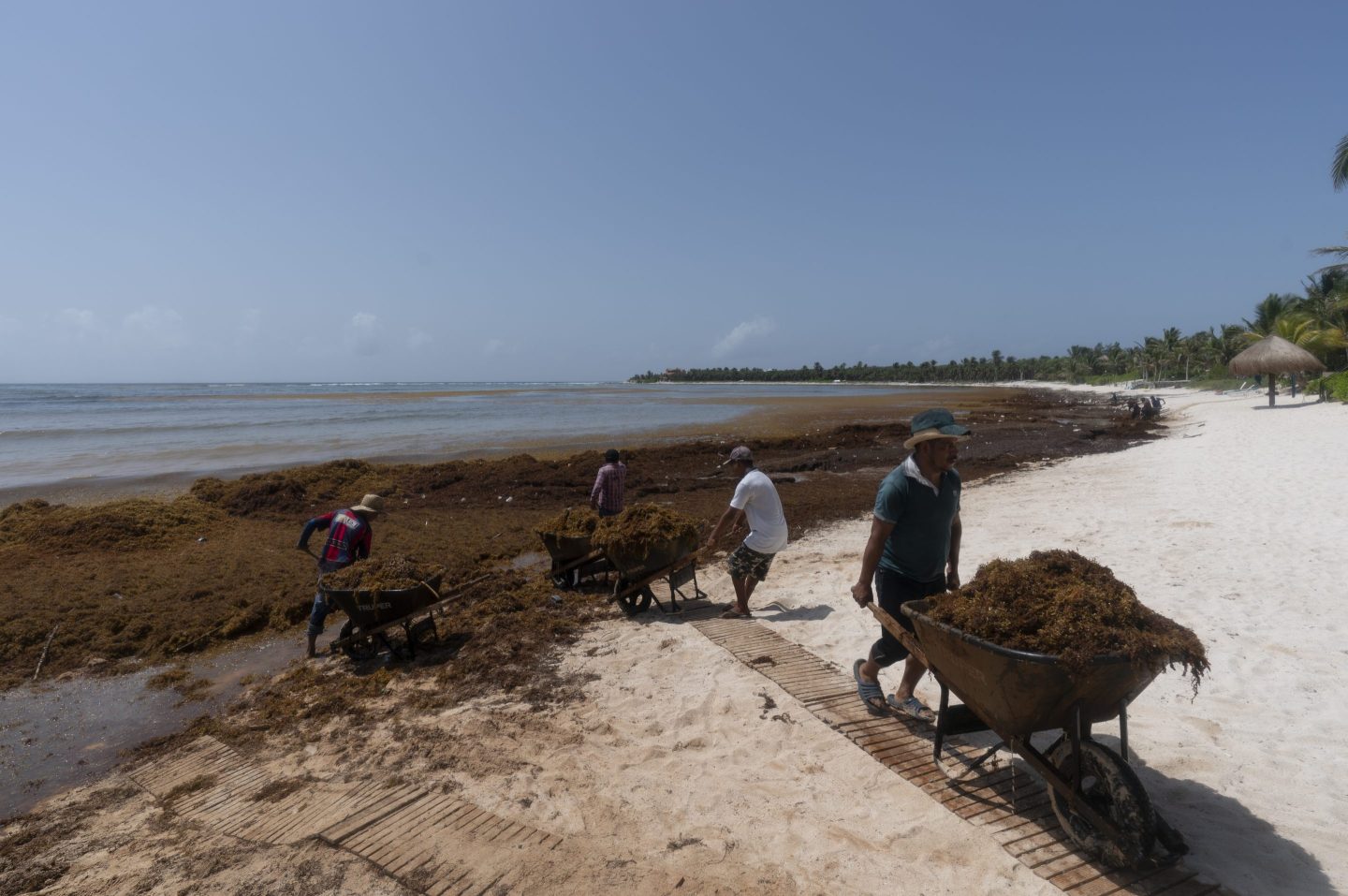
Workers, who were hired by residents, remove sargassum seaweed from the Bay of Soliman, north of Tulum, Quintana Roo state, Mexico, Aug. 3, 2022.
Workers, who were hired by residents, remove sargassum seaweed from the Bay of Soliman, north of Tulum, Quintana Roo state, Mexico, Aug. 3, 2022.AP Photo/Eduardo Verdugo

 A 5,000-mile seaweed belt lurking in the Atlantic Ocean is expected in the next few months to wash onto beaches in the Caribbean Sea, South Florida, and the Yucatán Peninsula in Mexico.

The Great Atlantic Sargassum Belt — as the biomass stretching from West Africa to the Gulf of Mexico is called — contains scattered patches of seaweed on the open sea, rather than one continuous blob of sargassum. It’s not a new occurrence, but satellite images captured in February showed an earlier start than usual for such a large accumulation in the open ocean.

Once it washes ashore, sargassum is a nuisance — a thick, brown algae that carpets beaches, releasing a pungent smell as it decays and ensnares humans and animals who step into it. For hotels and resorts, clearing the stuff off beaches can amount to a round-the-clock operation.

Here’s a look at this year’s sargassum seaweed bloom:

What is sargassum?

A leafy brown seaweed festooned with what look like berries. The seawood floats on the open ocean and — unlike other seaweeds — it reproduces on the water’s surface, helped by air-filled structures that give it buoyancy.

Sargassum originates in a vast stretch of the Atlantic Ocean called the Sargasso Sea, which lies well off the southeast U.S. The Sargasso has no land boundaries; instead, four prevailing ocean currents form its boundaries.

The matted brown seaweed stretches for miles across the ocean and provides breeding ground, food and habitat for fish, sea turtles and marine birds, according to the National Oceanic and Atmospheric Administration.

“It’s a dynamic, constantly changing set of pieces of this large mass,” said Rick Lumpkin, director of the Physical Oceanography Division at NOAA. “It’s not one big continuous blob heading straight to South Florida.”

Why is it a problem?

Sargassum piles up on beaches where it quickly decomposes under hot sun, releasing gases that smell like rotten eggs.

In recent years, sargassum has carpeted beaches on some Caribbean islands and Mexico’s Yucatán Peninsula in the spring and summer months. Beach towns and cities and hotels have struggled to keep up with the huge amounts of seaweed that wash ashore.

What about this year?

Some sargassum has already reached beaches in Key West, said Chuanmin Hu, a professor of oceanography at the University of South Florida. But most of it will arrive in the summer, Hu said.

“What is unusual this year compared to previous years is it started early,” Hu said. The algae generally blooms in the spring and summer, but “this year, in the winter, we already have a lot.”

Southern Florida, the Caribbean and the Yucatán Peninsula typically see sargassum piling up in the summer months and could expect the same this year, Hu said.

Is this much sargassum unusual?

It’s a lot, but it’s been worse.

Scientists estimate there’s more than 10 million metric tons of sargassum in the belt this year. Lumpkin called it “one of the strongest years, but not the strongest” since scientists began closely observing the biomass via satellite imagery in 2011.

He said there was more in 2018. The years 2019 and 2021 also saw a great deal of sargassum, he said.

What causes it?

Scientists aren’t exactly sure, in part because it wasn’t closely monitored until 2011.

“We do know that to get a lot of seaweed, you need nutrients, and you need sunlight. Of course, as you get close to the equator, there’s going to be more sunlight,” said Mike Parsons, a professor of marine science at Florida Gulf Coast University.

Parsons and other experts say agricultural runoff seeping into the Amazon and Orinoco rivers and eventually the ocean could explain the increased growth of the belt on the western side. Parsons said warming waters likely help the seaweed grow faster. Changes in wind patterns, sea currents, rainfall and drought could also affect blooms.

“It may be the entire belt is fed more some years than others by dust that contains iron and other nutrients that comes from the Sahara Desert,” said Lumpkin, of NOAA.

It’s not clear whether climate change is playing any part. Hu said extreme weather that is happening more frequently due to climate change — high wind events, storms, more precipitation — could be a contributor.

Is sargassum harmful to human health?

It can be. When sargassum decomposes, it releases ammonia and hydrogen sulfide, which accounts for the rotten-egg stench. Brief exposure isn’t enough to make people sick, but prolonged exposure — especially for those with respiratory issues — can be dangerous, scientists say.

Hu said it could be an issue for hotel workers and others who may spend hours removing the decomposing sargassum from beaches.

Left to rot on the beach, sargassum can turn into a problem. It can harm coastal marine ecosystems and also supports the growth of fecal bacteria.

Subscribe to Well Adjusted, our newsletter full of simple strategies to work smarter and live better, from the Fortune Well team. Sign up today.
About the Authors
By Suman Naishadham
See full bioRight Arrow Button Icon
By The Associated Press
See full bioRight Arrow Button Icon

Latest in Environment

coal
EnvironmentCoal
‘You have an entire culture, an entire community that is also having that same crisis’: Colorado coal town looks anxiously to the future
By Brittany Peterson, Jennifer McDermott and The Associated PressDecember 6, 2025
2 days ago
data center
EnvironmentData centers
The rise of AI reasoning models comes with a big energy tradeoff
By Rachel Metz, Dina Bass and BloombergDecember 5, 2025
2 days ago
Jaguar
EnvironmentArizona
‘This species is recovering’: Jaguar spotted in Arizona, far from Central and South American core
By Susan Montoya Bryan and The Associated PressDecember 5, 2025
3 days ago
Steve Jobs holds up the first iPod Nano
Big TechApple
Apple is experiencing its biggest leadership shake-up since Steve Jobs died, with over half a dozen key executives headed for the exits
By Dave SmithDecember 5, 2025
3 days ago
Paul Atkins
CommentaryCorporate Governance
Turning public companies into private companies: the SEC’s retreat from transparency and accountability
By Andrew BeharDecember 5, 2025
3 days ago
Four years ago, BKV started buying up the two Temple power plants in Texas—located between Austin and Dallas—which now total 1.5 gigawatts of electricity generation capacity—enough to power more than 1.1 million homes, or a major data center campus. There is room to expand.
Energypower
How a Texas gas producer plans to exploit the ‘megatrend’ of power plants for AI hyperscalers
By Jordan BlumDecember 5, 2025
3 days ago

Most Popular

placeholder alt text
Real Estate
The 'Great Housing Reset' is coming: Income growth will outpace home-price growth in 2026, Redfin forecasts
By Nino PaoliDecember 6, 2025
2 days ago
placeholder alt text
AI
Nvidia CEO says data centers take about 3 years to construct in the U.S., while in China 'they can build a hospital in a weekend'
By Nino PaoliDecember 6, 2025
2 days ago
placeholder alt text
Economy
The most likely solution to the U.S. debt crisis is severe austerity triggered by a fiscal calamity, former White House economic adviser says
By Jason MaDecember 6, 2025
1 day ago
placeholder alt text
Economy
JPMorgan CEO Jamie Dimon says Europe has a 'real problem’
By Katherine Chiglinsky and BloombergDecember 6, 2025
1 day ago
placeholder alt text
Politics
Supreme Court to reconsider a 90-year-old unanimous ruling that limits presidential power on removing heads of independent agencies
By Mark Sherman and The Associated PressDecember 7, 2025
17 hours ago
placeholder alt text
Big Tech
Mark Zuckerberg rebranded Facebook for the metaverse. Four years and $70 billion in losses later, he’s moving on
By Eva RoytburgDecember 5, 2025
3 days ago
Rankings
  • 100 Best Companies
  • Fortune 500
  • Global 500
  • Fortune 500 Europe
  • Most Powerful Women
  • Future 50
  • World’s Most Admired Companies
  • See All Rankings
Sections
  • Finance
  • Leadership
  • Success
  • Tech
  • Asia
  • Europe
  • Environment
  • Fortune Crypto
  • Health
  • Retail
  • Lifestyle
  • Politics
  • Newsletters
  • Magazine
  • Features
  • Commentary
  • Mpw
  • CEO Initiative
  • Conferences
  • Personal Finance
  • Education
Customer Support
  • Frequently Asked Questions
  • Customer Service Portal
  • Privacy Policy
  • Terms Of Use
  • Single Issues For Purchase
  • International Print
Commercial Services
  • Advertising
  • Fortune Brand Studio
  • Fortune Analytics
  • Fortune Conferences
  • Business Development
About Us
  • About Us
  • Editorial Calendar
  • Press Center
  • Work At Fortune
  • Diversity And Inclusion
  • Terms And Conditions
  • Site Map

© 2025 Fortune Media IP Limited. All Rights Reserved. Use of this site constitutes acceptance of our Terms of Use and Privacy Policy | CA Notice at Collection and Privacy Notice | Do Not Sell/Share My Personal Information
FORTUNE is a trademark of Fortune Media IP Limited, registered in the U.S. and other countries. FORTUNE may receive compensation for some links to products and services on this website. Offers may be subject to change without notice.