The chorus of voices claiming the Russian economy has proven vastly more resilient than expected is growing. Even former U.S. Treasury Secretary Larry Summers and CNN’s Fareed Zakaria have wrongly despaired over the inefficacy of Western sanctions on Russia.
The implications are equally disturbing–that unprecedented U.S.-led sanctions don’t work. Following on the IMF’s latest assessment that the Russian economy shrank by a less-than-expected -2.2% in 2022, many of these commentators point to the IMF’s projection of fractionally positive economic growth in Russia of +0.3% in 2023, outstripping Germany and the U.K., as evidence that the economic pressure campaign against Russia has failed.
Yet nothing could be further from the truth. Far from serving as the independent arbiter of the statistical underpinnings of global economic activity, the IMF has been asleep at the switch.
With respect to Russia, it is naively echoing Putin’s own invented GDP forecasts, in effect, canonizing and legitimating these economic myths with no verification–in fact, no independent analysis at all.
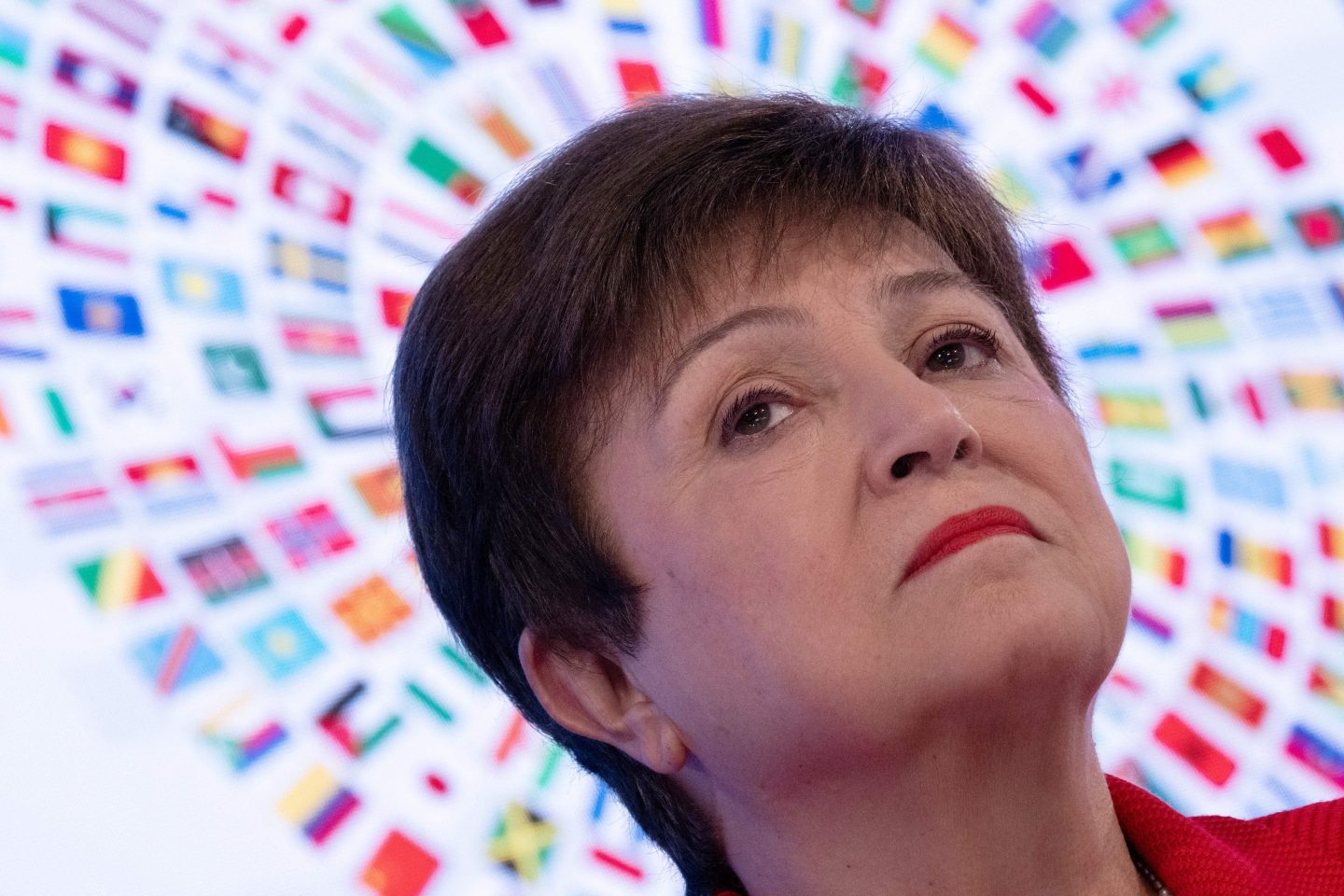
The IMF’s dubious methodology in tracking the Russian economy warrants close scrutiny. Nothing short of its institutional credibility is at risk, especially since the current IMF chief, Kristalina Georgieva, has been accused of pressuring economists to boost China’s business climate ratings during a previous tenure at the World Bank, which she denies.
For starters, the IMF’s forecast of economic growth in Russia exceeds even that of the Russian central bank, which expects GDP to fall by at least 1.5% this year. Even Russian oligarchs such as aluminum tycoon Oleg Deripaska are openly fretting about how Putin will run out of cash next year–and how he’s been cannibalizing Russian companies to make ends meet! Yet the truth is, as they candidly admitted to us, the IMF Russia Desk economists have “basically zero visibility” into what is actually going on in the Russian economy.
This is at odds with IMF protocols. Since the outbreak of war, the IMF has allowed Russia to be in violation of its own membership standards–which require member states to disclose transparent, verifiable, and comprehensive national income statistics.
Putin now refuses to disclose major economic indicators ranging from foreign trade data, monthly output data on oil and gas, capital inflows and outflows, financial statements of major companies, central bank monetary base data, foreign direct investment data, domestic value added by industry, and lending and loan origination data. Even Rosaviatsiya, Russia’s federal air transport agency, has stopped publishing data on air passenger volumes. Yet these are the major high-frequency flow statistics that go into the construction of an economy-wide GDP forecast for any nation–from the U.S. to China.
Thus, the IMF simply does not have the data needed to independently calculate Russia’s GDP by any accepted method–whether it’s by expenditures, production, or incomes. They are flying blind, with the Russian institutions offering zero visibility.
Rather than publicly admitting what they don’t know, they privately admit the “massive uncertainty.” The IMF Russia Desk economists unquestioningly swallow what little data Putin does release–cherry-picked and fabricated data releases spewed out by the increasingly unreliable Kremlin agency Rosstat, falsely certifying Putin’s fable of economic triumph.
There is no shortage of reasons why Rosstat releases should be treated as dubious when not verified against cross-channel checks and alternative benchmarks. Rosstat has a long history of manipulating official economic statistics to please Putin, “bending over backward to correct bad numbers and burying unflattering statistics” under the pressure the Kremlin has exerted to corrupt statistical integrity.
The agency has been “switching to new methodologies” and “recalculating data” with alarming frequency. Then there’s the overt political interference–Putin has fired the heads of Rosstat, transferred control of the agency to political appointees, and appointed a blatant political pick as deputy economic minister. It is no wonder outside observers ranging from international organizations to foreign investors regularly sound alarms over “concerns about the reliability and consistency of the Kremlin’s economic releases.”
However, the IMF remains mysteriously silent on the issue of Russian data integrity. Curiously, top IMF Russia Desk economists have admitted to us that they have “not had any engagement” with alternative Russian data sources. Apparently, that is too difficult to do, especially having “evacuated their entire Russian team.”
That is especially worrisome since so many independent economic facts contradict their published estimates. For example, our latest tabulations show that over 1,000 major multinationals have completely exited the country in protest of its illegal war in Ukraine.
Collectively, they have combined in-country revenues equivalent to 40% of Russia’s pre-war GDP by our estimates. Moreover, Russia has been reduced to irrelevancy in the global economy, as the world has moved on from Russian energy, food, metals, and other commodities.
Energy, the mainstay of the Russian economy, is in especially serious trouble. Energy export earnings are now down $500 million a day relative to last year’s highs. Due to insufficient pipeline capacity to major customers like China and India, Russia can’t seem to sell the 86% of its natural gas exports which previously went to the EU. Moreover, with the persistent Urals oil pricing discount, Russia is not making much money on every barrel of oil they sell when the price of oil is only around $55/barrel.
Our triangulation of primary source data–wherever Russia was the buyer we checked with the seller and vice versa–shows that virtually every sector has collapsed, with some such as automotive down more than 90%.
Millions of people have fled Russia this past year to neighboring nations, with TASS reporting 700,000 emigres just in April. The Uzbek ambassador to the U.S. told us last week that almost 500,000 Russians have fled to his country with employment in the Tashkent Technology Park soaring 500%–in what is dubbed the “Tash rush.”
Yet the IMF publicly chooses to ignore all of these well-documented data challenges, merely putting out a Putin-echoing sanguine GDP assessment while obfuscating the underlying inputs and assumptions. We don’t presume to know why. In fairness, we should ask why the Biden Administration and Congress have not filled the U.S. seat on the IMF’s Executive Board, leaving the largest vote share (16.5%) unrepresented–while Russia remains well represented by a veteran IMF insider who has the most seniority of any country’s representative, tilting IMF governance politics.
As Abraham Lincoln famously warned, “You can fool some of the people all the time and all of the people some of the time.” It seems Putin can fool sophisticated Western media voices–and even economists and former policymakers much of the time.
The economic experts and media pundits who are parroting presumed wisdom are fueling sanctions skeptics, naively falling for Putin’s propaganda, and drawing a false sense of comfort from an unfortunate seal of approval that comes with a now-tainted IMF brand. For whatever reason, they are helping Putin erode Western unity.
Jeffrey Sonnenfeld is the Lester Crown Professor in Management Practice and Senior Associate Dean at Yale School of Management.
Stephen Roach is the former Chairman of Morgan Stanley Asia and Chief Economist of Morgan Stanley. He is currently a senior fellow at Yale Law School.
Steven Tian is the director of research at the Yale Chief Executive Leadership Institute and former investment analyst at Rockefeller Capital.
The opinions expressed in Fortune.com commentary pieces are solely the views of their authors and do not necessarily reflect the opinions and beliefs of Fortune.
More must-read commentary published by Fortune:
- The return to the office could be the real reason for the slump in productivity. Here’s the data to prove it
- Overconfident tech CEOs have overpaid for ‘box tickers’ and ‘taskmasters.’ Here’s why the real ‘creators’ will survive the mass layoffs
- How the Russian economy self-immolated in the year since Putin invaded Ukraine
- I am a DoorDash driver who’s been elected to the Colorado State House. Food delivery companies are gamifying your tips and making it harder for drivers to earn a living wage. Here’s what you can do about it