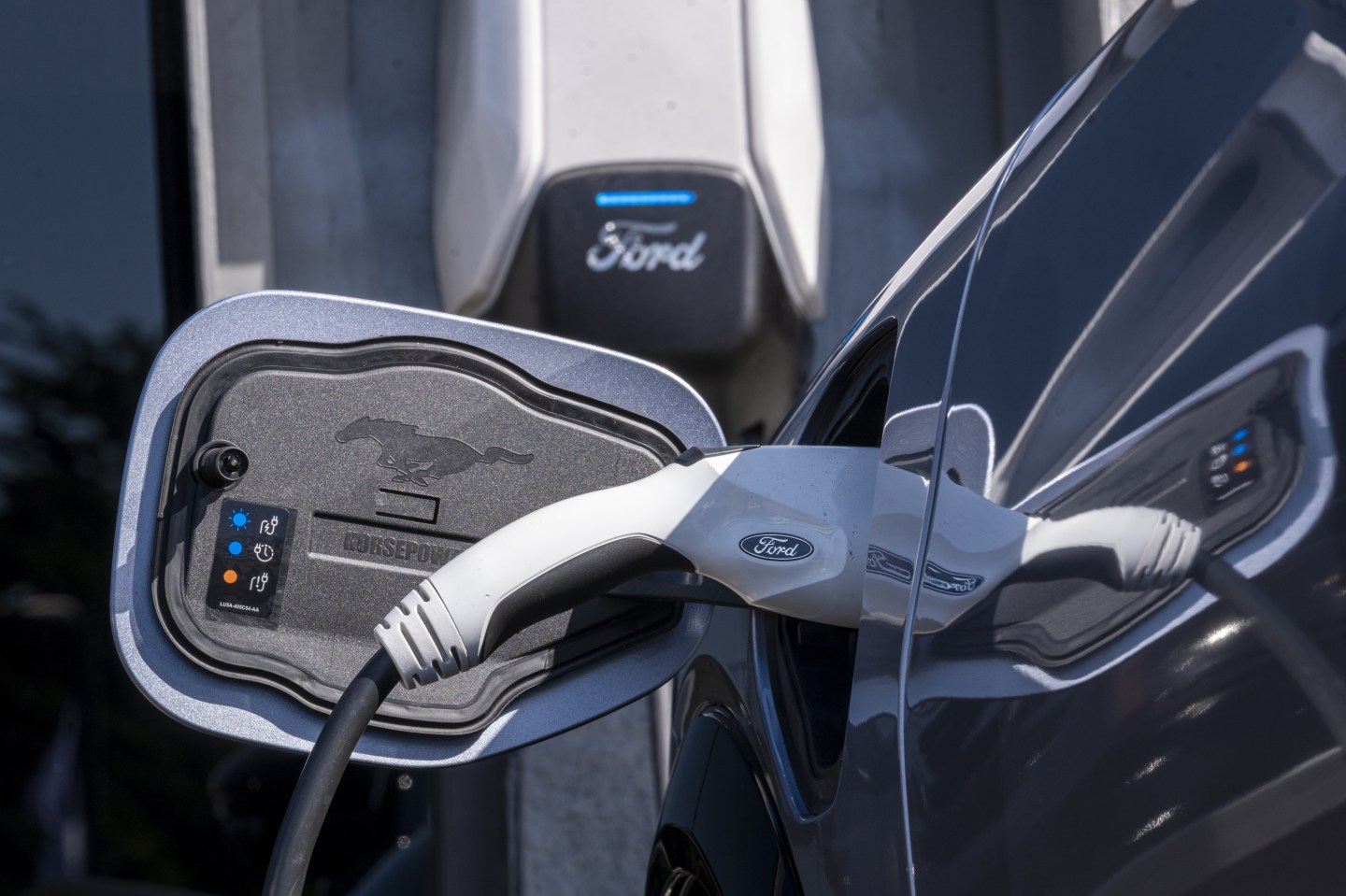
Starting Jan. 1, many Americans will qualify for a tax credit of up to $7,500 for buying an electric vehicle. The credit, part of changes enacted in the Inflation Reduction Act, is designed to spur EV sales and reduce greenhouse emissions.
But a complex web of requirements, including where vehicles and batteries must be manufactured to qualify, is casting some doubt on whether anyone can receive the full $7,500 credit next year.
The Treasury Department is rolling out more information on which vehicles qualify and how individuals and businesses can access credit beginning in 2023. One big loophole that allows tax credits for EVs purchased for “commercial” use, such as leasing or ride-share, even if they are foreign-made is drawing the ire of Sen. Joe Manchin, D-W.Va., who says it could circumvent the intent of the law to favor American manufacturing.
For at least the first two months of 2023, though, a delay in some of Treasury’s rules will likely make the full credit temporarily available to consumers who meet certain income and price limits.
The new law also provides a smaller credit for people who buy a used EV.
Certain EV brands that were eligible for a separate tax credit that began in 2010 and that will end this year may not be eligible for the new credit. Several EV models made by Kia, Hyundai and Audi, for example, won’t qualify because they are manufactured outside North America.
The new tax credit, which lasts until 2032, is intended to make zero-emission vehicles affordable to more people. Here is a closer look at it.
What’s new for 2023?
The credit of up to $7,500 will be offered to people who buy certain new electric vehicles as well as some plug-in gas-electric hybrids and hydrogen fuel cell vehicles. For people who buy a used vehicle that runs on battery power, a $4,000 credit will be available.
But the question of which vehicles and buyers will qualify for the credits is complicated and will remain uncertain until Treasury issues the proposed rules in March.
What’s known so far is that to qualify for the credit, new EVs must be made in North America. In addition, caps on vehicle prices and buyer incomes are intended to disqualify wealthier buyers.
Starting in March, complex provisions will also govern battery components. Forty percent of battery minerals will have to come from North America or a country with a U.S. free trade agreement or be recycled in North America. (That threshold will eventually go to 80%.)
And 50% of the battery parts will have to be made or assembled in North America, eventually rising to 100%.
Starting in 2025, battery minerals cannot come from a “foreign entity of concern,” mainly China and Russia. Battery parts cannot be sourced in those countries starting in 2024 — a troublesome obstacle for the auto industry because numerous EV metals and parts now come from China.
There also are battery-size requirements.
Which vehicles are eligible?
Because of the many remaining uncertainties, that’s not entirely clear. However, the Treasury Department released an initial list of vehicles that meet the requirements to claim the new clean vehicle tax credit beginning Jan. 1, including models from Chrysler, Ford, Jeep, Lincoln, Nissan and Rivian. More vehicles will be added to the list in the weeks and months to come.
The Energy Department also maintains a list of qualifying EVs.
General Motors and Tesla have the most EVs assembled in North America. Each also makes batteries in the U.S. But because of the requirements for where batteries, minerals and parts must be manufactured, it’s likely that buyers of those vehicles would initially receive only half the tax credit, $3,750. GM says its eligible EVs should qualify for the $3,750 credit by March, with the full credit available in 2025.
Until Treasury issues its rules, though, the requirements governing where minerals and parts must be sourced will be waived. This will allow eligible buyers to receive the full $7,500 tax incentive for qualifying models early in 2023.
What about price?
To qualify, new electric sedans cannot have a sticker price above $55,000. Pickup trucks, SUVs and vans can’t be over $80,000. This will disqualify two higher-priced Tesla models. Though Tesla’s top sellers, the models 3 and Y, will be eligible, with options, those vehicles might exceed the price limits.
Kelley Blue Book says the average EV now costs over $65,000, though lower-priced models are coming.
Will I qualify for the credits?
It depends on your income. For new EVs, buyers cannot have an adjusted gross income above $150,000 if single, $300,000 if filing jointly and $225,000 if head of a household.
For used EVs, buyers cannot earn more than $75,000 if single, $150,000 if filing jointly and $112,500 if head of household.
How will the credit be paid?
At first, it will be applied to your 2023 tax return, which you file in 2024. Starting in 2024, consumers can transfer the credit to a dealership to lower the vehicle price at purchase.
Will the credits boost EV sales?
Yes, but it probably will take a few years, says Mike Fiske, associate director for S&P Global Mobility. The credit may cause a bump in sales early next year because of Treasury’s delay in issuing the stricter requirements. But most automakers are now selling all the EVs they build and cannot make more because of shortages of parts, including computer chips.
And automakers may have trouble certifying the sources of battery minerals and parts, a requirement for buyers to receive the full credit. Automakers have been scrambling to move more EV supply chains to the U.S.
How does the used-EV credit work?
Consumers can receive tax credits of up to $4,000 — or 30% of the vehicle price, whichever is less — for buying EVs that are at least two years old. But the used EV must cost less than $25,000 — a tall order given the starting prices for most EVs on the market. A search on Autotrader.com shows that the Chevy Bolt, the Nissan Leaf and other relatively economical used EVs are listed at $26,000 or more for models dating back to 2019.
On the other hand, used EVs need not be made in North America or comply with the battery-sourcing requirements. That means that, for instance, a 2022 Kia EV6 that’s ineligible for the new-vehicle credit because it’s made in South Korea can qualify for a used-car credit if its price falls below $25,000.
“The real effects where these tax credits will have a big impact will be in the 2026-to-2032 period — a few years into the future — as automakers gear up and volumes increase,” said Chris Harto, a senior policy analyst for Consumer Reports magazine.
Why is the government offering the credits?
The credits are part of roughly $370 billion in spending on clean energy — America’s largest investment to fight climate change — that was signed into law in August by President Joe Biden. EVs now make up about 5% of U.S. new-vehicle sales; Biden has set a goal of 50% by 2030.
Sales of EVs have been climbing, particularly as California and other states have moved to phase out gas-powered cars. The rise of lower-cost competitors to Tesla, such as the Chevy Equinox, with an expected base price of around $30,000, are expected to broaden the EVs’ reach to middle-class households. S&P Global Mobility expects EVs’ share of auto sales to reach 8% next year, 15% by 2025 and 37% by 2030.
Could requirements be eased to make more EVs eligible?
It appears that may happen. Some U.S. allies are upset over North American manufacturing requirements that disqualify EVs made in Europe or South Korea.
The requirements knock Hyundai and Kia out of the credits, at least in the short term. They plan to build new EV and battery plants in Georgia, but those won’t open until 2025. European Union countries fear that the tax credits could make their automakers move factories to the U.S.
There is a loophole, however. The law appears to exempt commercial vehicles from the North America assembly and domestic battery mineral and parts requirements. That means that rental car and leasing companies with huge fleets as well as EVs used fuller-time for ride-share such as Uber and Lyft could be eligible for up to $7,500 in tax credits even for foreign-made EVs. A fact sheet released by Treasury on Thursday affirms it would allow exemptions for commercial vehicles, which the department says it must do based on the wording of the law.
That move drew the anger of Manchin, a key vote in passing the Inflation Reduction Act, who on Thursday accused the Biden administration of bending to the desires of foreign countries. He said the exemptions undermine the law’s intent to “bring our energy and manufacturing supply chains onshore to protect our national security, reduce our dependence on foreign adversaries and create jobs right here in the United States.”
Manchin said he would introduce legislation in the coming weeks that “prevents this dangerous interpretation from Treasury from moving forward.”
Are there credits for charging stations?
If you install an EV charger at home, credits may be available. The new law revives a federal tax credit that had expired in 2021; it provides 30% of the cost of hardware and installation, up to $1,000. It adds a requirement that the charger must be in a low-income or non-urban area. Businesses that install new EV chargers in those areas can receive tax credits of as much as 30% — up to $100,000 per charger.
Residential EV chargers can range in cost from $200 to $1,000; installation can add several more hundred dollars.
Should I buy now or wait?
That’s entirely a personal decision.
If you’ve grown tired of volatile gasoline prices and are considering an EV, you might want to go ahead. Buying a qualifying EV in January or February could net you the full $7,500 tax break before more stringent requirements take effect in March. Additional state credits also may be available.
But if you’re still on the fence, there’s no urgency. Consumers who rush to buy now, when relatively few qualifying EVs are available, may face dealer price markups. Within a few years, technology will improve, and more EVs will qualify for full credits.
Where can I find more information?
The Treasury Department on Thursday released several frequently asked questions documents for individual and commercial customers on the clean vehicle tax credits meant to help them understand how to access the various tax incentives.
The department also released a white paper explaining the anticipated direction that it is taking ahead of the proposed rule rollout.
Our new weekly Impact Report newsletter examines how ESG news and trends are shaping the roles and responsibilities of today's executives. Subscribe here.