The International Space Station is no longer the only place where humans can live in orbit.
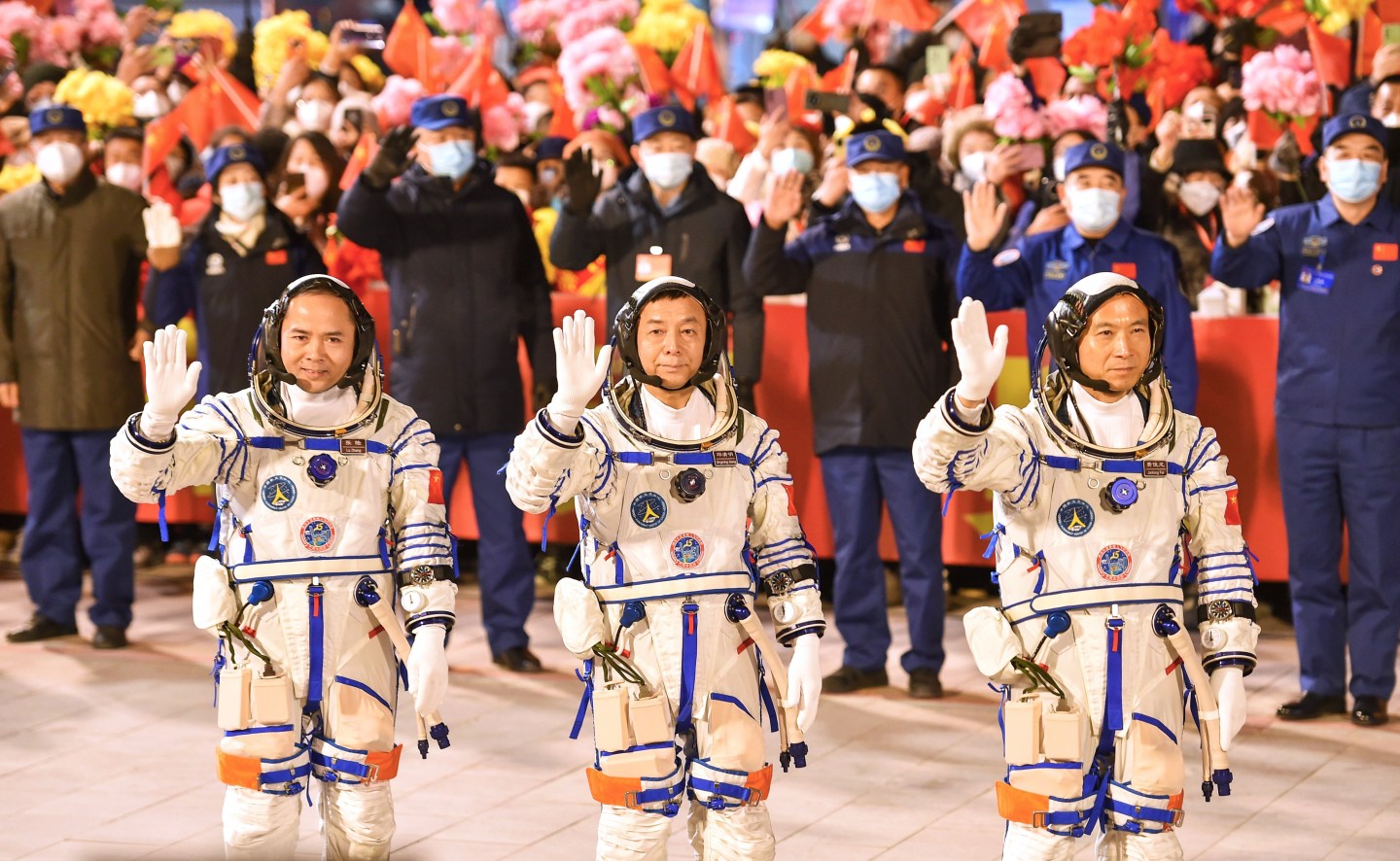
On Nov. 29, 2022, the Shenzhou 15 mission launched from China’s Gobi Desert carrying three taikonauts – the Chinese word for astronauts. Six hours later, they reached their destination, China’s recently completed space station, called Tiangong, which means “heavenly palace” in Mandarin. The three taikonauts replaced the existing crew that helped wrap up construction. With this successful mission, China has become just the third nation to operate a permanent space station.
China’s space station is an achievement that solidifies the country’s position alongside the U.S. and Russia as one of the world’s top three space powers. As scholars of space law and space policy who lead the Indiana University Ostrom Workshop’s Space Governance Program, we have been following the development of the Chinese space station with interest.
Unlike the collaborative, U.S.-led International Space Station, Tiangong is entirely built and run by China. The successful opening of the station is the beginning of some exciting science. But the station also highlights the country’s policy of self-reliance and is an important step for China toward achieving larger space ambitions among a changing landscape of power dynamics in space.
Capabilities of a Chinese station
The Tiangong space station is the culmination of three decades of work on the Chinese manned space program. The station is 180 feet (55 meters) long and is comprised of three modules that were launched separately and connected in space. These include one core module where a maximum of six taikonauts can live and two experiment modules for a total of 3,884 cubic feet (110 cubic meters) of space, about one-fifth the size of the International Space Station. The station also has an external robotic arm, which can support activities and experiments outside the station, and three docking ports for resupply vehicles and manned spacecraft.
Like China’s aircraft carriers and other spacecraft, Tiangong is based on a Soviet-era design – it is pretty much a copy of the Soviet Mir space station from the 1980s. But the Tiangong station has been heavily modernized and improved.
The Chinese space station is slated to stay in orbit for 15 years, with plans to send two six-month crewed missions and two cargo missions to it annually. The science experiments have already begun, with a planned study involving monkey reproduction commencing in the station’s biological test cabinets. Whether the monkeys will cooperate is an entirely different matter.
Science and a steppingstone
The main function of the Tiangong station is to perform research on life in space. There is a particular focus on learning about the growth and development of different types of plants, animals and microorganisms, and there are more than 1,000 experiments planned for the next 10 years.
Tiangong is strictly Chinese made and managed, but China has an open invitation for other nations to collaborate on experiments aboard Tiangong. So far, nine projects from 17 countries have been selected.
Although the new station is small compared to the 16 modules of the International Space Station, Tiangong and the science done aboard will help support China’s future space missions. In December 2023, China is planning to launch a new space telescope called Xuntian. This telescope will map stars and supermassive black holes among other projects with a resolution about the same as the Hubble Space Telescope but with a wider view. The telescope will periodically dock with the station for maintenance.
China also has plans to launch multiple missions to Mars and nearby comets and asteroids with the goal of bringing samples back to Earth. And perhaps most notably, China has announced plans to build a joint Moon base with Russia – though no timeline for this mission has been set.
Astropolitics
A new era in space is unfolding. The Tiangong station is beginning its life just as the International Space Station, after more than 30 years in orbit, is set to be decommissioned by 2030.
The International Space Station is the classic example of collaborative ideals in space – even at the height of the Cold War, the U.S. and the Soviet Union came together to develop and launch the beginnings of the space station in the early 1990s. By comparison, China and the U.S. have not been so jovial in their orbital dealings.
In the 1990s, when China was still launching U.S. satellites into orbit, concerns emerged that China was accidentally acquiring – or stealing – U.S. technology. These concern in part led to the Wolf Amendment, passed by Congress in 2011, which prohibits NASA from collaborating with China in any capacity. China’s space program was not mature enough to be part of the construction of the International Space Station in the 1990s and early 2000s. By the time China had the ability to contribute to the International Space Station, the Wolf Amendment prevented it from doing so.
It remains to be seen how the map of space collaboration will change in the coming years. The U.S.-led Artemis Program that aims to build a self-sustaining habitat on the Moon is open to all nations, and 19 countries have joined as partners so far. China has also recently opened its joint Moon mission with Russia to other nations. This was partly driven by cooling Chinese-Russian relations but also due to the fact that because of the war in Ukraine, Sweden, France and the European Space Agency canceled planned missions with Russia.
As tensions on Earth rise between China, Russia and the West, and some of that jockeying spills over into space, it remains to be seen how the decommissioning of the International Space Station and operation of the Tiangong station will influence the China-U.S. relationship.
An event like the famous handshake between U.S. astronauts and Russian cosmonauts while orbiting Earth in 1975 is a long way off, but collaboration between the U.S. and China could do much to cool tensions on and above the Earth.