• Home
  • Latest
  • Fortune 500
  • Finance
  • Tech
  • Leadership
  • Lifestyle
  • Rankings
  • Multimedia
China

Alibaba raised $25 billion in 2014 in what’s still the U.S.’s largest IPO. Now a U.S.-China fight could kick the Chinese tech giant off Wall Street

Nicholas Gordon
By
Nicholas Gordon
Nicholas Gordon
Asia Editor
Down Arrow Button Icon
Nicholas Gordon
By
Nicholas Gordon
Nicholas Gordon
Asia Editor
Down Arrow Button Icon
August 1, 2022, 5:35 AM ET
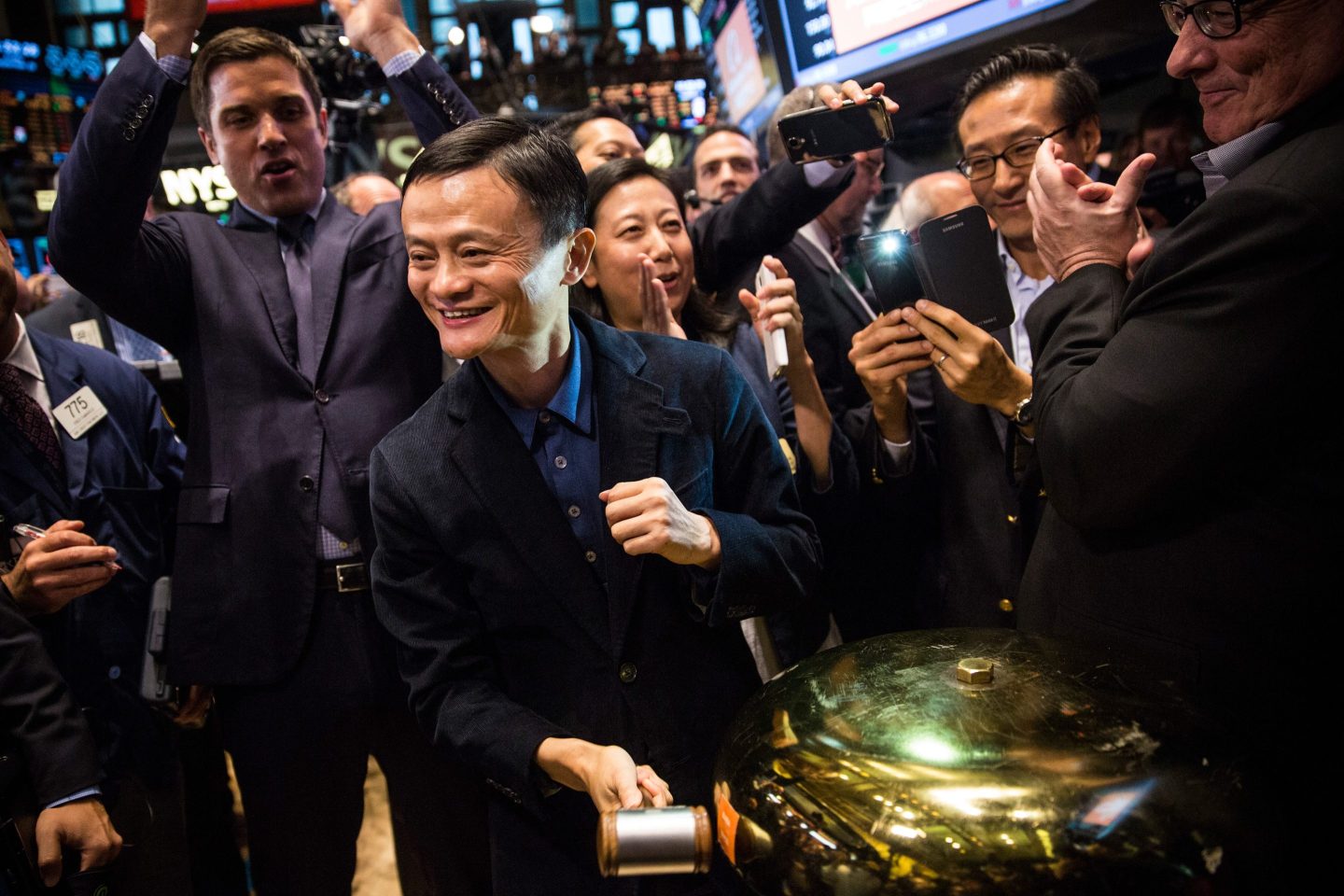
Alibaba founder Jack Ma, surrounded by traders, rings a bell on the floor of the New York Stock Exchange in 2014 to celebrate Alibaba's first day of trading
Alibaba's U.S. IPO in 2014 is still the country's largest, raising $25 billion. But a fight between the U.S. and China over auditing may kick the e-commerce giant out of Wall Street. Andrew Burton—Getty Images

Almost eight years ago, Alibaba founder Jack Ma watched as eight of his customers rang the opening bell at the New York Stock Exchange, marking the first trading day for the Chinese e-commerce company. Alibaba had just completed the world’s largest IPO at the time, raising $25 billion at $68 a share. One trader told Fortune at the time that he’d “never seen anything” like the hype that marked Alibaba’s trading debut. Ma was mobbed by reporters as he wandered the trading floor. Some traders even reportedly wore hoodies in Alibaba’s trademark orange, rather than their traditional suit and tie. Shares surged 38% on the first day of trading.

But Alibaba’s run on the U.S. stock exchange could soon come to an undignified end. On Friday, the U.S. Securities and Exchange Commission added Alibaba to its provisional list of companies that would be delisted from U.S. exchanges under the 2020 Holding Foreign Companies Accountable Act (HFCAA), meant to force U.S.-listed Chinese firms to open their books to U.S. inspectors.

The SEC has threatened to boot Chinese firms from U.S. exchanges for years, and it has even named other prominent firms—JD.com, video game publisher NetEase, agricultural platform Pinduoduo, EV maker NIO, and food retailer Yum China—among the 160 companies identified as violating the HFCAA. But Alibaba’s notoriety, Ma’s flamboyance, and the firm’s special place in Wall Street history make the Chinese internet giant the new face of the $1.3 trillion delisting saga and put the looming crisis front and center in a way it hasn’t been before.

A fight over (auditing) access

The SEC’s threat to delist Alibaba is a new chapter in a years-long dispute between U.S. and Chinese regulators over how to audit Chinese companies listed in the U.S. The fight over auditing requirements puts all 261 U.S.-listed Chinese companies, with a combined $1.3 trillion in market capitalization, at risk of being forced to leave U.S. markets.

Technically, Chinese companies listed in the U.S. are supposed to make their books available to U.S. regulators, but Beijing has barred such access under national security concerns. The U.S. let noncompliant firms slide until 2020, when Congress passed the HFCAA, which stipulates that if a company’s auditor does not allow U.S. inspections for three consecutive years, the company will be forced off U.S. exchanges.

Since the law’s passage, Beijing and Washington have tried to strike a compromise that would allow U.S.-listed Chinese companies to stay put. Earlier this year, Beijing offered to grant foreign auditors access to Chinese documents, though it also reserved the right to redact classified or security-related information as deemed fit. Last week, the Financial Times reported that Beijing was considering establishing a multitier system categorizing the national security risk of overseas-listed companies, with U.S. regulators granted full access to companies that have non-sensitive data. (China’s securities regulator denied it was developing such a classification.) U.S. regulators are skeptical that a compromise is possible, with SEC Chair Gary Gensler saying in July that he was “not particularly confident” about the prospects for a deal, saying that the law requires full access.

On Wednesday, Gensler said that the U.S. would not send auditing inspectors to China or Hong Kong until Beijing agreed to grant auditing access, which needs to happen “soon” if inspectors had “any chance” of approving documents this year. 

In with a bang, out with a whimper?

In Alibaba’s case, Beijing may consider the giant e-commerce company with data on over a billion users too sensitive to receive foreign scrutiny, teeing the firm up for delisting. “Every feature of Alibaba points to the fact that its time in the U.S. could soon be over,” Liqian Ren, director of ModernAlpha at Wisdom Tree Asset Maangement, previously told Fortune before Alibaba was added to the SEC’s list. 

On Monday, Alibaba said that it would “strive to maintain its listing status on both the NYSE and the Hong Kong Stock Exchange” in a statement filed to Hong Kong Exchange and Clearing, where the e-commerce firm has a secondary listing. Alibaba shares were down 3% in Hong Kong trading on Monday, even as the broader Hang Seng Index was flat.

Alibaba’s exit from Wall Street, if it happens, would be a dramatic change in fortune from when it arrived. Alibaba’s 2014 IPO is still the world’s second-largest initial public offering, only Saudi Aramco’s $26 billion IPO in 2019 has topped it. Alibaba’s IPO remains the largest listing ever in the U.S.

Alibaba’s IPO was the premier listing in what became a wave of debuts by Chinese firms between 2013 and 2021 as U.S. investors raced to cash in on China’s tech boom. U.S. institutional investors alone hold $200 billion in Chinese American Depository Receipts, which allow American investors to buy shares in Chinese firms.

Didi Global’s $4.4 billion IPO in June 2021 ended the crush of Chinese IPOs in the U.S. Data security concerns from Chinese regulators led to a crackdown on the ride-hailing company and greater scrutiny on overseas listings.

As U.S.-China relations soured, several companies listed on U.S. exchanges returned to China to launch secondary “homecoming” listings. Alibaba itself launched a secondary listing in Hong Kong in 2019, raising $12.9 billion. 

On July 26, Alibaba announced that it would upgrade its secondary listing in Hong Kong to a primary listing. By upgrading its listing, Alibaba might be able to take advantage of a scheme that allows direct access to mainland Chinese investors, with wealth management firm Bernstein predicting that the e-commerce firm could get as much as $21 billion in investor inflows from mainland China. An upgraded listing could also serve as a backup plan for Alibaba if it’s ejected from Wall Street.

The threat of delistings may encourage other U.S.-listed Chinese companies to launch primary listings in Hong Kong, which would boost the city’s flagging stock market. Two other Chinese firms on the SEC’s list, e-commerce platform Dingdong and cloud computing company Kingsoft Cloud, are reportedly following Alibaba’s lead in launching primary listings in Hong Kong.

Sign up for the Fortune Features email list so you don’t miss our biggest features, exclusive interviews, and investigations.


About the Author
Nicholas Gordon
By Nicholas GordonAsia Editor
LinkedIn iconTwitter icon

Nicholas Gordon is an Asia editor based in Hong Kong, where he helps to drive Fortune’s coverage of Asian business and economics news.

See full bioRight Arrow Button Icon

Latest in

Finance
Lorem ipsum dolor sit amet, consectetur adipiscing elit, sed do eiusmod tempor incididunt ut labore et dolore magna aliqua. Ut enim ad minim veniam
By Fortune Editors
October 20, 2025
Finance
Lorem ipsum dolor sit amet, consectetur adipiscing elit, sed do eiusmod tempor incididunt ut labore et dolore magna aliqua. Ut enim ad minim veniam
By Fortune Editors
October 20, 2025
Finance
Lorem ipsum dolor sit amet, consectetur adipiscing elit, sed do eiusmod tempor incididunt ut labore et dolore magna aliqua. Ut enim ad minim veniam
By Fortune Editors
October 20, 2025
Finance
Lorem ipsum dolor sit amet, consectetur adipiscing elit, sed do eiusmod tempor incididunt ut labore et dolore magna aliqua. Ut enim ad minim veniam
By Fortune Editors
October 20, 2025
Finance
Lorem ipsum dolor sit amet, consectetur adipiscing elit, sed do eiusmod tempor incididunt ut labore et dolore magna aliqua. Ut enim ad minim veniam
By Fortune Editors
October 20, 2025
Finance
Lorem ipsum dolor sit amet, consectetur adipiscing elit, sed do eiusmod tempor incididunt ut labore et dolore magna aliqua. Ut enim ad minim veniam
By Fortune Editors
October 20, 2025

Most Popular

Finance
Lorem ipsum dolor sit amet, consectetur adipiscing elit, sed do eiusmod tempor incididunt ut labore et dolore magna aliqua. Ut enim ad minim veniam
By Fortune Editors
October 20, 2025
Finance
Lorem ipsum dolor sit amet, consectetur adipiscing elit, sed do eiusmod tempor incididunt ut labore et dolore magna aliqua. Ut enim ad minim veniam
By Fortune Editors
October 20, 2025
Finance
Lorem ipsum dolor sit amet, consectetur adipiscing elit, sed do eiusmod tempor incididunt ut labore et dolore magna aliqua. Ut enim ad minim veniam
By Fortune Editors
October 20, 2025
Finance
Lorem ipsum dolor sit amet, consectetur adipiscing elit, sed do eiusmod tempor incididunt ut labore et dolore magna aliqua. Ut enim ad minim veniam
By Fortune Editors
October 20, 2025
Finance
Lorem ipsum dolor sit amet, consectetur adipiscing elit, sed do eiusmod tempor incididunt ut labore et dolore magna aliqua. Ut enim ad minim veniam
By Fortune Editors
October 20, 2025
Finance
Lorem ipsum dolor sit amet, consectetur adipiscing elit, sed do eiusmod tempor incididunt ut labore et dolore magna aliqua. Ut enim ad minim veniam
By Fortune Editors
October 20, 2025
Rankings
  • 100 Best Companies
  • Fortune 500
  • Global 500
  • Fortune 500 Europe
  • Most Powerful Women
  • Future 50
  • World’s Most Admired Companies
  • See All Rankings
Sections
  • Finance
  • Leadership
  • Success
  • Tech
  • Asia
  • Europe
  • Environment
  • Fortune Crypto
  • Health
  • Retail
  • Lifestyle
  • Politics
  • Newsletters
  • Magazine
  • Features
  • Commentary
  • Mpw
  • CEO Initiative
  • Conferences
  • Personal Finance
  • Education
Customer Support
  • Frequently Asked Questions
  • Customer Service Portal
  • Privacy Policy
  • Terms Of Use
  • Single Issues For Purchase
  • International Print
Commercial Services
  • Advertising
  • Fortune Brand Studio
  • Fortune Analytics
  • Fortune Conferences
  • Business Development
About Us
  • About Us
  • Editorial Calendar
  • Press Center
  • Work At Fortune
  • Diversity And Inclusion
  • Terms And Conditions
  • Site Map
  • Facebook icon
  • Twitter icon
  • LinkedIn icon
  • Instagram icon
  • Pinterest icon

Latest in

Young teacher in classroom
SuccessGen Z
Echoing the Great Recession, Gen Z graduates are pouring into education, with Teach For America reporting a 43% surge
By Emma BurleighJanuary 12, 2026
14 hours ago
Future of WorkJobs
Acquisition.com CEO says leaders ‘have it backwards’ when it comes to hiring: She says she hires for emotional intelligence over technical skills
By Jacqueline MunisJanuary 12, 2026
14 hours ago
Real EstateHousing
‘Something big’ just happened in the U.S. housing market, real estate CEO says. And it could mean the difference of being able to buy a home or not
By Sydney LakeJanuary 12, 2026
14 hours ago
EconomyFederal Reserve
The FOMC has the power to pick its own chair and could keep Powell—unless the DOJ probe and Supreme Court let Trump oust him from the Fed
By Jason MaJanuary 12, 2026
14 hours ago
Sergey Brin
SuccessEducation
Google’s Sergey Brin admits he’s hiring ‘tons’ of workers without degrees: ‘They just figure things out on their own in some weird corner’
By Preston ForeJanuary 12, 2026
14 hours ago
Jerome Powell adjusts his glasses, looking to his left.
EconomyFederal Reserve
Goldman Sachs top economist says Powell probe won’t change the Fed: ‘Decisions are going to be made based on employment and inflation’
By Sasha RogelbergJanuary 12, 2026
14 hours ago

Most Popular

placeholder alt text
Economy
‘Sell America’: Investors dump U.S. assets in fear of the end of Fed independence
By Jim EdwardsJanuary 12, 2026
20 hours ago
placeholder alt text
Economy
Treasury spent $276 billion in interest on the national debt in the final three months of 2025, says the CBO—up $30 billion from a year prior
By Eleanor PringleJanuary 12, 2026
19 hours ago
placeholder alt text
Success
An exec at $62 billion giant Colgate says Gen Z workers, despite getting flak for being woke and lazy, are actually ‘pushing us to get better’
By Emma BurleighJanuary 10, 2026
3 days ago
placeholder alt text
AI
This CEO laid off nearly 80% of his staff because they refused to adopt AI fast enough. 2 years later, he says he'd do it again
By Nick LichtenbergJanuary 11, 2026
2 days ago
placeholder alt text
Economy
A Supreme Court ruling that strikes down Trump's tariffs would be the fastest way to revive the stalling job market, top economist says
By Jason MaJanuary 11, 2026
1 day ago
placeholder alt text
Commentary
I run one of America's most successful remote work programs and the critics are right. Their solutions are all wrong, though
By Justin HarlanJanuary 11, 2026
2 days ago

© 2025 Fortune Media IP Limited. All Rights Reserved. Use of this site constitutes acceptance of our Terms of Use and Privacy Policy | CA Notice at Collection and Privacy Notice | Do Not Sell/Share My Personal Information
FORTUNE is a trademark of Fortune Media IP Limited, registered in the U.S. and other countries. FORTUNE may receive compensation for some links to products and services on this website. Offers may be subject to change without notice.