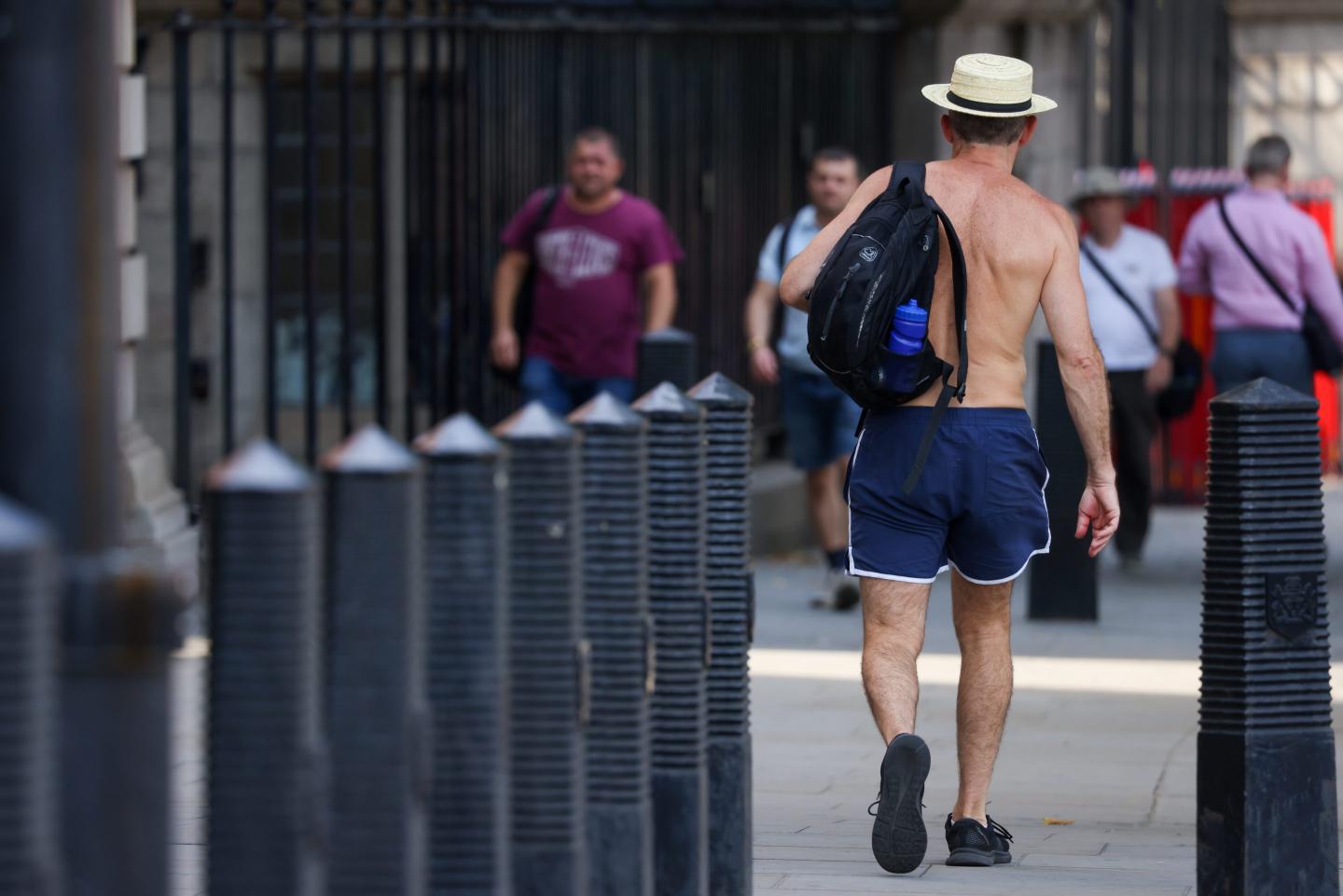
The U.K. is enduring a blistering heat wave that provisionally delivered the country’s hottest day on record, as temperatures boiled to 104.4°F. The British government has declared the severe weather a national emergency, and the U.K. meteorological office issued its first ever “red extreme heat warning,” cautioning that the high temperatures could lead to death.
The U.K. is just the latest country enveloped by a sweltering heat wave that has swept over Europe, sparking wildfires in Spain, prolonging drought in Portugal, and warping runways in England, causing further flight delays at London’s Luton Airport.
Despite the dangerously high temperatures, public health officials find that their warnings about heat don’t resonate with the public the way alarms about other natural disasters do.
“With heat waves, the problem is that not everyone thinks of hot weather as bad,” says Wändi Bruine de Bruin, a professor of public policy and behavioral science at the University of Southern California.
Your perception of extreme heat risk depends on where you live
Bruine de Bruin says people who live in countries that are normally wet and cool, like the U.K., are likely to view excessively inclement weather—heavy rain, snow, and floods—as “bad” weather, but more likely to welcome hot weather as a respite from the common dreariness.
Conversely, people who live in persistently hot areas are more likely to recognize the potential risks of higher temperatures. Bruine de Bruin says, “If you have past experience with heatstroke or other unpleasant consequences of heat waves, you are probably more likely to protect yourself.”
Extreme heat is bad, both for public health and the economy. According to the U.S. Centers for Disease Control and Prevention (CDC), more people die each year owing to heat than any other extreme weather event in the U.S., including hurricanes and floods.
Meanwhile, researchers at think tank the Atlantic Council estimate that heat waves stripped $100 billion off the U.S. economy in 2021, as scorching temperatures caused power outages and work stoppages—more than the $65 billion in economic loss caused by hurricanes the same year.
But the sluggish slowdown associated with intense heat doesn’t typically provide the same drama as 100 mph winds that rip roofs off houses and tear down power lines, which can make it difficult for people with little experience with intense heat to visualize it as a threat.
In 2015, researchers at Yale found that people living in the southern states of the U.S. were likely to rank heat as a greater personal risk than their compatriots in temperate northern states. But the research also showed that, even within hot states, the perception of heat risk could vary county to county, based on the demographics of those living there.
Marginalized groups are more likely to consider heat a health risk
Richer, white Americans were less likely than poorer people and people of color to see heat as a health risk, the researchers found. That disparity is because heat in the U.S. disproportionately harms poorer and non-white neighborhoods, where the public has less access to shade, AC, and other cooling measures.
Disadvantaged populations are also more likely to work jobs that place them at risk of heat exposure, which means they also disproportionately suffer the economic fallout of heat disruption. According to the Atlantic Council, Black and Hispanic residents in the U.S. lose “18% more in productivity than their White counterparts…because they live in higher percentages in heat-stressed locations.”
Public health experts should change their extreme heat messaging
The fact that people who are least accustomed to dealing with extreme heat are the least likely to recognize heat waves as a threat poses a conundrum for public health officials, tasked with persuading the public to protect themselves against heatstroke.
“Those who like the idea of warmer weather tend to be less likely to take recommended precautions when it gets hot, such as staying out of the sun during the hottest time of the day, avoiding exercise in the sun, or drinking lots of water,” Bruine de Bruin says.
“It might be better for messages to focus on how people can enjoy the sun, without putting themselves at risk for heatstroke or other unpleasant experiences,” Bruine de Bruin suggests. Warnings about how heat is dangerous “may not ring true” to people who have never suffered from it, she says.
It’s also true that the meaning of “heat wave” changes by location. Because heat waves are defined regionally, recorded as prolonged periods of temperature above the norm for a particular location at a particular time of year, a heat wave in the U.K. is usually not going to be as hot as a heat wave in Texas.
However, because climate change is increasing average temperatures in the U.K., the meteorological office raised its thresholds for declaring a heat wave in January this year. In London, the “heat wave” threshold is set at 82°F, yet temperatures in the city are expected to hit 104°F this week.