When Russia invaded Ukraine, countries around the world condemned the move, and abruptly cut economic, business and diplomatic ties.
Over 1,000 companies—from American to European and Japanese firms—abandoned their business operations in Russia. Western nations booted Russia from SWIFT—the international payments system that moves money around the world—and froze Russia’s central bank assets, barring it from accessing its $630 billion foreign reserve stash.
Economists and world leaders believed that combined, the economic impact on the country relegate it to an economic pariah, ensure losses in the billions and perhaps even lead to a wholesale collapse of the country’s financial system.
But that’s not quite how it worked out.
Across Russia, signs have emerged that the country is adapting to global economic isolation better than most people anticipated.
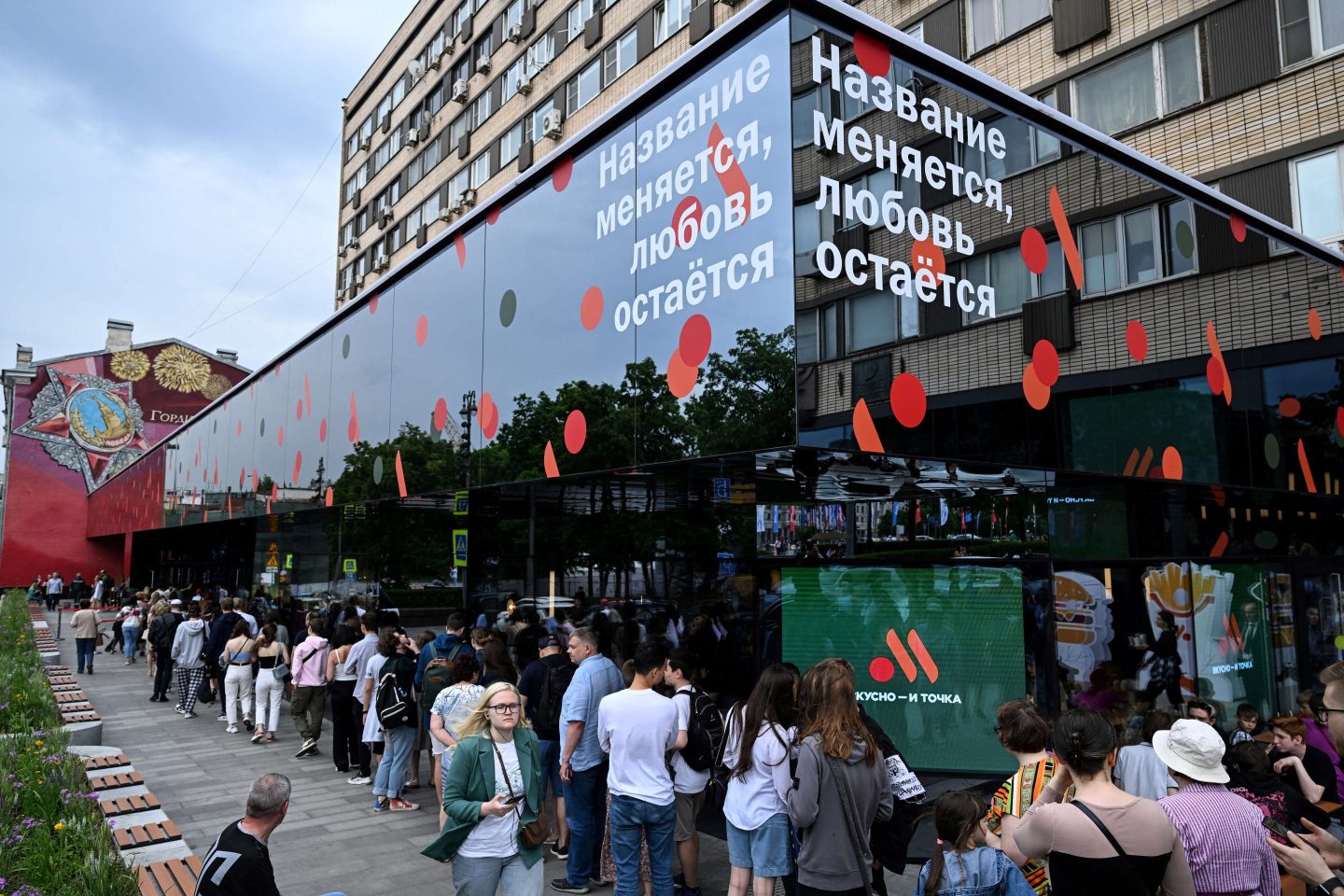
Russian businessmen have gobbled up western companies’ operations, like Siberian billionaire Alexander Govor’s purchase of McDonald’s 850 outlets across the country. Russian property developers, like MR Group are opening new shopping malls—simply sans western brands like H&M, Nike and Starbucks.
And despite becoming the world’s most sanctioned nation in the world, Russia’s economy hasn’t tanked. Russian President Vladimir Putin had began preparing the country years ago to endure western financial pressure by shoring up its currency reserves and befriending China. And in a stroke of luck, the Kremlin’s coffers are bursting because oil prices have skyrocketed, stabilizing the ruble.
The economy is staying afloat for now. But as the war drags on, cracks are beginning to show as Russia stares down its worst recession in 30 years, faces a looming EU oil embargo and grapples with a growing number of citizens pushed into poverty.
Stockpiling and rallies
After Russia’s invasion of Crimea in 2014, Putin began preparing the country’s economy to endure western sanctions. He stockpiled foreign currencies, reduced Russia’s dollar dependency and pivoted to a stronger partnership with China.
When Russia invaded Ukraine in February of this year, it did so with large currency reserves and minimal public debt.
In the weeks following the invasion, western nations pummelled Russia with harsh, unprecedented sanctions, restricting Russia’s access to the global financial system. In response, Russia barred citizens from transferring money to bank accounts abroad to prevent capital outflow, while the central bank imposed a 20% emergency interest rate hike as the ruble tumbled to record lows. Those “timely and strong” moves allowed the country to stave off a “full scale financial crisis,” Laura Solanko, senior advisor at The Bank of Finland Institute for Emerging Economies in Transition (BOFIT), an organization that researches emerging economies, told Fortune.
Such measures “would have been very difficult to implement in a democracy, but [feasible] in an autocracy [where] state-owned companies play a larger role,” she says.
The widespread notion that the Russian economy would collapse from sanctions in a few short months was “as unrealistic as Russia’s own blitzkrieg plan to conquer Ukraine” in mere days, because of the government’s preparations to ensure a financially stable economy, Russian political scientist Ilya Matveev told Fortune.
But Russia hasn’t just played a good game of economic defense. Its invasion of Ukraine destabilized the global oil market, raising prices, which provided it with an incredible source of funding.
Petrodollars
Since Feb. 24, petrodollars from energy sales have filled the Kremlin’s coffers and offered it an economic lifeline.
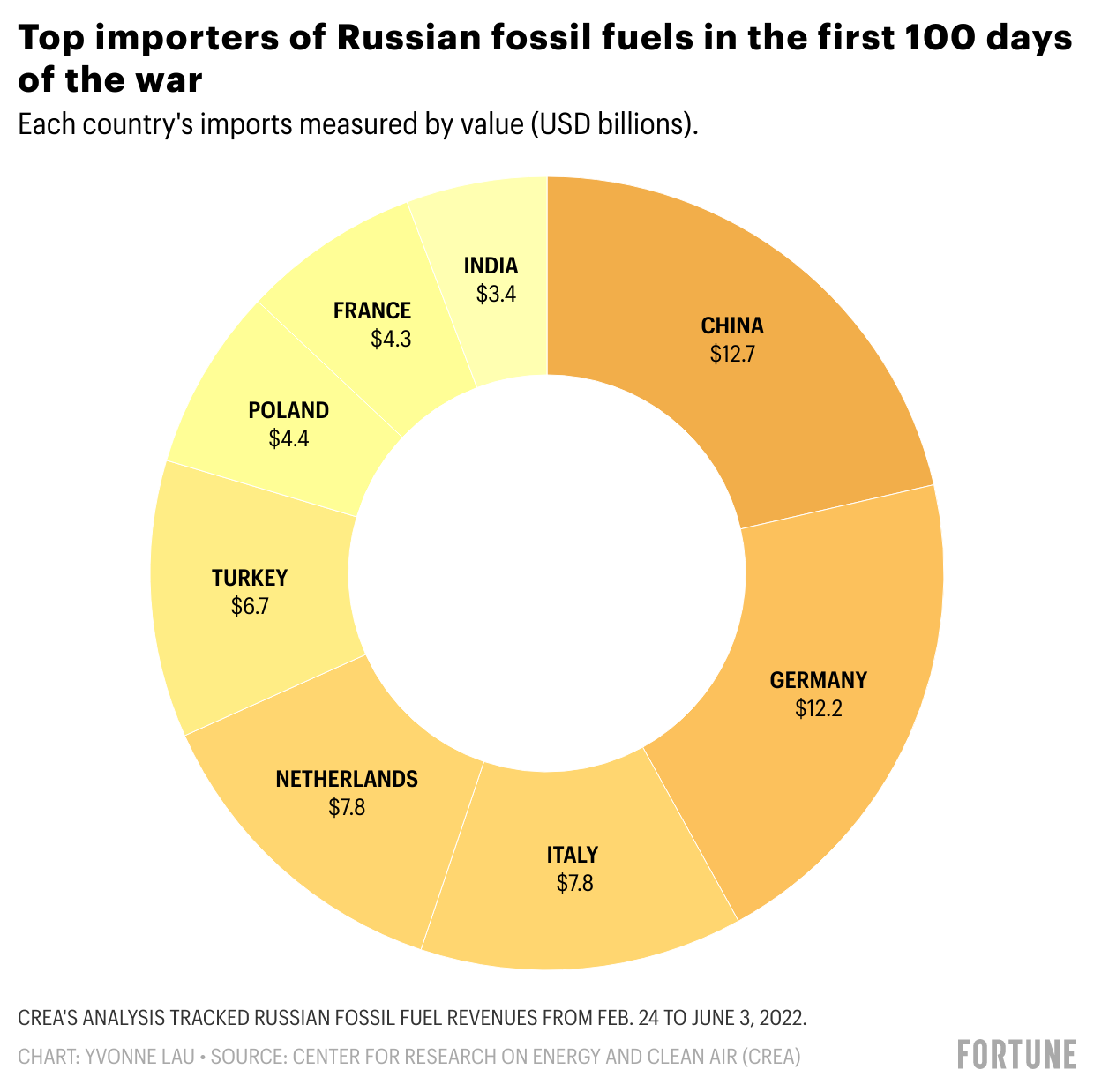
In the first 100 days of the war, Russia earned a record $94 billion from fossil fuel sales, despite selling its crude at a 30% discount and exporting lower volumes, according to analysis from Switzerland-based Center for Research on Energy and Clean Air (CREA). In May alone, Russia raked in $20 billion from energy sales, alone, up 11% from April.
Russia’s energy revenue is “unprecedented, because prices are unprecedented,” said CREA analyst Lauri Myllyvirta. From January to May this year, the country’s energy revenue grew 50%, says the International Energy Agency (IEA). Russia’s current account surplus—which measures a country’s exports against its imports—reached nearly $139 billion in the first six months of 2022, helped by its profits from energy and commodity exports, coupled with a collapse in imports due to sanctions.
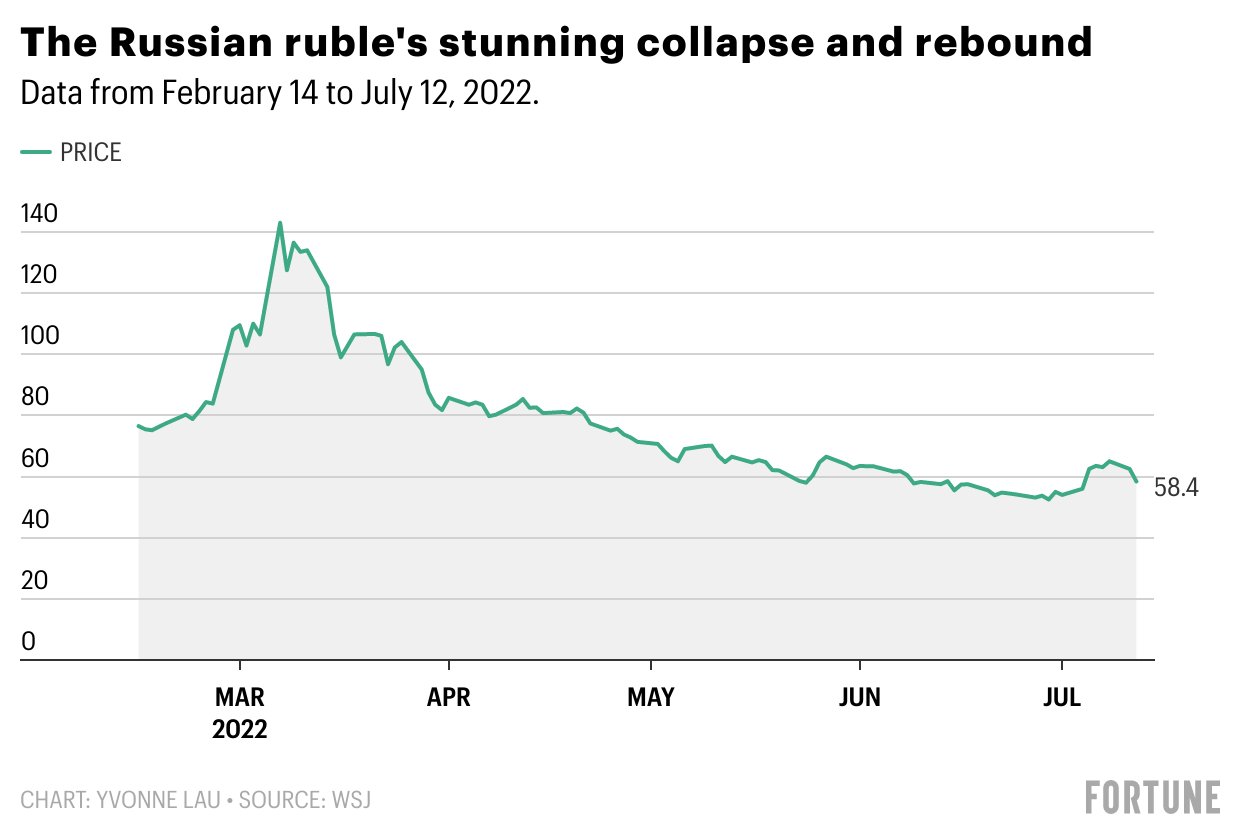
Those petrodollars also powered the ruble’s remarkable turnaround. Russia’s currency is the best-performing currency in the world this year. The ruble’s value plunged to less than one cent in March. But since January, it has surged 45% against the dollar. As of July 12, one U.S. dollar is worth 58.40 rubles. The ruble’s rally, in turn, has helped tame Russian inflation to its lowest level since February. In June, Russia’s consumer prices grew 15.9% year over year, compared to 17.1% in May and 17.8% in April, according to Russian government data.
The “bottom line” is that Russia’s oil and gas revenues haven’t been dented at all, allowing the government to keep funding the war and providing financial support for citizens, Peter Rutland, a Russia-focused professor of government at Wesleyan University, told Fortune.
“In the short run, the deck is stacked in favor of Russia,” he says.
Turbulence ahead
So far, Russia has managed to soften the blow to its economy and for its citizens. But its strong policy moves and growing oil revenues mask the ominous economic future that’s brewing just below the surface.
The ruble’s stunning turnaround is an artificial indicator that Russia’s economy is faring well, Sergei Guriev, scientific director of Sciences Po’s economics program and a research fellow at London-based think tank the Center for Economic Policy Research, told Fortune. Normally, a rising currency reflects the strengthened competitiveness of a country’s exports. But the main driver of the ruble’s strength is the collapse of Russian imports, which have plunged to 20-year lows, and drastically reduced its demand for dollars, Guriev says. The strong ruble doesn’t reflect Russia’s economic strength, but is a “symptom of something that’s very bad” for the nation, he says.
And behind the façade of a stabilizing economy, ordinary Russians are bearing the brunt of the sanctions. Russians’ real wages are expected to drop almost 6% this year, and their real disposable incomes set for a 7.5% decline, according to Russian bank VEB. Putin has authorized 10% hikes for pension incomes and minimum wages that went into effect last month. But even these boosts won’t stop Russians’ real wages, incomes and pensions from deteriorating, VEB said.
Although inflation is currently rising less rapidly than it was, double-digit inflation is set to continue in a country where 21 million people—nearly 15% of the national population—live below the poverty line, a number that has surged since the war began.
“Already-poor [Russians] will get poorer,” Matveev says. Andrei Illarionov, a former Putin aide, predicts that the number of Russians living in poverty will likely double, or even triple, as the war progresses, he told the BBC.

And four months into the war, Russian industries are suffering from a severe tech supply crunch.
Russia has replaced western goods with smartphones from China, refrigerators from Uzbekistan and 5G equipment from Israel and India since the war started. Still, there are big gaps that not even China—Russia’s largest trading partner—will be able to fill.
Sanctions have restricted western companies from supplying the country with chips, electrical equipment and other critical hardware needed to produce everything from kitchen appliances, cars, computers, data servers and military equipment. Entire supply routes for “[data] servers to computers to iPhones—everything—is gone,” one western chip executive told the FT.
China holds only 4% of the global semiconductor share and can’t make up the stymied supply from the world’s biggest chipmakers in the U.S. and Taiwan, Guriev says. Chinese firms are also holding back over concerns of triggering secondary sanctions from the west. The collapse of high-tech imports means that the Russian economy will undergo a “regressive transformation,” Matveev says. He notes that while the world progresses, Russia will be relegated to trying to reach its pre-war economic state, thus its technological and economic gap with the rest of the globe will widen over time.
Russia “hasn’t seen the worst yet,” even as its economy has undergone some initial shocks, Matveev says. “Unemployment will [increase] and shortages [of goods and parts] and price increases will continue,” he says.
Other experts agree. The EU’s sixth sanctions package against Russia, which will ban Russian seaborne crude by December and petroleum products by next February—90% of the bloc’s Russian oil imports—will be a major blow to the Kremlin if it’s implemented properly. The bloc accounted for 61% of Russia’s fossil fuel revenues from January to May this year. If the embargo is seriously enforced, Putin “won’t have enough money to recruit soldiers,” let alone prop up its citizens and industries, Guriev says.
Russia’s central bank expects an 8 to 10% gross domestic product (GDP) decline this year, compared to a pre-war growth forecast of 2%. That figure is a “substantial decline largely caused by western sanctions,” Solanko says.
Russia’s economic squeeze will come in the long run as the country deindustrializes, faces growing unemployment and continued stagflation and a run on goods, Rutland says.
In short, Russia is staring down its worst recession in 30 years, Guriev says.
Russia’s economic crises in 2009, 2014 and 2020 involved steep drops and fast recoveries. But experts agree that Russia won’t experience a speedy economic reboot his time around. Russia is facing a future of stagnation for years, perhaps even decades, Matveev says.
As Solanko notes, Russia is “isolating itself and decoupling from the global economy. This time, the fast recovery won’t come.”
Sign up for the Fortune Features email list so you don’t miss our biggest features, exclusive interviews, and investigations.