
• Home
  • Latest
  • Fortune 500
  • Finance
  • Tech
  • Leadership
  • Lifestyle
  • Rankings
  • Multimedia

Trendingnow

1

Jensen Huang made his $172 billion fortune on AI chips. His family's $75 million gift to Vanderbilt argues art decides what technology is for

2

'The demographic dividend of the last 40 years is ending': J.P. Morgan says the world is running out of the two things that kept interest rates down

3

The $39 trillion U.S. national debt isn’t as high as Japan’s and Singapore’s relative to economy size—and yet it's still worse somehow

1

Jensen Huang made his $172 billion fortune on AI chips. His family's $75 million gift to Vanderbilt argues art decides what technology is for

2

'The demographic dividend of the last 40 years is ending': J.P. Morgan says the world is running out of the two things that kept interest rates down

3

The $39 trillion U.S. national debt isn’t as high as Japan’s and Singapore’s relative to economy size—and yet it's still worse somehow
FinanceEconomy

Only some of today’s inflation is expected to stick around. Here are 5 key categories where prices are likely to stay higher for longer

Will Daniel
By
Will Daniel
Will Daniel
Down Arrow Button Icon
Will Daniel
By
Will Daniel
Will Daniel
Down Arrow Button Icon
July 16, 2022, 7:30 AM ET
A graph of Sticky-CPI.
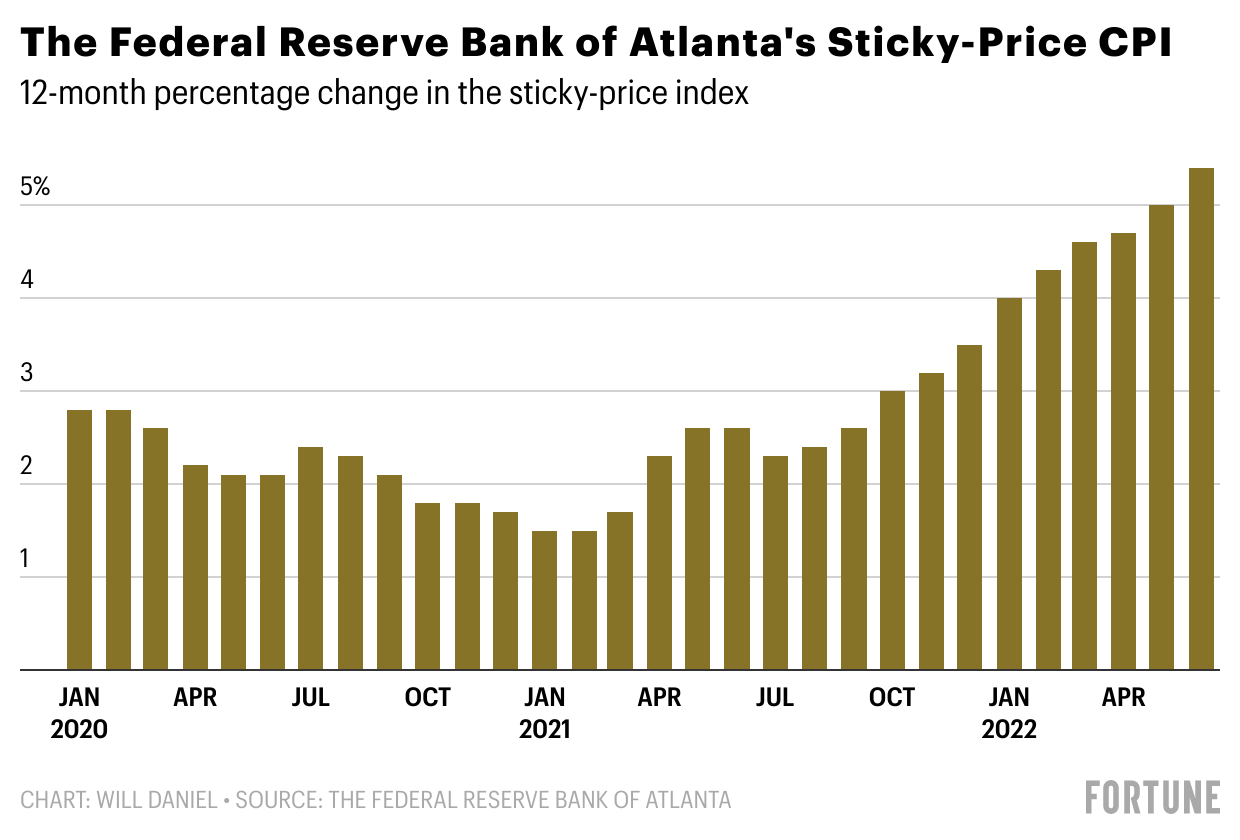
A chart of the Federal Reserve Bank of Atlanta's Sticky-Price consumer price index.
Add Fortune on Google for similar content.

There are a lot of ways to measure inflation in the U.S., and economists continue to debate which gauge is the best.

Many Americans will have heard of the consumer price index (CPI), which keeps track of price changes in a basket of goods and services commonly used by U.S. consumers. But there’s also the personal consumption expenditures (PCE) price index, which is preferred by the Federal Reserve and investment banks for economic analyses.

And then there are measures of inflation that are more under-the-radar, like the Atlanta Federal Reserve bank’s sticky-price CPI.

The sticky-price index measures inflation in goods and services where prices tend to change more slowly; meaning once a price hike comes, it’s likely to stick around.

In June, the sticky-price index hit a 31-year-high, rising at a 5.4% annual rate. That has some economists worried that inflation will be more difficult to combat than the Federal Reserve would like to admit.

“Inflation is becoming entrenched,” Bill Adams, Comerica Bank’s chief economist, told Fortune. “This is exactly what investors and central bankers worry about the most.” 

What makes a price sticky?

For years, economists have been attempting to find a way to accurately measure inflation, but it’s easier said than done. 

Measuring price changes across the economy in real-time is nearly impossible, so economists have taken to using lagging gauges that measure price increases and decreases that have already happened.

The problem is that different categories of goods and services experience price changes at different rates. If these rates aren’t taken into account, it can give a false sense of the reality of the inflationary pressures in the economy.

For example, the Fed can misjudge the staying power of inflation if price increases in sticky, critical categories like rent are considered to be equally short-lived as “flexible” price categories like energy.

The Atlanta Fed’s sticky-price index is meant to fix this issue. It measures price changes in goods and services where it can be a challenge for business owners to adjust prices, because it is more likely to affect people’s willingness to buy something. 

“The prevailing belief is that, in some markets, changing prices can involve significant costs. These costs can greatly reduce the incentive of firms to change prices,” officials from the Cleveland Federal Reserve Bank officials wrote in a 2010 research report.

The Atlanta Fed calls a CPI component “sticky” if the price changes less often, on average, than every 4.3 months. Roughly 70% of the consumer price index is made up of sticky price categories, while 30% is considered to be made up of “flexible” price categories.

Sticky prices can be useful economic indicators because they incorporate inflation expectations from businesses, the Cleveland Fed researchers said.

“Since price setters understand that it will be costly to change prices, they will want their price decisions to account for inflation over the periods between their infrequent price changes,” they noted.

Here are a few categories that the sticky-price index indicates are likely to experience more persistent inflation moving forward.

Sticky-Price Categories

Rent of primary residence

There are two main components that help factor housing and rent costs into the consumer price index, and both are considered to be sticky-price categories.

First, there is the cost of shelter for renter-occupied housing. This is called the “rent of primary residence” category, and it makes up roughly 6% of CPI. 

In June, the rent index rose 0.8 percent month-over-month, marking the largest monthly increase since April 1986. And even with signs that the housing market is cooling as mortgage rates soar, these rent increases could be here to stay, because price adjustments in the “rent of primary residence” category occur only every 11 months, on average.

Owners’ equivalent rent

The second component that factors housing costs into CPI is called owner’s equivalent rent (OER). It’s a measure of homeowners’ expectations for the rent they could possibly receive if they were renting their homes in the current market.

OER represents over 23% of CPI, making it one of the most important categories that determine U.S. inflation. The category saw prices increase for the third consecutive month in June, and it’s now up 5.5% year-over-year.

OER price adjustments also occur every 11 months, on average, meaning current OER increases could be here to stay for the next year at least.  

Food away from home

Food away from home, which details food costs at restaurants and fast food chains, is another key sticky-price category.

It accounts for roughly 6.5% of CPI, and price adjustments occur, on average, every 10.7 months. That means the 7.7% year-over-year jump in food away from home prices seen in June could be here to stay.

Public Transportation

Public transportation costs in the U.S. soared more than 23% from a year ago in June. Those price increases may be here to stay, because price adjustments in public transportation occur only every 9.4 months, on average. 

The good news is that public transportation only represents roughly 1.1% of the consumer price index. 

Medical Care Services

Medical care services are one of the most sticky-price categories in the consumer price index, according to the Fed.

Although they represent just 4.8% of CPI, the category only sees price adjustments every 14 months, on average. And in June, medical care services costs for Americans jumped 4.8% year-over-year. 

Sign up for the Fortune Features email list so you don’t miss our biggest features, exclusive interviews, and investigations.

About the Author
Will Daniel
By Will Daniel
LinkedIn iconTwitter icon
See full bioRight Arrow Button Icon
Add Fortune on Google for similar content.

Latest in Finance

Finance
Lorem ipsum dolor sit amet, consectetur adipiscing elit, sed do eiusmod tempor incididunt ut labore et dolore magna aliqua. Ut enim ad minim veniam
By Fortune Editors
October 20, 2025
Finance
Lorem ipsum dolor sit amet, consectetur adipiscing elit, sed do eiusmod tempor incididunt ut labore et dolore magna aliqua. Ut enim ad minim veniam
By Fortune Editors
October 20, 2025
Finance
Lorem ipsum dolor sit amet, consectetur adipiscing elit, sed do eiusmod tempor incididunt ut labore et dolore magna aliqua. Ut enim ad minim veniam
By Fortune Editors
October 20, 2025
Finance
Lorem ipsum dolor sit amet, consectetur adipiscing elit, sed do eiusmod tempor incididunt ut labore et dolore magna aliqua. Ut enim ad minim veniam
By Fortune Editors
October 20, 2025
Finance
Lorem ipsum dolor sit amet, consectetur adipiscing elit, sed do eiusmod tempor incididunt ut labore et dolore magna aliqua. Ut enim ad minim veniam
By Fortune Editors
October 20, 2025
Finance
Lorem ipsum dolor sit amet, consectetur adipiscing elit, sed do eiusmod tempor incididunt ut labore et dolore magna aliqua. Ut enim ad minim veniam
By Fortune Editors
October 20, 2025

Most Popular

Finance
Lorem ipsum dolor sit amet, consectetur adipiscing elit, sed do eiusmod tempor incididunt ut labore et dolore magna aliqua. Ut enim ad minim veniam
By Fortune Editors
October 20, 2025
Finance
Lorem ipsum dolor sit amet, consectetur adipiscing elit, sed do eiusmod tempor incididunt ut labore et dolore magna aliqua. Ut enim ad minim veniam
By Fortune Editors
October 20, 2025
Finance
Lorem ipsum dolor sit amet, consectetur adipiscing elit, sed do eiusmod tempor incididunt ut labore et dolore magna aliqua. Ut enim ad minim veniam
By Fortune Editors
October 20, 2025
Finance
Lorem ipsum dolor sit amet, consectetur adipiscing elit, sed do eiusmod tempor incididunt ut labore et dolore magna aliqua. Ut enim ad minim veniam
By Fortune Editors
October 20, 2025
Finance
Lorem ipsum dolor sit amet, consectetur adipiscing elit, sed do eiusmod tempor incididunt ut labore et dolore magna aliqua. Ut enim ad minim veniam
By Fortune Editors
October 20, 2025
Finance
Lorem ipsum dolor sit amet, consectetur adipiscing elit, sed do eiusmod tempor incididunt ut labore et dolore magna aliqua. Ut enim ad minim veniam
By Fortune Editors
October 20, 2025
Fortune Secondary Logo
Rankings
  • 100 Best Companies
  • Fortune 500
  • Global 500
  • Fortune 500 Europe
  • Most Powerful Women
  • World's Most Admired Companies
  • See All Rankings
  • Lists Calendar
Sections
  • Finance
  • Fortune Crypto
  • Features
  • Leadership
  • Health
  • Commentary
  • Success
  • Retail
  • Mpw
  • Tech
  • Lifestyle
  • CEO Initiative
  • Asia
  • Politics
  • Conferences
  • Europe
  • Newsletters
  • Personal Finance
  • Environment
  • Magazine
  • Education
Customer Support
  • Frequently Asked Questions
  • Customer Service Portal
  • Privacy Policy
  • Terms Of Use
  • Single Issues For Purchase
  • International Print
Commercial Services
  • Advertising
  • Fortune Brand Studio
  • Fortune Analytics
  • Fortune Conferences
  • Business Development
  • Group Subscriptions
About Us
  • About Us
  • Press Center
  • Work At Fortune
  • Terms And Conditions
  • Site Map
  • About Us
  • Press Center
  • Work At Fortune
  • Terms And Conditions
  • Site Map
  • Facebook icon
  • Twitter icon
  • LinkedIn icon
  • Instagram icon
  • TikTok icon
  • YouTube icon

Latest in Finance

Photo of RFK Jr.
HealthFDA
RFK Jr.’s peptide push narrowly gains backing from FDA advisers despite objections from scientists
By The Associated Press and Matthew PerroneJuly 24, 2026
5 hours ago
Canada celebrates new Detroit River bridge connecting Ontario to Michigan as 50% tariff feud keeps American officials away
North AmericaTariffs
Canada celebrates new Detroit River bridge connecting Ontario to Michigan as 50% tariff feud keeps American officials away
By The Associated Press, Mike Householder and Ed WhiteJuly 24, 2026
5 hours ago
dario
AIEconomics
Anthropic’s head of economics just explained why we haven’t seen a white-collar bloodbath — yet
By Nick LichtenbergJuly 24, 2026
6 hours ago
pjm
EnergyData centers
The AI boom’s hidden electricity bill — and why you’re paying it
By Nick LichtenbergJuly 24, 2026
7 hours ago
j
AINvidia
Nvidia, Microsoft lead call for open-weight AI models after Kimi
By Michael Shepard and BloombergJuly 24, 2026
7 hours ago
Trump’s latest import taxes could set a precedent for a ‘broad tariff generator’ on anything a president wants to target, expert warns
LawTariffs
Trump’s latest import taxes could set a precedent for a ‘broad tariff generator’ on anything a president wants to target, expert warns
By Jason MaJuly 24, 2026
7 hours ago

Most Popular

Jensen Huang made his $172 billion fortune on AI chips. His family's $75 million gift to Vanderbilt argues art decides what technology is for
Big Tech
Jensen Huang made his $172 billion fortune on AI chips. His family's $75 million gift to Vanderbilt argues art decides what technology is for
By Sydney LakeJuly 23, 2026
2 days ago
'The demographic dividend of the last 40 years is ending': J.P. Morgan says the world is running out of the two things that kept interest rates down
Economy
'The demographic dividend of the last 40 years is ending': J.P. Morgan says the world is running out of the two things that kept interest rates down
By Eleanor PringleJuly 24, 2026
17 hours ago
The $39 trillion U.S. national debt isn’t as high as Japan’s and Singapore’s relative to economy size—and yet it's still worse somehow
Economy
The $39 trillion U.S. national debt isn’t as high as Japan’s and Singapore’s relative to economy size—and yet it's still worse somehow
By Sasha RogelbergJuly 23, 2026
1 day ago
The millennial generation has split, new Fed research shows: Those over 35 are edging toward boomer-style wealth, while everyone else falls behind
Real Estate
The millennial generation has split, new Fed research shows: Those over 35 are edging toward boomer-style wealth, while everyone else falls behind
By Nick LichtenbergJuly 22, 2026
2 days ago
Current price of oil as of July 24, 2026
Personal Finance
Current price of oil as of July 24, 2026
By Joseph HostetlerJuly 24, 2026
15 hours ago
Turns out Dead Internet Theory was right: AI agents are eating the Web, growing by nearly 8,000% and rewiring the Internet's business model
AI
Turns out Dead Internet Theory was right: AI agents are eating the Web, growing by nearly 8,000% and rewiring the Internet's business model
By Mia OsmonbekovJuly 23, 2026
1 day ago

© 2026 Fortune Media IP Limited. All Rights Reserved. Use of this site constitutes acceptance of our Terms of Use and Privacy Policy | CA Notice at Collection and Privacy Notice | Do Not Sell/Share My Personal Information
FORTUNE is a trademark of Fortune Media IP Limited, registered in the U.S. and other countries. FORTUNE may receive compensation for some links to products and services on this website. Offers may be subject to change without notice.