There are a lot of ways to measure inflation in the U.S., and economists continue to debate which gauge is the best.
Many Americans will have heard of the consumer price index (CPI), which keeps track of price changes in a basket of goods and services commonly used by U.S. consumers. But there’s also the personal consumption expenditures (PCE) price index, which is preferred by the Federal Reserve and investment banks for economic analyses.
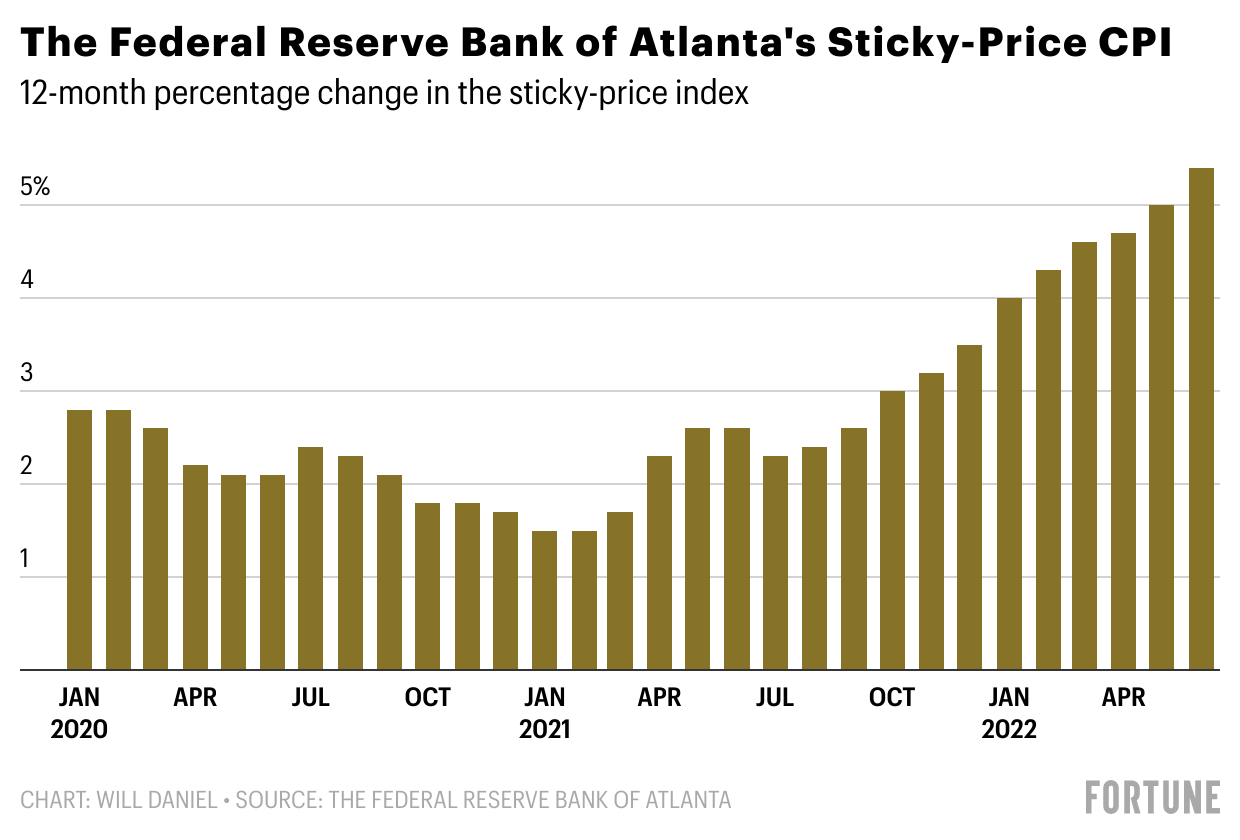
And then there are measures of inflation that are more under-the-radar, like the Atlanta Federal Reserve bank’s sticky-price CPI.
The sticky-price index measures inflation in goods and services where prices tend to change more slowly; meaning once a price hike comes, it’s likely to stick around.
In June, the sticky-price index hit a 31-year-high, rising at a 5.4% annual rate. That has some economists worried that inflation will be more difficult to combat than the Federal Reserve would like to admit.
“Inflation is becoming entrenched,” Bill Adams, Comerica Bank’s chief economist, told Fortune. “This is exactly what investors and central bankers worry about the most.”
What makes a price sticky?
For years, economists have been attempting to find a way to accurately measure inflation, but it’s easier said than done.
Measuring price changes across the economy in real-time is nearly impossible, so economists have taken to using lagging gauges that measure price increases and decreases that have already happened.
The problem is that different categories of goods and services experience price changes at different rates. If these rates aren’t taken into account, it can give a false sense of the reality of the inflationary pressures in the economy.
For example, the Fed can misjudge the staying power of inflation if price increases in sticky, critical categories like rent are considered to be equally short-lived as “flexible” price categories like energy.
The Atlanta Fed’s sticky-price index is meant to fix this issue. It measures price changes in goods and services where it can be a challenge for business owners to adjust prices, because it is more likely to affect people’s willingness to buy something.
“The prevailing belief is that, in some markets, changing prices can involve significant costs. These costs can greatly reduce the incentive of firms to change prices,” officials from the Cleveland Federal Reserve Bank officials wrote in a 2010 research report.
The Atlanta Fed calls a CPI component “sticky” if the price changes less often, on average, than every 4.3 months. Roughly 70% of the consumer price index is made up of sticky price categories, while 30% is considered to be made up of “flexible” price categories.
Sticky prices can be useful economic indicators because they incorporate inflation expectations from businesses, the Cleveland Fed researchers said.
“Since price setters understand that it will be costly to change prices, they will want their price decisions to account for inflation over the periods between their infrequent price changes,” they noted.
Here are a few categories that the sticky-price index indicates are likely to experience more persistent inflation moving forward.
Sticky-Price Categories
Rent of primary residence
There are two main components that help factor housing and rent costs into the consumer price index, and both are considered to be sticky-price categories.
First, there is the cost of shelter for renter-occupied housing. This is called the “rent of primary residence” category, and it makes up roughly 6% of CPI.
In June, the rent index rose 0.8 percent month-over-month, marking the largest monthly increase since April 1986. And even with signs that the housing market is cooling as mortgage rates soar, these rent increases could be here to stay, because price adjustments in the “rent of primary residence” category occur only every 11 months, on average.
Owners’ equivalent rent
The second component that factors housing costs into CPI is called owner’s equivalent rent (OER). It’s a measure of homeowners’ expectations for the rent they could possibly receive if they were renting their homes in the current market.
OER represents over 23% of CPI, making it one of the most important categories that determine U.S. inflation. The category saw prices increase for the third consecutive month in June, and it’s now up 5.5% year-over-year.
OER price adjustments also occur every 11 months, on average, meaning current OER increases could be here to stay for the next year at least.
Food away from home
Food away from home, which details food costs at restaurants and fast food chains, is another key sticky-price category.
It accounts for roughly 6.5% of CPI, and price adjustments occur, on average, every 10.7 months. That means the 7.7% year-over-year jump in food away from home prices seen in June could be here to stay.
Public Transportation
Public transportation costs in the U.S. soared more than 23% from a year ago in June. Those price increases may be here to stay, because price adjustments in public transportation occur only every 9.4 months, on average.
The good news is that public transportation only represents roughly 1.1% of the consumer price index.
Medical Care Services
Medical care services are one of the most sticky-price categories in the consumer price index, according to the Fed.
Although they represent just 4.8% of CPI, the category only sees price adjustments every 14 months, on average. And in June, medical care services costs for Americans jumped 4.8% year-over-year.
Sign up for the Fortune Features email list so you don’t miss our biggest features, exclusive interviews, and investigations.