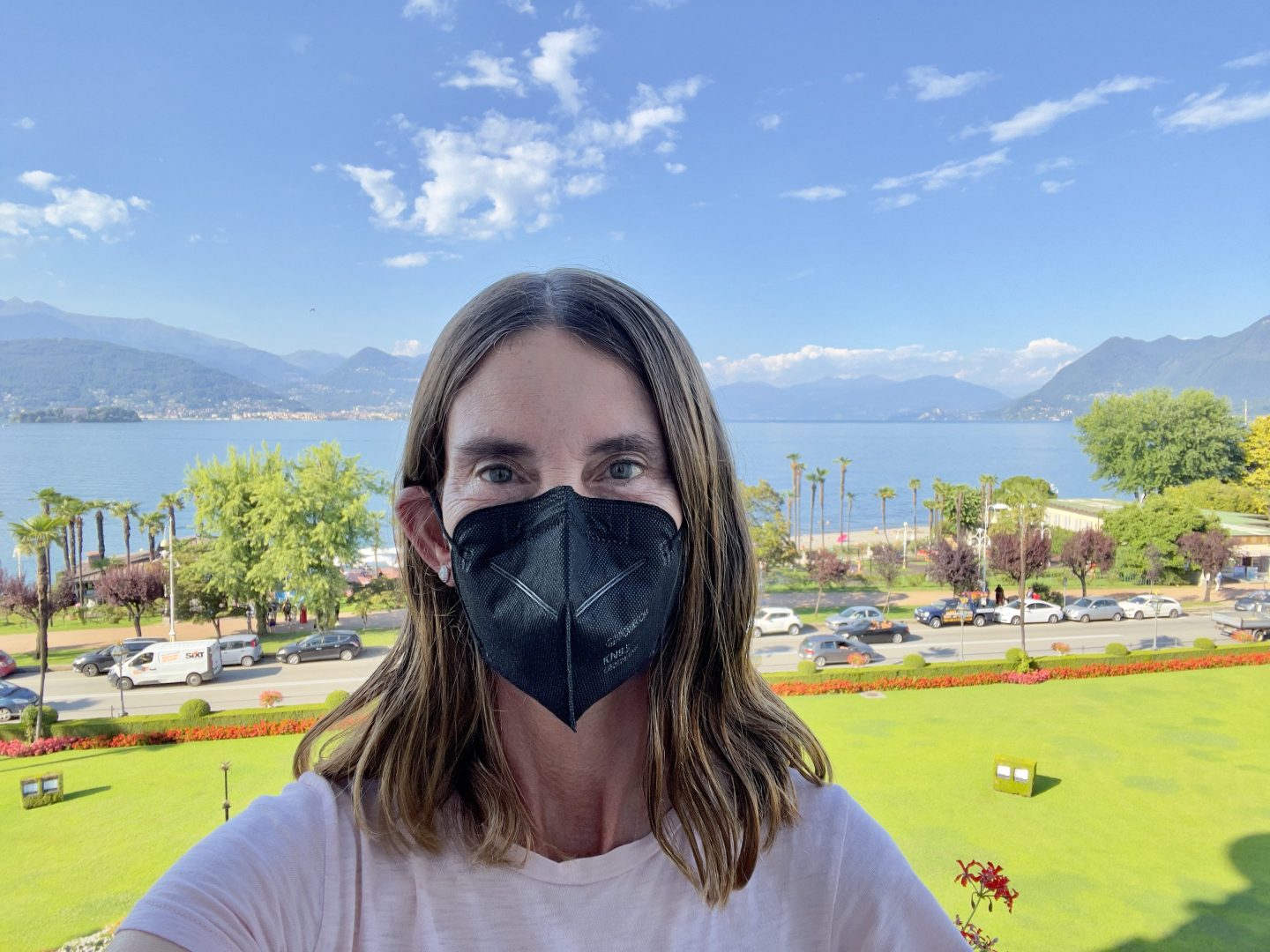
When I felt the tickle in my throat, I initially hoped for the best. I was up to date on my vaccinations, and I had timed my second COVID booster to coincide precisely with a bucket-list hiking trip in Italy’s breathtaking Lake District. I was on the trail when the symptoms hit.
I certainly had reasons to be concerned. As a cancer survivor, I have spent the past two and a half years exercising extreme caution in the face of the pandemic and avoiding crowds even when it meant missing the weddings of loved ones. After 25 years as an emergency physician, I’m well versed in the damage a runaway virus can cause. And as a science journalist, I know far too much not to shudder when the words “long COVID” come up.
I’ve been as careful as one could possibly be. My husband and I even double-checked that the tour company with which we signed up had absolute vaccine and testing requirements, along with strict mask policies across the board. These policies turned out to be not so absolute, and by late afternoon on that day at Lake Maggiore, I had tested positive.
Strictly speaking, my story is not so uncommon. But in some ways, that’s the point: Nearly 30 months into our global experience with COVID, we are still hurtling toward record numbers and rates of infection, not away from them. We have vaccines, but not containment. And the latest strains are the most evasive yet.
In Italy, where I went into quarantine, cases are up 89% from the average just two weeks ago, at approximately 95,000 per day–the highest level since January. SARS-CoV-2 appeared in Wuhan in November 2019, Omicron emerged in late 2021, and a stampede of viral variants have quickly outcompeted one another since. According to all available research, there’s no sign of that process slowing.
The most recently reported Omicron subvariants, BA.4 and BA.5, the latter of which is now dominant in the U.S., comprise an escalating proportion of sequenced samples globally, according to the World Health Organization. These surges are likely due to increased transmissibility, immune escape from previous infections or vaccines, and potentially, enhanced infectivity by the virus.
In a study reported in the New England Journal of Medicine, researchers found that in both triple-vaccinated participants and those with “natural immunity” from prior infection, BA.4 and BA.5-neutralizing antibody titers were more than 18 times lower as compared to those against the original Wuhan isolate.
Dan Barouch, director of the Center for Virology and Vaccine Research at Beth Israel and the lead author of that study, told me that subsequent variants have shown “increasing immune escape.” Antibody titers to BA.5, for example, were threefold lower than they were to the original Omicron variant, which itself is generations removed from Wuhan. “These findings help explain why we are seeing large surges by BA.5 amongst highly vaccinated populations as well as previously infected individuals,” Barouch told me.
In a new blog, Eric Topol, a cardiologist and the director of the Scripps Research Translational Institute, pointed out that besides immune escape, BA.5 appears to be infecting our cells more easily, according to a new preprint report from Australia. “The double whammy of immune escape and increased infectivity,” he commented on Twitter.
Though I can’t be sure, it is certainly likely that this virulent strain, BA.5, is the one that took me down after having successfully dodged COVID for so long. The statistics suggest that BA.5 is going to exact a significant toll on vast numbers of people, especially as the subvariants move through the U.S., where “Covid fatigue” is real and precautions have relaxed nearly across the board. BA.5-related hospitalizations are already on the rise in the U.S., though well below the peak in March.
Our research so far indicates that vaccine immunity still provides “robust protection against severe disease, hospitalization, and death,” Barouch said. But the vaccines don’t produce high-level protection against infection by the newest subvariants, and that is a pressing concern since breakthroughs allow subsequent transmission.
There are a couple of real dangers here. One is the fallout from potential reinfection–and because these new subvariants are immune-evasive, they may well reach those who might have thought they were done with COVID because they already had it.
“The risk of reinfection with BA.5 has substantially increased because prior infections are far away (antigenically) from an aligned immune response,” wrote Topol, in a blog post. “New versions of the virus are accelerating and we’re not done yet, by any stretch.”
These reinfections are not merely annoying. In a non-peer reviewed study, Ziyad Al-Aly and his team analyzed the health records of 34,000 people with breakthrough COVID infections in the health records of the U.S. Department of Veterans Affairs. Compared to individuals with a single infection, researchers found that these reinfected individuals had higher risks of mortality, hospitalization, and adverse health outcomes in multiple organs: heart, lung, brain, kidneys, etc. The risks were present regardless of vaccination status.
“Every infection or reinfection adds risk meaning that two infections carry more risk than one, and three infections carry more risks than two, for both acute and long-term complications,” Al-Aly, director of the Clinical Epidemiology Center at the Veterans Affairs St. Louis Health Care System and lead author, told me. “If you got infected once or twice, it is absolutely worth it to do your best to prevent yourself from catching COVID again. You are trying your luck (or rolling the dice) with every infection.”
In an earlier report, Al-Aly et al. found that while vaccines are good at preventing acute COVID-19, they were just 15% effective at preventing long COVID, which is defined by the CDC as suffering symptoms for four weeks or more after a diagnosis. The specter of long COVID looms large over this–or at least it should.
From its shadowy beginning as a phenomenon seemingly reported randomly and in small numbers, the condition is now understood as a long-term threat to the health of millions of people who’ve been infected, the vast majority of whom weren’t sick enough to require hospitalization when they first contracted the virus.
The stakes are high. A systematic review and meta-analysis has identified more than 50 effects of long COVID, including fatigue, memory loss, digestive disorders, shortness of breath, chest pain, and loss of smell. While estimates vary of how many people may ultimately be affected, a report by the Solve Long COVID Initiative estimates that some 22 million Americans are already dealing with the effects of the virus months after their initial infection.
While we don’t know the causes of long COVID, viral persistence has been found in multiple organs and tissues of deceased COVID-positive patients, even in those who died of mild or asymptomatic disease. In a manuscript under review for publication in Nature, researchers described viral RNA persistence for up to 230 days following symptom onset. I don’t want long COVID–and neither do you.
These are some of the less visible consequences of the latest viral spread, part of the evolution of COVID-19 that has been more easily predicted than confronted. Recent data shows a decline in vaccine protection against symptomatic infection, even with boosters, particularly with the Omicron subvariants.
This likely explains the many breakthrough infections. Prior infection (so-called “natural immunity”) does not seem to be protecting against subsequent infections the way it did pre-Omicron, according to a review of 43 studies from 17 countries.
There’s also the issue of how each variant of the virus affects the immune responses of those who are infected by it. A study conducted by a team at Imperial College London and Queen Mary University of London found that the first SARS-CoV-2 spike protein a person encounters will shape their future immune response.
“With every mutation, every change in the virus, it drifts away and away from the original virus for which the vaccine was designed,” says Al-Aly. Though vaccines still offer protection, he said, “vaccine effectiveness is dropping, especially now with BA.5 where we are seeing people who are fully vaccinated and double boosted have severe disease, get hospitalized and die from BA5.”
Hospitalizations are now rising in multiple countries and in the U.S., although they remain below the record highs of earlier waves, according to a Financial Times analysis, and deaths are proportionately low. “What we’re not seeing is an increase in intensive care admissions, so the vaccines are still working,” a World Health Organization official said this week in The Times.
So where do we go from here? Clearly, we desperately need a universal coronavirus vaccine that protects against both existing and future variants, or a nasal vaccine that boosts immunity right at the port of entry, to help fend off unwieldy viral intruders. At a recent WHO media briefing, officials said that while next-generation vaccines are needed to cover evolving variants, the solution is a pan-coronavirus vaccine.
“It is very important to develop vaccines that cover broad variations in COVID, last a long time, and also–very importantly–reduce transmission,” says Al-Aly. “So far, we are being reactive to the virus. We need to up our game and get ahead of it.”
While several of these types of pan-vaccines are in development, the government’s sense of urgency on this issue has been bafflingly lacking. Pfizer is reported to be testing one such vaccine soon, and Dr. Robert Seder, the chief of cellular immunology at the National Institutes of Health’s allergy and infectious disease division, is working on a next-generation vaccine as well. However, there has been no Operation Warp Speed-type push. The development of these vaccines must be fast-tracked to save lives, worry, and money.
In the meantime, the onus falls on the public. Avoid infection and reinfection as best you can. Get vaccinated and boosted and wear a well-fitting mask, preferably an N95 or KN95, both indoors and in crowded outdoor settings. Open doors and windows to improve ventilation. Use HEPA filtration. These aren’t new tactics, but they help.
As for me, I am waiting out my quarantine, with a beautiful Italian vista outside my window but no way for me to safely take it in. For years, I successfully avoided Covid’s long reach–but as we are still learning, that reach continues to extend.
We must respond forcefully, with vaccines that don’t try to chase the latest version of a virus that has proven again and again its ability to evolve. It’s time for a more comprehensive approach, pronto!
The opinions expressed in Fortune.com commentary pieces are solely the views of their authors and do not reflect the opinions and beliefs of Fortune.
More must-read commentary published by Fortune:
- What the media gets wrong in its persistent crypto criticism
- Why remote work will win this fall
- A list of companies supporting abortion rights after the Roe v. Wade ruling shows which firms are stepping up, and why
- Career hoarding is on the rise—but it comes at a cost
- Are billionaires just lucky?