• Home
  • Latest
  • Fortune 500
  • Finance
  • Tech
  • Leadership
  • Lifestyle
  • Rankings
  • Multimedia
Finance

2021 was a record year for IPOs. But don’t expect a repeat

Jessica Mathews
By
Jessica Mathews
Jessica Mathews
Senior Writer
Down Arrow Button Icon
Jessica Mathews
By
Jessica Mathews
Jessica Mathews
Senior Writer
Down Arrow Button Icon
December 24, 2021, 9:02 AM ET

The best time to take a company public is apparently during a pandemic, ideally while inflation is spiking, labor shortages are rampant and crippling supply chain issues prevail. 

Nearly 400 private companies raised $142.5 billion by going public on the U.S. stock exchange by mid-December 2021, according to data from Renaissance Capital, an IPO institutional research and investment product company. That’s more funding than companies have ever managed to raise in a 12-month period.

The stream of public debuts was near-constant: Affirm, ThredUp, Coursera, Oatly, Bumble, Duolingo, Rent the Runway, Rivian Motors, Robinhood, to name a few, all listed shares—with the backdrop of a bloated valuation environment and soaring stock market.

“That clearly makes it attractive for companies to consider a public listing, versus other alternative methods of accessing capital,” says Rachel Gerring, IPO Leader at EY Americas, of the hefty valuations companies have obtained this year. Only a few years ago, tech companies were struggling to maintain the private valuations they secured from venture capitalists and private equity firms on their way into the public market. A 2016 McKinsey report indicated that unicorns were staying private longer as a result.
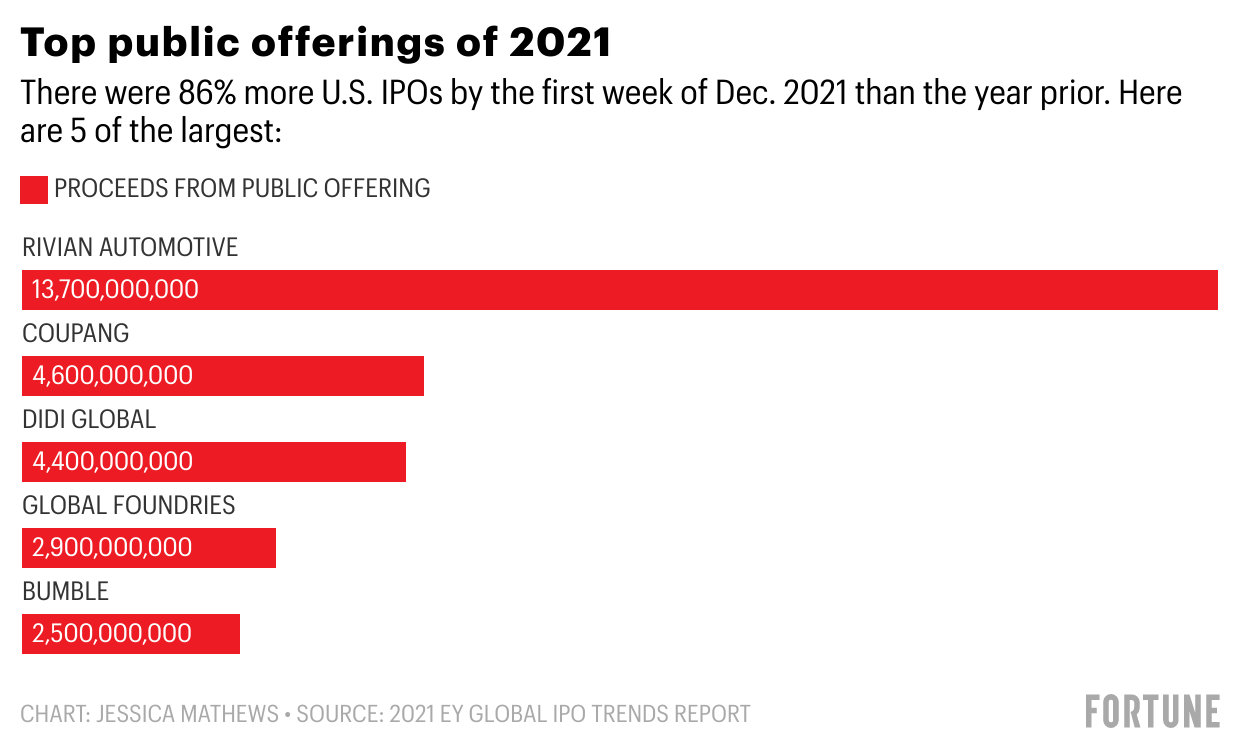
There’s also the boom in SPACs, or special purpose acquisition companies, which have made it quicker and simpler to list on an exchange—and more accessible to smaller companies. SPACs have really only become a popular means for companies to go public in the last few years, despite being an available method for a couple decades. Nearly 150 blank check companies had listed on a U.S. exchange by December 8, according to an EY IPO report.

But as 2021 comes to a close, it’s looking like the IPO boom is over, at least for now.

The stock market has become more erratic in recent weeks, which could be stemming from concerns about the highly contagious Omicron variant, inflation that has persisted for longer than expected, labor shortages, and breaks in the supply chain. Whatever the reasons, performance for newly listed companies has suddenly been quite spotty. A Fortune analysis from earlier this month showed that more than half of the 100 largest IPOs this year were trading below their initial offering price. 

“That does not bode well for those who are looking to go public,” says Gerring, who notes companies may be tempted to push back planned listings. “I don’t think it itself shuts down the market, but it certainly influences the market.”

S-1 filings have slowed to a trickle since the beginning of this month. Although there are still some private companies in transit to the public markets (one of the most notable on the agenda being Reddit, which recently said it had confidentially filed a draft registration statement with the SEC).

For those companies that do make it to the public markets in 2022, however, they may find themselves wishing for the good old days of pandemic-ridden, inflation-plagued 2021.

Never miss a story: Follow your favorite topics and authors to get a personalized email with the journalism that matters most to you.

About the Author
Jessica Mathews
By Jessica MathewsSenior Writer
LinkedIn iconTwitter icon

Jessica Mathews is a senior writer for Fortune covering startups and the venture capital industry.

See full bioRight Arrow Button Icon

Latest in Finance

Julian Braithwaite is the Director General of the International Alliance for Responsible Drinking
CommentaryProductivity
Gen Z is drinking 20% less than Millennials. Productivity is rising. Coincidence? Not quite
By Julian BraithwaiteDecember 13, 2025
1 hour ago
carbon
Commentaryclimate change
Banking on carbon markets 2.0: why financial institutions should engage with carbon credits
By Usha Rao-MonariDecember 13, 2025
2 hours ago
Oracle chairman of the board and chief technology officer Larry Ellison delivers a keynote address during the 2019 Oracle OpenWorld on September 16, 2019 in San Francisco, California.
AIOracle
Oracle’s collapsing stock shows the AI boom is running into two hard limits: physics and debt markets
By Eva RoytburgDecember 13, 2025
5 hours ago
EconomyFederal Reserve
Trump names Warsh, Hassett as top Fed contenders, WSJ says
By Jennifer A. Dlouhy and BloombergDecember 12, 2025
15 hours ago
EconomyFederal Reserve
The Fed just ‘Trump-proofed’ itself with a unanimous move to preempt a potential leadership shake-up
By Jason MaDecember 12, 2025
18 hours ago
robots
InnovationRobots
‘The question is really just how long it will take’: Over 2,000 gather at Humanoids Summit to meet the robots who may take their jobs someday
By Matt O'Brien and The Associated PressDecember 12, 2025
19 hours ago

Most Popular

placeholder alt text
Economy
Tariffs are taxes and they were used to finance the federal government until the 1913 income tax. A top economist breaks it down
By Kent JonesDecember 12, 2025
1 day ago
placeholder alt text
Success
Apple cofounder Ronald Wayne sold his 10% stake for $800 in 1976—today it’d be worth up to $400 billion
By Preston ForeDecember 12, 2025
1 day ago
placeholder alt text
Success
40% of Stanford undergrads receive disability accommodations—but it’s become a college-wide phenomenon as Gen Z try to succeed in the current climate
By Preston ForeDecember 12, 2025
24 hours ago
placeholder alt text
Economy
For the first time since Trump’s tariff rollout, import tax revenue has fallen, threatening his lofty plans to slash the $38 trillion national debt
By Sasha RogelbergDecember 12, 2025
20 hours ago
placeholder alt text
Economy
The Fed just ‘Trump-proofed’ itself with a unanimous move to preempt a potential leadership shake-up
By Jason MaDecember 12, 2025
18 hours ago
placeholder alt text
Success
At 18, doctors gave him three hours to live. He played video games from his hospital bed—and now, he’s built a $10 million-a-year video game studio
By Preston ForeDecember 10, 2025
3 days ago
Rankings
  • 100 Best Companies
  • Fortune 500
  • Global 500
  • Fortune 500 Europe
  • Most Powerful Women
  • Future 50
  • World’s Most Admired Companies
  • See All Rankings
Sections
  • Finance
  • Leadership
  • Success
  • Tech
  • Asia
  • Europe
  • Environment
  • Fortune Crypto
  • Health
  • Retail
  • Lifestyle
  • Politics
  • Newsletters
  • Magazine
  • Features
  • Commentary
  • Mpw
  • CEO Initiative
  • Conferences
  • Personal Finance
  • Education
Customer Support
  • Frequently Asked Questions
  • Customer Service Portal
  • Privacy Policy
  • Terms Of Use
  • Single Issues For Purchase
  • International Print
Commercial Services
  • Advertising
  • Fortune Brand Studio
  • Fortune Analytics
  • Fortune Conferences
  • Business Development
About Us
  • About Us
  • Editorial Calendar
  • Press Center
  • Work At Fortune
  • Diversity And Inclusion
  • Terms And Conditions
  • Site Map

© 2025 Fortune Media IP Limited. All Rights Reserved. Use of this site constitutes acceptance of our Terms of Use and Privacy Policy | CA Notice at Collection and Privacy Notice | Do Not Sell/Share My Personal Information
FORTUNE is a trademark of Fortune Media IP Limited, registered in the U.S. and other countries. FORTUNE may receive compensation for some links to products and services on this website. Offers may be subject to change without notice.