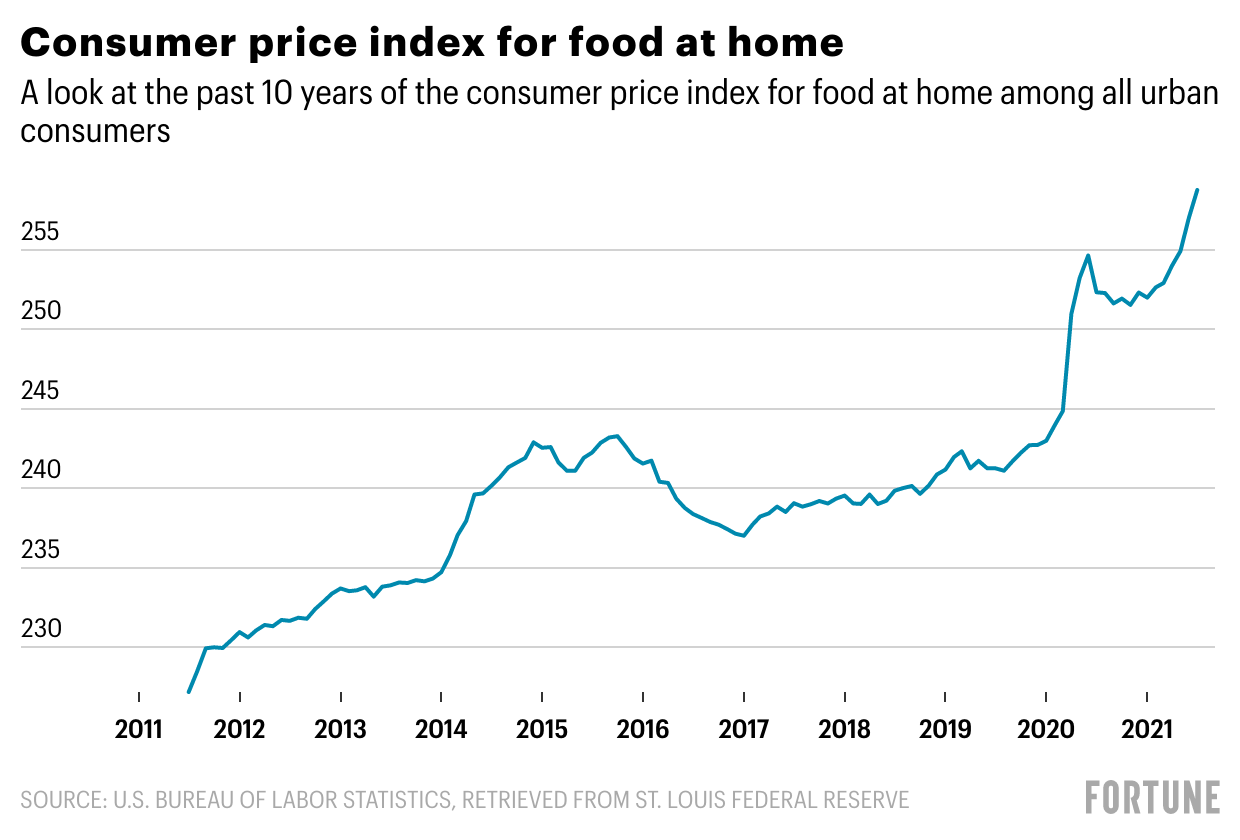
Food prices rose again last month by 0.7%, according to the latest consumer price index, released yesterday. That may not sound like a lot, but it adds up. Over the past year, prices for groceries and other food prepared at home increased 2.6%.
Groceries have been on an upward trend all year, and these steady price increases may be the new reality. “We’re going to continue to see price increases, probably for the next two years or so,” said Phil Lempert, an analyst and food trends expert known as the Supermarket Guru.
The recent rise in food costs can be attributed to a number of factors, including how the pandemic impacted the global supply chain, labor shortages, and even climate change, according to experts.
At the beginning of the pandemic, Americans saw dramatic jumps in the price of many food items, but over the past few months, those spikes have smoothed out. Instead, consumers are now seeing smaller, more consistent increases. “We had a big jump up and then sort of slow and steady increases,” said Jayson Lusk, head of the department of agricultural economics at Purdue University.
In the decade prior to the pandemic, year-over-year price increases have been around 1% for food at home, Lusk said. So July’s year-over-year increase is more than double what Americans have been accustomed to, he added. “That’s what’s drawing a lot of the attention.”
What’s driving the increase in food prices?
In some cases, these price increases were probably overdue. Agricultural commodity prices have been on the rise over the past year, which stems from both the conditions surrounding the growing season as well as buying trends.
China, for example, has been buying up a number of raw commodities, including soy, which is often used in animal feed, Lempert said. That pushes up the price and, as a result, pork and chicken prices are on the rise because it’s now more expensive to raise these animals.
Climate change is also having an impact on agricultural output, Lempert said. In Brazil, unsteady rain, drought, and even frost has hurt coffee production, while forest fires in California have damaged vineyards. “Climate change is greatly affecting the foods that we grow and how we grow them. Long term, we will see a lot more indoor farming, but that takes hundreds of millions of dollars and time to build,” Lempert noted.
Of course, the raw price of producing crops and animals on the farm is only a fraction of the total cost consumers pay at the store, Lusk said. Energy, transportation, and labor costs also factor in. And each of those aspects has seen a rise in costs as well. Gasoline prices alone have risen 41.8% since July 2020, according to the Bureau of Labor Statistics.
Transportation is another major issue, Lempert said. “We don’t have enough truck drivers,” he noted. “We’ve been talking probably for three or four years that the truck driver workforce is aging, retiring, and there’s not a lot of people who wake up in the morning who say, ‘I want to be a truck driver.’”
He pointed to meat producer Tyson, which issued yet another price increase this week, upping its average price for pork by 39%, beef by 12%, and chicken by 16%. Lempert believes those jumps are due, in part, to the fact that the price of refrigerated truck transportation went up 12%. “That has to be passed on,” he said.
Labor costs are also playing a role, added Lusk. Wages have been increasing in both food processing and retail, adding to the end cost for consumers. “It’s probably the case that if we want the kind of labor that we’ve come to expect in the food service sector and food processing, then [employers] are probably going to have to pay a little more,” he said.
Added Lempert: “It is a much bigger problem, and a much more complex problem, than the average consumer realizes or understands.”
Which prices will continue to rise?
When it comes to the items most likely to see continued increases, Lusk said beef is a prime suspect. Based on the number of cattle that U.S. farmers have on feed now and the higher costs of feed, Lusk said he believes Americans will see higher beef prices for at least the next year or two.
Lempert cast the net even wider, saying consumers should expect anything that touches an animal to continue to go up in price. That’s not just meat, but also the price of butter, cheese, and eggs will continue to rise because of the feed issue. Meat, poultry, fish, and egg prices actually saw the biggest year-over-year jump of 5.9% last month.
Consumers can also expect that the price of anything that comes in aluminum will also be on the rise, Lempert said. Major brands like Coca-Cola and J.M. Smucker already announced price increases owing to commodity costs, including that of aluminum.
For consumers on a tight budget, Lempert recommended spending more time shopping around and looking through weekly ads. Drugstores like CVS and Walgreens, for example, typically have milk priced cheaper than most supermarkets.
This may also be a good time to consider switching to less expensive store-branded products, Lempert added. “Aldi store brands are not only less expensive but superior quality to a lot of the national brands,” he said.
Those looking to keep their food budget on track (or even trim it) should avoid grocery delivery services. Not only do customers have to pay additional delivery charges, fees, and tips, but many times items are priced higher than they are on the physical shelves of the grocery store, Lempert said.
Subscribe to Fortune Daily to get essential business stories straight to your inbox each morning.