As panicked states issued far-reaching shutdowns during the early days of the pandemic, the economy went into a complete tailspin. The immediate economic shock was the worst on record—even worse than the 1929 stock market crash. Amid the unprecedented circumstances, Republican and Democratic lawmakers joined forces to put together the largest stimulus package ever passed. That $2.2 trillion CARES Act signed into law in March 2020 created a host of new programs, including forgivable small-business loans (PPP) and enhanced unemployment checks. But none was more popular than the one-time $1,200 stimulus check.
It’s easy to see why it was well liked: The $1,200 stimulus check was a lifeline to more than 100 million households. Its success and popularity were so strong that the additional aid packages passed in December 2020 and March 2021 also included direct payments.
Even now as the economy moves into a high growth phase, there are still calls for more stimulus checks. It is unlikely to happen again this year. However, the next time a recession hits, there will undoubtedly be a push for more stimulus checks.
On economic grounds, Mark Zandi, chief economist at Moody’s Analytics, says stimulus checks were unique to this crisis—which quickly plunged the economy into a historic contraction. The first check was very effective: The Tax Foundation finds around 75% was quickly spent by recipients. But the second and third rounds, which went out once the economy was already in recovery, were less impactful for the economy. For those rounds, over 70% of the money was used to pay off debt or put into savings, according to the Tax Foundation.
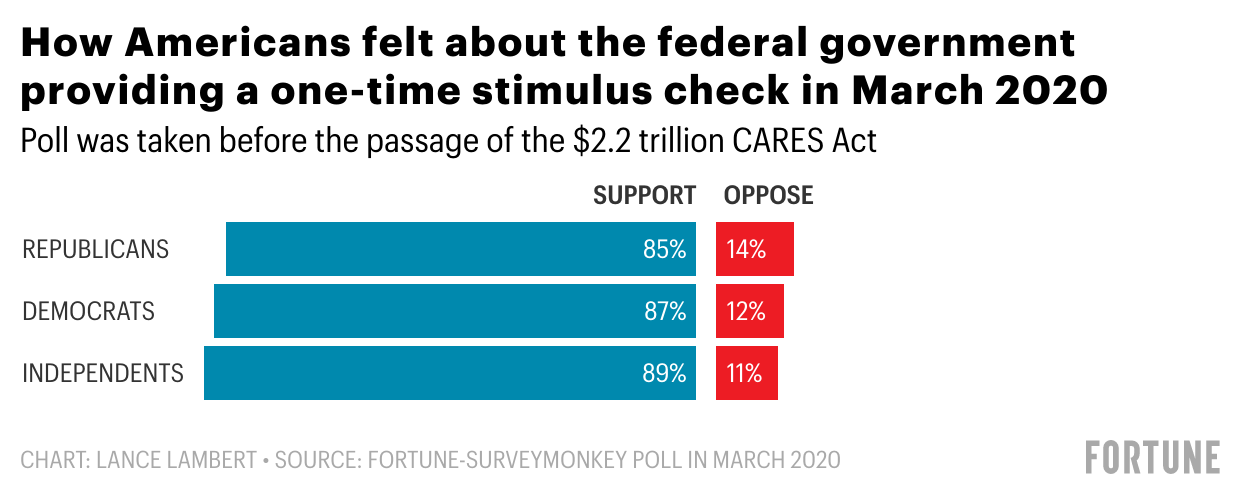
But the economic benefit of the checks isn’t why they’re likely to return, Zandi says. It’s the political popularity of the payments. Just days before the CARES Act was passed in March 2020, a Fortune-SurveyMonkey poll found 89% of Democrats and 85% of Republicans supported a one-time direct payment. In a polarized nation, that type of political consensus is rare.
“The politics of it suggest there will be future stimulus checks,” Zandi tells Fortune. Simply put, stimulus checks are poised to be a lasting policy creation of the COVID-19 recession.
The political power of stimulus checks was on full display last election season. In December, President Donald Trump failed to get his Republican colleagues in the U.S. Senate to increase the proposed stimulus checks from $600 to $2,000 in the December aid bill. Ultimately, the Senate passed the $600 checks. It then became a political issue in the two Georgia Senate runoff races. Those Jan. 5 races would decide party control of the Senate. Both Democratic candidates, Raphael Warnock and Jon Ossoff, promised to make $2,000 stimulus checks a reality if they won. That pressured the Republican candidates, David Perdue and Kelly Loeffler, to do the same. In the end, Democrats won both seats—something political analysts attributed to Republican senators blocking the $2,000 checks in December.
If not for voters’ demands for another check, Zandi agrees that Republicans might have retained the Senate. Once they took power this year, Democratic leadership quickly used it to pass a $1.9 trillion aid package in March, which included a $1,400 stimulus check.
Stimulus checks aren’t the only policy tool or measure likely to outlive the pandemic.
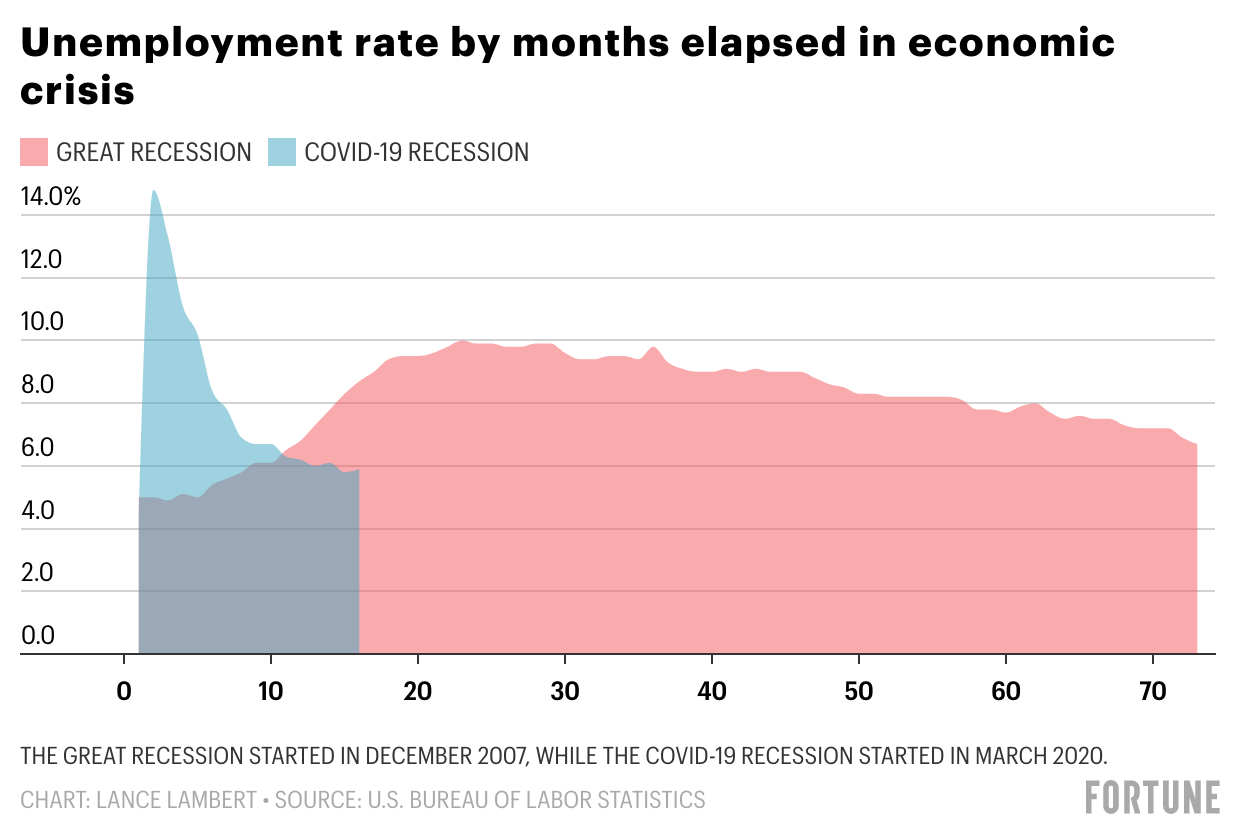
During the depths of the Great Recession, Congress passed a $787 billion stimulus package in 2009. That amounts to $991 billion in inflation-adjusted 2021 dollars. This go-around, Congress passed three massive packages totaling a staggering $5 trillion. The generosity of the stimulus during this crisis is among the reasons economists like Zandi believe the economy recovered faster. Following the 2008 financial crisis, the unemployment rate was above 7% from December 2008 to October 2013, or 59 consecutive months. During the pandemic, the jobless rate was above 7% for just six months. As of June, it stands at 5.9%. That relative success could incentivize Congress to continue to “go big” during future recessions.
“We would not be in this [good] position today if it weren’t for that policy response,” Zandi.
When it comes to the policies, Zandi foresees PPP as being the least likely to be used in a non-pandemic spurred recession. The most likely to return that is not named stimulus checks? Mortgage forbearance—which ends on Sept. 30—and enhanced unemployment benefits, he says. The latter, which is paid on top of state jobless benefits, is considered among the best policy tools used to blunt the impacts of the COVID-19 recession.
Subscribe to Fortune Daily to get essential business stories straight to your inbox each morning.