Investing in blue-chip wines seems, to most, like an activity for a closed club of wealthy collectors. Many fine wine auctions are held at well-known houses like Sotheby’s, Acker Merrall & Condit, and Zachys that seem geared for the world’s one percent—places where Jay-Z auctions off a $52,000 bottle of D’Ussé cognac. It’s the type of atmosphere that feels intimidating to someone who is newer to the game. The same goes for snagging cases, or even a single bottle, of the most expensive wines in the world, like Château Lafite Rothschild and Domaine de la Romanée-Conti, which gain immense value over time. Without spending years on the waiting list for an allocation, and snapping up tens of thousands of dollars in other wine from gatekeepers, you don’t have much hope of acquiring any for yourself.
But that’s changing with technology platform Vinovest, which allows anyone and everyone to invest in fine and rare wine.
When Vinovest cofounder Anthony Zhang was in his early twenties, he found himself looking for a great place to invest some extra savings he had on hand after selling his first startup in San Francisco. Being a fan of wine, he started researching opportunities in the industry. He quickly felt shut out: He wasn’t a longtime collector with deep pockets and connections to secretive brokers; he couldn’t get invitations to exclusive wine auctions; and he didn’t have access to allocations from some of the most sought-after producers, whose wines fetch large returns on investment.
What he could find: a massive amount of public data on wine prices over the course of decades. Like any savvy programmer, he wrote an algorithm to predict which bottles would be the best to seek out. Five years later, that strategy has become Vinovest, which uses machine-learning technology to acquire and sell bottles from top producers on behalf of its users. Zhang’s team of 11 handles the brokers, buying, storage, insurance, and management. Investors see profits. The annualized median returns in 2020 were more than 17%.
“Wine gets better with age but also scarcer, which makes it an investment because the price will increase with time,” Zhang says. “Getting access and being able to participate, though, was confusing and expensive. It seemed to me that wine investing was only something for people who were already wealthy. That didn’t sit well with me.”

The wine asset class is nothing new, but, as Zhang says, access to the space has proved daunting for potential investors, even those who already work in the wine industry. Traditionally, wine investors look for bottles at auctions hosted by heritage companies like Christie’s; estate sales of private collectors; or through futures, which are essentially presales, of major wines like those from Bordeaux, Burgundy, and Napa Valley. Brokers work with investors to help them manage relationships with in-demand producers and find the right lots to bid on at auctions they may attend. Any acquired wines are then shipped to storage managed by the individual until he or she wants to resell the products in future. To sell is an undertaking in and of itself, one that involves steps like approvals from authenticity specialists to confirm provenance before an auction house will accept cases of wine to be sold.
To run the entire process takes a significant amount of time and access to capital, typically tens of thousands of dollars. To be successful, it takes financial knowledge and prediction analysis of what may sell in 10, 20, 30 years—or more. Zhang considered his wine investing project to be a hobby at first, so he didn’t track how many hours he spent gathering data for his original financial model. But it was a lot.
“Auctions and the like are tough to navigate for anyone that does not work with that caliber of wine on a regular basis, or has bought and drank enough wine to figure it out for themselves,” says Jonathan Ross, a master sommelier and adviser to Vinovest. Ross explains that when an individual signs up for an account at traditional auction houses, there is no one to guide them. One must rely on acquired wine experience, and that’s not necessarily related to financial performance. “It has always been based on knowing what vintage is best suited for long-term aging, and from which parcel of vines within a small, esoteric, delimited vineyard,” he adds. “And that doesn’t even scratch the surface of producer quality and reputation. There’s a lot of subjectivity and gray areas there.”
Vinovest’s technology takes away the gray areas. Zhang built an algorithm based on which wines would gain value over a variety of different timelines, using data around drinking windows (the optimal time to age a wine), how that historically relates to sales at auctions, critics’ scores, technical analysis indicators, and any other details that could affect price. All of this predicts when a specific wine can turn a profit.
“People aren’t necessarily doing a lot of financial analysis into those decisions,” Zhang says, echoing Ross’s sentiment about the subjectivity of investing in wine. “I wanted to take a more quantitative approach to see if I could make a case for using software, as someone who knew little about the wine world.”
How that helps an investor is simple. Users give Vinovest information on how much they want to invest and when they expect to see a return. They don’t even have to know anything about wine. The program recommends what region and type of wine that investor’s portfolio will focus on, then handles the acquisition, storage, insurance, and management for a small fee. Different levels of investment allow access to rarer or more exclusive wines. It’s like any other stock management platform, except that the product is tangible rather than electronic.
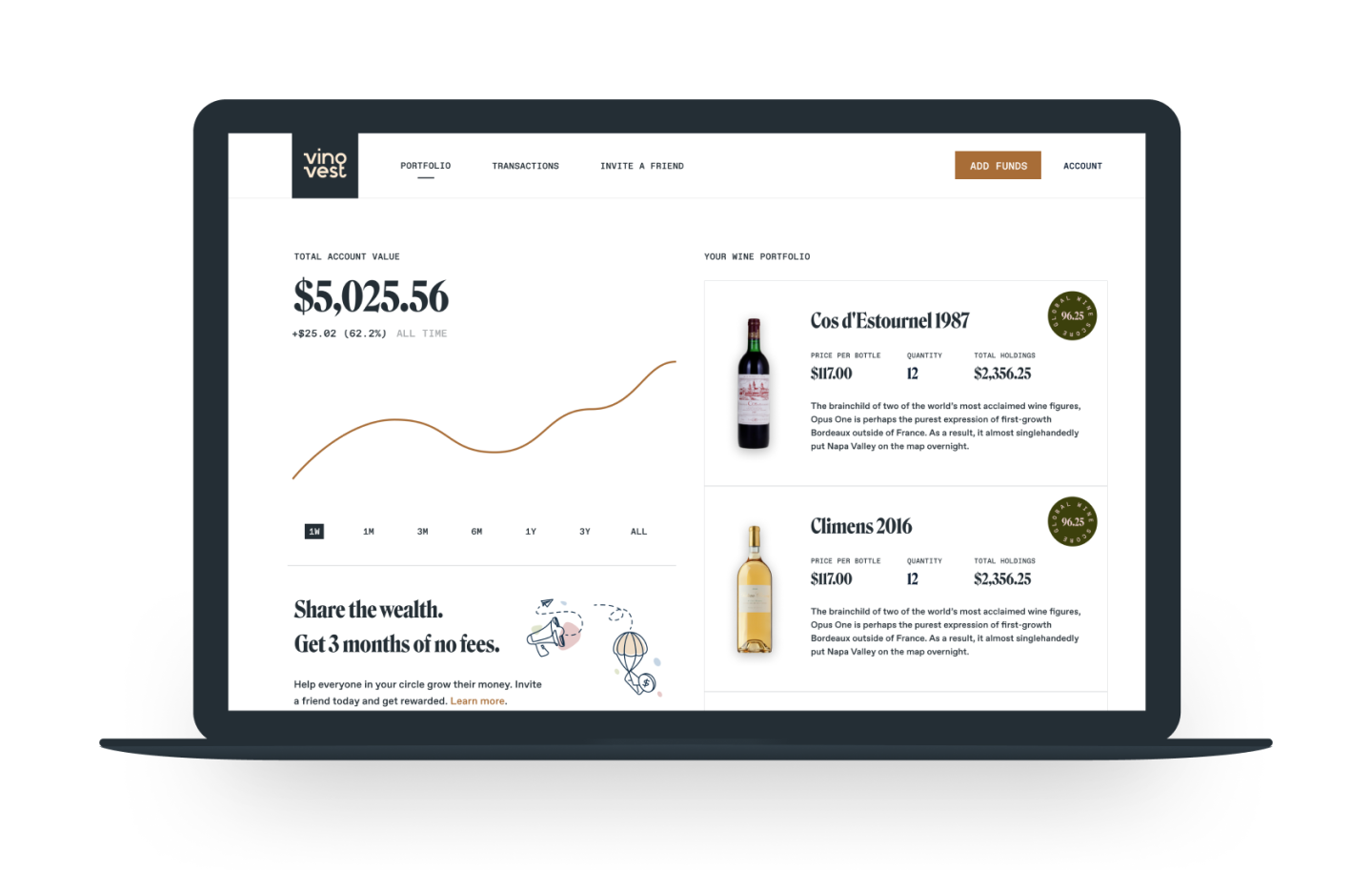
Where does that wine go? In most cases, it doesn’t leave its warehouse. Zhang built out a network of storage facilities around the globe. That eliminates shipping costs as well as hefty taxes and tariffs on transporting alcohol across country lines. That savings is passed along to the investor.
Ross is quick to point out that Vinovest is about wine investing, not collecting, so users shouldn’t expect to ever physically hold a bottle. A collector may want the wine within arm’s reach, so that he or she can pop it open for dinner. With wine investing, it’s less about what you like and don’t like, and more about what will see a return in the future. After all, it would be detrimental to one’s return on investment to drink the wine he or she has purchased, he adds.
Zhang says that producers are excited to work with him. He decided to work directly with wineries and distributors versus auction houses, since he felt more confident buying bottles for investment from the source. There would be less chance of variation in a wine’s storage, transport, and authenticity. What he’s found is that they appreciate his goal of providing access to a new set of investors, primarily younger ones: Zhang targets the 25- to 40-year-old market by placing the minimum investment at $1,000 and even running ads on Instagram. He knows he won’t be converting the person who drinks $15 bottles from the grocery store, but he might grab someone who is seeking a new lucrative asset class outside of stocks, and who also happens to enjoy perusing the wine list at an upscale restaurant.
“Why should the only people with a chance to see such high returns be the ones who are already in the room?” he says. “With this platform, anyone could do it, regardless of where they live or what their background is. It’s an easy starting point where one can learn about the investment type of wine.”
More must-read lifestyle and entertainment coverage from Fortune:
- One year later: 15 ways life has changed since the onset of the COVID pandemic
- When COVID canceled live events, Ironman built the next best thing virtually
- HBO Max will offer cheaper subscriptions—for people who don’t mind watching ads
- Returning to the office? Picture yourself in a “work tent”
- Director of a scathing new documentary on WeWork’s rise and spectacular fall tells all
Subscribe to Fortune Daily to get essential business stories straight to your inbox each morning.