• Home
  • Latest
  • Fortune 500
  • Finance
  • Tech
  • Leadership
  • Lifestyle
  • Rankings
  • Multimedia
CommentaryThe Biden administration

Can Biden rally Christians around a progressive economic agenda?

By
Julie Kohler
Julie Kohler
Down Arrow Button Icon
By
Julie Kohler
Julie Kohler
Down Arrow Button Icon
February 17, 2021, 12:30 PM ET
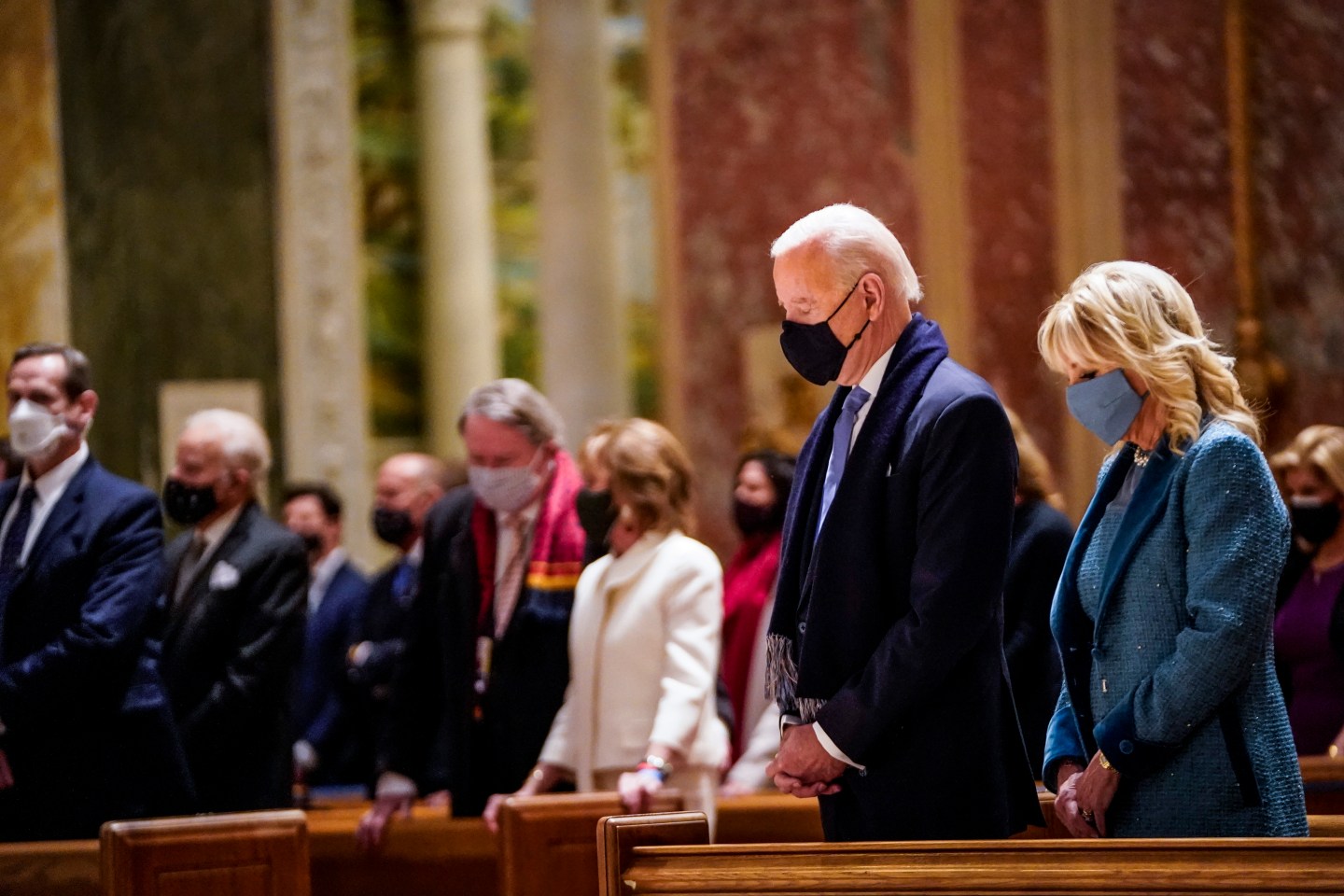
President-elect Biden and Jill Biden pray at the Cathedral of St. Matthew the Apostle in Washington, D.C., on Inauguration Day. With Biden’s election, writes Julie Kohler, “progressive theology and economics are no longer operating at the political margins; they have moved decidedly into the mainstream.”
President-elect Biden and Jill Biden pray at the Cathedral of St. Matthew the Apostle in Washington, D.C., on Inauguration Day. With Biden’s election, writes Julie Kohler, “progressive theology and economics are no longer operating at the political margins; they have moved decidedly into the mainstream.”(Photo by Jabin Botsford/The Washington Post via Getty Images)

“Dad, is everyone who goes to church a Democrat?”

I don’t remember exactly how old I was when I posed that question to my father—probably 7 or 8. It was the early 1980s, at the dawn of the Reagan revolution, and my suburban Minnesotan family was decidedly out of step with the dominant political ethos of the day. Small government and low taxes may have been popular in Washington, but they were anathema in my childhood home. Over dinner, I listened to my parents despair over rising poverty and our nation’s eroding safety net.

It was a message that was reinforced on Sundays, when my family attended church services at the Newman Center, the Catholic parish associated with the University of Minnesota. We sat on folding chairs in a basement room and sang hymns like “On Eagle’s Wings,” written by our congregation’s jocular priest, Father Michael Joncas, to guitar accompaniment.

It may have been a nontraditional church setting, but my parents were not fly-by-night Catholics. My father had spent 13 years as a Christian Brother before leaving to marry my mom. My mother came from a deeply observant Catholic family; my grandmother, a first-generation Polish immigrant, had a house chock-full of Pope John Paul II memorabilia. One of my uncles was an ex-priest; his wife, my aunt, was a former nun. My mother used to joke that early in my parents’ marriage, she would look around the room at parties and realize she was the only one there who had not spent time in a religious order.

As a child, I found my family’s religious and political beliefs to be mutually reinforcing. My church’s social justice teachings squared easily with the activism that surrounded me—the family friends that protested nuclear armament at the headquarters of Honeywell, the state’s largest defense contractor; the volunteer haircuts my father would give at the local homeless shelter. I failed to see how religion—or at least the religion that I knew—could be reconciled with a political agenda of massive defense spending and tax cuts for the rich. The notion that someone could be both religious and Republican seemed inconceivable to my young mind.

The 1980s were tough years for progressives like us. Ronald Reagan was a transformational figure who ushered in an era of market fundamentalism and “trickle down” economics that has remained politically dominant to this day. It was also a challenging time for Catholics like my parents, who came of age under the Second Vatican Council and believed in the vision of a modernized church. When the Vatican instead doubled down in opposition to abortion and LGBTQ rights, they became increasingly alienated from it. Holiday dinners routinely devolved into rants over the church’s misogyny, homophobia, and hypocrisy, especially when the Catholic Church’s vast sexual abuse scandal—and shameful cover-up—became public. With declining support from the local archdiocese, the University of Minnesota’s Newman community withered. My parents became religiously unaffiliated. I, then a teenager, cut ties with the church entirely, declaring myself an atheist.

Like many, I celebrated President Biden’s election this past November as a powerful repudiation of Donald Trump and his Republican enablers’ corruption, incompetence, authoritarianism, and embrace of violent white nationalism. But I also cheered the potential dawning of a new progressive economic era—the potential, as Biden says, to “Build Back Better” from the COVID-19 crisis. 

Over the past several years, an alternative economic framework has taken shape, championed by growing numbers of prominent economists, sociologists, and political scientists who have long protested the U.S.’s dominant market-fundamentalist approach and given new prominence by politicians such as Senators Bernie Sanders and Elizabeth Warren and Representative Alexandria Ocasio-Cortez. It is a framework characterized by a belief that government is both a critical check on market failure and a force for ensuring universal access to the necessities of a decent life—a good paying job, access to health care, affordable childcare.

It wasn’t, however, until I heard President Biden cite lines from the hymn “On Eagle’s Wings” in his victory speech last November that I fully grasped the full transformational potential of the moment. Biden and Harris enter office at a time when conservative Catholicism and white evangelical Christianity—the religions that helped fuel the rise of Reaganomics—are on the wane, and alternative religious traditions have gained new political and cultural footholds. The Black Church, which has long served as our nation’s prophetic voice for racial and economic justice, has seen its theology amplified through organizing efforts like the Poor People’s Campaign and the elections of pastors Raphael Warnock and Cori Bush to the Senate and House, respectively. Pope Francis has refocused Catholicism on its social justice teachings, de-emphasizing issues like abortion that drove many, my family included, from its ranks. 

President Biden is skilled in evoking his own Catholic faith as a tool for promoting unity and healing. As he recited those familiar lines (“And He will raise you up on eagle’s wings/Bear you on the breath of dawn/Make you to shine like the sun/And hold you in the palm of His hand”), I found myself—as someone who has barely set foot in a church for the better part of three decades—unexpectedly bursting into tears.

The question, then, is whether we can go further and connect the values-based language in which President Biden is fluent to an inclusive economic agenda. Although strong progressive faith-based organizing exists, it does not yet operate at the scale needed. Nor has the left built political institutions that serve as a true counterforce to what the white evangelical Christian megachurches provide to conservatives, from Reagan to today.

And yet, I find myself genuinely hopeful about the possibility of the moment. For the first time in my life, progressive theology and economics are no longer operating at the political margins; they have moved decidedly into the mainstream. And thanks to their joint ascension, we are thinking more boldly and grounding our politics in a powerful moral framework. It is one, I believe, with potential to speak to many—the faithful, formerly faithful, and secular alike—and unite us around a compelling agenda for economic dignity and shared prosperity.

Julie Kohler is the host of the Wonder Media Network podcast White Picket Fence. She is a senior adviser to the Democracy Alliance and a fellow in residence at the National Women’s Law Center. Follow her on Twitter.

About the Author
By Julie Kohler
See full bioRight Arrow Button Icon

Latest in Commentary

Finance
Lorem ipsum dolor sit amet, consectetur adipiscing elit, sed do eiusmod tempor incididunt ut labore et dolore magna aliqua. Ut enim ad minim veniam
By Fortune Editors
October 20, 2025
Finance
Lorem ipsum dolor sit amet, consectetur adipiscing elit, sed do eiusmod tempor incididunt ut labore et dolore magna aliqua. Ut enim ad minim veniam
By Fortune Editors
October 20, 2025
Finance
Lorem ipsum dolor sit amet, consectetur adipiscing elit, sed do eiusmod tempor incididunt ut labore et dolore magna aliqua. Ut enim ad minim veniam
By Fortune Editors
October 20, 2025
Finance
Lorem ipsum dolor sit amet, consectetur adipiscing elit, sed do eiusmod tempor incididunt ut labore et dolore magna aliqua. Ut enim ad minim veniam
By Fortune Editors
October 20, 2025
Finance
Lorem ipsum dolor sit amet, consectetur adipiscing elit, sed do eiusmod tempor incididunt ut labore et dolore magna aliqua. Ut enim ad minim veniam
By Fortune Editors
October 20, 2025
Finance
Lorem ipsum dolor sit amet, consectetur adipiscing elit, sed do eiusmod tempor incididunt ut labore et dolore magna aliqua. Ut enim ad minim veniam
By Fortune Editors
October 20, 2025

Most Popular

Finance
Lorem ipsum dolor sit amet, consectetur adipiscing elit, sed do eiusmod tempor incididunt ut labore et dolore magna aliqua. Ut enim ad minim veniam
By Fortune Editors
October 20, 2025
Finance
Lorem ipsum dolor sit amet, consectetur adipiscing elit, sed do eiusmod tempor incididunt ut labore et dolore magna aliqua. Ut enim ad minim veniam
By Fortune Editors
October 20, 2025
Finance
Lorem ipsum dolor sit amet, consectetur adipiscing elit, sed do eiusmod tempor incididunt ut labore et dolore magna aliqua. Ut enim ad minim veniam
By Fortune Editors
October 20, 2025
Finance
Lorem ipsum dolor sit amet, consectetur adipiscing elit, sed do eiusmod tempor incididunt ut labore et dolore magna aliqua. Ut enim ad minim veniam
By Fortune Editors
October 20, 2025
Finance
Lorem ipsum dolor sit amet, consectetur adipiscing elit, sed do eiusmod tempor incididunt ut labore et dolore magna aliqua. Ut enim ad minim veniam
By Fortune Editors
October 20, 2025
Finance
Lorem ipsum dolor sit amet, consectetur adipiscing elit, sed do eiusmod tempor incididunt ut labore et dolore magna aliqua. Ut enim ad minim veniam
By Fortune Editors
October 20, 2025
Rankings
  • 100 Best Companies
  • Fortune 500
  • Global 500
  • Fortune 500 Europe
  • Most Powerful Women
  • Future 50
  • World’s Most Admired Companies
  • See All Rankings
Sections
  • Finance
  • Leadership
  • Success
  • Tech
  • Asia
  • Europe
  • Environment
  • Fortune Crypto
  • Health
  • Retail
  • Lifestyle
  • Politics
  • Newsletters
  • Magazine
  • Features
  • Commentary
  • Mpw
  • CEO Initiative
  • Conferences
  • Personal Finance
  • Education
Customer Support
  • Frequently Asked Questions
  • Customer Service Portal
  • Privacy Policy
  • Terms Of Use
  • Single Issues For Purchase
  • International Print
Commercial Services
  • Advertising
  • Fortune Brand Studio
  • Fortune Analytics
  • Fortune Conferences
  • Business Development
About Us
  • About Us
  • Editorial Calendar
  • Press Center
  • Work At Fortune
  • Diversity And Inclusion
  • Terms And Conditions
  • Site Map
  • Facebook icon
  • Twitter icon
  • LinkedIn icon
  • Instagram icon
  • Pinterest icon

Latest in Commentary

sharma
CommentaryTraining
AI will infiltrate the industrial workforce in 2026—let’s apply it to training the next generation, not replacing them
By Kriti SharmaJanuary 15, 2026
10 hours ago
CommentaryBusiness
Using AI just to reduce costs is a woeful misuse of a transformative technology
By Nigel VazJanuary 15, 2026
12 hours ago
powell
CommentaryMiddle class
Forget the K-Shape: We have a barbell economy—and the middle class is buckling under the weight
By Katica RoyJanuary 14, 2026
1 day ago
engineer
Commentaryengineering
China graduates 1.3 million engineers per year, versus just 130,000 in the U.S. We need AI to bridge the gap
By Paul Eremenko and Ashish SrivastavaJanuary 14, 2026
1 day ago
powell/trump
CommentaryFederal Reserve
Is Powell’s Fed head independence dead? Trump outfoxes himself this time
By Jeffrey SonnenfeldJanuary 13, 2026
2 days ago
paramount
CommentaryM&A
A cautionary Hollywood tale: the Ellisons’ lose-lose Paramount positioning
By Jeffrey Sonnenfeld and Stephen HenriquesJanuary 12, 2026
3 days ago

Most Popular

placeholder alt text
Personal Finance
Peter Thiel makes his biggest donation in years to help defeat California’s billionaire wealth tax
By Nick LichtenbergJanuary 14, 2026
1 day ago
placeholder alt text
AI
Being mean to ChatGPT can boost its accuracy, but scientists warn you may regret it
By Marco Quiroz-GutierrezJanuary 13, 2026
2 days ago
placeholder alt text
Success
Despite a $45 million net worth, Big Bang Theory star still works tough, 16-hour days—he repeats one mantra when overwhelmed
By Orianna Rosa RoyleJanuary 15, 2026
10 hours ago
placeholder alt text
AI
'Godfather of AI' says the technology will create massive unemployment and send profits soaring — 'that is the capitalist system'
By Jason MaJanuary 12, 2026
3 days ago
placeholder alt text
Success
Despite his $2.6 billion net worth, MrBeast says he’s having to borrow cash and doesn’t even have enough money in his bank account to buy McDonald’s
By Emma BurleighJanuary 13, 2026
2 days ago
placeholder alt text
Economy
Jamie Dimon warns $38 trillion national debt is going to 'bite': 'You can't just keep borrowing money endlessly'
By Eleanor PringleJanuary 14, 2026
1 day ago

© 2025 Fortune Media IP Limited. All Rights Reserved. Use of this site constitutes acceptance of our Terms of Use and Privacy Policy | CA Notice at Collection and Privacy Notice | Do Not Sell/Share My Personal Information
FORTUNE is a trademark of Fortune Media IP Limited, registered in the U.S. and other countries. FORTUNE may receive compensation for some links to products and services on this website. Offers may be subject to change without notice.