While it might have been a normal greeting in the Before Times, these days—in the age of COVID-19—“How are you?” feels like a loaded question. Because for many of us, even if we reply we’re okay, it’s probably not true.
Lululemon Athletica, a fitness retailer that thrives on promoting and promising endorphins and relief through its apparel and lifestyle brand, is releasing an inaugural report dedicated to global wellness, with a core purpose of exposing the paradox of what it means to feel “fine.” And the initial results suggest we’re anything but.
“There is little doubt that the challenges of the past year have taken a toll on people’s psyches and underscored the importance of our collective health and well-being. And while many of us often say ‘everything is fine,’ it’s clear that we would all benefit from raising the bar for what it means to truly be well,” wrote Lululemon CEO Calvin McDonald, in the report.
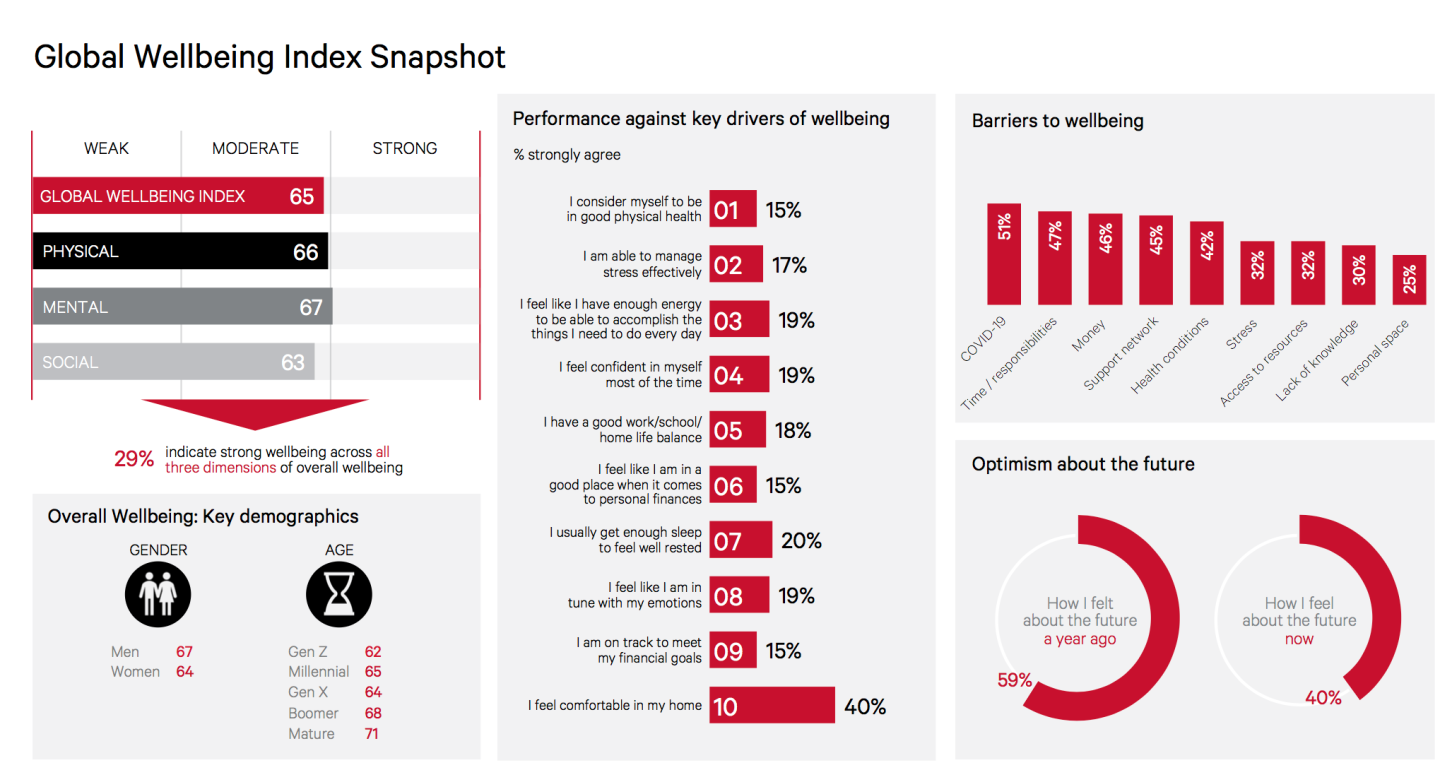
Only 29% of respondents across 10 countries reported having a healthy and strong sense of well-being across physical, mental, and social dimensions. The report’s Global Wellbeing Index also sits at 65 on a scale of 100, which translates to a moderate level of well-being on a spectrum of weak to strong.
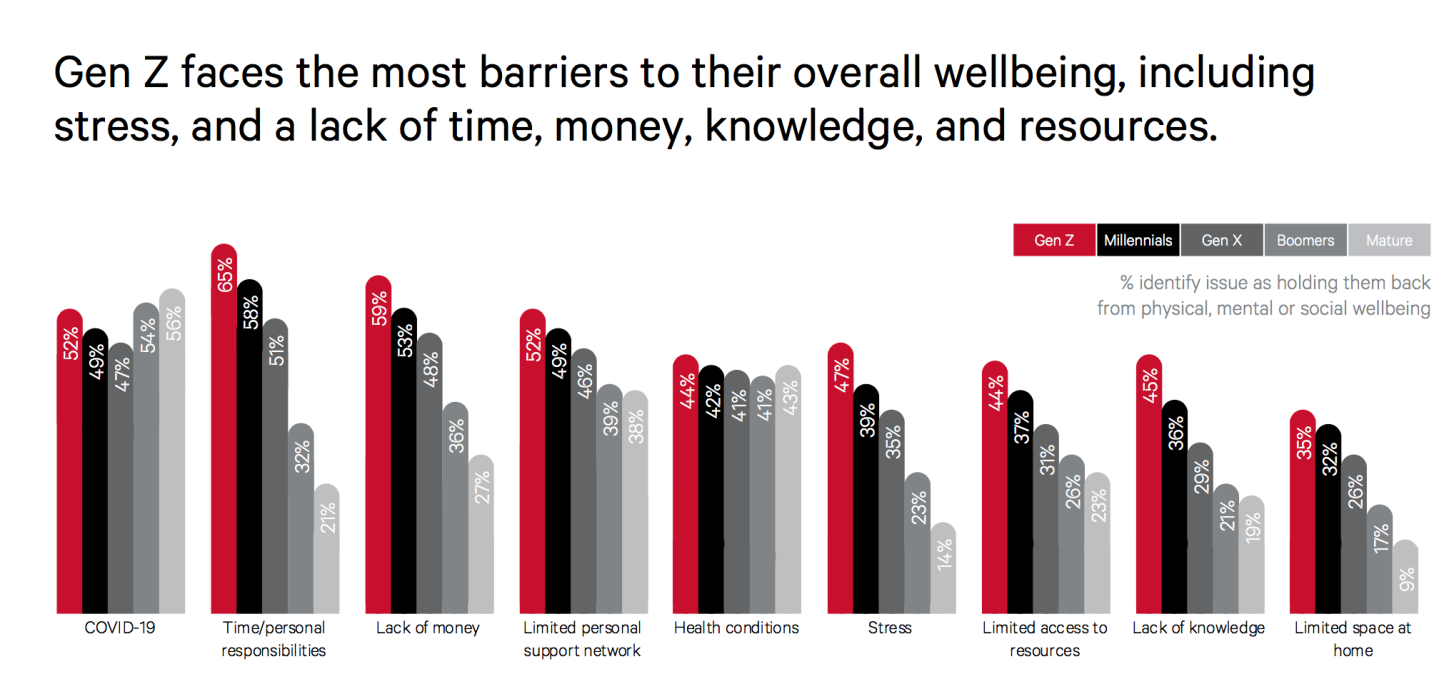
The situation is even more dire for younger respondents. Members of Generation Z, which roughly encompasses people born after 1997, were found to have the lowest well-being among generations, with 92% of Gen Z citing barriers to their well-being, including stress brought on by a lack of time, money, knowledge, and resources. And they report the lowest index score across generations at a 56 out of 100. One in four Gen Z adults said that they are deeply affected by issues including COVID-19 and racial injustice, creating a barrier to their mental well-being.
And as the pandemic continues, optimism for the future is on the decline. Optimism has fallen 19 percentage points, with only 40% feeling optimistic about the future now, compared with 59% who felt optimistic about the future a year ago.
The increasing wellness gap can also be attributed to the collapse in work/life balance amid stay-at-home orders to slow the spread of COVID-19. Unsurprisingly, amid the devastating global economic crisis and record-breaking jobless claims, those who are employed were found to have a higher well-being than those who are currently unemployed.
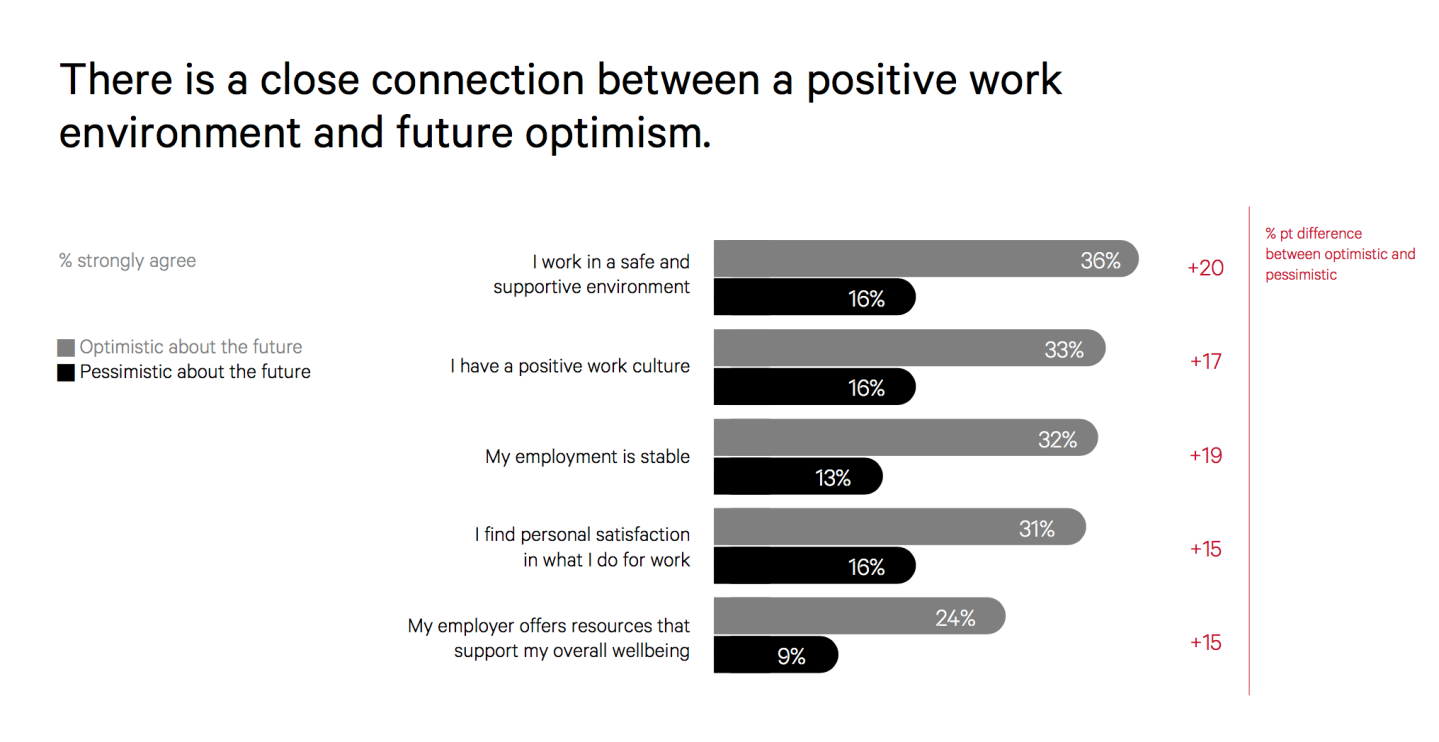
Still, time pressures present the largest barrier to well-being among the employed population. And stress is also amplified among those employed. Overall, only 15% of those employed strongly agree that their employer offers resources that support their overall well-being. The problem was found to be most acute in Japan, where only one in 10 respondents say they experience a positive work/life balance.
Nevertheless, the report suggests there is an opportunity for business managers to support better time balance and stress management, but the onus is on employers to do better for their employees.
“When we reviewed the findings and we saw that only 15% of respondents strongly agree that their employer offers resources that support their overall well-being, it reinforces the importance for employers to take a holistic approach to helping their people be well,” McDonald told Fortune via email. “Whether that’s offering programs that focus on resiliency and mental well-being, or other opportunities to help employees manage and lead through times of uncertainty, we will use this data at Lululemon to accelerate our efforts for our people and hope it’s helpful to other business leaders as well.”
People coping well with the conditions of the pandemic were found to be focused on simpler activities to support their well-being. This includes getting enough sleep, eating healthy food, being physically active, spending time outdoors, and connecting with family and friends. This list might be easier to accomplish for some more than others, but as optimism declines, the value placed on improving personal well-being appears to be growing: Based on the report’s responses, approximately half of global citizens expect to increase focus on physical and mental well-being this year.
Lululemon noted that the motivation for launching the report was to advance the company’s commitment to well-being—enabling holistic well-being through movement, mindfulness, and connection. With that in mind, the study finds that the drivers of being well are interconnected; making strides in one area will benefit overall well-being. People with a proactive mindset are significantly more likely to be optimistic about the future (53%) than those who are not proactive (22%).
Lululemon commissioned an online survey, managed by Edelman Data & Intelligence and conducted in 10 countries between Nov. 13 and Dec. 1, 2020, with 1,000 respondents per country and 10,000 respondents in total. The countries included in the survey are the United States, Canada, Japan, South Korea, China, Australia, Singapore, France, Germany, and the United Kingdom.
More must-read lifestyle and entertainment coverage from Fortune:
- The founder who decided to stop fundraising and instead hold on to her equity
- Vans creator pens memoir with inside details about the iconic shoe brand
- Biden’s attire progressed through three distinct and deliberate phases as candidate, President-elect, and President
- This female-founded face mask brand had a wait list of more than 40,000 customers
- Harry’s Labs takes a skin care approach to hair care with new brand Headquarters